Does anyone know what happened to her after her death? Museum?If you're interested in exact dates, she arrived at Hagenbecks Tierpark on 29th January's 1955 and died there 3rd August 1960.
( Dates again come from Weigl (2005)).
You are using an out of date browser. It may not display this or other websites correctly.
You should upgrade or use an alternative browser.
You should upgrade or use an alternative browser.
Caspian tigers in the captivity around the world.
- Thread starter Zulfu Farajli
- Start date
You might be interested in this report on large carnivores in Turkey from 2004 and also addressed the Caspian Tiger from Dr Can.
Can_2004_Large_carnivores_Turkey.pdf (catsg.org)
Can_2004_Large_carnivores_Turkey.pdf (catsg.org)
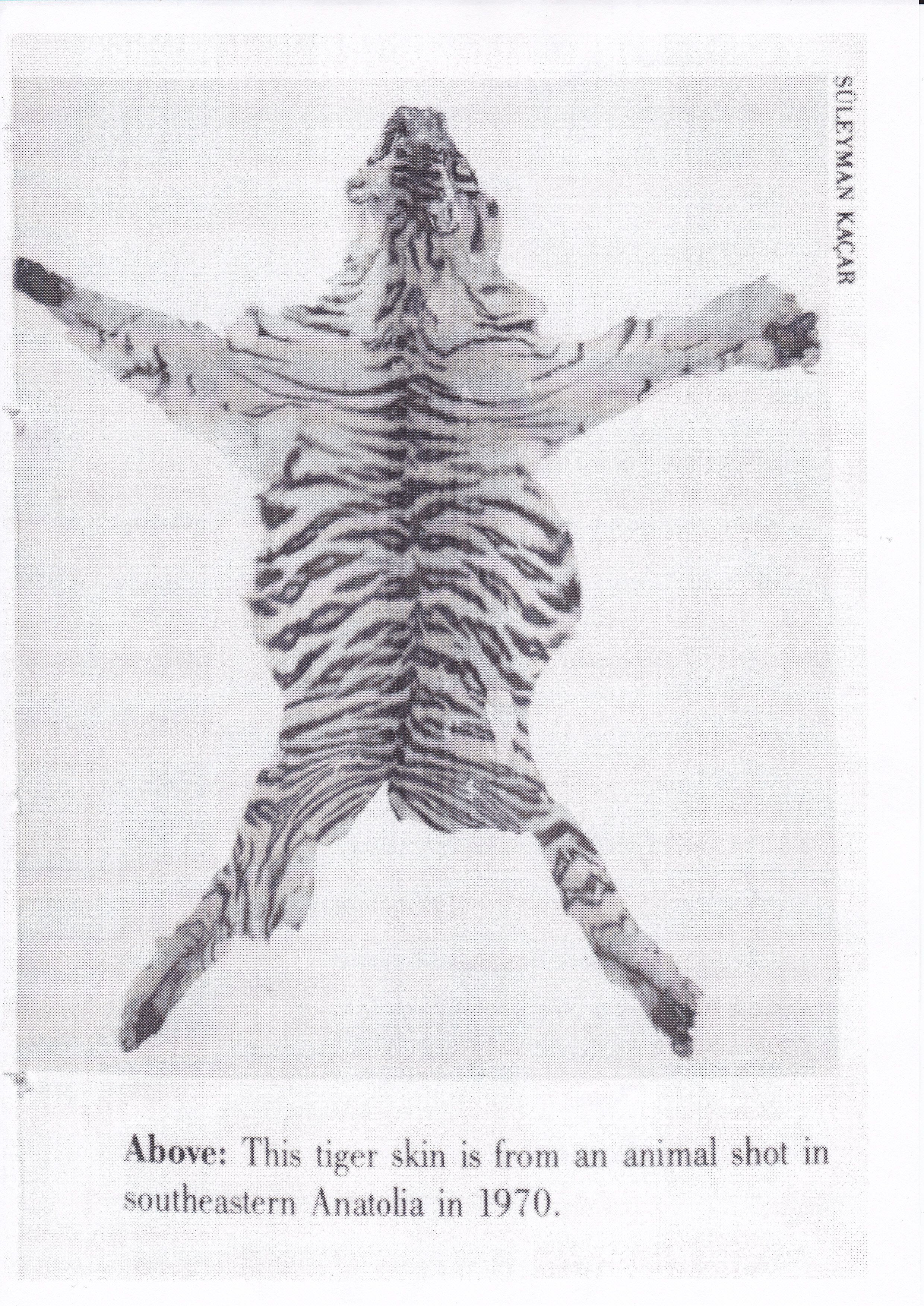
Are the photos of the 1970 skin available?. It says they are in the 'Appendix' but seemingly not visible.You might be interested in this report on large carnivores in Turkey from 2004 and also addressed the Caspian Tiger from Dr Can.
Can_2004_Large_carnivores_Turkey.pdf (catsg.org)

I had a look on the original paper (on Google Scholar) but there is no Appendix. I'm wondering if the line was a badly-phrased reference to an Appendix of the referenced paper (Baytop, T. 1974. La prÈsence du Vrai tigre, Panthera tigris (LinnÈ, 1758) en Turquie. S‰ugetlerkdi, Mitt 22: 254-256.) but that is not available online so I couldn't check it.Are the photos of the 1970 skin available?. It says they are in the 'Appendix' but seemingly not visible.
Zulfu Farajli
Member
Are the photos of the 1970 skin available?. It says they are in the 'Appendix' but seemingly not visible.
I believe this is the skin, I have seen another photo and cannot find now.
Zulfu Farajli
Member
Bit later response, but here is the color photo of the skin from the tiger hunted in Türkiye in the 70s. It was recently published as the guy who had it in its private collection was arrested for illegal trophy hunting and importing.
Ps. couldn't upload the image so adding a link - https://i.patronlarkulisi.com/storage/files/images/2024/03/19/1-cung.jpg
Ps. couldn't upload the image so adding a link - https://i.patronlarkulisi.com/storage/files/images/2024/03/19/1-cung.jpg
Zulfu Farajli
Member
Sorry, It seems I missed this message of yours. Is there any chance you can share the pics of these 2 tigers here?
I have the Chicago Zoological Park Handbook, Giant Panda edition, from 1937 it doesn’t share much, but states they have them, there is a picture with 2 tigers

Sorry, It seems I missed this message of yours. Is there any chance you can share the pics of these 2 tigers here?
I own a copy of that guidebook myself, so I've just dug it up for you
 here is the relevant photograph:
Attachments
Zulfu Farajli
Member
Thanks a lot! There's footage of two tigers in the enclosure in Chicago zoo from 1934, now I wonder if they are the same tigers as these ones. I will try to compare the stripe pattern between photo and video.I own a copy of that guidebook myself, so I've just dug it up for you
View attachment 696863
And if you don't mind sharing the next page about these tigers where the text continues, I would appreciate that!
Last edited by a moderator:
And if you don't mind sharing the next page about these tigers where the text continues, I would appreciate that!
Sadly there's not really much point in digging it back out of my storage boxes - the text merely continues to cite the fact they also had Bengal and Sumatran Tigers from the other extremes of the species' range, with nothing else said about the Caspian Tigers or their provenance.
DaveTheEagle
New Member
Probably the same "Western Tigers".
1930s RPPC Postcard showing two Tigers at the Chicago Zoological Park Chicago IL | eBay
Western Tigers Brookfield, Ill, USA, real photo Tiger Unused | Topics - Animals - Other, Postcard
Rppc Brookfield Illinois Chicago ZOO Western Tigers Vintage Real Photo Postcard | United States - Illinois - Chicago, Postcard
1930s RPPC Postcard showing two Tigers at the Chicago Zoological Park Chicago IL | eBay
Western Tigers Brookfield, Ill, USA, real photo Tiger Unused | Topics - Animals - Other, Postcard
Rppc Brookfield Illinois Chicago ZOO Western Tigers Vintage Real Photo Postcard | United States - Illinois - Chicago, Postcard
DaveTheEagle
New Member
Anyone know if this is actually a Caspian tiger and, if so, which zoo the pic was taken at?
https://redbook.su/wp-content/uploads/2021/01/101-2-1-870x400.jpg
Туранский Тигр (Фото): Как выглядит, Где обитал, Чем питался и Интересные факты
https://redbook.su/wp-content/uploads/2021/01/101-2-1-870x400.jpg
Туранский Тигр (Фото): Как выглядит, Где обитал, Чем питался и Интересные факты
Zulfu Farajli
Member
Anyone know if this is actually a Caspian tiger and, if so, which zoo the pic was taken at?
https://redbook.su/wp-content/uploads/2021/01/101-2-1-870x400.jpg
Туранский Тигр (Фото): Как выглядит, Где обитал, Чем питался и Интересные факты
No, it's a Sumatran one
Log in to Facebook

You can find photos online of a taxidermied tiger in the Kabul zoo dated 1992, not sure of the subspecies tho.
As per a UN OCHA report from 1997, the Kabul zoo was intending on buying a pair of tigers caught in Laghman. Pretty sure these were leopards, given how far away this is from known tiger ranges (the local word for tiger - sher, and leopard - pṛang are used interchangeably), but given the fact that Laghman province would be on the frontline of a civil war that very year, I'm not surprised at the lack of a follow up. However if these were indeed tigers, the recent claim of a historical tiger sighting from the adjoining Pakistani (ex)state of Chitral might be substantiated.
As per a UN OCHA report from 1997, the Kabul zoo was intending on buying a pair of tigers caught in Laghman. Pretty sure these were leopards, given how far away this is from known tiger ranges (the local word for tiger - sher, and leopard - pṛang are used interchangeably), but given the fact that Laghman province would be on the frontline of a civil war that very year, I'm not surprised at the lack of a follow up. However if these were indeed tigers, the recent claim of a historical tiger sighting from the adjoining Pakistani (ex)state of Chitral might be substantiated.
Interestingly some Russian sources considered P. t. virgata to be closer to P. t. tigris tha. to P. t. altaica. I also remember seeing a map by VG Heptner of the reconstructed range of the tiger where he connected P. t. virgata to P. t. tigris via Afghanistan and Pakistan instead of to P. t. altaica. On a side note tigers in the Indus plain would've occupied a very similar habitat to the riverine forests of middle Asia.To be precise, Caspian was merged with Siberian several years *before* the additional (and, I agree, somewhat ridiculous) merging of all mainland subspecies, and for rather more legitimate reasons - it appears that the two formed a single widespread population until the early 19th century, with the differences between the two being the result of a morphological cline combined with genetic bottlenecking after their separation.
That said, whether it was the same subspecies as Siberian or not, the loss of the Caspian was no less a tragedy - it is very strange to consider that they extended into Ukraine as recently as the 12th century!
This one looks more like a Siberian tiger than a Sumatran. It is tall, with shaggy fur on the belly, very untypical of a Sumatran. In those days (circa 1924) species were often misidentified.No, it's a Sumatran one
Log in to Facebook