You are using an out of date browser. It may not display this or other websites correctly.
You should upgrade or use an alternative browser.
You should upgrade or use an alternative browser.
Melbourne Zoo Melbourne Zoo News 2024
- Thread starter Zoofan15
- Start date
-
- Tags
- melbourne zoo
- Status
- Not open for further replies.

From what was posted it appeared the pair Melbourne were importing were both from Europe. Unless they expand the current facilities, I doubt Arturo were to return. It was also mentioned Adelaide and DDZ would be acquiring pairs too, so I'd imagine a female would be imported for Arturo over there.Would there be any expectation of Arturo returning to Melbourne if the zoo will hold lowland tapir again? Or more likely he'd stay in Adelaide, and Melbourne would import new animals?

Would there be any expectation of Arturo returning to Melbourne if the zoo will hold lowland tapir again? Or more likely he'd stay in Adelaide, and Melbourne would import new animals?
By the time Melbourne Zoo import tapir, Arturo may have even passed. He’s getting on in years and is well past his prime.
Melbourne Zoo will likely maintain one pair; but by having multiple pairs in the region, there’s the option to swap pairs around if they don’t breed.

That Aussie Guy
Well-Known Member
I’ll miss the Collared peccaries when they go. Though no longer classified as part of the Suidae family, they’re a decent substitute for species we can’t import like Warthog and Babirusa. It will indeed be nice to see them displayed along Brazilian tapir.
If only Melbourne Zoo would bring back Maned wolf!
I would love to see Aussie zoos put together some more South/Latin American focussed precincts. Most of the time our South (or Latin) American representation starts and ends at tamarins/marmosets, capybaras, maned wolves, and copious amounts of parrots.

NathanTheAsian
Well-Known Member
100% agree. South American birds, aside from parrots, are quite underrepresented in Australian zoos. I for one would love some Curassows to be held.I would love to see Aussie zoos put together some more South/Latin American focussed precincts. Most of the time our South (or Latin) American representation starts and ends at tamarins/marmosets, capybaras, maned wolves, and copious amounts of parrots.
Michael Stace
Active Member
I 100% agree too. What with Asian elephants moving to the open-range zoos and the open-range zoos focusing primary on African species, it would be nice for the city zoos in Australasia to get a bigger collection on Asian, European, North American and South American species. Each continent has a variety of interesting and endangered species that fingers crossed would thrive in Australasian city zoos.I would love to see Aussie zoos put together some more South/Latin American focussed precincts. Most of the time our South (or Latin) American representation starts and ends at tamarins/marmosets, capybaras, maned wolves, and copious amounts of parrots.
I 100% agree too. What with Asian elephants moving to the open-range zoos and the open-range zoos focusing primary on African species, it would be nice for the city zoos in Australasia to get a bigger collection on Asian, European, North American and South American species. Each continent has a variety of interesting and endangered species that fingers crossed would thrive in Australasian city zoos.
Melbourne (and Adelaide) should absolutely be focussing on forest species where possible. In the case of those who lack an open range sister zoo, the prioritisation of savannah species in acceptable, but not so much justifiable for those with an open range sister zoo within 45 minutes.

The Sleepy Hippo
Well-Known Member
I did the Snow Leopard Animal Encounter this morning - was potentially the best one I've done and I've done most.
We saw Mishka.
Mishka (0.1) is currently overweight. She is weighing 36kg and the preferred weight is 32kg. Kanju is weighing a healthy 40kg.
The reason Mishka is overweight was that for several months quality meat was scarce and what they were getting had a higher amount of fat. They are monitoring her weight and it is gradually getting back down.
No breeding is on the horizon. Due to being a part of the European breeding program, directions come from there, and there are no other holders in the region with room to house any cubs, and there is little interest from other zoos to take them on, and keepers suggested even some current holders are reconsidering due to the cost of housing them (primarily enclosure cooling is expensive to install and to run).
Today being quiet, we got the go ahead from higher up to include a behind the scenes walk to the historic abattoir where they used to bring live cattle to slaughter to feed the big cats. I took some photos. Might upload later on.
We saw Mishka.
Mishka (0.1) is currently overweight. She is weighing 36kg and the preferred weight is 32kg. Kanju is weighing a healthy 40kg.
The reason Mishka is overweight was that for several months quality meat was scarce and what they were getting had a higher amount of fat. They are monitoring her weight and it is gradually getting back down.
No breeding is on the horizon. Due to being a part of the European breeding program, directions come from there, and there are no other holders in the region with room to house any cubs, and there is little interest from other zoos to take them on, and keepers suggested even some current holders are reconsidering due to the cost of housing them (primarily enclosure cooling is expensive to install and to run).
Today being quiet, we got the go ahead from higher up to include a behind the scenes walk to the historic abattoir where they used to bring live cattle to slaughter to feed the big cats. I took some photos. Might upload later on.
I did the Snow Leopard Animal Encounter this morning - was potentially the best one I've done and I've done most.
We saw Mishka.
Mishka (0.1) is currently overweight. She is weighing 36kg and the preferred weight is 32kg. Kanju is weighing a healthy 40kg.
The reason Mishka is overweight was that for several months quality meat was scarce and what they were getting had a higher amount of fat. They are monitoring her weight and it is gradually getting back down.
No breeding is on the horizon. Due to being a part of the European breeding program, directions come from there, and there are no other holders in the region with room to house any cubs, and there is little interest from other zoos to take them on, and keepers suggested even some current holders are reconsidering due to the cost of housing them (primarily enclosure cooling is expensive to install and to run).
Today being quiet, we got the go ahead from higher up to include a behind the scenes walk to the historic abattoir where they used to bring live cattle to slaughter to feed the big cats. I took some photos. Might upload later on.
I’m glad you enjoyed the Snow leopard encounter, it’s one I would definitely consider doing if there was an opportunity to do so in the future.
I was hopeful there would be a repeat breeding recommendation issued and was even wondering if this brief window of encounters was a prelude to giving the felids increased privacy for mating/pregnancy.
It’s also disappointing to hear of the lack of interest from other holders. Mogo and Canberra have both phased out Snow leopards for Sri Lankan leopards and when Billabong’s elderly males pass, it wouldn’t surprise me if they did the same.
Shame to hear. I'm not sure of their overall genetic value, but I wouldn't be surprised if this pair are in fact surplus to the European region which is why their initial litter has been placed into non breeding situations regionally. There's obviously little interest in having cubs of this pair return to Europe for breeding purposes.No breeding is on the horizon. Due to being a part of the European breeding program, directions come from there, and there are no other holders in the region with room to house any cubs, and there is little interest from other zoos to take them on, and keepers suggested even some current holders are reconsidering due to the cost of housing them (primarily enclosure cooling is expensive to install and to run)
Considering their ages, fingers crossed they are given one recommendation before Mishka gets past reproductive age.
Shame to hear. I'm not sure of their overall genetic value, but I wouldn't be surprised if this pair are in fact surplus to the European region which is why their initial litter has been placed into non breeding situations regionally. There's obviously little interest in having cubs of this pair return to Europe for breeding purposes.
Considering their ages, fingers crossed they are given one recommendation before Mishka gets past reproductive age.
It was reported on here that Tasmania Zoo plan to import a female Snow leopard to form a breeding pair with Sikari; but Wellington’s females will remain non-breeding as far as I’m aware. In any case, Wellington don’t plan to breed.
Since the Sumatran tiger breeding programme has worked to extend the inter-generational gaps (females breeding at eight/nine years as opposed to four years), so it would make sense for Miska’s second litter to be the breeding cats. Since Sikari is a male, they have more time to utilise him for breeding. He could be paired for the first time in his early teens without issue.
The Sleepy Hippo
Well-Known Member
I was wrong.I'm unconviced on the "construction" in TOTE being indicative of anything necessarily. It seems more akin to the early stages of when they removed the vegetation from the island several years ago.
The "village farm" area after Hutan is where the 2-3 sections of cyclone fence with a generic "construction site" sign as you approach it. There may have also been a solitary witches hat.
The construction just has the bamboo and banana treets in that space cut to about a foot or so from the ground. But only plants within that space, not the surrounding folliage. No plants have been removed. Just cut down to just over a foot high. The area is not completely fenced off, just enough to suggest not to walk there.
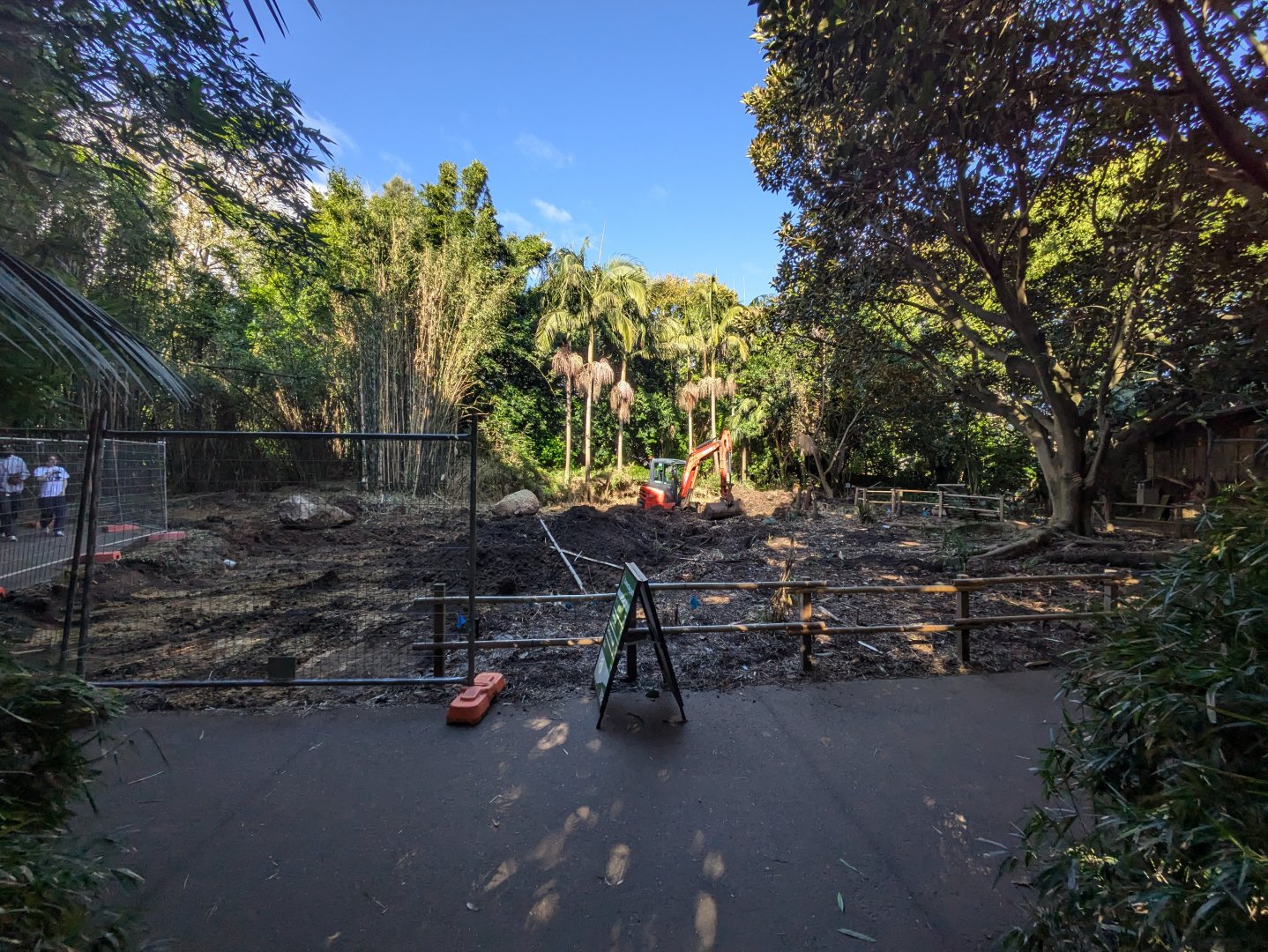
Small Construction site on TOTE, 26/7/24
"Village Farm" space before the Butterfly House
The space of the "village Farm" before the Butterfly House has been cleared completely and is fenced off completely.
I imagine that this will be converted either into a playground or small-medium enclosure, so that when they close off the Elephant section of TOTE after the elephants leave, there will be something else to see on the reduced trail.
I'm sure "Something exciting is coming soon"...
This is the space which was a 'elephant clearing section' designed to demonstrate how elephants damage undergrowth when they pass through forests. It's a shame that this is now gone as I did always appreciate the 'beware elephant' signs and the other designs that were placed there.The space of the "village Farm" before the Butterfly House has been cleared completely and is fenced off completely.
I imagine that this will be converted either into a playground or small-medium enclosure, so that when they close off the Elephant section of TOTE after the elephants leave, there will be something else to see on the reduced trail.
Considering the size of the construction site you'd hope its a small enclosure. It would have to be something appealing to keep visitor interest in the meantime though. I remain hopeful for a species like Komodo Dragon.
I was wrong.
Small Construction site on TOTE, 26/7/24
"Village Farm" space before the Butterfly House
The space of the "village Farm" before the Butterfly House has been cleared completely and is fenced off completely.
I imagine that this will be converted either into a playground or small-medium enclosure, so that when they close off the Elephant section of TOTE after the elephants leave, there will be something else to see on the reduced trail.
I'm sure "Something exciting is coming soon"...
This is the space which was a 'elephant clearing section' designed to demonstrate how elephants damage undergrowth when they pass through forests. It's a shame that this is now gone as I did always appreciate the 'beware elephant' signs and the other designs that were placed there.
Considering the size of the construction site you'd hope its a small enclosure. It would have to be something appealing to keep visitor interest in the meantime though. I remain hopeful for a species like Komodo Dragon.
Although it was a nice accompaniment to the elephants, it loses all relevance with their departure, so it isn’t a great loss in the wider scheme. It’ll be interesting to see what goes there.
I’m hopeful for a new species as it’s not big enough to build a playground on the scale Melbourne are apparently aspiring to. Given the construction work throughout the precinct over the next year or so, I’d say Komodo dragon is a good guess over more noise sensitive species such as small mammals.

From chatting to a volunteer the plan for a kids play area is only a short term solution, they are hoping to bring in a few new species but cant begin anything more long term until after the elephants have gone.
I did suspect that could be the case. Even something more advanced like a high ropes course could be quickly rigged up and provide an alternative to empty spaces until the elephant paddocks can be redeveloped.
Hopefully as we go into 2025, we’ll see some initiative towards building new exhibits, with an expansion for the apes (orangutans and gibbons) remaining the strongest likelihood.

A two-year-old male Veiled Chameleon has now been moved on-show at Melbourne. The import came from Riga Zoo, Latvia specifically.

Melbourne Zoo’s reptile department is on a roll once again. The zoo has re-acquired Tokay Gecko which I saw on my visit today.
- Status
- Not open for further replies.