Australasian Sumatran Tiger Population

Adelaide Zoo - Tiger Cub ID

Adelaide Zoo’s website has advised how to ID their Sumatran tiger triplets, now 18 months old:

1.0 Ketambe - vertical ‘fish hook’ marking on his head

0.1 Marni - triangular markings on her forehead and black flecks between her eyes

0.1 Susu - two black ‘dots’ in the middle on her head

Marni is the smallest of the two females; with both considerably smaller than their brother, Ketmabe.

Another interesting note re. Ketambe:

Ketambe is a gentleman with his sisters – he always seeks permission before playing with them.

There’s a preference to pair tigers for breeding who have grown up with opposite sex siblings, as it teaches them how to interact with opposite sex peers. In this case, Ketambe is clearly learning his own strength and how to regulate that through play.
 
If they're intending the space for tigers, perhaps the intention will be for further breeding after the current two cubs have grown up and been transferred out.

I’ll reply in this thread regarding Hamilton Zoo’s tigers:

I imagine the majority of tiger transfers within the region over the next five years will revolve around Ramah, Zayana and their offspring. Assuming their next litter yields at least two surviving cubs, it makes sense to then re-pair Ramah and Zayana. Three offspring are sufficient to make matches with the next generation; yet Ramah and Zayana will remain genetically valuable tigers with multiple applications to the breeding programme.

There’s countless options, but some I believe are likely (speculation):

0.1 Cahya (2024) to Orana Wildlife Park to pair with 1.0 Reggie (2016). Orana Wildlife Park have stated an intention to receive a tigress for breeding and Cahya is his best genetic match.

1.0 Ramah (2017) to Taronga to breed with 0.1 Tengah (2019). It’s not hard to imagine Auckland’s non-surviving male cub could have been sent to Taronga to pair with Tengah. Due to her age, waiting for a son of Ramah and Zayana to be born (and then mature) could make her age an issue (she’d be a minimum of 10 years); so if Ramah is to be re-paired, I’d assess her as an excellent candidate. She’ll be the sole representative of Assiqua’s line going forward and a genetically valuable tigress.

0.1 Scout (2016) to Hamilton to breed with 0.1 Zayana (2018). Having undertaken the effort to import Ramah/Zayana, I feel like Auckland Zoo would be (justifiably) keen to retain one of them for a re-pairing. A match between Zayana with one of Kaitlyn’s sons appears one of the most suitable options and logistically, Scout is the best choice.

In the event Scout transferred out, Hamilton Zoo could be left with Kirana and her two daughters (following the passing of Sali). If they had three exhibits, Kirana and one of the daughters could be housed in one; with the other two used to manage the breeding of the other daughter with a new male. Due to the age of Wellington’s pair, a vacancy will likely open up in the coming years for an additional 1-2 tigers to be held there. Unless Wellington were to build a third exhibit (expanding into the sun bear exhibit when Sasa passes for example), I imagine they’ll receive a non-breeding pair (siblings, mother and daughter etc) which could provide options for dispersing surplus from Auckland, Hamilton etc. One of many options here could be Kirana and one of her daughters.
 
Successful pairing of Ramah and Zayana’s parents:

I don’t usually post on our tigers’ relatives outside the region (after all, this is called the Australasian Sumatran Tiger Population thread for a reason); but I thought the recent birth at the Louisville was worth noting for a few reasons:

The parents of the latest cub are Kami Sambal (father of Ramah) and Jingga (mother of Zayana). This is only the second time the respective parents of a breeding pair of Sumatran tigers in our region have also been paired for breeding. The first being the (sadly unsuccessful) pairing of Tuan and Assiqua at Adelaide Zoo; with their respective son and daughter (Satu and Jumilah) producing 2.1 cubs at Taronga Zoo in 2011.

Jingga was 14 years and 4 months upon the birth of her latest litter, a notably advanced maternal age given no Sumatran tigress in Australasia has successfully bred beyond 13 years. Reproductive longevity is a heritable trait in most mammals species, meaning Zayana could well still be cycling at 14 years. Given she’s a founder, it’s more likely Zayana will be desired for breeding into her early teens compared to Australasian bred tigresses.

Most curious of all, the litter consists of a single cub. Though there have been occasions of a tigress successfully raising a single cub in captivity, they’re greatly outweighed by issues with the mother’s milk drying up/rejecting the cub - a natural phenomenon influenced by the advantages of dedicating 18 months of expenditure to raising a litter comprising multiple cubs. A week on and all is going well, so fingers crossed for success here.
 
Jingga was 14 years and 4 months upon the birth of her latest litter, a notably advanced maternal age given no Sumatran tigress in Australasia has successfully bred beyond 13 years. Reproductive longevity is a heritable trait in most mammals species, meaning Zayana could well still be cycling at 14 years. Given she’s a founder, it’s more likely Zayana will be desired for breeding into her early teens compared to Australasian bred tigresses.

Jingga's mother, Bahagia ("Baha"), was still cycling at over 15 years and 2 months old when she was killed by a male in a failed breeding attempt.
 
Jingga's mother, Bahagia ("Baha"), was still cycling at over 15 years and 2 months old when she was killed by a male in a failed breeding attempt.

I thought of that tigress as I was writing this, but I didn’t realise she was Jingga’s mother/Zayana’s grandmother, so that’s interesting to know.

Anecdotally, it appears tigresses (and lionesses) that have previously bred are more successful in conceiving at advanced ages; compared to attempts to breed from tigresses for the first time at 10 years plus. Being on contraception (especially for a long period of time) can affect fertility in big cats, so the explanation could be as simple as that a tigress that has had several litters has spent less time on contraception. The two oldest mothers in Australasia were Meta (1975) and Kaitlyn (2007), who each gave birth in their 13th year and had each had several litters previously.

Cahya (2024) is to date only the second cub successfully reared by her mother as a singleton; the other was Jambi (1988) at Taronga Zoo. In both cases, they had a twin, who lived for at least four weeks, which I theorise enabled a sufficient milk flow from the mother.
 
Successful pairing of Ramah and Zayana’s parents:

I don’t usually post on our tigers’ relatives outside the region (after all, this is called the Australasian Sumatran Tiger Population thread for a reason); but I thought the recent birth at the Louisville was worth noting for a few reasons:

The parents of the latest cub are Kami Sambal (father of Ramah) and Jingga (mother of Zayana). This is only the second time the respective parents of a breeding pair of Sumatran tigers in our region have also been paired for breeding. The first being the (sadly unsuccessful) pairing of Tuan and Assiqua at Adelaide Zoo; with their respective son and daughter (Satu and Jumilah) producing 2.1 cubs at Taronga Zoo in 2011.

Jingga was 14 years and 4 months upon the birth of her latest litter, a notably advanced maternal age given no Sumatran tigress in Australasia has successfully bred beyond 13 years. Reproductive longevity is a heritable trait in most mammals species, meaning Zayana could well still be cycling at 14 years. Given she’s a founder, it’s more likely Zayana will be desired for breeding into her early teens compared to Australasian bred tigresses.

Most curious of all, the litter consists of a single cub. Though there have been occasions of a tigress successfully raising a single cub in captivity, they’re greatly outweighed by issues with the mother’s milk drying up/rejecting the cub - a natural phenomenon influenced by the advantages of dedicating 18 months of expenditure to raising a litter comprising multiple cubs. A week on and all is going well, so fingers crossed for success here.

This is really fascinating, thanks for providing this update! Hopefully this bodes well for Zayana's continued reproductive success into the future.
 
This is really fascinating, thanks for providing this update! Hopefully this bodes well for Zayana's continued reproductive success into the future.

It will be interesting to see what the future holds for Zayana. A second (surviving) litter with Ramah will follow; and then I’m predicting a re-pairing within the region. Beyond that, whether she’s re-paired with a third male is anyone’s guess; but she’s one of the most genetically valuable females in the region.

Zayana could theoretically have her next litter with Ramah in the second half of 2026 (8 years); be re-paired to produce a third litter around 2029 (11 years); and then potentially an additional re-pairing circa 2032 (14 years).

For comparison, Kaitlyn (2007) produced four surviving litters with three males between 2013 and 2020.
 
Update on Cahya (Auckland Zoo):

Tiger cub Cahya takes a trip to the dentist | Auckland Zoo News

Our carnivore keepers noticed that Cahya had broken one of her upper canines – which likely happened through natural play and investigation - and they were able to take a photograph of the tooth to show our veterinary team.

On the morning of August 1st, Cahya was anesthetised (this was incredibly stress free thanks to hand-injection training by our amazing carnivore team) and brought to our vet hospital where radiographs were taken to assess the tooth. We had hoped that the tooth pulp would be viable enough for the dental specialist to perform pulp treatment, but it had already necrotised, so the baby tooth was removed to ensure no damage would be caused to the permanent tooth.


Once the tooth was extracted the ‘hole’ was sutured closed to assist with healing. The entire procedure took about two and a half hours and as soon as Cahya was awake, she was reunited with her mum Zayana - and in no time was playfully pouncing on her in greeting! To give the gums time to heal, Cahya was given soft food for a week as well as antibiotics and pain relief. It’s now been just over two weeks and our keepers report she is active, lively and chewing on bones again!

Full article in link.

upload_2024-8-17_13-32-21.jpeg
Photo credit: Auckland Zoo
 

Attachments

  • upload_2024-8-17_13-32-21.jpeg
    upload_2024-8-17_13-32-21.jpeg
    151.7 KB · Views: 143
She is a beauty, but no longer so little! I was away from the zoo for almost a month due to illness, and when I returned, I was surprised how quickly she had grown up!

Cahya has grown up very fast. I took this photo of her at three months old and as you can see from previous updates on her weight, she’s more than doubled in size. I’m strongly of the opinion one cub is more work than a multiple cub litter. Cahya wouldn’t leave Zayana alone on my last visit!

upload_2024-8-23_8-36-47.jpeg
 

Attachments

  • upload_2024-8-23_8-36-47.jpeg
    upload_2024-8-23_8-36-47.jpeg
    280.2 KB · Views: 125
Cahya has grown up very fast. I took this photo of her at three months old and as you can see from previous updates on her weight, she’s more than doubled in size. I’m strongly of the opinion one cub is more work than a multiple cub litter. Cahya wouldn’t leave Zayana alone on my last visit!

View attachment 724058

She certainly was very little and wee back then! Zayana is an amazing mum to her! It makes more sense that a single cub is more work, as Zayana has to fill the dual role of both carer and playmate to Cahya.
 
She certainly was very little and wee back then! Zayana is an amazing mum to her! It makes more sense that a single cub is more work, as Zayana has to fill the dual role of both carer and playmate to Cahya.

It’ll be interesting to see what age they seperate Zayana and Cahya.

Many zoos in the region have artificially extended the dispersal age of the cubs to three years by contracepting the tigress around 12-18 months after the birth. Since contraception isn’t desirable if the tigress is planned to breed again (as we know Zayana is), it wouldn’t surprise me if they let nature take its course and seperate them as and when Zayana indicates it’s time for Cahya to move out. This could be as early as the first half of 2025.

Historically, several females have transferred out at this age. Selatan (1990), Malu (1996) and Molek (2000) are all examples of females who left their mother and went on to breed successfully, proving extended socialisation with their dam isn’t essential. In Selatan’s case, she didn’t even transfer out with a sibling like the latter two did.
 
Auckland Zoo - Update on Cahya

It’s great to see Auckland Zoo continue to provide regular updates on what will easily be regarded as one of their biggest animal stars of the 2020’s.

I thought the mention of Cahya’s ruff was interesting as while more prominent in male tigers, many females also have pronounced ruffs. Photos of an 18 month old Selatan upon her arrival at Taronga Zoo in 1992 show her large trademark ruff to have already grown in; and Kirana at Hamilton (great great granddaughter of Selatan) similarly has an impressive ruff. I’ll be interesting to see how Cahya’s develops as her father has a relatively small ruff for a male.

—————————————

From socials:

We’re celebrating eight months of this curious cub!

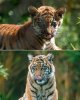
With each day, Cahya is beginning to resemble a miniature version of her mother Zayana and taking on more adult features. The top image was taken in April this year, and when compared to the image on the bottom that was taken more recently, you can see how much her face has transformed, making way for a more mature look.

Cahya has started growing into her paws, with her body becoming more proportionate, and she’s developing a ‘ruff’ around her face and ears. Sumatran tigers are distinguished by their darker orange fur compared to other tiger species, and their stripes are closer together to better blend into their environment.

She now weighs 38kg, which is about the same weight as the female cheetah sisters, Qia and Quartz! See if you can spot the differences in her growth next time you visit.

Cahya at three months (top); Cahya at eight months (bottom):

upload_2024-9-12_20-6-44.jpeg

Photo credit: Auckland Zoo
 

Attachments

  • upload_2024-9-12_20-6-44.jpeg
    upload_2024-9-12_20-6-44.jpeg
    92.9 KB · Views: 100
Auckland Zoo - Update on Cahya

It’s great to see Auckland Zoo continue to provide regular updates on what will easily be regarded as one of their biggest animal stars of the 2020’s.

I thought the mention of Cahya’s ruff was interesting as while more prominent in male tigers, many females also have pronounced ruffs. Photos of an 18 month old Selatan upon her arrival at Taronga Zoo in 1992 show her large trademark ruff to have already grown in; and Kirana at Hamilton (great great granddaughter of Selatan) similarly has an impressive ruff. I’ll be interesting to see how Cahya’s develops as her father has a relatively small ruff for a male.

—————————————

From socials:

We’re celebrating eight months of this curious cub!

With each day, Cahya is beginning to resemble a miniature version of her mother Zayana and taking on more adult features. The top image was taken in April this year, and when compared to the image on the bottom that was taken more recently, you can see how much her face has transformed, making way for a more mature look.

Cahya has started growing into her paws, with her body becoming more proportionate, and she’s developing a ‘ruff’ around her face and ears. Sumatran tigers are distinguished by their darker orange fur compared to other tiger species, and their stripes are closer together to better blend into their environment.

She now weighs 38kg, which is about the same weight as the female cheetah sisters, Qia and Quartz! See if you can spot the differences in her growth next time you visit.

Cahya at three months (top); Cahya at eight months (bottom):

View attachment 729765

Photo credit: Auckland Zoo

She certainly has grown quite rapidly! I recently took a photo of Cahya at 7-8 months and she has grown considerably since I last photographed her at 6 months. Quite the contrast to Bahmi the orangutan, who is growing at a much slower rate and is still very much appearing as a baby at the age of two!
 
She certainly has grown quite rapidly! I recently took a photo of Cahya at 7-8 months and she has grown considerably since I last photographed her at 6 months. Quite the contrast to Bahmi the orangutan, who is growing at a much slower rate and is still very much appearing as a baby at the age of two!

Very true. Even though Cahya will remain playful into her second year, felids mature quickly compared to great apes.

Hamilton Zoo’s twins (born the day after Cahya) are similarly growing fast; though in contrast, I’m not anticipating a repeat breeding recommendation will be issued to Scout and Kirana. It wouldn’t surprise me to see Zayana breed again in the second half of 2026.

Photo taken by myself of Mayang and Andalas with their mother, Kirana (31/08/2024):

upload_2024-9-13_13-40-11.jpeg
 

Attachments

  • upload_2024-9-13_13-40-11.jpeg
    upload_2024-9-13_13-40-11.jpeg
    267.8 KB · Views: 98
When I went today I was told that one of the tigers (I think Senja but not 100% sure) was taken to the vet for a procedure. Not heard any update on the Instagram account yet regarding what was wrong or how it went. Hopefully she's fine!

Wellington Zoo - Senja Health Check/Contraceptive Implant

From socials:

Massey University has been busy developing a collar that can be safely and comfortably worn by an animal while collecting all sorts of data about their movements, including when and where they sit, stand, sleep, eat, and loads more.

Yesterday, Senja the Tiger was placed under general anaesthetic so our Vet team could carry out a full body health check before fitting the collar. The plan was for her to wear the collar for two weeks, sending thousands of pieces of data to receivers at Massey for analysis.

However, Senja has a mind of her own and after spending a few hours in the collar, decided she didn’t like it and removed it. The option for self-removal was built into the collar’s welfare-focused design to ensure that Senja could make a choice about whether or not to participate.

Despite the research not going to plan, our Vet team was still able to carry out a full health check including x-rays and bloodwork. Because Senja is an ageing animal, health checks like these are an essential part of her care and welfare.

After the health checks were complete, the team placed Senja’s contraceptive implant. This implant will manage her hormonal cycles over the coming months and help to maintain a peaceful relationship between her and Bashii as they live in neighboring habitats but aren’t breeding.

1.0 Bashi (04/12/2007) Imported 2008
0.1 Senja (21/08/2010) Lari x Soraya
 
Taronga Zoo - Export Update

It was previously reported by @Elena that:

1.0 Pemanah is going to Memphis Zoo
0.1 Mawar is going to Point Defiance Zoo

Both will go to Memphis Zoo originally.

This article states:

Two Sumatran tigers leaving Memphis Zoo

Two male Sumatran tigers are leaving the Memphis Zoo next week in efforts to continue breeding the endangered subspecies. Two females will remain here, with another male expected next year, zoo officials said.

It therefore appears the export is expected to occur in 2025, which I thought I’d mention as there’s been speculation the tigers have left Taronga already.
 
Wellington Zoo - Bashi’s Gametes Collected/Stored

Some exciting news regarding this unrepresented founder:

Bashii the Sumatran Tiger was placed under general anaesthetic at Te Kōhanga The Nest last week so he could undergo an aged animal health check.

Last week’s health check included a dental and joint assessment, as well as x-rays, blood work, and an ultrasound. Our Vet team confirmed that Bashii has osteoarthritis in his joints as well as some dental disease which required a tooth being pulled.

While Bashii was under anaesthetic, a team from @masseyuniversity and Tararua Fertility collected a semen sample from him to ensure his genetics are preserved. The sample has been cryopreserved and will remain in store in case we need it in the future.
 
Back
Top