Melbourne Zoo Melbourne Zoo history

I thought I'd share a few small Melbourne Zoo clippings I've got. First one is from 1996 with Melbourne Zoo's proposed 25-year masterplan which of course wasn't realised beside a few developments at the front of the zoo. The second is the initial arrival of the Thai elephants in 2006 as we count down the last couple months of them being at Melbourne Zoo.

full


full

This masterplan is a masterpiece. Brown bears and Sloth bears; a plethora of felids; Giant anteater and sloths; Red River hogs; and birds we can only dream of such as the Secretary bird. Though I concede housing so many species on a site the size of Melbourne Zoo would have the trade off of what we’d now consider inadequate sized exhibits, I’m in awe of the biodiversity.

Jaguar were clearly intended as the headliner of the South American Rainforest section. A female was imported from Budapest Zoo in 1997 as a mate for Melbourne’s male Jaguar; and it’s so unfortunate she was unable to breed, since that may have preserved the species in the region - at least for another decade or so.
 
I thought I'd share a few small Melbourne Zoo clippings I've got. First one is from 1996 with Melbourne Zoo's proposed 25-year masterplan which of course wasn't realised beside a few developments at the front of the zoo. The second is the initial arrival of the Thai elephants in 2006 as we count down the last couple months of them being at Melbourne Zoo.

full


full
The masterplan is an awesome find! It's intriguing to see such a collection of species; majority of which would be considered unique to zoo collections these days within Australia. The strong focus on geographical bio themed zones is something I really appreciate seeing too. Melbourne lacks either these days, but this can be attributed to availability of species ect.

It's not surprising to see why this didn't eventuate. Acquiring all the species is one thing, let alone having the space for more than 120 species and exhibits as are mentioned above. Seems to be more of a fantasy idea to me, very surprised to see it made it into the Herald Sun!
 
Its kind of like if Melbourne Zoo had the size and funding level of say the Bronx Zoo or Whipsnade Zoo (or possibly San Diego Zoo) it could of been.

But Melbourne Zoo is impressive but more on the scale of say Chester Zoo (albeit think Chester has more hectares from memory) but has done impressive on its availability.

Would of been a great concept, lots of import hurdles especially with exotic birds (imagine Brown Hyenas, Sloth Bears and Giant Anteaters to name just a few in our region, and additional facility to the Tarongas for Indian Rhinos.)

Lol did anyone else get a technicality ‘twitch’ reaction in their mind when they saw for example Emperor Tamarins located on the concept map in the tropical Asia section hahaha albeit kind of mirrors how our zoos create fantastic geographical biome precincts and often over time a new resident will replace a departed one that isn’t exactly from that part of the world (Im looking at you Blackbucks and Squirrel Monkeys, love them both but).
 
Its kind of like if Melbourne Zoo had the size and funding level of say the Bronx Zoo or Whipsnade Zoo (or possibly San Diego Zoo) it could of been.

But Melbourne Zoo is impressive but more on the scale of say Chester Zoo (albeit think Chester has more hectares from memory) but has done impressive on its availability.

Would of been a great concept, lots of import hurdles especially with exotic birds (imagine Brown Hyenas, Sloth Bears and Giant Anteaters to name just a few in our region, and additional facility to the Tarongas for Indian Rhinos.)

Lol did anyone else get a technicality ‘twitch’ reaction in their mind when they saw for example Emperor Tamarins located on the concept map in the tropical Asia section hahaha albeit kind of mirrors how our zoos create fantastic geographical biome precincts and often over time a new resident will replace a departed one that isn’t exactly from that part of the world (Im looking at you Blackbucks and Squirrel Monkeys, love them both but).

Melbourne and Taronga are arguably the best zoos in the region; followed by Auckland Zoo. Chester Zoo is just over twice the size of Melbourne Zoo, with the latter being more comparable to London Zoo imo. In the formative years, the layout was even modelled on London Zoo.

It’s an understatement to say Melbourne Zoo’s masterplan was ambitious and it’s a stark contrast to the plans for rampant phase outs (especially of felids and primates) that followed within a decade.

In most cases, the zones were grouped by biomes. On noticing the absence of Maned wolf in the South American section, I acknowledged it did say ‘rainforest’ and looked for the Maned wolf elsewhere. I found it along with Plains bison from North America in the Grasslands section.

The inclusion of leopard in the African rainforest section was interesting considering the region’s purebred leopard subspecies at the time was the Persian leopard (also held at Melbourne Zoo from 1992-2013).
 
@Zoofan15

Oh thanks for the info. I didn't realise just how big Chester actually is wow. Visited London Zoo twice in December 2009 (remember walking the canal too and seeing the African Hunting Dogs running up and down their very long exhibit by the border fence of the middle enclave of the zoo too, heard that Arabian Oryx were once in that enclosure). Oh that makes sense that Melbourne Zoo modelled itself after London Zoo. The grounds of London Zoo really are steeped in history and the layout does have a Victorian era feel to its gardens still quite a bit but peppered with great modern exhibits/re-using historical exhibits cleverly).

Yeah it was an ambitious rough masterplan concept to say the least, a brilliant one, but you're right, the phase outs of many exotic species really occurred at Melbourne shortly after (some shortly before as learn from you like their Chimpanzees in '93, noticed one of the only absent charismatic large mammals missing from the '96 25 year concept).

Looking at it realise a fair number of the species on there have been at Melbourne Zoo anyway at some point in the last 70 years (obviously a fair few would of been first timers in the country had it eventuated). The concept even managed to be planned for them to of continued to of had the most extensive number of felid species in the country (looks like they may of aimed for importing a couple of African Leopards from the tropical regions of Africa if not generic un-sub-specified Leopards, interesting considering they held Persian ones at the time of the concept. Though apparently Bronx Zoo now has an Amur Leopard in their Rainforest House to keep up with the Nth American Zoos & Aquaria Associations commitment to the subspecies being prioritised). Sorry if digressing a lot.
 
Last edited:
@Zoofan15

Oh thanks for the info. I didn't realise just how big Chester actually is wow. Visited London Zoo twice in December 2009 (remember walking the canal too and seeing the African Hunting Dogs running up and down their very long exhibit by the border fence of the middle enclave of the zoo too, heard that Arabian Oryx were once in that enclosure). Oh that makes sense that Melbourne Zoo modelled itself after London Zoo. The grounds of London Zoo really are steeped in history and the layout does have a Victorian era feel to its gardens still quite a bit but peppered with great modern exhibits/re-using historical exhibits cleverly).

Yeah it was an ambitious rough masterplan concept to say the least, a brilliant one, but you're right, the phase outs of many exotic species really occurred at Melbourne shortly after (some shortly before as learn from you like their Chimpanzees in '93, noticed one of the only absent charismatic large mammals missing from the '96 25 year concept).

Looking at it realise a fair number of the species on there have been at Melbourne Zoo anyway at some point in the last 70 years (obviously a fair few would of been first timers in the country had it eventuated). The concept even managed to be planned for them to of continued to of had the most extensive number of felid species in the country (looks like they may of aimed for importing a couple of African Leopards from the tropical regions of Africa if not generic un-sub-specified Leopards, interesting considering they held Persian ones at the time of the concept. Though apparently Bronx Zoo now has an Amur Leopard in their Rainforest House to keep up with the Nth American Zoos & Aquaria Associations commitment to the subspecies being prioritised). Sorry if digressing a lot.

London Zoo’s architecture is world renowned and it’s nice to see Melbourne Zoo retain numerous remnants from that era, with the distinction of them not hampering progress as a modern zoo like the old exhibits do at London.

It’s staggering to think of the range of species held by our region’s zoos. Every now and then I’ll come across reference to a lone rarity imported by one of our region’s main zoos, that subsequently died out because only a single animal or pair was imported and failed to breed. Others were easier to breed and subsequently thrived - examples being Chacma baboons and chimpanzees; while only one of the gorilla infants imported in the early to mid 1900’s produced offspring (when paired with an imported mother raised male). A similar trend was observed with elephants; with Melbourne’s Bong Su being the only elephant imported in the 1900’s to produce offspring in the region. Countless potential founder lines were lost - including another three which will die out with the eventual deaths of Mek Kepah, Burma and Permai.

Melanistic Jaguar and leopards clearly became a craze. Taronga Zoo imported two melanistic Jaguar brothers from Rotterdam, with one (Ali ) retained at Taronga; and the other (Branco) transferred to Adelaide. At this time (1979), the rest of the regional population descended from the successful golden pairs at Melbourne and Auckland; and their melanistic counterparts proved a huge drawcard. Melbourne never bred a melanistic Jaguar cub, but their last male was Ali’s son Maya (1987-2008) - transferred in from Taronga, who were fortunate enough to breed two melanistic cubs.
 
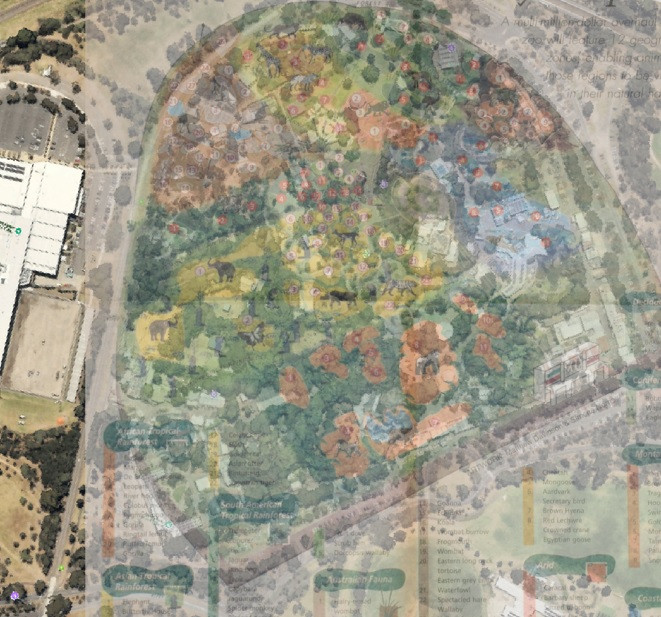
Far far from fully 'clicking into place' but thought would try have a go at seeing what an overlap with the zoo's actual grounds would look like:

dbFFDGe.jpg

It’s a little hard to envisage, but looking at the map it’s interesting to see a few things which came to pass:

A large elephant complex in the existing location, with exhibits for the bull and cow.

A decent sized Hamadryas baboon exhibit in the existing location.

The apparent demolition of the Lion Park, with the lions housed in a small exhibit.

—————

The Marine precinct (despite its size) lacked pinnipeds. I feel like the average visitor would have been underwhelmed by a collection of birds and fish.

It’s a shame one of the gorilla exhibits was taken out. Even now, I’d rather see bachelor males accommodated at Melbourne; and the exhibit at Werribee house either Common chimpanzee or Hamadryas baboon.
 
@Zoofan15

Yeah sorry am not very good at that merge overlap (or any artistic abilities unfortunately lol) did it to personally try and have a rough look at what it might of encompassed spatial wise on the grounds of the zoo. Then thought might as well upload.

Its great to know you noticed some aspects of the plan did eventuate in the form of the Elephants exhibits etc.

Have long thought you are really right about how a Chimpanzee troop (and Hamadryas Baboons) at Werribee would of been a great move (and Melbourne to continue with Mandrills as their 'Baboon or Baboon-like' ambassador species). Melbourne city is lucky in the sense it really has two zoos, a historical one at the centre and an open range one within driving distance of all residents of the city. (Adelaide yeah same albeit longer drive to Monarto, and Sydney has two 'city zoos' now rather than an open-range one within day visit driving distance).

Thought the best way for Werribee to go would be to have a range of 75-80% different species to Melbourne Zoo with a 20-25% range of the same species (mainly endangered ones) they could share breeding and caring programs together on (know they already do the latter, just thought more exotic megafauna variance between the two for a wider range of species for visitors to both zoos).

Agree about the marine precinct, something more aligned with Taronga's Great Southern Oceans precinct would have been a much better concept (multiple Seal & Sea-Lion and Penguin species, a few Sea Birds as part of a rescue and rehabilitation program, leave the rest of the marine life to Melbourne Aquarium).
 
Last edited:
@Zoofan15

Yeah sorry am not very good at that merge overlap (or any artistic abilities unfortunately lol) did it to personally try and have a rough look at what it might of encompassed spatial wise on the grounds of the zoo. Then thought might as well upload.

Its great to know you noticed some aspects of the plan did eventuate in the form of the Elephants exhibits etc.

Have long thought you are really right about how a Chimpanzee troop (and Hamadryas Baboons) at Werribee would of been a great move (and Melbourne to continue with Mandrills as their 'Baboon or Baboon-like' ambassador species). Melbourne city is lucky in the sense it really has two zoos, a historical one at the centre and an open range one within driving distance of all residents of the city. (Adelaide yeah same albeit longer drive to Monarto, and Sydney has two 'city zoos' now rather than an open-range one within day visit driving distance).

Thought the best way for Werribee to go would be to have a range of 75-80% different species to Melbourne Zoo with a 20-25% range of the same species (mainly endangered ones) they could share breeding and caring programs together on (know they already do the latter, just thought more exotic megafauna variance between the two for a wider range of species for visitors to both zoos).

Agree about the marine precinct, something more aligned with Taronga's Great Southern Oceans precinct would have been a much better concept (multiple Seal & Sea-Lion and Penguin species, a few Sea Birds as part of a rescue and rehabilitation program, leave the rest of the marine life to Melbourne Aquarium).

You make a good point about Melbourne Zoo continuing with Mandrill long term. It was identified early on that the exhibit wasn’t big enough to house a troop in excess of 100 like you might find in the wild; but the exhibit would at least allow a troop consisting of a male, several females and their infants. The initial occupants were a troop of approximately eight Mandrill (the exhibit opened 1992; and in 1993, they had eight Mandrill); but due to most these being identified as hybrids, the zoo moved to establish a pure line with 1.2 Mandrill (Yonaton, Louise and Timbiri). Thus the troop size had decreased drastically by the early 2000’s from what was the intention a decade prior. This was in part in line with changing perceptions of what was an acceptable exhibit size. A further decade on and the exhibit would be considered cramped for even that trio, let alone their offspring or additional adults.

With the above in mind, I’d have been in favour of housing Mandrill in what is now the Hamadryas baboon exhibit; with bachelor gorillas retained at Melbourne; and Hamadryas baboon in the Werribee gorilla exhibit.

Interestingly, the masterplan shows giraffe/zebra, but not in the existing location of the giraffe exhibit. It’s an interesting deviation considering the age/historical significance of the Giraffe House, which has remained fully functional to this day (albeit with a new barn added this year).
 
I thought I'd share a few small Melbourne Zoo clippings I've got. First one is from 1996 with Melbourne Zoo's proposed 25-year masterplan which of course wasn't realised beside a few developments at the front of the zoo. The second is the initial arrival of the Thai elephants in 2006 as we count down the last couple months of them being at Melbourne Zoo.

full


full

Thank you for sharing this masterplan! I agree with the other posters that it's absolutely fascinating. I'm surprised that there's nothing indicated for the area in the bottom-right corner, to the right of the Main Gate. It's not like the area was out of use at the time (being the location of the infamous baboon cage).

This masterplan is a masterpiece. Brown bears and Sloth bears; a plethora of felids; Giant anteater and sloths; Red River hogs; and birds we can only dream of such as the Secretary bird. Though I concede housing so many species on a site the size of Melbourne Zoo would have the trade off of what we’d now consider inadequate sized exhibits, I’m in awe of the biodiversity.

Jaguar were clearly intended as the headliner of the South American Rainforest section. A female was imported from Budapest Zoo in 1997 as a mate for Melbourne’s male Jaguar; and it’s so unfortunate she was unable to breed, since that may have preserved the species in the region - at least for another decade or so.

When I saw it, it did make me think of the sort of masterplan a ZooChatter would put together for Melbourne Zoo if money, import restrictions or space concerns were no object. You make a good point that jaguars may have been maintained in the region for a little while longer if Melbourne had bred in the late 1990s.

Its kind of like if Melbourne Zoo had the size and funding level of say the Bronx Zoo or Whipsnade Zoo (or possibly San Diego Zoo) it could of been.

But Melbourne Zoo is impressive but more on the scale of say Chester Zoo (albeit think Chester has more hectares from memory) but has done impressive on its availability.

Would of been a great concept, lots of import hurdles especially with exotic birds (imagine Brown Hyenas, Sloth Bears and Giant Anteaters to name just a few in our region, and additional facility to the Tarongas for Indian Rhinos.)

Lol did anyone else get a technicality ‘twitch’ reaction in their mind when they saw for example Emperor Tamarins located on the concept map in the tropical Asia section hahaha albeit kind of mirrors how our zoos create fantastic geographical biome precincts and often over time a new resident will replace a departed one that isn’t exactly from that part of the world (Im looking at you Blackbucks and Squirrel Monkeys, love them both but).

The comparison to Chester Zoo is a great one! It is pretty funny that the masterplan included Emperor tamarins housed amongst the Asian animals. It doesn't seem like there is an inherent reason for them to be in that area other than a shared biome. Most times when an otherwise geographically-themed precinct houses an anachronistic species, usually it is because the zoo needed to fill an empty exhibit or house surplus animals, or it's in lieu of being able to acquire a similar-looking species (a la blackbuck instead of springbok).

Far far from fully 'clicking into place' but thought would try have a go at seeing what an overlap with the zoo's actual grounds would look like:

dbFFDGe.jpg

Thank you for this, it's certainly an interesting comparison.

It’s a little hard to envisage, but looking at the map it’s interesting to see a few things which came to pass:

A large elephant complex in the existing location, with exhibits for the bull and cow.

A decent sized Hamadryas baboon exhibit in the existing location.

The apparent demolition of the Lion Park, with the lions housed in a small exhibit.

—————

The Marine precinct (despite its size) lacked pinnipeds. I feel like the average visitor would have been underwhelmed by a collection of birds and fish.

It’s a shame one of the gorilla exhibits was taken out. Even now, I’d rather see bachelor males accommodated at Melbourne; and the exhibit at Werribee house either Common chimpanzee or Hamadryas baboon.

Other than the elephant exhibit, it seems the other similarities are coincidences. Trail of the Elephants opened in 2003 I believe, which taking into account time for planning and construction, it does seem like this masterplan was still in the minds of those planning when it was built. The lack of pinnipeds is a little surprising considering they would have represented a phase-out.
 
Thank you for sharing this masterplan! I agree with the other posters that it's absolutely fascinating. I'm surprised that there's nothing indicated for the area in the bottom-right corner, to the right of the Main Gate. It's not like the area was out of use at the time (being the location of the infamous baboon cage).


When I saw it, it did make me think of the sort of masterplan a ZooChatter would put together for Melbourne Zoo if money, import restrictions or space concerns were no object. You make a good point that jaguars may have been maintained in the region for a little while longer if Melbourne had bred in the late 1990s.


The comparison to Chester Zoo is a great one! It is pretty funny that the masterplan included Emperor tamarins housed amongst the Asian animals. It doesn't seem like there is an inherent reason for them to be in that area other than a shared biome. Most times when an otherwise geographically-themed precinct houses an anachronistic species, usually it is because the zoo needed to fill an empty exhibit or house surplus animals, or it's in lieu of being able to acquire a similar-looking species (a la blackbuck instead of springbok).


Thank you for this, it's certainly an interesting comparison.


Other than the elephant exhibit, it seems the other similarities are coincidences. Trail of the Elephants opened in 2003 I believe, which taking into account time for planning and construction, it does seem like this masterplan was still in the minds of those planning when it was built. The lack of pinnipeds is a little surprising considering they would have represented a phase-out.

You’re correct that Trail of the Elephants opened in 2003; with the Thai cows arriving in 2006. I see planning for the complex commenced in 1999, so not long after the 1996 masterplan. What would have been considered recent exhibits remained where they were in the masterplan (as you’d expect). These included the Gorilla Rainforest (1990), Sumatran tiger exhibit (1992) and the Mandrill/Pygmy hippopotamus exhibits (1992).

I too noticed the absence of construction planned for what became Growing Wild. My guess is additional office/education buildings; or off display breeding for small felids etc. which wrapped around that time with the last Temminck’s golden cats bred in 1998.

The inclusion of rhinoceros (presumably Indian rhinoceros, unless they went full Zoo Tycoon with this masterplan and were aspiring to Javan rhinoceros) is an interesting move considering the phase out of Common hippopotamus the decade prior. Planning had likely begun on a regional level for the group import of Southern white rhinoceros in 1999; though they obviously recognised the primarily solitary Indian rhinoceros as a better fit for a city zoo than the semi-social white rhinoceros, which they have at Werribee.
 
It’s a shame one of the gorilla exhibits was taken out. Even now, I’d rather see bachelor males accommodated at Melbourne; and the exhibit at Werribee house either Common chimpanzee or Hamadryas baboon.
I believe the other gorilla exhibit was just one of the Great Ape grottoes, as it seems to be in the same location as to where Rigo was kept at the time.

It's also interesting to see Ring Tailed and Ruffed Lemurs were also planned for that area which is also something that came to fruition a few decades later, albeit on a larger scale.
 
I believe the other gorilla exhibit was just one of the Great Ape grottoes, as it seems to be in the same location as to where Rigo was kept at the time.

It's also interesting to see Ring Tailed and Ruffed Lemurs were also planned for that area which is also something that came to fruition a few decades later, albeit on a larger scale.

Yes, I recall reading that the Gorilla Rainforest was connected to the old Great Ape Grottos via a raceway, which was a great idea as they were still functional exhibits and it enabled the zoo to manage multiple groupings. It’s otherwise hard to imagine they managed three males separately at one point, with Buluman and Rigo never sharing an exhibit space; and Motaba seperated from Buluman upon the birth of Buzandi, due to fears he could injure his infant son.

Ring-tailed and Ruffed lemur were taking off in a big way at that point. Hamilton Zoo (one of the region’s breeding hubs for Ruffed lemur) used to have a plaque up in the Rainforest, commemorating their purchase of a male Ruffed lemur in 1994; and Auckland and Hamilton Zoo received the founders of their Ring-tailed lemur colonies that same decade.
 
Theres a fair few interesting black and white photos of the animals and accounts in this book about Melbourne Zoo over a century ago:

Almost Human : reminiscences from the Melbourne Zoo (published 1918)
written by author Annie R Osborn, from interviewing Andrew Arthur Wellesley Wilkie (the overseer of the zoo in those days; later the zoo's director from 1923-1936).

Almost Human - reminiscences from the Melbourne Zoo.pdf

published by Whitcombe & Tombs Ltd.
The Smithsonian Libraries kept a copy of this (much appreciation to them for doing so).
 
Last edited:
I believe the other gorilla exhibit was just one of the Great Ape grottoes, as it seems to be in the same location as to where Rigo was kept at the time.
.
Correct. The grotto enclosure wae designed to only hold a pair of gorillas and frankly were outdated when they were built. They were not suitable for a group, and subsequent to the rainforest being built housed single animals for management purposes. They were also too close to the main group for a bachelor group.

As an aside, I did a year 11 work experience at the zoo in 1974, soon after it opened, and remember holding the finger of one of the gorillas which of course at that time was still a juvenile.
 
Correct. The grotto enclosure wae designed to only hold a pair of gorillas and frankly were outdated when they were built. They were not suitable for a group, and subsequent to the rainforest being built housed single animals for management purposes. They were also too close to the main group for a bachelor group.
Only once the Orangutans moved over to the TOTE was the gorilla grotto expanded to both exhibits, formulating a decent, yet still small enclosure.

It's not coincidence this was the time the decision was made to move Rigo back into the breeding group and the bachelor group was moved into the grottoes with the more space available. They wouldn't never been able to all fit together in the previous enclosure.
 
@Jambo @MRJ

Speaking of the Gorillas when in the old great ape grottoes, theres footage of them in here in this 1978 commercial for the zoo (guessing was one that was shown in cinemas including drive-ins given the length of the ad) that uses the 'Old MacDonald' song with lyrics changed to zoo etc (it gets a little bit grating musically after about a minute imo lol but interesting to see footage and cute idea for an ad (old fella acting in it seemed like was probably quite a character):
https://ia804608.us.archive.org/28/items/OldMacDonaldsZoo/Old MacDonalds Zoo.mp4
 
Last edited:
@Jambo @MRJ

Speaking of the Gorillas when in the old 'Great Ape Grottos', theres footage of them in here in this 1978 commercial for the zoo (guessing was one that was shown in cinemas including drive-ins given the length of the ad) that uses the 'Old MacDonald' song with lyrics changed to zoo etc (it gets a little bit grating musically after about a minute imo lol but interesting to see footage and cute idea for an ad (old fella acting in it seemed like was probably quite a character):
https://ia804608.us.archive.org/28/items/OldMacDonaldsZoo/Old MacDonalds Zoo.mp4

Definitely one to watch on mute, but thanks for sharing as was nice to see footage of Rigo (1970) and Yuska (1971) as adolescents. Considering they were captured so young, it’s amazing Yuska learned sufficient social skills to later breed with a mother raised male; and assimilate into a troop, albeit remaining on the fringes. She was arguably peer-raised, as she arrived with Rigo; but not the extent of the Aphenheul founders, who grew up in a larger troop. It really paints a picture of the critical learning period for this species.

Nice to see the baboons and hippopotami too in the video! The cows would have been Genevieve and Henrietta; with Genevieve being the mother of Primrose at Werribee.
 
Back
Top