
Onychophora, commonly known as ‘Velvet Worms’ are fascinating creatures. These micropredators are adapted to life in dark and damp forests hiding under rocks and logs where they prey on other insects using their ‘silk’ which is infact not silk but water mixed with a cocktail of proteins to immobilise their prey. Some species such as Euperipatoides rowelli even have social hierarchies, in the case for this species there is a single dominant female amongst a group of velvet worms. There are two velvet worm families, Peripatidae which is found in Central America, the Caribbean and most of South America as well as in South East Asia and Borneo. The family Peripatopsidae is entirely distributed in the Southern Hemisphere and is found in Australia, New Zealand, New Guinea, Wallacea, southern South Africa and Chile.
To my knowledge, there are no Velvet Worms in any zoos or aquaria, while they are fascinating animals, they make poor public displays due to the animals hiding under bark or substrate. While they are either extremely rare or absent from public collections there are velvet worms in research facilities and in private collections.
In North America and Europe, the most common species of Velvet Worm in captivity is Epiperipatus barbadensis found in Barbados. This species is coloured brown and grows up to 90mm. I found several instances of this species being kept including video and records of captive breeding.
In Australia the most common species kept is Euperipatoides rowelli which is found in New South Wales and in the Australian Capital Territory. Like E.barbadensis this species has been captive bred, and in this species’s case, breeds readily. It is blue in colour and much larger than E.barbadensis reaching up to 5cm in length. E.rowelli has a complex social structure with a dominant female that eats on killed prey first, then other females consume the prey and finally the males get their turn to eat. This is considered one of the easiest velvet worm species (although still an intermediate-advanced invertebrate) to keep due to its large size and most importantly, it’s tolerance to cold temperatures as it is found in temperate climates rather than tropical climates like a lot of other species.
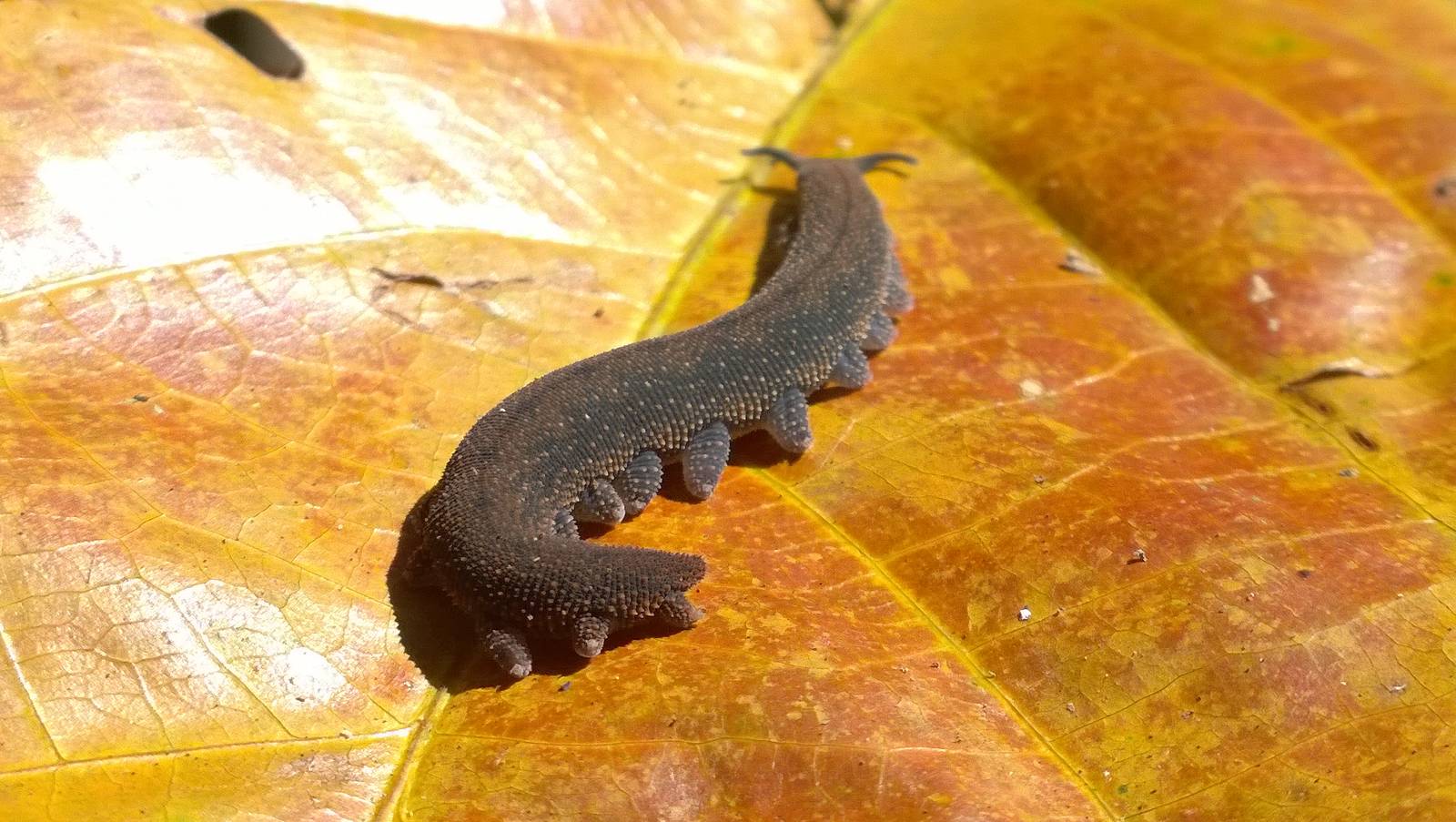
Photo of a Velvet Worm sp by @ronnienl
To my knowledge, there are no Velvet Worms in any zoos or aquaria, while they are fascinating animals, they make poor public displays due to the animals hiding under bark or substrate. While they are either extremely rare or absent from public collections there are velvet worms in research facilities and in private collections.
In North America and Europe, the most common species of Velvet Worm in captivity is Epiperipatus barbadensis found in Barbados. This species is coloured brown and grows up to 90mm. I found several instances of this species being kept including video and records of captive breeding.
In Australia the most common species kept is Euperipatoides rowelli which is found in New South Wales and in the Australian Capital Territory. Like E.barbadensis this species has been captive bred, and in this species’s case, breeds readily. It is blue in colour and much larger than E.barbadensis reaching up to 5cm in length. E.rowelli has a complex social structure with a dominant female that eats on killed prey first, then other females consume the prey and finally the males get their turn to eat. This is considered one of the easiest velvet worm species (although still an intermediate-advanced invertebrate) to keep due to its large size and most importantly, it’s tolerance to cold temperatures as it is found in temperate climates rather than tropical climates like a lot of other species.
Photo of a Velvet Worm sp by @ronnienl
Velvet Worm
- ronnienl
- 2
Velvet Worm (Peripatus sp.).
Photos from my stay at Cape tribulation in 2014.
Photos from my stay at Cape tribulation in 2014.
