Tawny Frogmouths captive care

Tomoko Kitamura

Active Member
Posts split from this thread: Featherdale News [Featherdale Wildlife Park]


Please tell me about the Tawny Frogmouths.
Recently, a male and a female Tawny Frogmouth moved into my local zoo. The two were part of a herd at a zoo 500 kilometers from here. Previously kept together with siblings, they are now kept individually in noisy concrete enclosures at the zoo. There are perches, but no leaves and nowhere to hide. Especially females born in April are always frightened.
Instead of clinging to trees, they cling to cages and elongate their bodies to camouflage themselves and appear to be constantly shaking. A sign posted by zookeepers says the species is solitary.
You said you saw three of them, but is there any relationship between them?
 
Last edited by a moderator:
@Tomoko Kitamura

Liked your comment for joining the conversation and for the info but am sorry to hear about the living conditions for the Tawny Frogmouth's at your local zoo, really hope their living conditions get better and appropriate aviaries are built for them for their happiness, thanks heaps for sharing the info here with us though :)
 
@Tomoko Kitamura

Liked your comment for joining the conversation and for the info but am sorry to hear about the living conditions for the Tawny Frogmouth's at your local zoo, really hope their living conditions get better and appropriate aviaries are built for them for their happiness, thanks heaps for sharing the info here with us though :)

Thank you for your message.Before they immigrated, these two birds lived in this kind of environment.
x.com
I don't know why the zoo they are in now is keeping them isolated and alone.
Do Tawny frogmouth necessarily need to be kept alone? Will they fight if a male and female are kept together?
This zoo's system allows the general public to cooperate with the zoo by making donations. Of course, we can't do anything big like build an aviary, but could you please give us some advice on how we can help?
 
Thank you for your message.Before they immigrated, these two birds lived in this kind of environment.
x.com
I don't know why the zoo they are in now is keeping them isolated and alone.
Do Tawny frogmouth necessarily need to be kept alone? Will they fight if a male and female are kept together?
This zoo's system allows the general public to cooperate with the zoo by making donations. Of course, we can't do anything big like build an aviary, but could you please give us some advice on how we can help?

I think Tawny Frogmouth's pair during breedings season but otherwise prefer to be solitary and males can be aggressive to female when in a territorial mood so its better to have two seperate but possibly combined exhibits but can share as a pair in one for certain times of the year. In Australia its common to keep a Tawny Frogmouth in Nocturnal House exhibits with medium to small sized marsupial mammals like Possums, Gliders, Bandicoots, nocturnal Wallabies, Hare-Wallabies, Bettongs and Potoroos (smaller marsupials like Dunnarts, Phascogales, Planigales, Mulgaras, Honey Possums, and native rodents (in Australian native case: mice and rats) would probably be at risk as seen as food in a Tawny's minds-eye, but probably an irrelivent tangent by me as has never been attempted in captivity {a.f.a.i.k} for that reason).

With advocating for change at one's local zoo it can be tricky and unfortunately definitely no expert on although there are very experted minds and some Australian zoo and wildlife park owners and managers who are members here on this Australia forum. So advice wise the only advice could offer would be to write to zoo or animal park in question asking if there are plans to upgrade living conditions and see if they're open to a fundraiser drive for if they do have intentions for. Otherwise seems to be a gradual build up of noted dissatisfaction from visitors with a general living area of particular animals that sometimes does eventually generate an undertaking by zoo management after a while to look into improving certain animals living quarters (often the zoo keepers and other staff themselves already are wanting to have certain exhibits improved on for the animals given they're devoted animal carers who prioritise the welfare and happiness of their animal 'charges').

A bit over a decade ago the previous owners of Peel Zoo (now Ranger Red's Zoo & Conservation Park in south-Western Australia) were heavily involved in the upgrading renovations of Bali Zoo in Indonesia which had come under heavy (and to be brutally honest, kind-of deserved/warranted imo) criticism by visitors for its inadequate living conditions for many of its animals, since then the zoo has improved significantly (nothing grand, but to be fair, very very improved). Just as an example of the positive change that does come about and was noted via here on ZooChat (however am not sure how the initial working relationship between the Peel Zoo's owners and Bali Zoo came about).

Thanks again for the info by the way and nice to 'meet' you too :)
Much more knowledgable and experienced minds here on this Australia (and New Zealand) forum(s) will be able to share a tonne of knowledge and advice with you and answer questions with more solid and helpful answers.
 
Last edited:
I think Tawny Frogmouth's pair during breedings season but otherwise prefer to be solitary and males can be aggressive to female when in a territorial mood so its better to have two seperate but possibly combined exhibits but can share as a pair in one for certain times of the year. In Australia its common to keep a Tawny Frogmouth in Nocturnal House exhibits with medium to small sized marsupial mammals like Possums, Gliders, Bandicoots, nocturnal Wallabies, Hare-Wallabies, Bettongs and Potoroos (smaller marsupials like Dunnarts, Phascogales, Planigales, Mulgaras, Honey Possums, and native rodents (in Australian native case: mice and rats) would probably be at risk as seen as food in a Tawny's minds-eye, but probably an irrelivent tangent by me as has never been attempted in captivity {a.f.a.i.k} for that reason).

With advocating for change at one's local zoo it can be tricky and unfortunately definitely no expert on although there are very experted minds and some Australian zoo and wildlife park owners and managers who are members here on this Australia forum. So advice wise the only advice could offer would be to write to zoo or animal park in question asking if there are plans to upgrade living conditions and see if they're open to a fundraiser drive for if they do have intentions for. Otherwise seems to be a gradual build up of noted dissatisfaction from visitors with a general living area of particular animals that sometimes does eventually generate an undertaking by zoo management after a while to look into improving certain animals living quarters (often the zoo keepers and other staff themselves already are wanting to have certain exhibits improved on for the animals given they're devoted animal carers who prioritise the welfare and happiness of their animal 'charges').

A bit over a decade ago the previous owners of Peel Zoo (now Ranger Red's Zoo & Conservation Park in south-Western Australia) were heavily involved in the upgrading renovations of Bali Zoo in Indonesia which had come under heavy (and to be brutally honest, kind-of deserved/warranted imo) criticism by visitors for its inadequate living conditions for many of its animals, since then the zoo has improved significantly (nothing grand, but to be fair, very very improved). Just as an example of the positive change that does come about and was noted via here on ZooChat (however am not sure how the initial working relationship between the Peel Zoo's owners and Bali Zoo came about).

Thanks again for the info by the way and nice to 'meet' you too :)
Much more knowledgable and experienced minds here on this Australia (and New Zealand) forum(s) will be able to share a tonne of knowledge and advice with you and answer questions with more solid and helpful answers.
Thank you for your very detailed advice. I am very happy to meet such a kind person as you.
This zoo is old and small, but the keepers are very good. The keepers in charge of Tawny Frogmouth are also very studious and competent, but they have just been transferred from another zoo this spring. I heard that it is her first time to keep a bird.
After reading your detailed advice, I felt that she is definitely on the right track.
However, each animal has its own personality. The female born in April has lost the companion she has been close to since birth and seems to have difficulty settling in her new environment. In addition, now that the breeding season is over, it may be difficult for the Tawny Frogmouths to live together.
What are the benefits of keeping medium-sized marsupials together? Will it reduce the stress of a nervous female?
Fortunately, the males are very used to people. However, the enclosure for this animal is completely separated by a concrete wall, so the female cannot see the male. Would she feel relieved if she could meet the male she spent time with at the previous zoo? (This enclosure previously housed a Japanese Scops-owl and an owl monkey, who lived very long lives.)
I respect this zookeeper and posted this because I wanted to help her in some way. And more than anything, I want to find a way to help this frightened female animal live a happier life. Tawny Frogmouths only have a lifespan of about 10 years. I want them to live every day, every second, happily.
 
Thank you for your very detailed advice. I am very happy to meet such a kind person as you.
This zoo is old and small, but the keepers are very good. The keepers in charge of Tawny Frogmouth are also very studious and competent, but they have just been transferred from another zoo this spring. I heard that it is her first time to keep a bird.
After reading your detailed advice, I felt that she is definitely on the right track.
However, each animal has its own personality. The female born in April has lost the companion she has been close to since birth and seems to have difficulty settling in her new environment. In addition, now that the breeding season is over, it may be difficult for the Tawny Frogmouths to live together.
What are the benefits of keeping medium-sized marsupials together? Will it reduce the stress of a nervous female?
Fortunately, the males are very used to people. However, the enclosure for this animal is completely separated by a concrete wall, so the female cannot see the male. Would she feel relieved if she could meet the male she spent time with at the previous zoo? (This enclosure previously housed a Japanese Scops-owl and an owl monkey, who lived very long lives.)
I respect this zookeeper and posted this because I wanted to help her in some way. And more than anything, I want to find a way to help this frightened female animal live a happier life. Tawny Frogmouths only have a lifespan of about 10 years. I want them to live every day, every second, happily.

Pleasure my friend and really respect your advocating for them they really are amazingly beautiful animals hey.

Thought maybe (alphabetically) @Hix @MRJ @Red @Steve Robinson @tetrapod
could give the best advice with their knowledge and experience.
 
Last edited:
Pleasure my friend and really respect your advocating for them they really are amazingly beautiful animals hey.

Thought maybe (alphabetically) @Hix @MRJ @Red @Steve Robinson @tetrapod
could give the best advice with their knowledge and experience.
Thank you very much for your kindness and for introducing me to such wonderful people.

I would like to seek advice from experts who know these adorable Tawny Frogmouths and find a way to help them live happily ever after.
 
Pleasure my friend and really respect your advocating for them they really are amazingly beautiful animals hey.

Thought maybe (alphabetically) @Hix @MRJ @Red @Steve Robinson @tetrapod
could give the best advice with their knowledge and experience.

The enclosure sounds as if it is far too small. In the wild frogmouths are happy to sit very still in close proximity to humans and if the birds are clutching the wire they are significantly stressed. Visiting Japan thirty and forty years ago I can remember some distressingly small box-like enclosures, and while birds may exist in these for years, it must have been mental torture for them. I hope the enclosures allow them space for flight at least.

In a reasonable sized aviary, it is not a problem to keep a male and a female together, they will largely ignore each other outside breeding season.

Not sure about the question regarding marsupials. What species are we talking about?
 
Thank you for your very detailed advice. I am very happy to meet such a kind person as you.
This zoo is old and small, but the keepers are very good. The keepers in charge of Tawny Frogmouth are also very studious and competent, but they have just been transferred from another zoo this spring. I heard that it is her first time to keep a bird.
After reading your detailed advice, I felt that she is definitely on the right track.
However, each animal has its own personality. The female born in April has lost the companion she has been close to since birth and seems to have difficulty settling in her new environment. In addition, now that the breeding season is over, it may be difficult for the Tawny Frogmouths to live together.
What are the benefits of keeping medium-sized marsupials together? Will it reduce the stress of a nervous female?
Fortunately, the males are very used to people. However, the enclosure for this animal is completely separated by a concrete wall, so the female cannot see the male. Would she feel relieved if she could meet the male she spent time with at the previous zoo? (This enclosure previously housed a Japanese Scops-owl and an owl monkey, who lived very long lives.)
I respect this zookeeper and posted this because I wanted to help her in some way. And more than anything, I want to find a way to help this frightened female animal live a happier life. Tawny Frogmouths only have a lifespan of about 10 years. I want them to live every day, every second, happily.

Yes, I hope so too.
The zoo took really good care of Brad the Night Monkey, and though the environment might not be the best, I believe zoos in Yokohama have excellent experience handling animals.
 
The enclosure sounds as if it is far too small. In the wild frogmouths are happy to sit very still in close proximity to humans and if the birds are clutching the wire they are significantly stressed. Visiting Japan thirty and forty years ago I can remember some distressingly small box-like enclosures, and while birds may exist in these for years, it must have been mental torture for them. I hope the enclosures allow them space for flight at least.

In a reasonable sized aviary, it is not a problem to keep a male and a female together, they will largely ignore each other outside breeding season.

Not sure about the question regarding marsupials. What species are we talking about?
Thank you very much for your detailed advice.I am deeply moved by your kindness in caring for this frightened little life.
I think the zoo you saw when you came to Japan that had "distressingly small box-like enclosures" is probably the one I'm talking about.
The Tawny Frogmouths are kept in a concrete enclosure built 60 years ago.
Unfortunately, I don't know about flight distance.
Keepers may have separated the birds to give each bird as much space as possible. There is a risk of fighting when a male and female live together, but sometimes that isn't a problem, right?They lived together as friends at the previous zoo, so it looks like they will be able to live together.
I was hoping that coexistence with marsupials would reduce the female's stress, but this may be difficult due to space constraints.
For example, if it is difficult for a male and female to live together, could a zookeeper reassure a scared female by giving her a stuffed animal instead of a companion? Will a leaf-like blindfold make her feel safe?
This weekend marks a month since they moved here. I'm going to visit them with anticipation and anxiety, hoping that the female's tremors have subsided.
 
Yes, I hope so too.
The zoo took really good care of Brad the Night Monkey, and though the environment might not be the best, I believe zoos in Yokohama have excellent experience handling animals.
Thank you for your message. I completely agree with your message.
However, many visitors to the zoo seem to wonder if Brad was happy during his 34 years of solitary life. It is important that we get creative and help the animals live as happy as possible their short lives, even in the old and cramped environment of our facility.
 
Thank you very much for your detailed advice.I am deeply moved by your kindness in caring for this frightened little life.
I think the zoo you saw when you came to Japan that had "distressingly small box-like enclosures" is probably the one I'm talking about.
The Tawny Frogmouths are kept in a concrete enclosure built 60 years ago.
Unfortunately, I don't know about flight distance.
Keepers may have separated the birds to give each bird as much space as possible. There is a risk of fighting when a male and female live together, but sometimes that isn't a problem, right?They lived together as friends at the previous zoo, so it looks like they will be able to live together.
I was hoping that coexistence with marsupials would reduce the female's stress, but this may be difficult due to space constraints.
For example, if it is difficult for a male and female to live together, could a zookeeper reassure a scared female by giving her a stuffed animal instead of a companion? Will a leaf-like blindfold make her feel safe?
This weekend marks a month since they moved here. I'm going to visit them with anticipation and anxiety, hoping that the female's tremors have subsided.
If there is enough space, keeping them together is not a problem but if there is not enough space keeping them together would make the situation worse.

Putting them with another species will not help. perhaps make the situation far worse. Nor would a soft toy mean anything to the bird.

The bird needs to feel secure, that means being far enough away from people, preferably higher than people, or maybe with a barrier (which might be foliage) that makes it feel that it cannot be seen.

If the zoo cannot house the animals properly it has a moral obligation to move the animals to somewhere that can.
 
Thank you for your message. I completely agree with your message.
However, many visitors to the zoo seem to wonder if Brad was happy during his 34 years of solitary life. It is important that we get creative and help the animals live as happy as possible their short lives, even in the old and cramped environment of our facility.
Visitors would be right to think this. Primates are social animals. Brad would be no happier than we would be if kept for 34 years without human contact.
 
Last edited:
I assume you are referring to Nogeyama zoo. I tried looking for footage of the frogmouths in the enclosures. Unfortunately, there aren’t too many pictures showing the overall enclosures but this is what I found.

The zoo announcing the arrival of the birds:

x.com

Visitor pictures of the birds:

x.com
x.com
x.com

I don’t know too much about frogmouth behavior so I can’t give any advice. I just wanted to provide any possible footage for the professionals to see for themselves.

In another note, I did find footage of the enclosures back when it had the scops owl and night monkey. The first two pictures might give us a better idea of the size of the enclosure:

x.com

The first picture on this post shows the night monkey exhibit. There isn’t a sign for the scops owl but I assume it’s enclosure is in the same picture as well.
x.com
 
If there is enough space, keeping them together is not a problem but if there is not enough space keeping them together would make the situation worse.

Putting them with another species will not help. perhaps make the situation far worse. Nor would a soft toy mean anything to the bird.

The bird needs to feel secure, that means being far enough away from people, preferably higher than people, or maybe with a barrier (which might be foliage) that makes it feel that it cannot be seen.

If the zoo cannot house the animals properly it has a moral obligation to move the animals to somewhere that can.
Thank you very much for your very important advice.
You have convinced me that a good way to help this fearsome female in the current environment is to install leaves as a fence.
@PossumRoach provided the photo posted on X by a visitor. The female seems much calmer than last week. This photo was the first time I saw her without her disguise.
The zoo is scheduled for major renovations and I hope Tawny Frogmouths will be able to fly freely and live in a safe environment.
 
I assume you are referring to Nogeyama zoo. I tried looking for footage of the frogmouths in the enclosures. Unfortunately, there aren’t too many pictures showing the overall enclosures but this is what I found.

The zoo announcing the arrival of the birds:

x.com

Visitor pictures of the birds:

x.com
x.com
x.com

I don’t know too much about frogmouth behavior so I can’t give any advice. I just wanted to provide any possible footage for the professionals to see for themselves.

In another note, I did find footage of the enclosures back when it had the scops owl and night monkey. The first two pictures might give us a better idea of the size of the enclosure:

x.com

The first picture on this post shows the night monkey exhibit. There isn’t a sign for the scops owl but I assume it’s enclosure is in the same picture as well.
x.com
Thank you for providing this information. As you say, the best way to understand the situation is to look at photos, but it is visually difficult to photograph the entire interior of the animal enclosure.
However, the photo you posted of X shows the frightened woman calming down.
I felt a little relieved.I'm going to meet that woman this weekend.
 
@Tomoko Kitamura

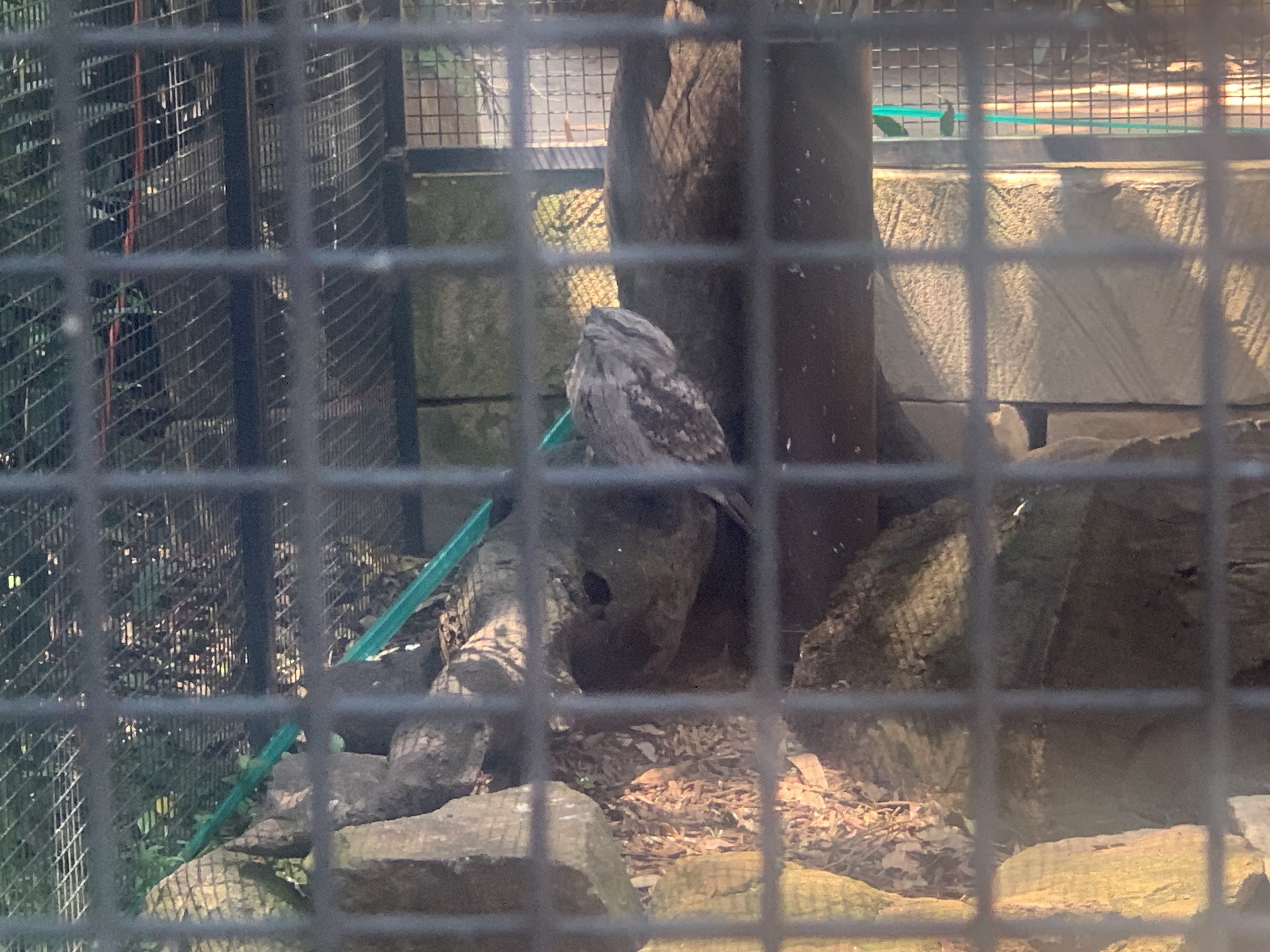
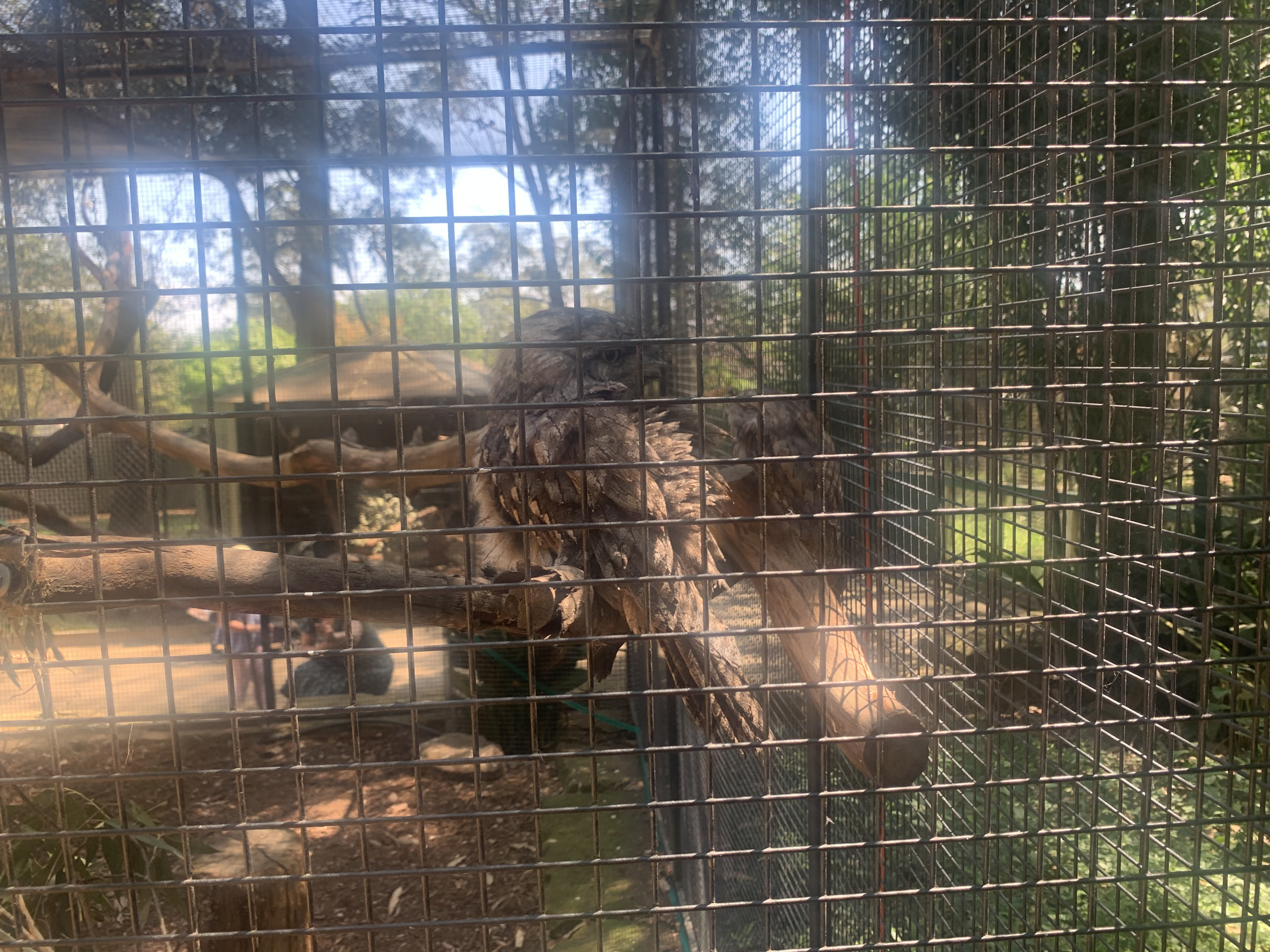
Ended up seeing two Tawny Frogmouths at a native wildlife park in northern Sydney on Friday (the Koala Park Sanctuary) they lived in an aviary they shared with one or two Ringtailed Possums (did not see the Possums); found this news link that mentions the Tawny Frogmouths at the park: Revheadecologist (@revheadecologist) on Threads

full

2GDmuII.jpg

2GDmWQ9.jpg
 
@Tomoko Kitamura

Ended up seeing two Tawny Frogmouths at a native wildlife park in northern Sydney on Friday (the Koala Park Sanctuary) they lived in an aviary they shared with one or two Ringtailed Possums (did not see the Possums); found this news link that mentions the Tawny Frogmouths at the park: Revheadecologist (@revheadecologist) on Threads
Thank you for showing us your precious photos. They seem happy to be living together.
I was surprised to learn that they were kept outdoors. I think this cage is about the same size as the indoor enclosure for two birds at the zoo I'm talking about. And this zoo has an outdoor cage about the same size as this photo. The owl that was kept there has been married off to another zoo, so it's vacant, but in Japan, avian influenza is prevalent for more than half the year, and keeping wild birds outdoors is a big risk.
This weekend, the female was still on the railing of the cage, not on a perch, but she was not camouflaged and seemed a little calmer.
In cases like this, the important thing is the scary thing about getting used to things. I would like to take the many pieces of advice you have given me and make suggestions to the zoo while watching over her, so that her suffering and fear do not become a part of her daily life.
 
Guess this manual could be very helpfull for you ( and the birds ) :

https://nswfmpa.org/Husbandry Manuals/Published Manuals/Aves/Tawny Frogmouth.pdf
Thank you very much for introducing this very interesting material. I wanted to read something like this, so I'm going to read it little by little.
I recently learned about these adorable birds, Tawny Frogmouths, when I came across two young birds at the zoo. They were deprived of various freedoms in exchange for safety, so I hope they can live as peacefully and happily as possible.
 
Back
Top