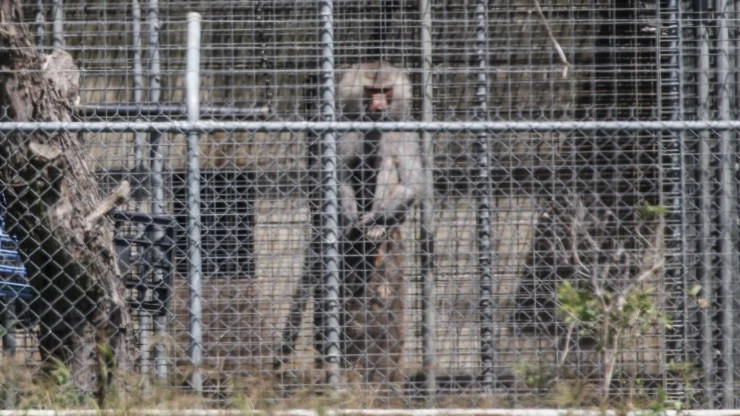
Launceston City Park Launcestion City Park macaques

Swanson02

Well-Known Member
I visited Launceston City Park today, and witnessed the quite impressive Japanese Macaque exhibit there. Counted give or take 21 Macaques with 3-4 younger individuals. Apparently they are tied to the Japanese Monkey centre? Who apparently control the troop?
 
Last edited by a moderator:
On 14/09/2024, I visited Launceston City Park and got to witness their impressive Japanese macaque exhibit. I counted 21 individuals, including three infants. It was a real treat seeing the troop so active, and it got me thinking about how great it would be if more zoos in our colder regions housed large troops of Japanese macaques. I know their troop is controlled by the Japanese Monkey Centre, so there may be logistical reasons stopping other zoos from acquiring them, but I’d love to see more of these cold-adapted monks in Australia.

460968526_1087345132986176_5218217762764011242_n.jpg


- Launceston City Park Japanese Macaque exhibit
 
Last edited by a moderator:
Also visited Launceston City Park today, and witnessed the quite impressive Japanese Macaque exhibit there. Counted give or take 21 Macaques with 3-4 younger individuals. Apparently they are tied to the Japanese Monkey centre? Who apparently control the troop?
Launceston to vote whether to sterilise iconic monkeys living in city park | Watch
A short video about Launceston council voting as to whether they should sterilize the remaining monkeys, as they are already inbreeding and they say its no longer legal to import new genetics/new animals. They say if they sterilized them, they could die out in the next 25 years but the council would consider housing different animals in the enclosure such as Tasmanian Devils
 
Launceston to vote whether to sterilise iconic monkeys living in city park | Watch
A short video about Launceston council voting as to whether they should sterilize the remaining monkeys, as they are already inbreeding and they say its no longer legal to import new genetics/new animals. They say if they sterilized them, they could die out in the next 25 years but the council would consider housing different animals in the enclosure such as Tasmanian Devils

I think this is a really poor decision if it gets through. The monkey enclosure was immensely popular when I went with lots of families gathering to watch the troop. The enclosure was of good size and the troop was highly active, utilising all of the enrichment and space. Imo the monkeys in city park add to the charm of Launceston as a city, a fun/cool quirk. Like the Bears in Bern Switzerland or the Ravens at the Tower of London. I don't understand how it's illegal to import Japanese macaque into the country? Sounds like an excuse to me, primates are readily imported by every zoo. Likewise letting the monkeys die off is depressing as in 10 years, 3-4 lonely old monkeys will be left, akin to the regions mandrill population.

Furthermore Tasmanian devils are too reclusive for the location and a busy city park with bright night lights would be too stressful for a Nocturnal species imo. I don't think we have any Australian natives that could fill the engagement gap left by a busy troop of Japanese Macaque and the cool quirk they add to the city of Launceston.
 
I think this is a really poor decision if it gets through. The monkey enclosure was immensely popular when I went with lots of families gathering to watch the troop. The enclosure was of good size and the troop was highly active, utilising all of the enrichment and space. Imo the monkeys in city park add to the charm of Launceston as a city, a fun/cool quirk. Like the Bears in Bern Switzerland or the Ravens at the Tower of London. I don't understand how it's illegal to import Japanese macaque into the country? Sounds like an excuse to me, primates are readily imported by every zoo. Likewise letting the monkeys die off is depressing as in 10 years, 3-4 lonely old monkeys will be left, akin to the regions mandrill population.

Furthermore Tasmanian devils are too reclusive for the location and a busy city park with bright night lights would be too stressful for a Nocturnal species imo. I don't think we have any Australian natives that could fill the engagement gap left by a busy troop of Japanese Macaque and the cool quirk they add to the city of Launceston.
There is no way this will go through, the people of Launceston love the monkeys too much! (Trying to convince myself)
 
There is no way this will go through, the people of Launceston love the monkeys too much! (Trying to convince myself)
I think the same - seems like a bit of a joke to me in all honesty. I do know they carry a Herpes B virus so perhaps this is one of the factors as to why they're making the decision to not acquire any additional monkeys and obviously introduce them to the virus.
 
I think the same - seems like a bit of a joke to me in all honesty. I do know they carry a Herpes B virus so perhaps this is one of the factors as to why they're making the decision to not acquire any additional monkeys and obviously introduce them to the virus.

Hepatitis (risk of transmission) is the reason zoos in Australia have phased out macaques and why more can’t be imported.

They’ve resigned themselves to this troop being on site for the 25 years or so it’ll take for them to die out; but have cited inbreeding as the reason for ceasing breeding. Species like Indian antelope and Barbary sheep have been subject to much higher levels of inbreeding and while I acknowledge the potential for genetic flaws to arise in primates may be higher, I’m not aware of this being an issue at this point with the troop.
 
Hepatitis (risk of transmission) is the reason zoos in Australia have phased out macaques and why more can’t be imported.

They’ve resigned themselves to this troop being on site for the 25 years or so it’ll take for them to die out; but have cited inbreeding as the reason for ceasing breeding. Species like Indian antelope and Barbary sheep have been subject to much higher levels of inbreeding and while I acknowledge the potential for genetic flaws to arise in primates may be higher, I’m not aware of this being an issue at this point with the troop.

Its interesting because sometimes Macaques are still imported into Australia as you guys know for scientific experiment subjects (a while back now but 2015 ten Crab-eating Macaques imported into Australia from France for that reason & 2009 forty-four Sth Pig-tailed Macaques from Indonesia). Know obviously does not include Japanese Macaques (their import last being the '79 one that established this Launceston group to replace the Rhesus ones).

But if zoos like now shut Alma Park were able to adopt some of these Macaques after a while from some of the laboratories wonder if there is tiniest sliver of hope yet that could be done again with some other Macaques for the region (maybe not Launceston specifically, wonder if introducing some of the other {equally inbred from what have heard} Japanese Macaques from Gorge would of been possible few years back before what presume might be age sterility now in Gorge's group, because while both groups inbred it would of been an outcrossing of genes maybe).

Remembered that Taronga euthanised all 10 of their remaining Crab-eating Macaques in 1999 and the autopsy biopsy's revealed only a few had the antibodies for the herpes b virus which believe does not mean they directly had the virus but had developed antibodies as an immune system response to being in close contact with it at some point. It is risky absolutely and a scary virus with its fatality for people.


@Jambo Yeah don't hear often about Japanese Macaques have had minimal to not much evidence of being carriers of it (mostly Rhesus, Crabeating and sometimes Sth Pigtailed - interestingly the latter two the most recently imported for labs' in Aus') so it is a shame that Japanese Macaques are thrown into the concern category (thought same with endangered Sulawesi Crested Macaques being phased out of the region was a crying shame and a sad loss to happen).
 
Last edited:
Its interesting because sometimes Macaques are still imported into Australia as you guys know for scientific experiment subjects (a while back now but 2015 ten Crab-eating Macaques imported into Australia from France for that reason & 2009 forty-four Sth Pig-tailed Macaques from Indonesia). Know obviously does not include Japanese Macaques (their import last being the '79 one that established this Launceston group to replace the Rhesus ones).

But if zoos like now shut Alma Park were able to adopt some of these Macaques after a while from some of the laboratories wonder if there is tiniest sliver of hope yet that could be done again with some other Macaques for the region (maybe not Launceston specifically, wonder if introducing some of the other {equally inbred from what have heard} Japanese Macaques from Gorge would of been possible few years back before what presume might be age sterility now in Gorge's group, because while both groups inbred it would of been an outcrossing of genes maybe).

Remembered that Taronga euthanised all 10 of their remaining Crab-eating Macaques in 1999 and the autopsy biopsy's revealed only a few had the antibodies for the herpes b virus which believe does not mean they directly had the virus but had developed antibodies as an immune system response to being in close contact with it at some point. It is risky absolutely and a scary virus with its fatality for people.

At this stage, it appears the ZAA appears uninterested in acquiring macaques or other primates from the research labs.

Research labs would also be a valuable potential source of female Hamadryas baboons, which not only would introduce new genetics into the region, but improve the male-female ratio in many of the troops.
 
@Zoofan15

Absolutely really really good point you make, think they really should reconsider soon (theres many precedents of monkeys being acquired this way with a couple of the small private zoos in recent past). Sth Pigtailed Macaques and Dorocouli's technically being in Australia but only in research labs now.

Theres a Hamadryas Baboon colony set up for (from memory) diabetes research next door to Zambi Wildlife Retreat in Wallacia who are owned by NSW state health department (think theres close to 100 Baboons), visited once in late 2011 for TAFE animal studies field trip (the staff there refer to them by their Sacred Baboons alternative name, at least in 2011 they did).
 
@Zoofan15

Absolutely really really good point you make, think they really should reconsider soon (theres many precedents of monkeys being acquired this way with a couple of the small private zoos in recent past). Sth Pigtailed Macaques and Dorocouli's technically being in Australia but only in research labs now.

Theres a Hamadryas Baboon colony set up for (from memory) diabetes research next door to Zambi Wildlife Retreat in Wallacia who are owned by NSW state health department (think theres close to 100 Baboons), visited once in late 2011 for TAFE animal studies field trip (the staff there refer to them by their Sacred Baboons alternative name, at least in 2011 they did).
It would be nice if they were one day introduced into our regional program to bolster genetics, however it's probably unlikely due to the conditions they've been exposed to in the past and the likely inbreeding they've experienced. I do wonder how they manage to keep close to 100 baboons in an adequate environment!
 
It would be nice if they were one day introduced into our regional program to bolster genetics, however it's probably unlikely due to the conditions they've been exposed to in the past and the likely inbreeding they've experienced. I do wonder how they manage to keep close to 100 baboons in an adequate environment!

Yeah true. Really wish just a couple of new Macaques could be imported though.

Yeah it might not be 100 exactly but felt like it (will if mentions the number online somewhere). In a series of fairly thick metal wired cages (thicker than an aviaries wire, like whats used for some big cat enclosures) the exhibits look like a multiple amount of sort if similar to Melbourne Zoo’s old Baboon exhibit. But a bunch of them adjoining and believe there was at least one or two access tunnels at a certain height. Will send the google maps co-ordinates for it when back home.
 
Yeah true. Really wish just a couple of new Macaques could be imported though.

Yeah it might not be 100 exactly but felt like it (will if mentions the number online somewhere). In a series of fairly thick metal wired cages (thicker than an aviaries wire, like whats used for some big cat enclosures) the exhibits look like a multiple amount of sort if similar to Melbourne Zoo’s old Baboon exhibit. But a bunch of them adjoining and believe there was at least one or two access tunnels at a certain height. Will send the google maps co-ordinates for it when back home.

A 2020 article stated 272 primates were used in medical research in Australia in 2017, with 165 of those in NSW. The baboon colony was/is quite large.

The region’s zoos have some excellent baboon exhibits. I’ve been throughly impressed by the ones I’ve seen recently at Melbourne Zoo and Sydney Zoo. It’s a far cry from the outdated cages seen at zoos like Auckland (up until the move of their Chacma baboon troop to Baboon Hill in 1999); and Melbourne Zoo until the opening of their exhibit just over a decade ago.
 
@Zoofan15 @Jambo

Oh yeah the article about the male and two females Baboons escaping on the way to RPA hospital in central Sydney for the male's vasectomy (well he got his vasectomy postponed lol).

Here's the location of the colony: -33.86976772157601, 150.67433215069627

When visited the colony, Zambi next door was still a few months from being founded, was still land owned by Bullens, was their Animal World park until sometime in 1985, imagine soon after the animal studies/animal husbandry students at TAFE did field trips to Zambi rather. From memory they didnt encourage photos being taken at the colony though plenty of other students snapped a few pics am sure, and think there were rules about having to stand certain distance from the wire and maybe something about better not to wear perfume or something, memory hazy now.

Do remember one of the staff of the colony pointed to the west and said just beyond the dams was land owned by the Bullens family and that Lions and Tigers were still there (might of said an Elephant or two still also).

Lol sorry not a very Tasmania Zoo-centric post.
 
Last edited:
@Zoofan15 @Jambo

Apparently the Wallacia facility is permitted to hold up to 165 Baboons but thats just set at the maximum limit, believe its a bit lower than this; just in case you were interested to know.

photo showing a Hamadryas' at the facility
2WbFVpa.jpg

photo source Dallas Kilponen photographer SMH
(article, bit of a puff piece: Baboons used in 'Frankenstein-like' medical experiments)
 
I think this is a really poor decision if it gets through. The monkey enclosure was immensely popular when I went with lots of families gathering to watch the troop. The enclosure was of good size and the troop was highly active, utilising all of the enrichment and space. Imo the monkeys in city park add to the charm of Launceston as a city, a fun/cool quirk. Like the Bears in Bern Switzerland or the Ravens at the Tower of London. I don't understand how it's illegal to import Japanese macaque into the country? Sounds like an excuse to me, primates are readily imported by every zoo. Likewise letting the monkeys die off is depressing as in 10 years, 3-4 lonely old monkeys will be left, akin to the regions mandrill population.

Furthermore Tasmanian devils are too reclusive for the location and a busy city park with bright night lights would be too stressful for a Nocturnal species imo. I don't think we have any Australian natives that could fill the engagement gap left by a busy troop of Japanese Macaque and the cool quirk they add to the city of Launceston.

I agree, and why do we need to have a native utilise the space. Tas has a decent amount of places where natives are easily seen.
It sounds like council just dont want to pay for it anymore. They can't go in and destroy the animals, so the next best thing is to let them die out. Im not sure if they are illegal to import but they are seen as a huge health risk with visitors, and that's the reason most zoos have dropped the species or similar species.
 
The research baboons will never be completely removed. They are still very very much used in human vaccine and medical trails. Of memory they were utilised for COVID. From memory when I did my undergrad 10 years ago, new genetics is imported when need. There is I think 3 (possibly more) species that are maintained, the research facility is partnered by majour hospitals like Westmead and science organisations like the CSIRO.


The old zoo facility at wallacia still very much has various primate species, lions and tigers. Of memory the bears have died of. You can get to the road near the place and still hear lions and tiger calls from the road from what some family friends have said. I have heard them probably 10 years ago since I have personally driven by.
 
I visited the Japanese macaque enclosure in Launceston this morning, partly prompted by the sad news about their likely eventual demise. They're such a fun and distinctive city exhibit, it really will be a shame when they're gone.

The group was very active this morning, with 2 young infants that I could see. And there was a small but engaged crowd of people watching them even at 7:45am.

(Incidentally, I did the Low Head penguin tour outside Launceston last night, which was great. And saw plenty of pademelons and Bennett's wallabies on the drive back afterwards.)
 
Back
Top