Chlidonias Goes To Asia, part seven: 2024-2025

Photos from Cape Ochiishi:

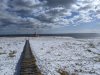
PXL_20250211_024631253.jpg
Boardwalk through the spruce forest.

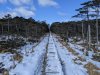
PXL_20250211_025652451.jpg
The lighthouse at Cape Ochiishi.

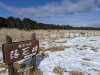
PXL_20250211_025704556.jpg
Cape Ochiishi sign, looking back at the forest (with Sika Deer).
 

Attachments

  • PXL_20250211_025652451.jpg
    PXL_20250211_025652451.jpg
    204.8 KB · Views: 105
  • PXL_20250211_024631253.jpg
    PXL_20250211_024631253.jpg
    230.9 KB · Views: 109
  • PXL_20250211_025704556.jpg
    PXL_20250211_025704556.jpg
    210.2 KB · Views: 108
Abashiri

Amongst the animals I had hoped to see when I was up at Rausu a few days earlier were seals, of which there are several possible species around Hokkaido in winter, but there was no ice on the ocean this winter and so the Nature Cruise boats didn't bother going out beyond the port. When I got back to Kushiro I therefore spent some time on the internet trying to find where else might be a good spot to try before leaving Hokkaido.

I found two likely-sounding spots. One was a town called Abashiri which is on the north coast, about three hours train-ride from Kushiro, where there is a "Drift Ice Cruise". The second was a town in the northwest called Wakkanai which I had come across durng my initial planning stages (back in New Zealand) because it was the site of a paper about Steller's Sealions, but which I hadn't actually put into the plan because it seemed really out of the way, and because I expected to see seals at Rausu.

I decided I would visit both places now. I didn't have high hopes for Abashiri after there being no seals at Rausu, but I could do it as a day-trip from Kushiro and if I did get to see Spotted Seals there then when I went to Wakkanai I could just concentrate on the Steller's Sealions (which I was sure I'd see) - and if I didn't see Spotted Seals at Abashiri then I'd still have a second chance to try at Wakkanai.

The Drift Ice Cruise at Abashiri was listed on their website as being 5000 Yen for a one hour trip, with several trips per day. Their site says, and I quote, "When there is no drift ice, the large ship Aurora will take you on a sea excursion to Cape Notoro". I knew there probably wouldn't be ice (there had been none at Rausu) but I hoped that I might see seals and seabirds on the trip up to Cape Notoro.

In Kushiro it was minus 9 degrees in the morning. There was full ice on my beard by the time I got to the train station, which was only about three minutes walk from the hotel.

I caught the 6.38am train to Abashiri, arriving at 9.49am. I saw three Red Foxes from the train, one at the far side of a field and the other two sitting together on a hill right beside the train track. It was a twenty minutes walk to the ferry terminal.

There was, as expected, no drift ice. The lady at the ticket counter told me that because of this the "cruise" would just be within the breakwaters, would only be twenty minutes long, and the price was discounted to 1200 Yen. I said that their website states they go to Cape Notoro and she said that there isn't any ice so they can't go there, which makes no sense at all. I knew this was therefore a pointless boat ride, but I had come all this way so I had to do it. Maybe there would be a seal resting somewhere inside the sea-walls.

Boarding was at 10.30am, sailing was at 11am - so everyone was just standing on a motionless vessel for longer than the actual length of the "cruise". There were a lot of people on the ship though, probably all there for the same reason as me ("well we're here, may as well just do it anyway"). When the "cruise" did get underway, the ship went in a letter-L route up the port and back. Have a look at a map of Abashiri and see the breakwaters. That's where the "cruise" was. Complete waste of a day.

full

Whooper Swans inside the breakwaters


There are only four trains a day between Abashiri and Kushiro, and the next one was almost four hours away. To fill in time I walked back along the river, and eventually to Lake Abashiri which was frozen. Amongst other waterfowl on the river I saw a male Smew.

full

Smew

full

Common Goldeneye

full

Common Mergansers fishing. They swim along with their heads under the surface, looking for fish.
 
Last edited:
PXL_20250212_013346454.jpg
The ship in which the lengthy cruise at Abashiri is undertaken.

PXL_20250212_014233119.jpg
The route went down to that far breakwater, turned around, came back. Fabulous.

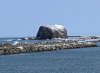
PXL_20250212_014033396~3.jpg
This rock looks like a giant plum pudding. Truly nature is wonderous.
 

Attachments

  • PXL_20250212_014033396~3.jpg
    PXL_20250212_014033396~3.jpg
    123.6 KB · Views: 105
  • PXL_20250212_014233119.jpg
    PXL_20250212_014233119.jpg
    100.5 KB · Views: 108
  • PXL_20250212_013346454.jpg
    PXL_20250212_013346454.jpg
    132.9 KB · Views: 108
Do you have a Hall of Fame for disappointing wildlife experiences, and would this day be in it?
I would have to have a think about "most disappointing" from various trips. That would be interesting.

Going to Abashiri was definitely the only time in Japan where I have felt like I had completely wasted my time. There have been some other days which didn't work out great - e.g. at Kawayu Onsen and Cape Ochiishi I didn't see much, but I still had good enough days - but Abashiri just felt so pointless. I do really like the photo I got there of the icicles hanging off the house, though.
 
Wakkanai

Abashiri was easily done as a day-trip from Kushiro, but Wakkanai - my next destination in an attempt to find some seals - was much further away. I would need to travel first from Kushiro to Sapporo in the west of Hokkaido (about four to five hours travel), and then go north from Sapporo to Wakkanai (about six hours travel). Wakkanai is actually the northernmost town in Japan.

When I had first arrived in Hokkaido it was by ferry to Tomakomai, which is near to Sapporo. To get from Tomakomai to Kushiro the train took half as long as the bus (4 vs 8 hours) but was only about NZ$20 more expensive, probably because I'd have had to take a bus to Sapporo first. Going in the other direction from Kushiro to Sapporo direct, the train cost about 10,000 Yen and the bus almost half that at 5230 Yen, but there was only an hour's difference in travel-time (4 vs 5 hours). Naturally, I took the bus.

There are only a few buses each day between Sapporo and Wakkanai, and I was hoping to catch the one which left at 1pm. I was confident that this bus wouldn't be full, the question was more whether I would make it on time. I assumed that would be easy because the 7.05am bus from Kushiro was scheduled to arrive at Sapporo Station at 12.15pm, and Google had told me that the Wakkanai bus left from the Odori Bus Center, and that the Odori Station is only a two minute subway ride from Sapporo Station.

However, the bus to Sapporo didn't stop at the train station but a block away and it was snowing heavily, so that was fun. I took the subway one stop to Odori Station, which was enormous. It was basically a giant underground mall. I asked a guard how to get to the Odori Bus Center and he gave me a map and said I had to go to exit 27 (!). I didn't get to the bus centre until 12.50pm but fortunately, as anticipated, there were plenty of seats and I got a ticket no problem. It was a bit weird that at the counter they said there were three seats available, yet there were only five people on the bus for the whole trip.

I had booked a room at the Surfeel Hotel for about 7400 Yen. There were two cheaper places in town but (at the time I booked) they weren't a great deal cheaper and this one had a 24-hour reception and was right by the train station, and I knew I would be arriving in town after dark - possibly close to midnight if I couldn't get the earlier buses - and there was a good chance it would be snowing.

The hotel was luxurious! I walked into the enormous chandelier-bedecked lobby with my pack and snow-covered beard, looking like a post-apocalyptic Raggedy Man, thinking "I shouldn't be sullying this place with my presence". I felt like apologising to the staff at the reception desk for having to serve me. I checked the price on Trip again when I arrived, and the same room type was now 9824 Yen per night, and that was also a discounted price.
 
Photos from the bus ride between Sapporo and Wakkanai. The weather alternated between "fine" and "white-out".

PXL_20250213_054615903.jpg

PXL_20250213_054523386.MP.jpg

PXL_20250213_055454670.jpg

PXL_20250213_060341703.MP.jpg
 

Attachments

  • PXL_20250213_060341703.MP.jpg
    PXL_20250213_060341703.MP.jpg
    98.8 KB · Views: 104
  • PXL_20250213_055454670.jpg
    PXL_20250213_055454670.jpg
    47.9 KB · Views: 103
  • PXL_20250213_054523386.MP.jpg
    PXL_20250213_054523386.MP.jpg
    37.5 KB · Views: 100
  • PXL_20250213_054615903.jpg
    PXL_20250213_054615903.jpg
    22.6 KB · Views: 98
The Surfeel Hotel in Wakkanai:

PXL_20250213_095208010.jpg
When I first arrived.

PXL_20250213_100603674.jpg
PXL_20250213_100550528.jpg

PXL_20250213_100532276.jpg
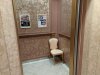
The elevator is so big it needs a chair to rest in.

PXL_20250213_095844965.jpg
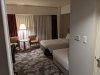
The room, which is quite nice.

PXL_20250213_225234942.jpg
View from the room - I could see Harlequin Ducks from my window!
 

Attachments

  • PXL_20250213_100550528.jpg
    PXL_20250213_100550528.jpg
    123.4 KB · Views: 99
  • PXL_20250213_100532276.jpg
    PXL_20250213_100532276.jpg
    132 KB · Views: 102
  • PXL_20250213_225234942.jpg
    PXL_20250213_225234942.jpg
    59.3 KB · Views: 105
  • PXL_20250213_100603674.jpg
    PXL_20250213_100603674.jpg
    122 KB · Views: 101
  • PXL_20250213_095844965.jpg
    PXL_20250213_095844965.jpg
    102.8 KB · Views: 104
  • PXL_20250213_095208010.jpg
    PXL_20250213_095208010.jpg
    106.8 KB · Views: 96
Wakkanai - Steller's Sealions

There were two main places I was to visit while in Wakkanai - Cape Soya for Steller's Sealions which have a winter haul-out on Benten-Jima rock off the cape; and Bakkai Port where I had read Spotted Seals gather. Secondarily there was Cape Noshappu (not to be confused with Cape Nosappu which I visited near Kushiro) which I thought might be good for seabirds and maybe Spotted Seals, and which also has a small aquarium as a bonus. There are also a couple of islands offshore called Rebun and Rishiri to which ferries run daily.

There are a handful of bus routes around Wakkanai but they mostly have infrequent run-times so require some schedule-planning.

There are only four buses per day to Cape Soya, of which only two were of any use to me - at 9.30am (arriving at 10.20am), and 1.30pm (arriving at 2.20pm). The 4.12pm and 7.30pm buses are no good in winter because it would already be dark when arriving there (the bus isn't specifically for tourists visiting Cape Soya, that is just one of the stops). Coming back from Cape Soya the only two buses which work are at 11.04am and 3.20pm. The 9.30am bus from Wakkanai only gives 45 minutes at the Cape before the 11.04am return bus (or five hours with the 3.20pm return bus but that is way too long to be standing out there in winter!), while the 1.30pm bus gives one hour exactly before the 3.20pm return bus. A discounted return ticket from the bus counter costs 2560 Yen (if paying the driver with cash it would work out at something like 2900 Yen).

The bus to Noshappu, on the other hand, can be fitted around other things easily because it runs every ten to fifteen minutes throughout the day and it is only about ten minutes ride between the Wakkanai Station and Noshappu. The fare is 220 Yen.

I decided to go to Noshappu first because then I could have a bit longer at Cape Soya on the later bus.

.......................................

Noshappu was freezing, with wild winds and driving snow. I had an hour until the aquarium opened at 10am. There were Harlequin Ducks out on the waves as always, but otherwise just Common Goldeneyes, Slaty-backed and Glaucous Gulls, and a couple of Temminck's Cormorants.

The Wakkanai Aquarium has an outdoor pool for Spotted Seals and another for Humboldt Penguins, although the latter was completely covered over in snow and the penguins were being housed indoors because it is too cold for them outside. The aquarium itself is very small and feels quite run down. The signage is almost solely in Japanese, without even scientific names most of the time, so I didn't really know what I was looking at in most tanks. Highlight of the visit were the Sea Angels Clione elegantissima, which are pelagic shell-less gastropods.

[Edit: months later I found time to go through my photos of all the signage, and created a species list here with photos of the exhibits included: Wakkanai Aquarium (Hokkaido): species list, February 2025]

Photos from the aquarium can also be seen here: Japan - Other - ZooChat

full

Sea Angels - they are very very small, so the photo isn't exactly sharp!

full

Spotted Lumpfish


After catching the bus back to town I went for a wander along the port to see if I could Spot any Seals but no luck. There were groups of Black Scoters and a single male Long-tailed Duck in the port which was nice. I then caught the 1.30pm bus to Cape Soya.

.......................................

Cape Soya is regarded as the northern-most point of Japan. If it had been a clear day I could have seen Sakhalin Island, which is part of Russia. Technically Benten-Jima rock, which is 1.2km off the cape, is the northern-most point of Japan. This rock is a winter haul-out for Steller's Sealions, which is why I was here.

Visiting here means I have now been to both the eastern-most (Cape Nosappu) and northern-most points of "mainland" Japan (i.e. the four main islands). The western-most and southern-most points of "mainland" Japan are both on Kyushu, so I might be able to visit those as well. There are of course other versions of the "direction-most" points if you include all the small islands of Japan, and also if you include the Kuril Islands in the northeast which are disputed between Japan and Russia.

According to a digital temperature gauge on the souvenir building it was minus 5.5 degrees at Cape Soya, but it felt much colder than that with the wind. A large flock of Pintails on the ocean was a surprise. Otherwise, again, Harlequin Ducks and Common Goldeneyes were the only seabirds seen apart for gulls.

Benten-Jima was alternatively clearly visible and pretty much invisible, depending on how much snow was in the air. The scientific paper I had read about the sealions specifically said that the authors counted them using binoculars and a camera from the road. I'm looking across at the rock thinking "how did they do that?" - and then I suddenly realised that the big spiky rocks at one end of the island were moving. I hadn't even registered that they were sealions! Anyone who has seen a bull Steller's Sealion will know how big they are, but for anyone else they are so big that you could hollow one out and use it as a tent. They are extremely large, especially if one is used to a "regular" sealion like a Californian or Hooker's Sealion.

I had to take my gloves off to take photos but could only have them off very briefly because within less than a minute my hands were too numb to use. It really was extremely cold out there!

full

The spiky "rocks" at the right end of the island are sealions. The pale shapes all over the rock itself are also sealions.
 
Last edited:
Photos:

PXL_20250213_233607867.jpg
A lot of the signs around town are in Japanese and Russian. Sometimes English.

PXL_20250214_001311162.jpg
Dolphin at Cape Noshappu.

PXL_20250214_052657893.jpg
PXL_20250214_054458048.jpg
Cape Soya marker as northern-most point in Japan.

PXL_20250214_052704878.MP.jpg
Benten-Jima rock in its entirety.

PXL_20250206_022748265.jpg
A photo from earlier in Hokkaido (at the visitor centre at Cape Nosappu, by Nemuro), but showing the size of a bull Steller's Sealion for those who don't know.
 

Attachments

  • PXL_20250206_022748265.jpg
    PXL_20250206_022748265.jpg
    199.8 KB · Views: 99
  • PXL_20250213_233607867.jpg
    PXL_20250213_233607867.jpg
    62.2 KB · Views: 100
  • PXL_20250214_001311162.jpg
    PXL_20250214_001311162.jpg
    85 KB · Views: 98
  • PXL_20250214_052657893.jpg
    PXL_20250214_052657893.jpg
    80 KB · Views: 98
  • PXL_20250214_054458048.jpg
    PXL_20250214_054458048.jpg
    75.8 KB · Views: 106
  • PXL_20250214_052704878.MP.jpg
    PXL_20250214_052704878.MP.jpg
    135.5 KB · Views: 101
Wakkanai - Bakkai Port

One of the local Spots I had found online for Seals was Bakkai Port, where Spotted Seals apparently gather and are an attraction for tourists. Whether this would be the case in mid-winter I didn't know, but it was a good start.

Bakkai is on the opposite side of the peninsula from Wakkanai and there is no bus, but the lady in the tourist centre told me that there was a train and gave me a timetable. There were only four trains a day - 5.21am, 10.28am, 6.10pm, and 8.15pm. The last two are obviously out because those are after dark. And there are only three trains in the other direction, at 7.50am, 11.48am, and 7.33pm. It is only an 18 minute ride, but the port is then a 3km walk from the train station. The only way it would work, taking into account that it would be about half an hour's walk in either direction between the station and the port, and that I didn't want to spend the entire day out there, was to catch the 5.21am train to Bakkai.

My plan didn't seem too clever when I got up in the morning. The weather forecast said gale-force winds, snow (obviously), and a temperature of minus 5 degrees but feels like minus 10 degrees. And I'd have to be walking for half an hour in the dark in that.

But if I didn't do it, then who would?

It was actually no problem. It was very windy but there was no snow in the air, and the road has snow-baffles on the windward side so I was walking mostly on actual road and not ice and snow.

Didn't find any Spotted Seals though! The main roads along the port were cleared but otherwise most of the area was blocked with huge snowdrifts, so only some parts could be viewed through my binoculars. It was a bit of a wasted effort, but obviously that's something one only knows with hindsight.

I was back at the station in time to catch the 7.50am train back to Wakkanai. I had been planning on then taking one of the ferries to either Rishiri Island or Rebun Island, just as a day trip because I thought I might see seals and seabirds from the boat, but it was so windy that I decided to not do that today. Instead I paid for an extra night at the hotel so I could go over there tomorrow. This did turn out to be a good decision.
 
Wakkanai - Rebun Island

There are two small islands just near to Wakkanai, called Rishiri and Rebun. Rishiri is the one most tourists go to, but I had been looking up where to find Spotted Seals around Wakkanai and Rebun had come up several times. Apparently Kaneda Point at the top of the island is where they congregate.

The ferry to Rebun is quite expensive at 3950 Yen each way. There are two sailings a day (6.35am and 2.10pm, with return times of 9am and 5.05pm) and it takes about 2.5 hours, so if you're going for a day-trip then the only times which work are the 6.35am there and the 5.05pm back.

The tickets can't be booked ahead of time, you just buy them on the morning of sailing. The website says to be at the terminal 35-40 minutes before sailing, which I was, and which was pointless. There were only about ten people on the morning sailing (and four on the way back), because there just aren't very many tourists around these parts in winter and the ones who are will most likely be going to the other island.

I tend towards sea-sickness, although so far on this trip I haven't had any issues when on ferries and boats (fingers crossed that continues!), so I was glad that the day was perfectly calm and clear. I spent the crossing out on deck with my binoculars. It was ridiculously cold out there, but it was worth it in the end.

There weren't many birds seen, and even fewer were identified. Leaving Wakkanai were the usual Slaty-backed Gulls and Pelagic Cormorants, as well as a White-tailed Sea Eagle perched on a breakwater. I was really hoping for alcids on the crossing, and I did see a number of auklet-sized ones, but only two individual birds of those were close enough and stayed long enough within view to identify. By chance they were two different species, the first being a Japanese Auklet (which was a lifer) and the second being an Ancient Murrelet (which I had seen for the first time a few days ago at Cape Nosappu by Nemuro). A third alcid species was seen closer to Rebun, with several small groups of Common Murres flying past.

I spotted a bull Steller's Sealion swimming near to the ship, briefly before it dived - I actually saw it much better than the distant ones at Cape Soya but it was just a short view. More exciting was a beaked whale, also a brief sighting but my first one ever.


There are three bus routes on Rebun. Two of them are in the south of the island and are just short routes to nearby villages (both of them only taking ten minutes from the ferry terminal to their end-points), running three times a day. The third bus route is a long one, taking an hour from the ferry terminal right up the east coast and around the north to Sukoton, running four times a day. This long route goes around Kaneda Point at the top of the island, and was the one I needed to try and see Spotted Seals.

It was a good thing I didn't come over yesterday on the afternoon sailing because there wouldn't have been time to take the long bus route, I definitely wouldn't have seen any seals, and it would have been wasted money.

There is a one-day pass which can be bought from the driver and used on all the buses for 2000 Yen. Just one of the short-route buses is 300 Yen one way, so this day pass is a considerable saving.

The first run for the long-route bus to the top of the island is 7.30am, which is before the ferry arrives, so I had until 10.45am to wait for the second run. There is nothing in town here - everything was closed and there was nowhere to even buy food except a Seicomart way north of the town. Rather than just sit in the terminal for two hours I took rides on both of the short-route buses. There was nothing to see but it was okay for filling in time.

The road to the top of the island hugs the coastline the entire way and I kept my eyes peeled. I had read in some sources online that the seals only gathered at Kaneda Point, but then others said they were found "all along the coast". Maybe it's seasonal, I don't know. But I did actually see some seals from the bus! I was a bit surprised to be honest.

They were a group of seven or so on a rock platform just offshore, and they stood out clearly against the dark rock. It was right by a bus stop, fortuitously, but I kept on going to see if there were any more further along. There were no more seen - and none at Kaneda Point - so on the return ride I just got off there so I could have a proper look at them and get some photos.

full

Spotted Seals


The next bus heading back to the ferry was an hour away, so instead I got that bus as it was going northwards (so I only had to wait twenty minutes) and just rode it all the way round.

I had a couple of hours to wait for the ferry, so spent the time working out what species of beaked whale I saw. It was brown in colour, and I had got a good look at the dorsal fin as it went down. Based on the animal's size and colour, and the shape of the dorsal fin, I narrowed it down to either a Cuvier's or a Stejneger's Beaked Whale. Cuvier's is apparently the most commonly seen beaked whale (worldwide) but it only occurs off Hokkaido in summer (it used to be hunted by commercial whalers off Japan along with Baird's Beaked Whales, and so there are detailed catch records). Stejneger's Beaked Whale is a North Pacific species which occurs year-round in the Sea of Okhotsk, so that's what I have settled on.
 
Photos:

PXL_20250215_214054044.MP.jpg
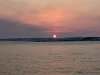
Sunrise from the ferry on the way to Rebun Island.

PXL_20250216_044127187.jpg
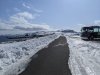
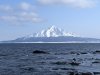
Rishiri Island as seen from Rebun Island. It looks like a miniature version of Fujiyama.

PXL_20250216_024306750.jpg
End of the road at the top of Rebun Island...

PXL_20250216_024335803.jpg
...and the view back the other way.

PXL_20250216_051848080.jpg
PXL_20250216_051900444.MP.jpg
Snow in town on Rebun.
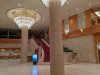
PXL_20250216_073858414.jpg
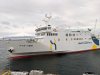
The ferry - it looks like it is about to tip over and sink in the harbour, but it is just turning as it arrives.
 

Attachments

  • PXL_20250216_024335803.jpg
    PXL_20250216_024335803.jpg
    169.1 KB · Views: 100
  • PXL_20250216_073858414.jpg
    PXL_20250216_073858414.jpg
    111.1 KB · Views: 106
  • PXL_20250215_214054044.MP.jpg
    PXL_20250215_214054044.MP.jpg
    95.6 KB · Views: 98
  • PXL_20250216_044127187.jpg
    PXL_20250216_044127187.jpg
    136.2 KB · Views: 100
  • PXL_20250216_051900444.MP.jpg
    PXL_20250216_051900444.MP.jpg
    148.2 KB · Views: 100
  • PXL_20250216_051848080.jpg
    PXL_20250216_051848080.jpg
    142.8 KB · Views: 98
  • PXL_20250216_024306750.jpg
    PXL_20250216_024306750.jpg
    129.3 KB · Views: 99
Last edited:
I've seen an adult Steller's Sealion bull at Paira Daiza in Belgium. He is colossal, bordering on Walrus size I think and about three times the size of the cows. Probablythe most impressive animal in the whole park I think. In your photo I can see what look like a couple of huge adult bulls in the group on the far right. They dwarf Hookers, which I've also seen, which in turn dwarf Californian. Its good that all your long bus journeys to see them provided the reward at the end.
 
Leaving Hokkaido

Wakkanai was the last place for me in Hokkaido. It ended well with both species I was after being successfully seen (Steller's Sealion and Spotted Seal), with some bonus animals as well.

I took the morning bus back to Sapporo, where my flight was leaving from the next morning. I arrived at 2.20pm, the hotel was about 2km walk from the Odori Bus Center - luckily it wasn't snowing today - and check-in was at 3pm (in Japan they mostly seem to stick with their check-in times, unlike China where you can check in whenever you arrive). The flight to Haneda Airport in Tokyo would be at 10.20am the following morning, with Air Do (formerly called Air Hokkaido), so there was no time to do anything in town - no visit to the Maruyama Zoo in Sapporo or to the nearby Otaru Aquarium.

PXL_20250218_004657949.MP.jpg


A recap of my route: I arrived by ferry into Tomakomai in the west where I visited Lake Utonai. Then I took a train east to Kushiro where I visited the Akan International Crane Center, with side-trips out to Cape Kiritappu and Cape Nosappu for birds and Sea Otters. Then I took a bus up to Rausu in the northeast to see Steller's Sea Eagles and Blakiston's Fish Owl. Back down to Kushiro where I fitted in a visit to the Kushiro Zoo, and then three day-trips to Kawayu Onsen, Cape Ochiishi, and Abashiri. Finally I went to Wakkanai via Sapporo to look for seals.

The weather was cold but generally fine. Pretty much everywhere was covered in snow. At some places there was heavy snowfall when I was there, or there was snow coming and going. Two days in Kushiro were lost to a bad snowstorm.

I saw 54 species of birds there, which doesn't seem like many but Hokkaido in winter is more about specific birds rather than lots of different birds. There are 405 species listed for Hokkaido on eBird, with a lot obviously being ones I wouldn't see because they are either not there in winter or they are vagrants or whatever. Just checking February lists there are 194 species recorded, so I saw over a quarter of that. A third of the birds I saw were lifers (19 species out of 54).

I saw seven mammal species, of which five were lifers. Sika Deer and Red Fox were the two species I had already seen elsewhere. Sea Otter, Stejneger's Beaked Whale, Steller's Sealion, Spotted Seal and Kuril Seal were all lifers.
 

Attachments

  • PXL_20250218_004657949.MP.jpg
    PXL_20250218_004657949.MP.jpg
    115 KB · Views: 91
Leaving Hokkaido

Wakkanai was the last place for me in Hokkaido. It ended well with both species I was after being successfully seen (Steller's Sealion and Spotted Seal), with some bonus animals as well.

I took the morning bus back to Sapporo, where my flight was leaving from the next morning. I arrived at 2.20pm, the hotel was about 2km walk from the Odori Bus Center - luckily it wasn't snowing today - and check-in was at 3pm (in Japan they mostly seem to stick with their check-in times, unlike China where you can check in whenever you arrive). The flight to Haneda Airport in Tokyo would be at 10.20am the following morning, with Air Do (formerly called Air Hokkaido), so there was no time to do anything in town - no visit to the Maruyama Zoo in Sapporo or to the nearby Otaru Aquarium.

View attachment 773764


A recap of my route: I arrived by ferry into Tomakomai in the west where I visited Lake Utonai. Then I took a train east to Kushiro where I visited the Akan International Crane Center, with side-trips out to Cape Kiritappu and Cape Nosappu for birds and Sea Otters. Then I took a bus up to Rausu in the northeast to see Steller's Sea Eagles and Blakiston's Fish Owl. Back down to Kushiro where I fitted in a visit to the Kushiro Zoo, and then three day-trips to Kawayu Onsen, Cape Ochiishi, and Abashiri. Finally I went to Wakkanai via Sapporo to look for seals.

The weather was cold but generally fine. Pretty much everywhere was covered in snow. At some places there was heavy snowfall when I was there, or there was snow coming and going. Two days in Kushiro were lost to a bad snowstorm.

I saw 54 species of birds there, which doesn't seem like many but Hokkaido in winter is more about specific birds rather than lots of different birds. There are 405 species listed for Hokkaido on eBird, with a lot obviously being ones I wouldn't see because they are either not there in winter or they are vagrants or whatever. Just checking February lists there are 194 species recorded, so I saw over a quarter of that. A third of the birds I saw were lifers (19 species out of 54).

I saw seven mammal species, of which five were lifers. Sika Deer and Red Fox were the two species I had already seen elsewhere. Sea Otter, Stejneger's Beaked Whale, Steller's Sealion, Spotted Seal and Kuril Seal were all lifers.
Did you not see spotted seal in Vladivostok?

Also, it's a bit funny seeing -10 C considered frigid cold. When you are already a bit miserable and it's blowing hard, it feels cold, yes, but that's only 14 degrees Fahrenheit.

That being said, the aesthetic of being on the tip of an island off the tip of an island off the northern end of an island chain on the eastern edge of a continent is quite something. Congratulations on those mammals you found in Wakkanai! Are you on Honshu now?
 
Back
Top