
As someone who has a growing fondness for exhibits that depict underrepresented Asian ecosystems; this is probably my favorite entry thus far. Especially, as its execution is very well done, might I add.

As someone who has a growing fondness for exhibits that depict underrepresented Asian ecosystems; this is probably my favorite entry thus far. Especially, as its execution is very well done, might I add.
@KevinB, while I’ve tried to keep this list from being too overwhelming. I wouldn’t mind seeing at least one or two of these ideas coming into fruition:
- Meghalaya Subtropical Forest
- Upper Gangetic Plains
- Deccan Plateau
- Western + Eastern Himalayan Broadleaf Forest - (2 in 1)
- Ogasawara Subtropical Moist Forest
- Gobi Desert
- Daurian Forest Steppe
- Qin Ling Mountains + Deciduous Forest
- Thar Desert
- Bornean Peat Swamp-Forest

I really enjoyed this project of yours.A good day everyone.
Although I said in August last year I would not return to speculative zoo design again, I started to rethink that choice some months ago and finally started to foray back into speculative zoo design.
I would like to give special thanks @Mr Gharial for inspiring me to get back into speculative zoo design with his species lists and his own projects.
The first result of my return to speculative zoo design is the project I will be presenting today.
We start off with the design map for this project.
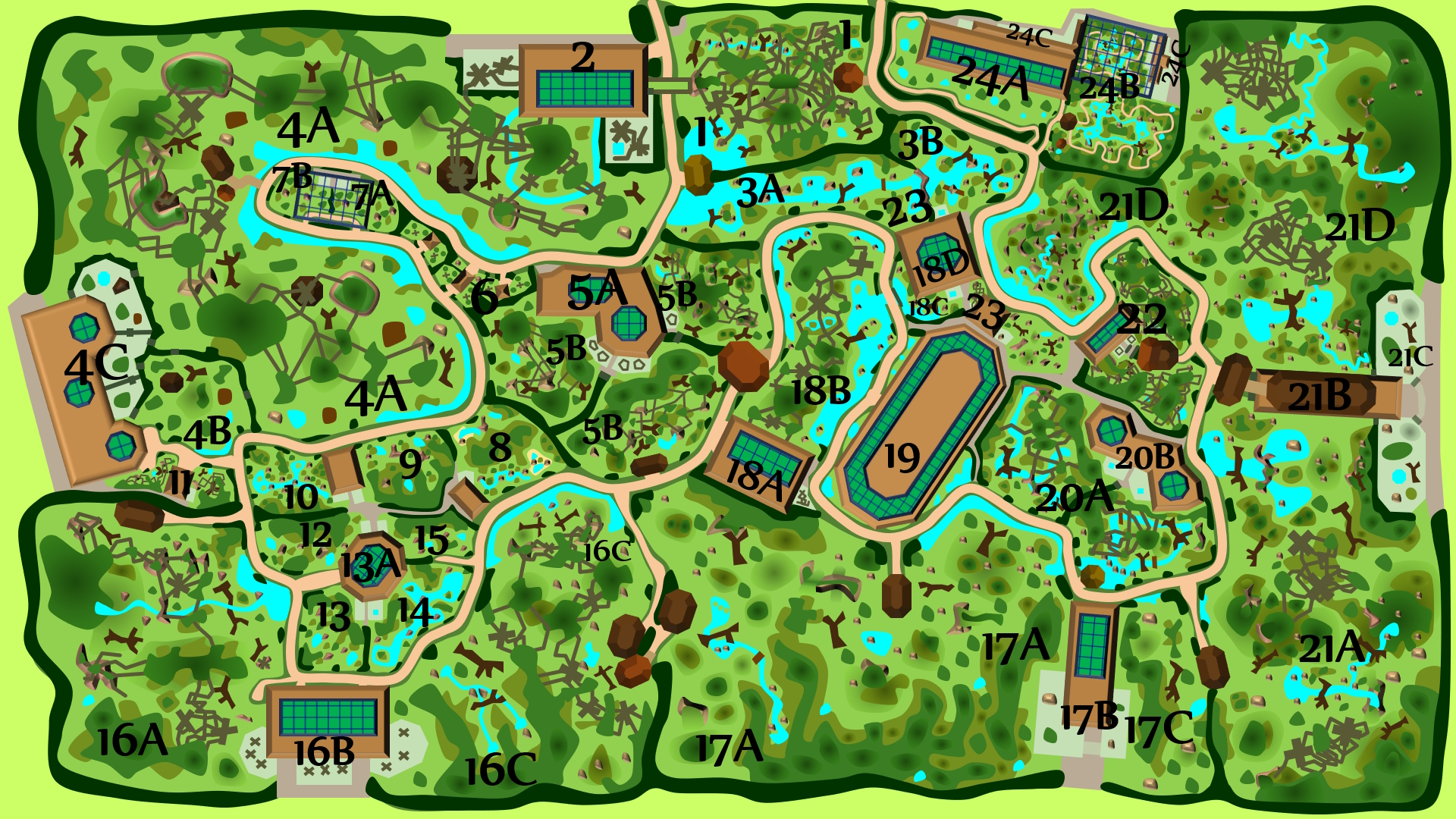
Cardamom Mountains
- KevinB
- 2
A project on the Cardamom Mountains of Cambodia and Thailand. My first successful foray back...
This map has one mistake I found after I already posted it: the number 23 above 18D should have been removed, the only correct 23 is the one above building 19.
Today we will be travelling to the Cardamom Mountains of Cambodia and Thailand.
Cardamom Mountains - Wikipedia
Cardamom Mountains rain forests - Wikipedia
The first exit we see - located between the entrance and exit of this area - is a large, tall netted primate exhibit with live trees and shrubs, bamboo, tall and short grass, sandy or mulch-floored areas, grassy or forested hills and extensive climbing structures that include dead tree parts, nets and wooden platforms and little huts. The exhibit also features a rocky creek area and some rocky areas made from stacked natural rocks and/or mock rock structures. A little further down the road we see that this exhibit, unusually for a primate, also has a lage pool with an underwater viewing area. This is because this exhibit houses one of the few primates known to regularly swim and dive: the Crab-eating macaque or Long-tailed macaque (Macaca fascicularis) [1].
We notice there is an overhead mesh tunnel connecting the exhibit to a building, the visible parts of which are finished with wood or natural stone. We enter the building [2] and notice it not only contains indoor housing for the crab-eating macaques, but also for Pileated gibbons (Hylobates pileatus) which are housed in an exhibit we will soon get to. From the indoor visitor area we see tall indoor primate exhibits with mulch or paved floors and extensive climbing structure, with skylights providing natural light into the exhibit. We notice that the climbing structures in the macaque and gibbon indoor exhibits are different, catering to the specific needs and locomotion methods of these two species. This building also contains a nocturnal exhibit for Pygmy slow loris (Xanthonycticebus pygmaeus) with climbing structures and elevated dens in a separated room, and a number of off-show indoor exhibits for the macaques and gibbons. Adjacent to the building there are two netted holding/separation exhibits for the macaques and gibbons.
As we head to the major exhibit the gibbons can enter, we get our first view of an exhibit we will come back to later in this section. This is a river-based exhibit for Indochinese smooth-coated otters (Lutrogale perspicillata perspicillata) [3A], with a large, long central pool with rocky, sandy and grassy islands and banks. We also notice some logs used as structural materials in the exhibit, some crossing the pool, and some wooden bridges. The banks surrounding the central river are a mix of rocky, sandy and vegetated areas. Shelter is provided by plants or contained within structural materials such as rocks and rocks. We will see the secondary exhibit [3B] and the indoor housing for these otters [18D] later on. The underwater viewing area from which we can the macaque pool also features underwater viewing into the deepest part of the smooth-coated otter exhibit.
After leaving the otters behind, we reach one of the major exhibits in this complex, a mixed exhibit for ungulates and gibbons. We notice this exhibit is clearly inspired by the banteng, deer, muntjac and siamang exhibit in the Rimba area at Burgers' Zoo. This exhibit houses Pileated gibbon (Hylobates pileatus), Javan banteng (Bos javanicus javanicus), Indian Sambar deer (Rusa unicolor niger) and Reeves’s muntjac (Muntiacus reevesi) [4A]. The Javan bantengs serve as a stand-in for the mainland subspecies Birmese banteng (B. j. birmanicus), the Indian sambar deer serve as a stand-in for the Southeast Asian subspecies (R. u. cambojensis) and the Reeves's muntjacs are a stand-in for the Southeast Asian species Northern red muntjac (M. vaginalis). These subspecies or species that are native to the Cardamom Mountains are not available in European zoos, we notice that the use of "incorrect" species or subspecies is also explained at the exhibit.
Next to the gibbon and macaque house we see a peninsula that is a mostly separate area for the gibbons, with live trees, ropes and climbing structures connected to the building, to the off-show gibbon exhibit and to the rest of the exhibit. This large mixed exhibit [4A] consists of a mix of open grassy or sandy areas and forested areas. Some of the exhibits consists of low, gently sloped hills, but the exhibit also has a few elevated areas with steep slopes looking like mud banks or rocky outcroppings. These elevated areas are covered with shrubs and trees. Many of the forested areas and the elevated areas are connected with ropes and climbing structures, and thus serve as a habitat for the gibbons, while the bantengs, deer and muntjacs live on the ground below. Some areas with shrubs and bamboos are screened off from the bantengs and/or the deer to give the smaller species an area to get away. There are two shelters and feeding areas for the ungulates, with climbing structures for the gibbons above them, like the shelter in the exhibit in Burgers' Zoo Rimba, visible in the pictures below.
Rimba - Large mixed exhibit (Sep 16th, 2018) - ZooChat
Mixed exhibit for Banteng and other Asian hoofstock - ZooChat
Banteng - Siamang - Macaque - ZooChat
As we head down the road alongside the large mixed exhibit, we come across several exhibits.
The first we see is our first view of one of the Indochinese clouded leopard (Neofelis nebulosa nebulosa) [5] outdoor exhibits, as well as two of their indoor exhibits. Although we will not see the other two outdoor exhibits for this species until later on, we will discuss all of the facilities for this species now. The three exhibits are tall netted exhibits with live threes, shrubs, bamboo and long grasses, partially set on hilly ground, extensive climbing structures with wooden platforms and huts at different levels, rock structures or natural rocks and small pools. The building for the Indochinese clouded leopards is a tall building with skylights above the largest exhibits, including one of the indoor exhibits that visitors can look into. The viewable indoor exhibits have paved or mulch floors and have large climbing structures with wooden platforms and huts. This building also houses several more off-show exhibits with climbing structures, including two nearly completely enclosed - even for staff members - maternity dens. Next to the building there are also be three off-show outdoor exhibits.
Next up are the exhibits located in between the viewing areas for the large mixed exhibit. First we see a series of small exhibits, for sets of two netted exhibits with a small wood-finished barn in between them. These are the rodent and tree shrew exhibits [6]. Two of the rodent exhibits and the tree shrew exhibit feature climbing structures and live plants, while the last one features different types of soil, artificial dens, rocky areas and logs. The indoor exhibits have similar furnishings. The following four species are housed here:
- Finlayson’s squirrel (Callosciurus finlaysonii)
- Himalayan striped squirrel (Tamiops mcclellandii)
- Northern tree shrew (Tupaia belangeri)
- Greater bamboo rat (Rhizomys sumatrensis)
The next exhibit we see is a greenhouse, with two adjacent outdoor aviaries. This exhibit however houses not birds, but flying foxes. One side of the building houses Large flying foxes (Pteropus vampyrus) [7A], the other Lyle’s flying foxes (Pteropus lylei) [7B]. The exhibits have a strong netting structure at the top as well as ropes and trees, dead or living, which the bats can hang from, specialized feeding areas for the bats and some landscaping with rocks and planted areas. The flying foxes can be seen both indoors and outdoors.
Heading down alongside the large mixed exhibit [4A] we finally reach the ungulate house for this exhibit. The ungulates have their indoor housing in a large building, the visible parts of which are finished with colored and textured natural stones, on the opposite end of the exhibit from the gibbon and macaque house [4B and 4C]. Next to this house there are three off-show and one off-show paddocks, able to be connected to or separated from the main exhibit as needed. We notice that we can look into two communal indoor exhibits, with mulch floors, for the bantengs and deer. These communal stables look somewhat like the hoofstock stable below. The building also contains off-show communal and individual hoofstock stables for the three different species.
African Hoofstock Stable - ZooChat
Near the hoofstock stable we see two tall netted exhibits and a small wood-finished building for Asian Palm civets (Paradoxurus hermaphroditus) [11]. These exhibits feature live shrubs and small trees, climbing structures and wooden platforms and huts. We notice there is signage at the exhibit discussing the dangers of the bush meat consumption of civets and the abuses and conservation issues faced by these animals when used for bush meat or the production of a specific and infamous type of coffee.
The area we have now arrived in has a series of large aviaries, housing a variety of medium and large bird species.
The first aviary, which we can view from two sides, houses Brahminy kites (Haliastur indus) [8]. In between the two viewing areas is a vegetated area with bamboo, tall grasses and live trees, while the areas alongside the viewing areas feature sandy and rocky areas, pools and some areas with tall grasses and small trees. Nesting areas a provided, and the kites have their indoor housing in a wood-finished barn or mew with sandy floors, perches, platforms and an indoor bathing area. Next to an off-show area connecting several different bird exhibits there is an off-show holding aviary, and the barn has one main indoor exhibit, able to be viewed through a window, and a smaller off-show room.
Next up are two owl aviaries, with a shared barn or mew very similar to the one for the Brahminy kites. These aviaries house Brown wood owls (Strix leptogrammica) [9] and Buffy fish owls (Ketupa ketupu) [10]. The aviary for the brown wood owls is a forest-based aviary with live trees and bamboos at the backside, and an area with rocks, tall grasses and lower bamboos and trees at the front. The aviary for the buffy fish owls represents a rocky creek running through the forest. The creek has rocky or grassy islands and rocky, grassy or sandy banks, bordered by areas with tall grasses, bamboo and live trees. We see the buffy fish owls have a larger indoor pool.
We now arrive in an area with four aviaries connected to a central octagonal building with an interior visitor area. These aviaries house several species of larger tropical forest and wetland birds from the Cardamom Mountains region.
Two of these aviaries, with mulch or grassy floors, rock structures, pools, planted areas live trees and bamboo and large dead branches, houses two types of hornbills, the Great hornbill (Buceros bicornis) [12] and the Wreathed hornbill (Rhyticeros undulatus) [13]. Another similarly furnished forest-based aviary houses Green peafowl (Pavo muticus) and Pink-necked green pigeon (Treron vernans) [15]. The fourth and largest aviary in this complex is a wetland-based aviary with a large pond with grassy or vegetated islands, surrounded by sandy or grassy banks, some rocky areas and vegetated areas with reeds and other wetland plants and trees, in some of which we notice nests. This aviary houses Asian woolly-necked stork (Ciconia episcopus), Black-headed ibis (Threskiornis melanocephalus) and Javan pond-heron (Ardeola speciosa) [14].
The shared building for these four aviaries [13A], which we can enter, features mulch or sand-floored indoor aviaries with branches, rocky outcroppings and live plants for the forest-based birds, and sand-floored indoor exhibits with indoor pools, platforms and perches for the wetland birds. A large skylight provides natural light for the indoor bird exhibits.
We go down a sight trail, which leads us to a wooden viewing cabin with a thatched roof. This is a viewing cabin for the next major exhibit - the first exhibit for sun bears (Helarctos malayanus) [16A]. This exhibit, as well as the second exhibit for sun bears [16C], has a mix of sandy, grassy or mulch substrate, hilly areas with short or tall grass, bamboo or trees, rocky areas, large rocks and dead trees and extensive climbing structures for these bears, which are the most arboreal as well as the smallest of the large bears (Ursidae), connecting large tower-like climbing frames to different elements in the exhibits such as rocky areas, dead trees and live trees. Enrichment feeding structures and shelters are also provided at different levels.The exhibits also have small and larger pools and a creek. Both of the exhibit have an area where a lowered pool is used as a barrier on the visitor side, while in other areas fencing and large, tall glass windows are used as barriers.
Continuing on located in between the two sun bear exhibits we find the sun bear house [16B], which features an indoor viewing area for the two major sun bear indoor exhibits. These exhibits look somewhat like the exhibit of which a photo is included below, with mulch floors rocky areas and extensive climbing structures with platforms. The building also features off-show indoor exhibits, including a maternity den, and next to the building there are three off-show exhibits with climbing structures for the bears.
ABH - Sunbear (Helarctos malayanus malayanus) - ZooChat
The second sun bear exhibit [16C] has a similar viewing cabin to the first, also located down a side trail, but next to it there is a second cabin set on poles with a staircase, allowing an elevated view of the sun bears at the level of some of their climbing structures and trees.
Located close to and on the same side trail as the two viewing cabins for the second sun bear exhibit is a viewing cabin for the next exhibit: the exhibit for a pack of Chinese dholes (Cuon alpinus lepturus) [17A]. The Chinese dhole, the subspecies kept in European zoos, serves here as a stand-in for the Southeast Asian subspecies of the dhole, the Indochinese dhole (C. a. infuscus). The dhole exhibit has a mostly grassy substrate, with some areas with mulch or sand. The exhibit has zones covered with grasses of different lengths, bamboo or forested areas with shrubs and trees, hilly areas with grasses, bamboo or shrubs and trees, rocky areas, a rocky creek with a wooden bridge, small ponds, large logs and rock dens built into hillsides or covered with grass and/or shrubs, consisting of rocks and a concrete structure covered with dirt and vegetation. This exhibit is viewable through windows on the main road or from two wooden viewing cabins, through mesh or across a water-filled moat.
Although we will only see the secondary dhole exhibit [17C] and the dhole house [17B] further down the road, we will discuss them now. The dhole house is a wood-finished building featuring a viewable indoor exhibit with a mulch floor, a rock den, wooden dens, some logs and enrichment materials, as well as off-show dens. Next to the building there are off-show holding yards for the dholes. The secondary dhole exhibit has similar features as the main exhibit, although on a smaller scale. The secondary dhole exhibit shares a viewing cabin on a side trail with the Asiatic black bear exhibit, which we will discuss further on.
The next exhibit we get to is the Binturong (Arctictis binturong) and Asian small-clawed otter (Aonyx cinereus) exhibit. First we see the binturong house [18A], which has a viewable indoor exhibit, somewhat similar to the sun bear indoor exhibits, with a mulch floor, climbing structures and platforms and dens at height. The house also has off-show indoor exhibits and an off-show holding exhibit. After the house we see the outdoor exhibit, which the binturongs share with a family group of Asian small-clawed otters [18B]. The exhibit has a central hilly area with trees and extensive climbing structures with ropes, bridges, planks and poles connecting trees and climbing frames, and with platforms and elevated dens. On the ground level, and for the otters, the exhibit features large moats and pools with some grassy and rocky islands, fallen logs, rocky areas, ground-level otter shelters and areas with tall grasses, bamboo and shrubs.
Built above the main walkway between the binturong and Asian small-clawed otters and two of the three clouded leopard exhibits is a tree house, accessible via a staircase, which allows elevated viewing of the binturongs and the clouded leopards.
The Asian small-clawed otters have a separate outdoor exhibit [18C], with similar features as discussed immediately above, but smaller, connected to the binturong exhibit via land and water tunnels underneath the main visitor walkway. This exhibit sits next to the otter house [18D], which the Asian small-clawed otters share with the Indochinese smooth-coated otters housed in exhibit [3]. The otter indoor exhibits have large indoor pools, sandy, mulch-floored or paved land areas rocks and logs as structural materials and wooden dens. Both species of otters have viewable main indoor exhibits and off-show dens, on the opposite sites of the building.
As we head towards the entrance of the next exhibit complex, which is the terrarium and aquarium house [19], we notice that this building has outdoor exhibits, which signage discusses as being seasonal for some of the larger reptile species. Presuming it is a warm(er) day when we visit, we might see species such as Siamese crocodile, Reticulated python, Asian water monitor, Elongated tortoise, different turtle species or Chinese water dragons outdoors in exhibits with pools, sandy or grassy land areas, rocky areas and areas with tall grassy or shrubby vegetation.
As we head inside we notice the building has a ring of large skylights all around the building, sitting above the main terrariums and the large fish tank, providing them with natural light.The different herp exhibits of different sizes are sized, designed and furnished based on the habitat and needs of the different species housed. They are mostly based on forest creeks, the forest floor and undergrowth or the forest canopy. There is also a "village" themed exhibit featuring elements from human structures such as a tool shed and a livestock barn for the house and tokay geckos. Where possible the exhibits feature live plants. The Siamese crocodile exhibit has a large pond with an underwater viewing area. Next to the main Siamese crocodile exhibit there are two smaller exhibits for crocodile offspring. The building also feature a sizable herp nursery. The building features two large fish tanks, the smaller one with the smaller fish species being quite densely planted, the larger tank with the large fish species featuring only some tough plants and fake and real wood and rock structures as structural materials.
In addition to the animal exhibits this building also houses a natural history and conservation education exhibition room.
The full species list for this building is as follows:
- Siamese crocodile (Crocodylus siamensis)
- Asian water monitor (Varanus salvator)
- Reticulated python (Malayopython reticulatus)
- Elongated tortoise (Indotestudo elongata)
- Giant Asian pond turtle (Heosemys grandis)
- Yellow-headed temple turtle (Heosemys annandalii)
- Domed box turtle (Cuora amboinensis kamaroma) and Chinese water dragon (Physignathus cocincinus)
- Asian house gecko or Common house gecko (Hemidactylus frenatus)
- Tokay gecko (Gekko gecko)
- Mourning gecko (Lepidodactylus lugubris)
- Radiated rat snake (Coelognathus radiatus)
- Red-tailed green rat snake (Gonyosoma oxycephalum)
- Oriental garden lizard, eastern garden lizard, Indian garden lizard, common garden lizard, bloodsucker or changeable lizard (Calotes versicolor)
- Brown pricklenape (Acanthosaura lepidogaster)
- Taylor's bug-eyed frog, purple-spotted warted frog, spotty warted tree frog, stellar bug-eyed frog or Chantaburi bug-eyed tree frog (Theloderma stellatum)
- Banded bullfrog (Polypedates megacephalus)
- Vietnamese giant centipede (Scolopendra dehaani)
- Orchid-blossom mantis (Hymenopus coronatus)
- Fish tank 1: Tinfoil barb (Barbonymus schwanenfeldii), Asian arowana (Scleropages formosus), Clown featherback, clown knifefish or ocellated featherback (Chitala ornata), Giant black sharkminnow (Labeo chrysophekadion) and Iridescent shark, iridescent shark catfish, swai, Siamese shark catfish or sutchi catfish (Pangasianodon hypophthalmus)
- Fish tank 2: Silver flying fox (Crossocheilus reticulatus), Cambodian logsucker, stonelapping minnow or false Siamese algae eater (Ceratogarra cambodgiensis), Black-line rasbora or slender rasbora (Rasbora daniconius), Silver rasbora (Rasbora argyrotaenia), Dwarf tiger barb (Puntigrus partipentazona) and Croaking gourami (Trichopsis vittata)
After leaving the reptile house again and walking past more viewing areas for the dhole exhibit, discussed above, we reach the exhibits for fishing cats (Prionailurus viverrinus) [20A]. These are tall, netted exhibits with some similarities to the Indochinese clouded leopard exhibits discussed above, but because of the more aquatic and wetland-oriented habits and habitat of the fishing cat these exhibits feature a lot more water features, consisting of creeks and pools, and wetland-type plants in addition to live threes, shrubs, bamboo and long grasses, partially set on hilly ground, extensive climbing structures with wooden platforms and huts at different levels, rock structures or natural rocks. In one of the two exhibits the creeks form a large island of part of the exhibit. One of the two fishing cat exhibits has an underwater viewing hut next to the deepest and largest pool area for the cats. The fishing cat house [20B] is similar to the clouded leopard house in terms of exhibit structure, and has one viewable indoor exhibits with similar features to the clouded leopard indoor exhibits, although also including an indoor pond.
We now reach the last large mammal exhibit in this section - and also the largest exhibit in this section. This is the exhibit for Asiatic black bears (Ursus thibetanus). There are two large outdoor exhibits [21A and 21D], with a holding building and two off-show holding exhibits located between them. The two exhibits have a shared viewing area, located on top of the holding building [21B]. The viewing area has a mainly wooden structure, the structure and idea for the holding and viewing area is similar to the exhibits for Eurasian brown bears of which pictures are linked below.
Holding and viewing building original brown bear exhibit, 2020-07-12 - ZooChat
Second Eurasian brown bear exhibit - Exhibit for two old bears, 2021-08-15 - ZooChat
Eurasian brown bear forest viewing area, 2021-05-29 - ZooChat
Eurasian brown bear holding building with viewing area on top, 2021-05-29 - ZooChat
The two main outdoor exhibits [21A and 21D] have some similarities to the sun bear exhibits, although they feature far lower and less extensive climbing structures for these more ground-dwelling and ground-foraging larger bears. These exhibits feature a mix of sandy, grassy or mulch substrate, hilly areas with short or tall grass, bamboo or trees, rocky areas, large rocks and dead trees and some climbing structures with connections between climbing frames, some rocky areas and climbable living and dead trees. Enrichment feeding structures and shelters are provided, including wooden shelters and rock dens. The exhibits also have large pools and rocky creeks. Both exhibits have a moated area where a lowered moat is the barrier on the visitor side, while in other areas fencing and large, tall glass windows are used as barriers. The moated area of the second Asiatic black bear exhibit [21D] is mostly a large rocky hill with scattered vegetated patches, a cascading creek and a large rock den.
We find another arboreal mammal, the Yellow-throated marten (Martes flavigula) [22], being housed in a set of two tall, netted exhibits with hilly, vegetation-covered areas with bamboo and trees, connected by ropes and wooden climbing structures, and a wood-finished house with viewable indoor exhibits similar to those housing the cats. In between the two exhibits we see viewing hut with ground-level viewing areas and a staircase leading to a small elevated viewing area.
The next to last set of exhibits we get to are two more rodent exhibits, housing Asian brush-tailed porcupine (Atherurus macrourus) and Black rat (Rattus rattus) [23]. The Asian brush-tailed porcupine exhibit is an open-topped exhibit with rock areas, shrubs, logs, artificial dens and wooden platforms, their indoor exhibit features wooden platforms, dens and a mulch or straw floor. The black rat exhibit is a cage with metal netting and a viewing window, with wood and bamboo climbing structures and shelters, as well as some stone shelters, and different enrichment feeders, both indoors and outdoors.
The final exhibit complex in this section is for the birds, and features a pheasantry [24A] and a forest walk-through greenhouse and aviary [24B].
The pheasantry consists of a series of indoor and outdoor aviaries, designed, sized, furnished and planted according to the habitat and needs of the different species. There are forest and wetland-based aviaries, and aviaries with specific accommodations for parakeets. The pheasantry's indoor aviaries are well-lit by skylights, while the visitor area alongside them is darker, and the furnishings and ,including plantings, of the outdoor aviaries continue indoors as much as possible. The visitor area is separated by a low fence from a narrow keeper zone directly alongside the aviaries, which leads to the accesses to the indoor and outdoor aviaries.
The pheasantry also lets us see into a bird nursery and a few raising or spare aviaries, set in of two sets of off-show bird buildings [24C] located behind the pheasantry and to the side of the forest greenhouse. These buildings house off-show quarantine and breeding aviaries as well as an off-show part of the nursery and a bird medical room.
The following species are kept in this pheasantry:
The forest greenhouse and aviary [24B] are a set an indoor and an outdoor walk-through exhibits with walkways running through areas with trees, bamboo, more open areas with scattered vegetation, grass or mulch and over bridges across creeks. The aviaries also have ponds with islands and areas with rocks and small waterfalls or logs. Different feeding areas and nesting opportunities are spread throughout these exhibits. The outdoor aviary features an elevated viewing cabin.
- Siamese fireback (Lophura diardi)
- Silver pheasant (Lophura nycthemera)
- Moustached parakeet or Red-breasted parakeet (Psittacula alexandri)
- Alexandrine parakeet (Psittacula eupatria)
- Little grebe (Tachybaptus ruficollis)
- Striated heron (Butorides striata)
- Grey-headed purple swamphen (Porphyrio poliocephalus)
- Barred buttonquail and Red avadavat, red munia or strawberry finch (Amandava amandava)
- King quail (Synoicus chinensis) and Scaly-breasted munia or spotted munia (Lonchura punctulata)
- White-crested laughingthrush (Garrulax leucolophus)
- Greater hill myna (Gracula religiosa)
- Oriental bay owl (Phodilus badius)
- Red-billed blue magpie (Urocissa erythroryncha)
- Racket-tailed treepie (Crypsirina temia)
- Collared falconet (Microhierax caerulescens)
We can look for the following species in this area:
We have come to the end of this project. Hopefully you have enjoyed.
- Asian white-winged wood duck (Asarcornis scutulata)
- Grey-capped emerald dove (Chalcophaps indica)
- Pied imperial pigeon (Ducula bicolor)
- Pink-necked green pigeon (Treron vernans)
- Red turtle dove (Streptopelia tranquebarica)
- Asian fairy blue-bird (Irena puella)
- Red-whiskered bulbul (Pycnonotus jocosus)
- Asian glossy starling (Aplonis panayensis)
- Lesser whistling duck (Dendrocygna javanica)
There’s two more ecosystem ideas that come to my mind and those are the gir forest, and the Mongolian-Manchurian steppe and the gir forest is the home and last bastion of the asiatic lion in the wild. While the Mongolian-Manchurian steppe is home to a lot of species like the corsac fox, Pallas cat, Przewalski’s horse, Bobak marmot, Mongolian wolf, Mongolian gazelle and many other species.@KevinB, while I’ve tried to keep this list from being too overwhelming. I wouldn’t mind seeing at least one or two of these ideas coming into fruition:
- Meghalaya Subtropical Forest
- Upper Gangetic Plains
- Deccan Plateau
- Western + Eastern Himalayan Broadleaf Forest - (2 in 1)
- Ogasawara Subtropical Moist Forest
- Gobi Desert
- Daurian Forest Steppe
- Qin Ling Mountains + Deciduous Forest
- Thar Desert
- Bornean Peat Swamp-Forest