A Zoo Man's Notebook, 2025

It’s something I’ve described repeatedly on this thread that often an animal that has zero appeal to the public manages to become a zookeeper favorite. Sometimes, something near to the opposite also happens – an animal that the zookeeper would expect the public to have no interest in will, unexpectedly, become the crowd’s favorite.

I’m specifically thinking of a certain American crow. He had the distinction of being the only passerine I have ever worked with (not even a zebra finch or canary for me), illegally taken from the nest by a member of the public and raised, before being turned over to the zoo (AZA). Given his origins, it made sense to start him off as an education bird and he was initially housed in the mews, but never responded to training and handling. Dissatisfied with the housing situation for him, I eventually suggested that we make him an exhibit bird – and that’s when the crow found stardom.

View attachment 794730
The crow in his mews, in education holding - I wasn't usually able to get this close to him when he was moved into the exhibit.

I’ve described the beaver exhibit in a few other posts – it was a largish exhibit with two pools, some deadfall and trees, rocks – which was also shared with night herons, turtles, and ducks. We’d recently moved out the screech owl because the herons were stealing the food, and so we introduced the crow to take its place. The bird seemed to thrive in the large space, able to fly the length of the exhibit. It was here that his personality really shone. When we were in the exhibit with him, he was still wary, seldom letting us approach close. With visitors on the outside of the exhibit, he became extremely personable.

The beaver exhibit had a fake lodge built into it with a window, so visitors could peak inside and see the beavers. The crow liked to sit on top of the lodge, where he could be right next to visitors with just mesh between them – the lack of an additional barrier at the one spot had never been a problem before. There, he would talk to visitors, sometimes even croaking a rough “Hello.” (He was probably a more reliable talker than any of our parrots). They would, inevitably, stick fingers in, which he would gently nibble, and they would scratch him on the back of the head. We probably should have put up another barrier, some finer mesh over that spot, sooner, but I think we were all so dumbfounded. Besides, we might have been worried that the visitors would riot. That crow quickly became the most popular animal in the zoo.

It's just as well, probably, that he accepted so many snack items from the public, no matter how much we begged for people not to feed him, because the crow never seemed to eat his actual diet. This I slightly resented, not only for animal health reasons, but because his diet was an intricate one that took a while to make. It consisted of dry dog food, Mazuri insectivore, bird of prey diet, diced produce, and mealworms. For animals that are supposed to be the ultimate omnivores, this crow was never a good eater and frequently left everything. The exception seemed to be grapes. He loved his grapes. I like feeding variety, but considering how much food we wasted on this crow, we probably could have simplified the diet some.

An enormous number of visitors refused to believe that the crow was an actual zoo animal, instead assuming that he was a wild bird that had gotten in. Once a week, I’d have someone run up to me in a panic to let me know that a crow had gotten into the beaver exhibit. Yes, starlings, cardinals, finches, etc frequently flew into zoo exhibits (and, in the case of tamarins, they didn’t fly out) – but a hole big enough to admit the crow would have allowed the ducks and probably herons to get out too. Once or twice I even had visitors who seemed almost offended by the bird’s presence – what kind of zoo puts a crow on display? For the most part, people loved that bird, and he was easily the bird in the collection for which the most visitors knew his name (come to think of it, he was one of the only non-parrot birds that was named).
What a coincidence, I was only talking to an old friend yesterday evening, about two corvids that came to me in the past ,a European magpie and European Jay. Both were injured birds that were brought to me by him. I think that their injuries were probably caused by a predator . They both recovered very well and became pets. Corvids,being very intelligent birds they learned to utter some words and Clive the magpie even impersonated the sound of my grass mower.Both were tame enough to take food from my fingers. The Jay ,Derek ,had an annoying habit of using his beak ,like a pneumatic drill on my head, which hurt. When friends and family visited, those two birds were more popular than all of our other animals. They both had long lives and it was a sad day when they died.
 
The geckos are a diverse group of lizards, one of the most speciose lizard families out there (even if you tend to see the same species over and over again in most zoos). I’ve worked with a decent cross section of them over the years, from the cantankerous, ubiquitous tokay gecko to the Madagascar giant day gecko to the African fat tail. Today, I’ll talk about two of the larger and more spectacular species which I’ve worked with, but nocturnal island giants, though from different parts of the world. I worked with both species at the same AZA zoo.

First, we’ll look at Uroplatus fimbriatus, the giant leaf-tailed gecko. The Uroplatus as a whole are widely represented in zoos and private collections – at one point, there were SSPs for four species of this genus, more than any other lizard genus. We had some specimens on exhibit in the reptile house galleries, and some in the back up area, in tall glass caging. In either case, the animals spent most of their time squished flat up against a piece of cork bark, demonstrating their amazing camouflage or, less effectively, on the glass. When they chose the latter, they obviously stood out more, but the advantage was that you got to appreciate their unique design all the better, including the little frills of skin that break up their outline so well when they are on a tree. There are few sights in herpetology more spectacular than the eyes of this nocturnal species when seen close up.

These geckos do best in vertically-arranged enclosures with lots of climbing structures and plenty of humidity – they had a mister on them, but I was also always spraying them down (automatic misters are nice, but spraying by hand also forces you to take time to look at your animal constantly). In the exhibit all of the substrate and furniture was natural. Off-exhibit, there was also PVC pipe (easy to clean) and other plastic perching. One thing I like about vertical enclosures is that they allow the animals to thermoregulate more easily, moving up and down towards the heat source as they desire. Though the species is nocturnal, we did have a light on them, though there were plenty of options for them to get out from under it into darker conditions (at least for the exhibit animals – the off-exhibit ones were still in a hallway which was well-lit, whereas the public space of the reptile house was darkened).

We only had one leaf-tail per enclosure, so I can’t attest to their social arrangements. I’ve seen this species exhibited with chameleons at other zoos, but never have housed them with other species myself.

The diet consisted of various inverts- crickets, dubias, waxworms, superworms – sometimes fed on tongs, sometimes crickets broadcast into the enclosure. Though the lizards got all of their moisture from misting, water bowls were still provided –not that I ever saw this species go to the ground. At the very least, I suppose the water bowl added to the humidity.

The geckos were fairly intolerant of handling, which I typically only did once every other week, picking them up to weigh them, then putting them in a bin while I gave the enclosure a deep clean. When handled, they’d give a scream in a very startling manner; when approached, the tail would stand straight up and they’d gape, then lunge for a quick snap, which, combined with their overall unworldly appearance, made them unnerving animals to handle.

I thought the leaf-tails were cool, but I had a much softer spot for our New Caledonian giant geckos, Rhacodactylus leachianus, often simply called leachies. Behaviorally they were quite similar to the leaf-tails – often clinging to the walls or branches, head down, not doing much else, but with their much bulkier size (the world’s largest geckos), they never quite managed to blend into their surroundings like the Uroplatus did. Housing and husbandry was pretty similar to the leaf-tails, though humidity wasn’t as big of a factor, and in fact this species shouldn’t be kept as wet, otherwise they can get bacterial infections. Another difference between the two is the diet; leachies will eat all of the inverts that the leaf-tails will, but they also eat more fruit.

Our zoo had bred their leachies shortly before I started, and we had an entire rack of youngsters in my section. Each was already about the size of a crested gecko adult. They were kept in a rack system (something I’ve since come to dislike in many cases – it has a role in raising lots of young animals or medical cases, but should never be the permanent housing option for a species). One of my favorite jobs in that reptile house was feeding the babies. I’d get a can of fruit-flavored baby food – peach and pear seemed to be their favorites, mix in a few torn-up crickets and sprinkle in some calcium powder, and then settle back into a swivel chair, a spoon in one hand, a baby gecko in the other. Each gecko would patiently lap up the contents of the spoon, and then I’d replace the gecko in the enclosure, wash and refill the spoon, and then start the process with another. It was a very peaceful job, and I almost let myself be lulled to sleep by it more than once.

upload_2025-5-23_10-37-36.png

The adults themselves were handled about as often as the leaf-tails, though with much less fuss and drama. I used to handle them fairly carelessly, they were so docile and placid – until one night out at dinner, our supervisor showed us a scar on his hand that he’d gotten from a leachie years ago. After that, I tended to be a bit more cautious with my handling.
 

Attachments

  • upload_2025-5-23_10-37-36.png
    upload_2025-5-23_10-37-36.png
    170.3 KB · Views: 144
Last edited:
The geckos are a diverse group of lizards, one of the most speciose lizard families out there (even if you tend to see the same species over and over again in most zoos). I’ve worked with a decent cross section of them over the years, from the cantankerous, ubiquitous tokay gecko to the Madagascar giant day gecko to the African fat tail. Today, I’ll talk about two of the larger and more spectacular species which I’ve worked with, but nocturnal island giants, though from different parts of the world. I worked with both species at the same AZA zoo.

First, we’ll look at Uroplatus fimbriatus, the giant leaf-tailed gecko. The Uroplatus as a whole are widely represented in zoos and private collections – at one point, there were SSPs for four species of this genus, more than any other lizard genus. We had some specimens on exhibit in the reptile house galleries, and some in the back up area, in tall glass caging. In either case, the animals spent most of their time squished flat up against a piece of cork bark, demonstrating their amazing camouflage or, less effectively, on the glass. When they chose the latter, they obviously stood out more, but the advantage was that you got to appreciate their unique design all the better, including the little frills of skin that break up their outline so well when they are on a tree. There are few sights in herpetology more spectacular than the eyes of this nocturnal species when seen close up.

These geckos do best in vertically-arranged enclosures with lots of climbing structures and plenty of humidity – they had a mister on them, but I was also always spraying them down (automatic misters are nice, but spraying by hand also forces you to take time to look at your animal constantly). In the exhibit all of the substrate and furniture was natural. Off-exhibit, there was also PVC pipe (easy to clean) and other plastic perching. One thing I like about vertical enclosures is that they allow the animals to thermoregulate more easily, moving up and down towards the heat source as they desire. Though the species is nocturnal, we did have a light on them, though there were plenty of options for them to get out from under it into darker conditions (at least for the exhibit animals – the off-exhibit ones were still in a hallway which was well-lit, whereas the public space of the reptile house was darkened).

We only had one leaf-tail per enclosure, so I can’t attest to their social arrangements. I’ve seen this species exhibited with chameleons at other zoos, but never have housed them with other species myself.

The diet consisted of various inverts- crickets, dubias, waxworms, superworms – sometimes fed on tongs, sometimes crickets broadcast into the enclosure. Though the lizards got all of their moisture from misting, water bowls were still provided –not that I ever saw this species go to the ground. At the very least, I suppose the water bowl added to the humidity.

The geckos were fairly intolerant of handling, which I typically only did once every other week, picking them up to weigh them, then putting them in a bin while I gave the enclosure a deep clean. When handled, they’d give a scream in a very startling manner; when approached, the tail would stand straight up and they’d gape, then lunge for a quick snap, which, combined with their overall unworldly appearance, made them unnerving animals to handle.

I thought the leaf-tails were cool, but I had a much softer spot for our New Caledonian giant geckos, Rhacodactylus leachianus, often simply called leachies. Behaviorally they were quite similar to the leaf-tails – often clinging to the walls or branches, head down, not doing much else, but with their much bulkier size (the world’s largest geckos), they never quite managed to blend into their surroundings like the Uroplatus did. Housing and husbandry was pretty similar to the leaf-tails, though humidity wasn’t as big of a factor, and in fact this species shouldn’t be kept as wet, otherwise they can get bacterial infections. Another difference between the two is the diet; leachies will eat all of the inverts that the leaf-tails will, but they also eat more fruit.

Our zoo had bred their leachies shortly before I started, and we had an entire rack of youngsters in my section. Each was already about the size of a crested gecko adult. They were kept in a rack system (something I’ve since come to dislike in many cases – it has a role in raising lots of young animals or medical cases, but should never be the permanent housing option for a species). One of my favorite jobs in that reptile house was feeding the babies. I’d get a can of fruit-flavored baby food – peach and pear seemed to be their favorites, mix in a few torn-up crickets and sprinkle in some calcium powder, and then settle back into a swivel chair, a spoon in one hand, a baby gecko in the other. Each gecko would patiently lap up the contents of the spoon, and then I’d replace the gecko in the enclosure, wash and refill the spoon, and then start the process with another. It was a very peaceful job, and I almost let myself be lulled to sleep by it more than once.

View attachment 794800

The adults themselves were handled about as often as the leaf-tails, though with much less fuss and drama. I used to handle them fairly carelessly, they were so docile and placid – until one night out at dinner, our supervisor showed us a scar on his hand that he’d gotten from a leachie years ago. After that, I tended to be a bit more cautious with my handling.
Hi Aardwolf
With the giant leaf-Tailed geckos, did they have UVB light, because, I'm pretty sure that with UVB light they need no additional D3 and with conventional lights they require additional D3. How did it work with your setup?
 
@Strathmorezoo , that I cannot recall. I wouldn't have been surprised if it wasn't, looking back. This was about 20 years ago, and there were still some pretty strong beliefs in herpetology circles - zoo and private - that nocturnal herps didn't need UVB, a claim that I still see circulating on hobbyist groups about leopard and crested geckos.

I’ve worked with five species of deer over the course of my career, of which my absolute favorite was Reeve’s muntjac – likely the “least deerlike” of the bunch. Or, I should say, there was one individual muntjac that was my favorite.

My experience with the species was split between two non-AZA zoos. At one, the muntjac was somewhat of a shoe-horn exhibit. The zoo had a large pond which housed waterfowl. After an insurance agent commented that the pond was an enormous liability, as it had no barriers and a child could easily wander into it and drown, the owner erected a fence all the way around it, set a few yards back from the edge of the water. With that, we suddenly, and unexpectedly, had a new exhibit, and figured we might as well put something in it, and so a muntjac was added.

The exhibit was in many ways very poorly suited to exhibited muntjac, as it was a very long, think exhibit wrapped around a large pond, and I rarely got within 10 yards of the animal, as he often kept the body of water between me and him. It was a major challenge providing him with his daily diet in such a manner that we would be able to eat it before all of the wild and captive waterfowl descended upon it – even if the bowl (grain with chopped produce) was placed in his hutch, the geese would go in after it. This hutch, unheated but well-bedded with hay, was the animal’s only shelter, but seemed to meet his needs adequately. Honestly, my biggest fears with this exhibit were 1) how on earth we would catch him if we ever needed to, 2) snowfall drifting up against the fence and him jumping out, and 3) the fact that, even though we provided him with clean water, he seemed to drink mostly from the pond itself which, if we’re being honest, was about equal parts water and goose poop.

As opposed to this zoo, where the lone muntjac was added as something of an afterthought, the other non-AZA was muntjac city. It had several exhibits with this species, including one large paddock that contained several animals. It probably was one of the nicer habitats at this zoo, a good sized, wooded yard, shaded by several large trees, with several hutches for the animals, a drinking trough, and a decent number of hiding spots. I just wished it hadn’t held so many muntjacs. This may have been the first time, perhaps the only time, that I’d ever seen muntjac managed as a herd. Considering how beaten/scratched up some of the individuals were, I’d say there probably was a reason why you don’t often see the species managed that way. Still, even with the chaos, the animals mostly did well in the exhibit. They certainly bred frequently, and the rabbit-like little fawns were especially endearing. Considering the females can become sexual mature within 1 year, it’s not surprising that we soon had a lot of fawns.

upload_2025-5-26_9-27-33.png

As a rule, most of the muntjacs were extremely skittish – I was glad of the size of the enclosure, because otherwise I’d worry about them hurting themselves trying to get away from me. It was with the muntjacs here that I first developed a keeping technique that stuck with me for several years when cleaning the exhibits of small, skittish animals – leave the wheelbarrow outside, in this case, just on the other side of the fence (so that I could reach over the dump my shovel directly into it), and just go in with a rake and shovel. This allows the keeper to move about much more quietly and more fluidly, creating less disturbance for the animals, and finishing the exhibit more quickly. For exhibits holding small, fast-moving species, such as muntjac and mara, it also greatly reduces the amount of time that the exhibit door has to be open – especially helpful if you’re in an exhibit that lacks a keeper area.

Among all of the skittish, skittering muntjacs, there was one older female who I became very close to. I say “older” but I don’t think she was geriatric – just adult, having had a few fawns, and rather beaten up, with some scars and some patchiness to her coat. She was certainly the bottom of the pecking order in that exhibit. It’s a position I’ve heard a few zookeepers say – and even saw referenced in Yann Martel’s Life of Pi, perhaps the most popular novel written about zookeeping – that, in a group of social animals in a zoo exhibit, it is the least-dominant animal that is most likely to solicit a positive relationship with the keeper, because that’s the animal that has the most to gain. I could tell that she benefited from our close association, as she was the single animal in that herd who, by virtue of approaching me, got handfed a few choice tidbits every day, who easily had fly spray applied, and who was the most likely to have her scratches cleaned and tended to. I’ve even heard it suggested that, despite the best efforts of SSPs and Studbooks, we may inadvertently be domesticating some zoo species, especially ungulates, because the animals most likely to thrive in a zoo setting are those that are most temperamentally suited to the presence of their keepers – those that stress less, eat better, have fewer diseases, and are least likely to run at a fence and break their necks.
 

Attachments

  • upload_2025-5-26_9-27-33.png
    upload_2025-5-26_9-27-33.png
    1.1 MB · Views: 136
@Strathmorezoo , that I cannot recall. I wouldn't have been surprised if it wasn't, looking back. This was about 20 years ago, and there were still some pretty strong beliefs in herpetology circles - zoo and private - that nocturnal herps didn't need UVB, a claim that I still see circulating on hobbyist groups about leopard and crested geckos.

I’ve worked with five species of deer over the course of my career, of which my absolute favorite was Reeve’s muntjac – likely the “least deerlike” of the bunch. Or, I should say, there was one individual muntjac that was my favorite.

My experience with the species was split between two non-AZA zoos. At one, the muntjac was somewhat of a shoe-horn exhibit. The zoo had a large pond which housed waterfowl. After an insurance agent commented that the pond was an enormous liability, as it had no barriers and a child could easily wander into it and drown, the owner erected a fence all the way around it, set a few yards back from the edge of the water. With that, we suddenly, and unexpectedly, had a new exhibit, and figured we might as well put something in it, and so a muntjac was added.

The exhibit was in many ways very poorly suited to exhibited muntjac, as it was a very long, think exhibit wrapped around a large pond, and I rarely got within 10 yards of the animal, as he often kept the body of water between me and him. It was a major challenge providing him with his daily diet in such a manner that we would be able to eat it before all of the wild and captive waterfowl descended upon it – even if the bowl (grain with chopped produce) was placed in his hutch, the geese would go in after it. This hutch, unheated but well-bedded with hay, was the animal’s only shelter, but seemed to meet his needs adequately. Honestly, my biggest fears with this exhibit were 1) how on earth we would catch him if we ever needed to, 2) snowfall drifting up against the fence and him jumping out, and 3) the fact that, even though we provided him with clean water, he seemed to drink mostly from the pond itself which, if we’re being honest, was about equal parts water and goose poop.

As opposed to this zoo, where the lone muntjac was added as something of an afterthought, the other non-AZA was muntjac city. It had several exhibits with this species, including one large paddock that contained several animals. It probably was one of the nicer habitats at this zoo, a good sized, wooded yard, shaded by several large trees, with several hutches for the animals, a drinking trough, and a decent number of hiding spots. I just wished it hadn’t held so many muntjacs. This may have been the first time, perhaps the only time, that I’d ever seen muntjac managed as a herd. Considering how beaten/scratched up some of the individuals were, I’d say there probably was a reason why you don’t often see the species managed that way. Still, even with the chaos, the animals mostly did well in the exhibit. They certainly bred frequently, and the rabbit-like little fawns were especially endearing. Considering the females can become sexual mature within 1 year, it’s not surprising that we soon had a lot of fawns.

View attachment 795536

As a rule, most of the muntjacs were extremely skittish – I was glad of the size of the enclosure, because otherwise I’d worry about them hurting themselves trying to get away from me. It was with the muntjacs here that I first developed a keeping technique that stuck with me for several years when cleaning the exhibits of small, skittish animals – leave the wheelbarrow outside, in this case, just on the other side of the fence (so that I could reach over the dump my shovel directly into it), and just go in with a rake and shovel. This allows the keeper to move about much more quietly and more fluidly, creating less disturbance for the animals, and finishing the exhibit more quickly. For exhibits holding small, fast-moving species, such as muntjac and mara, it also greatly reduces the amount of time that the exhibit door has to be open – especially helpful if you’re in an exhibit that lacks a keeper area.

Among all of the skittish, skittering muntjacs, there was one older female who I became very close to. I say “older” but I don’t think she was geriatric – just adult, having had a few fawns, and rather beaten up, with some scars and some patchiness to her coat. She was certainly the bottom of the pecking order in that exhibit. It’s a position I’ve heard a few zookeepers say – and even saw referenced in Yann Martel’s Life of Pi, perhaps the most popular novel written about zookeeping – that, in a group of social animals in a zoo exhibit, it is the least-dominant animal that is most likely to solicit a positive relationship with the keeper, because that’s the animal that has the most to gain. I could tell that she benefited from our close association, as she was the single animal in that herd who, by virtue of approaching me, got handfed a few choice tidbits every day, who easily had fly spray applied, and who was the most likely to have her scratches cleaned and tended to. I’ve even heard it suggested that, despite the best efforts of SSPs and Studbooks, we may inadvertently be domesticating some zoo species, especially ungulates, because the animals most likely to thrive in a zoo setting are those that are most temperamentally suited to the presence of their keepers – those that stress less, eat better, have fewer diseases, and are least likely to run at a fence and break their necks.
As you said, some animals can become the bottom of the pecking order. The animal I'm thinking of, was a young Barbary Sheep. Even though he was raised within the herd of 12 animals and there were young born after him,he was the one that was always pushed around particularly at feeding. So, he became favourite with the keepers and given treats. As he became older, he started to behave more boisterous and by the time he reached about 2 years old he had started to develop horns. He enjoyed butting the food bucket and then started to try butting myself and another keeper,it was becoming dangerous. It was decided that anytime a keeper had to enter the enclosure, another keeper would distract him. Fortunately, after a few weeks, he started to calm down to point he was almost ignoring me and joined in with the others to feed.
 
From a rodent-like deer yesterday, we turn to a deer-like rodent. I’ve worked with Brazilian, or red-rumped, agoutis at one AZA facility. The species (originally just one male, later a female was added) lived in an outdoor, mesh-enclosed habitat with a troop of cotton-topped tamarins and assorted waterfowl. The exhibit consisted of varying substrate – gravel, dirt, leaf litter, a good-sized pool for the ducks, deadfall and perching for the tamarins, and some rocks and assorted ground clutter for the agouti. Chief among these was a large, hollow log, partially buried, which was the preferred shelter of the agouti.

Diet consisted of Mazuri rodent block, along with assorted produce – apple, pear, carrot, sweet potato, and lettuce, presented in large chunks to encourage gnawing. The highlight of the agouti’s day, however, was the small handful of nuts that were included. Peanuts were a staple, and greatly enjoyed, but it was always a special day when we were able to offer a more exciting variety of nuts. I particularly enjoyed feeding out Brazil nuts in the shell. In their wild state, agoutis are closely associated with these hard-shelled nuts, and are actually considered essential to their dispersal in the forest. With rodents in captivity, it can be very important to provide suitable outlets for chewing, one of their key natural behaviors. (Related, as with all other rodents, we fed the agoutis out of metal pans to keep them from ingesting plastic).

upload_2025-5-27_8-52-16.png
My favorite thing about the agoutis was the way they'd sit on their haunches to savor a favorite tidbit of food, especially nuts. On some occasions, they'd bury nuts in little caches around the enclosure.

Agoutis have a nervous, twitchy disposition – Gerald Durrell once likened them to racehorses on the edge of a nervous breakdown – and ours were very wary little beasts. I’d usually have to make sure to do my morning observations from outside the enclosure, because as soon as I went in, they’d be in the log or other hiding space, or running around in a frenzy. I appreciated that our exhibit was fairly large, which allowed the animals to keep some distance from us. I could just imagine the challenges of managing these guys in a smaller, indoor exhibit, as in a Small Mammal House.

Traditionally, the agoutis overwintered in their exhibit – an electric heating pad had been incorporated into their fallen log, and they were generally able to keep pretty cozy in there, which spared us the trouble of having to catch them up and remove them in the winter. Towards the end of my time at that zoo, however, we began to extreme some unusually brutal winter weather, which required us to relocate all sorts of animals that had previously stayed out year-round. It may also have had to do with the fact that our male was starting to get a bit old, and maybe a little less cold-hardy as a result. We were loathe to put them through the stress of a seasonal move, one which would put them in a smaller living space, but we didn’t feel confident that they’d handle the colder weather as well as they used to.

We compromised on the agoutis by finding them an off-exhibit holding space that we’d previously been using as a quarantine pen – a decent outdoor yard, about 20’ x 20’, with an adjacent shed that we could lock them in on cold nights, well-bedded with hay and with a radiant heater. Before moving them in, we first had to sheath the walls with metal wire to prevent the agoutis from gnawing their way out. If we’d be redesigning the exhibit from scratch, I’d have liked to have modified the adjacent tamarin holding building to be able to accommodate agoutis as well (as it was, there was a little door built into it for the agoutis to use, but the interior of the building was not a space that worked well for them, and it had been sealed off before I ever started working there.

It was this first year that the agoutis were pulled for the winter that we bred our Brazilian teals successfully for the first time (post 248 in this thread). That’s how it really came to our notice that agoutis, given the chance, will eat bird eggs. It also turns out that, given the chance, they will eat small birds, as we discovered later. Our adult ducks were too large for them to consider. The one year we tried introducing the agoutis back to the exhibit after the ducklings had hatched – well, it took us three minutes to discover that was a bad idea, and they were quickly pulled until the birds were full grown. We never saw any interaction between the agoutis and the tamarins – I’d expected to see the agoutis try to eat food dropped by the tamarins, but it’s possible that either the tamarins cleaned their plates too thoroughly or that the food was diced too small to be of interest to the agoutis.

upload_2025-5-27_8-53-16.png

Keepers didn’t have too close of a relationship with the agoutis, and we were very hands-off in our management of them, for the most part (except on the rare occasions when they had to be caught up). They avoided us, but they seldom seemed to actually be that stressed by our presence, even on days when we’d power-wash the exhibit pool – they’d just avoid us. Visitor interactions with the agouti were essentially nonexistent – I think so many guests were so entranced with the tamarins that they didn’t look at the exhibit floor. On days when there were tons of school groups, the agoutis would hide in their log, but on quieter days, they’d often be out and about, scurrying around the floor of the enclosure, plain to see for those who would tear their eyes away from the tamarins.

And this makes 100 species/groups of species highlighted so far.
 

Attachments

  • upload_2025-5-27_8-52-16.png
    upload_2025-5-27_8-52-16.png
    613.7 KB · Views: 128
  • upload_2025-5-27_8-53-16.png
    upload_2025-5-27_8-53-16.png
    780.1 KB · Views: 123
From a rodent-like deer yesterday, we turn to a deer-like rodent. I’ve worked with Brazilian, or red-rumped, agoutis at one AZA facility. The species (originally just one male, later a female was added) lived in an outdoor, mesh-enclosed habitat with a troop of cotton-topped tamarins and assorted waterfowl. The exhibit consisted of varying substrate – gravel, dirt, leaf litter, a good-sized pool for the ducks, deadfall and perching for the tamarins, and some rocks and assorted ground clutter for the agouti. Chief among these was a large, hollow log, partially buried, which was the preferred shelter of the agouti.

Diet consisted of Mazuri rodent block, along with assorted produce – apple, pear, carrot, sweet potato, and lettuce, presented in large chunks to encourage gnawing. The highlight of the agouti’s day, however, was the small handful of nuts that were included. Peanuts were a staple, and greatly enjoyed, but it was always a special day when we were able to offer a more exciting variety of nuts. I particularly enjoyed feeding out Brazil nuts in the shell. In their wild state, agoutis are closely associated with these hard-shelled nuts, and are actually considered essential to their dispersal in the forest. With rodents in captivity, it can be very important to provide suitable outlets for chewing, one of their key natural behaviors. (Related, as with all other rodents, we fed the agoutis out of metal pans to keep them from ingesting plastic).

View attachment 795673
My favorite thing about the agoutis was the way they'd sit on their haunches to savor a favorite tidbit of food, especially nuts. On some occasions, they'd bury nuts in little caches around the enclosure.

Agoutis have a nervous, twitchy disposition – Gerald Durrell once likened them to racehorses on the edge of a nervous breakdown – and ours were very wary little beasts. I’d usually have to make sure to do my morning observations from outside the enclosure, because as soon as I went in, they’d be in the log or other hiding space, or running around in a frenzy. I appreciated that our exhibit was fairly large, which allowed the animals to keep some distance from us. I could just imagine the challenges of managing these guys in a smaller, indoor exhibit, as in a Small Mammal House.

Traditionally, the agoutis overwintered in their exhibit – an electric heating pad had been incorporated into their fallen log, and they were generally able to keep pretty cozy in there, which spared us the trouble of having to catch them up and remove them in the winter. Towards the end of my time at that zoo, however, we began to extreme some unusually brutal winter weather, which required us to relocate all sorts of animals that had previously stayed out year-round. It may also have had to do with the fact that our male was starting to get a bit old, and maybe a little less cold-hardy as a result. We were loathe to put them through the stress of a seasonal move, one which would put them in a smaller living space, but we didn’t feel confident that they’d handle the colder weather as well as they used to.

We compromised on the agoutis by finding them an off-exhibit holding space that we’d previously been using as a quarantine pen – a decent outdoor yard, about 20’ x 20’, with an adjacent shed that we could lock them in on cold nights, well-bedded with hay and with a radiant heater. Before moving them in, we first had to sheath the walls with metal wire to prevent the agoutis from gnawing their way out. If we’d be redesigning the exhibit from scratch, I’d have liked to have modified the adjacent tamarin holding building to be able to accommodate agoutis as well (as it was, there was a little door built into it for the agoutis to use, but the interior of the building was not a space that worked well for them, and it had been sealed off before I ever started working there.

It was this first year that the agoutis were pulled for the winter that we bred our Brazilian teals successfully for the first time (post 248 in this thread). That’s how it really came to our notice that agoutis, given the chance, will eat bird eggs. It also turns out that, given the chance, they will eat small birds, as we discovered later. Our adult ducks were too large for them to consider. The one year we tried introducing the agoutis back to the exhibit after the ducklings had hatched – well, it took us three minutes to discover that was a bad idea, and they were quickly pulled until the birds were full grown. We never saw any interaction between the agoutis and the tamarins – I’d expected to see the agoutis try to eat food dropped by the tamarins, but it’s possible that either the tamarins cleaned their plates too thoroughly or that the food was diced too small to be of interest to the agoutis.

View attachment 795674

Keepers didn’t have too close of a relationship with the agoutis, and we were very hands-off in our management of them, for the most part (except on the rare occasions when they had to be caught up). They avoided us, but they seldom seemed to actually be that stressed by our presence, even on days when we’d power-wash the exhibit pool – they’d just avoid us. Visitor interactions with the agouti were essentially nonexistent – I think so many guests were so entranced with the tamarins that they didn’t look at the exhibit floor. On days when there were tons of school groups, the agoutis would hide in their log, but on quieter days, they’d often be out and about, scurrying around the floor of the enclosure, plain to see for those who would tear their eyes away from the tamarins.

And this makes 100 species/groups of species highlighted so far.
Hi Aardwolf, thought this might be of interest. Here at Strathmorezoo, we have Azaras agouti which we house in a large planted aviary with various softbills. It has substrate of barkchips and grass and a small pool. The agouti, also can climb onto a low platform, on which they sunbathe . They access ,via a dogflap into an indoor flight which is heated during the cold weather with nestbox with hay/straw bedding. . We feed a diet of rodent pellets and chopped apple, pear,banana, cauliflower, tomato, orange, mango and strawberries, when available.Once a week rodent multvit is sprinkled over their food. Also, shelled coconut, walnut Hazel nut and nuts in shells, particularly Brazil nuts which are important for the maintenance of healthy teeth. I agree that the way that they sit to eat their food is great to watch, especially, when they make squeaky noisesOccasionally, we offer small cardboard boxes for enrichment with nuts and their favourite fruits , orange and mango inside,which they enjoy ripping apart The agouti are steady animals and occasionally enjoy their ears tickled. I think that this is a good comparison to your experience.
 
Last edited:
For today’s post, we make a stink about skunks. I’ve worked with two species of skunk at three facilities. At two AZA facilities, I’ve worked with striped skunks as ambassador animals. At one non-AZA zoo, I worked with eastern spotted skunks.

We’ll start with the stripes, by far one of the most common small carnivores in zoos. At both zoos, skunks were kept off-exhibit in ambassador holding. At one facility, that was indoors, in modular caging – poured concrete floor with shavings. At the other, it was in a stall in the ambassador bird of prey mews with a dirt floor, buried wire. Each had a stall about 6’ x 6’. The outdoor skunk had a nest box with a heating pad, though the skunk in that pen went on to dig a little burrow under the nest box, which is where she mostly slept. On educator, with more guts than sense, reached blindly into that burrow on one day to fish the skunk out and received a nip on her hand for her trouble. By some unspoken decree, all of the staff vowed never to speak of it, for fear that the skunk would be euthanized for rabies testing (rabies vaccines are not considered very effective for skunks, and we were worried that state authorities would require the animal’s destruction. The educator, who was mortified by her mistake and refused to risk the animal because of it, was perfectly fine).

upload_2025-5-28_9-27-21.png

Diet was kibble with a little bit of produce and some bugs. Feeding skunks is one of the great challenges of zookeeping. Not because they’re picky eaters – far from it. It’s because skunks are super prone to obesity, and once they are obese, it is very hard to get them to shed weight. Skunks don’t live terribly long to begin with, so doing anything to shorten their lives is especially undesirable. I had a person once drive up to the front gate of an AZA with a cardboard box containing a pet skunk she wanted to donate to the zoo. When I looked at the bottom of the box, I had to wince – there was the fattest skunk I’d ever seen… surrounded by gnawed bones of fried chicken. I tried hard to keep skunks I’ve worked with active and exercised. In the case of the mews skunk, that involved playing games of chase in the enclosed hallway, running back and forth. It also meant lots of slow feeders and puzzle feeders to stretch the diet out, and a strict limit on treats.

The one (understandable) bite aside, the striped skunks were lovely little beasts, fond of snuggling (burrowing animals in general seem inclined to nestle into your arms and clothes). Even though they were de-scented, they still maintained a powerful smell that stayed in your clothes. (They’re poop is particularly unpleasant – not unlike ferret poop, for any folks who have had those as pets). I’ve never actually been bothered by skunk smell, having been in the vicinity of many fresh sprays in the wild, though never sprayed myself, nor do I know any keepers who have been sprayed by zoo skunks. It always amused me to take a skunk on an education program in a crate – the crate would be sitting right in front of the audience for maybe half an hour, no comment from anyone. But as soon as they actually see the skunk, suddenly they’re all gagging and gasping and can’t breathe because of the smell which, somehow, only became present once they saw the skunk themselves.

upload_2025-5-28_9-26-32.png
Striped skunk anesthetized during a de-scenting procedure

The spotted skunks I was particularly enchanted by. They were exhibit animals at a non-AZA zoo. Perhaps unique among all of the animals at that zoo, they had a themed exhibit. At the back of their exhibit was a shed, which looked like a little Appalachian cabin. The exhibit itself was a 10’ x 10’ or so wire mesh cage built in front of it, with a woodpile and ax stuck into a stump, and a few other rustic yard implements. There was a hole cut in the back wall of the exhibit, which allowed the skunks to have access to a small wire cage inside the shed, in which there was a water bottle hung for them. Diet was fairly similar to that fed to the striped skunks at the AZA zoos – kibble and a little bit or produce and bug.

We had a male and female in that exhibit, and the female was one of the most delightful animals I’ve ever worked with. For a while, I was working on training her as an ambassador, and even took her home for a few weeks for training, with her sleeping in a cage in my bedroom (I found the smell of this species to be much less pungent than the striped skunk), and she’d perch on my shoulder as I would do housework. This skunk was actually indirectly responsible for the firing of the one keeper I’ve ever let go in my career – about two weeks after I brought the skunk home, a keeper (and she was already on very thin ice) mentioned to me that she hadn’t seen the female skunk that day… after I’d had the skunk out of the exhibit for two weeks. That told me how great of a job she’d been doing on checking the animals (or reading the daily reports – I’d put on the paperwork weeks ago that the skunk was staying with me).

upload_2025-5-28_9-27-56.png
The female spotted skunk

The skunk loved to be handled, but she had her limits. We’d bought a small ferret harnass for her from a pet store, and I was trying it on her one day in the back of our reptile house (she was very squirmy, and I wanted her someplace enclosed in case she wriggled loose). I had one keeper holding her, while I fiddled with the harness, trying to get it situated properly. At that moment, the zoo owner burst in and began firing off a long stream of questions, asking one right after the other without waiting for answers, as was his custom. I was trying to split my attention between him and the skunk (which was foolish on my part), and the keeper, intimidated and nervous by the boss, got distracted. Suddenly, the skunk chomped my finger – and I don’t think I’ve ever had a bite that hurt so much, especially from such a small animal. I immediately launched into a vigorous bout of profanity while the poor new keeper, convinced she was next to get fired, looked like she wanted to melt into the floor (I was cursing at the world at large, to be fair, not her), while my boss simply put his hands in his pockets and walked out the door, whistling. Never did get that harness to work on the skunk…

My other goal was to breed the skunks, and his lead to the greatest heartache of my time at that zoo. I came in one morning, only for my counterpart, the hoofstock supervisor, to tell me that the female had given birth, but it had been stillborn. I asked where the baby was, and she’d told me that she’d thrown it away. Sadly (and a little miffed at the improper disposal method), I fished the little baby out of the trash and held it, looking at it wistfully. And then it began to twitch in the palm of my hand. I was split at that moment between horror, hope, and absolute fury. I was frozen between indecision about whether I should try to rush her back to the mother, try hand-rearing her, or cut straight to the chase and execute the hoofstock supervisor on the spot, before settling on the middle option. Unfortunately, the baby passed shortly after I found it. I can’t help but think it would have at least had a better chance of surviving if we’d a) left it with the mom, b) pulled it straight for hand-rearing, or c) done literally anything else besides toss it in the trash. There’s a lesson here – you can be good at taking care of some animals and amazingly incompetent at taking care of others.

upload_2025-5-28_9-28-20.png
The male spotted skunk in a hollow log in the exhibit.

Compounding the tragedy, the mother passed away not too long after. I don’t think I ever cried so hard at losing a zoo animal. We got another female in, but then the male passed away – again, skunks don’t live too long, and it made sense that both the male and female, bought together years ago, were about the same age, and so would pass at about the same time. And so, just as I was getting attached to the new female, the owner decided to re-sell her, leaving us skunk-less.
 

Attachments

  • upload_2025-5-28_9-26-32.png
    upload_2025-5-28_9-26-32.png
    220.9 KB · Views: 120
  • upload_2025-5-28_9-27-21.png
    upload_2025-5-28_9-27-21.png
    785.7 KB · Views: 108
  • upload_2025-5-28_9-27-56.png
    upload_2025-5-28_9-27-56.png
    978 KB · Views: 115
  • upload_2025-5-28_9-28-20.png
    upload_2025-5-28_9-28-20.png
    1.1 MB · Views: 126
For today’s post, we make a stink about skunks. I’ve worked with two species of skunk at three facilities. At two AZA facilities, I’ve worked with striped skunks as ambassador animals. At one non-AZA zoo, I worked with eastern spotted skunks.

We’ll start with the stripes, by far one of the most common small carnivores in zoos. At both zoos, skunks were kept off-exhibit in ambassador holding. At one facility, that was indoors, in modular caging – poured concrete floor with shavings. At the other, it was in a stall in the ambassador bird of prey mews with a dirt floor, buried wire. Each had a stall about 6’ x 6’. The outdoor skunk had a nest box with a heating pad, though the skunk in that pen went on to dig a little burrow under the nest box, which is where she mostly slept. On educator, with more guts than sense, reached blindly into that burrow on one day to fish the skunk out and received a nip on her hand for her trouble. By some unspoken decree, all of the staff vowed never to speak of it, for fear that the skunk would be euthanized for rabies testing (rabies vaccines are not considered very effective for skunks, and we were worried that state authorities would require the animal’s destruction. The educator, who was mortified by her mistake and refused to risk the animal because of it, was perfectly fine).

View attachment 795867

Diet was kibble with a little bit of produce and some bugs. Feeding skunks is one of the great challenges of zookeeping. Not because they’re picky eaters – far from it. It’s because skunks are super prone to obesity, and once they are obese, it is very hard to get them to shed weight. Skunks don’t live terribly long to begin with, so doing anything to shorten their lives is especially undesirable. I had a person once drive up to the front gate of an AZA with a cardboard box containing a pet skunk she wanted to donate to the zoo. When I looked at the bottom of the box, I had to wince – there was the fattest skunk I’d ever seen… surrounded by gnawed bones of fried chicken. I tried hard to keep skunks I’ve worked with active and exercised. In the case of the mews skunk, that involved playing games of chase in the enclosed hallway, running back and forth. It also meant lots of slow feeders and puzzle feeders to stretch the diet out, and a strict limit on treats.

The one (understandable) bite aside, the striped skunks were lovely little beasts, fond of snuggling (burrowing animals in general seem inclined to nestle into your arms and clothes). Even though they were de-scented, they still maintained a powerful smell that stayed in your clothes. (They’re poop is particularly unpleasant – not unlike ferret poop, for any folks who have had those as pets). I’ve never actually been bothered by skunk smell, having been in the vicinity of many fresh sprays in the wild, though never sprayed myself, nor do I know any keepers who have been sprayed by zoo skunks. It always amused me to take a skunk on an education program in a crate – the crate would be sitting right in front of the audience for maybe half an hour, no comment from anyone. But as soon as they actually see the skunk, suddenly they’re all gagging and gasping and can’t breathe because of the smell which, somehow, only became present once they saw the skunk themselves.

View attachment 795866
Striped skunk anesthetized during a de-scenting procedure

The spotted skunks I was particularly enchanted by. They were exhibit animals at a non-AZA zoo. Perhaps unique among all of the animals at that zoo, they had a themed exhibit. At the back of their exhibit was a shed, which looked like a little Appalachian cabin. The exhibit itself was a 10’ x 10’ or so wire mesh cage built in front of it, with a woodpile and ax stuck into a stump, and a few other rustic yard implements. There was a hole cut in the back wall of the exhibit, which allowed the skunks to have access to a small wire cage inside the shed, in which there was a water bottle hung for them. Diet was fairly similar to that fed to the striped skunks at the AZA zoos – kibble and a little bit or produce and bug.

We had a male and female in that exhibit, and the female was one of the most delightful animals I’ve ever worked with. For a while, I was working on training her as an ambassador, and even took her home for a few weeks for training, with her sleeping in a cage in my bedroom (I found the smell of this species to be much less pungent than the striped skunk), and she’d perch on my shoulder as I would do housework. This skunk was actually indirectly responsible for the firing of the one keeper I’ve ever let go in my career – about two weeks after I brought the skunk home, a keeper (and she was already on very thin ice) mentioned to me that she hadn’t seen the female skunk that day… after I’d had the skunk out of the exhibit for two weeks. That told me how great of a job she’d been doing on checking the animals (or reading the daily reports – I’d put on the paperwork weeks ago that the skunk was staying with me).

View attachment 795868
The female spotted skunk

The skunk loved to be handled, but she had her limits. We’d bought a small ferret harnass for her from a pet store, and I was trying it on her one day in the back of our reptile house (she was very squirmy, and I wanted her someplace enclosed in case she wriggled loose). I had one keeper holding her, while I fiddled with the harness, trying to get it situated properly. At that moment, the zoo owner burst in and began firing off a long stream of questions, asking one right after the other without waiting for answers, as was his custom. I was trying to split my attention between him and the skunk (which was foolish on my part), and the keeper, intimidated and nervous by the boss, got distracted. Suddenly, the skunk chomped my finger – and I don’t think I’ve ever had a bite that hurt so much, especially from such a small animal. I immediately launched into a vigorous bout of profanity while the poor new keeper, convinced she was next to get fired, looked like she wanted to melt into the floor (I was cursing at the world at large, to be fair, not her), while my boss simply put his hands in his pockets and walked out the door, whistling. Never did get that harness to work on the skunk…

My other goal was to breed the skunks, and his lead to the greatest heartache of my time at that zoo. I came in one morning, only for my counterpart, the hoofstock supervisor, to tell me that the female had given birth, but it had been stillborn. I asked where the baby was, and she’d told me that she’d thrown it away. Sadly (and a little miffed at the improper disposal method), I fished the little baby out of the trash and held it, looking at it wistfully. And then it began to twitch in the palm of my hand. I was split at that moment between horror, hope, and absolute fury. I was frozen between indecision about whether I should try to rush her back to the mother, try hand-rearing her, or cut straight to the chase and execute the hoofstock supervisor on the spot, before settling on the middle option. Unfortunately, the baby passed shortly after I found it. I can’t help but think it would have at least had a better chance of surviving if we’d a) left it with the mom, b) pulled it straight for hand-rearing, or c) done literally anything else besides toss it in the trash. There’s a lesson here – you can be good at taking care of some animals and amazingly incompetent at taking care of others.

View attachment 795869
The male spotted skunk in a hollow log in the exhibit.

Compounding the tragedy, the mother passed away not too long after. I don’t think I ever cried so hard at losing a zoo animal. We got another female in, but then the male passed away – again, skunks don’t live too long, and it made sense that both the male and female, bought together years ago, were about the same age, and so would pass at about the same time. And so, just as I was getting attached to the new female, the owner decided to re-sell her, leaving us skunk-less.
Hi Aardwolf, another interesting post ,two things you mentioned, which definitely resonated with me. The first one was about the terrible keeper that most definitely needed to be dismissed and the other keeper who couldn't tell the difference between a live animal and a dead one. I also think that this was the saddest post so far, highlighting your grief for the dead Skunk. This showed the emotional roller coaster of a zookeepers life, I've been there!!
 
New For today’s post, we make a stink about skunks. I’ve worked with two species of skunk at three facilities. At two AZA facilities, I’ve worked with striped skunks as ambassador animals. At one non-AZA zoo, I worked with eastern spotted skunks.

We’ll start with the stripes, by far one of the most common small carnivores in zoos. At both zoos, skunks were kept off-exhibit in ambassador holding. At one facility, that was indoors, in modular caging – poured concrete floor with shavings. At the other, it was in a stall in the ambassador bird of prey mews with a dirt floor, buried wire. Each had a stall about 6’ x 6’. The outdoor skunk had a nest box with a heating pad, though the skunk in that pen went on to dig a little burrow under the nest box, which is where she mostly slept. On educator, with more guts than sense, reached blindly into that burrow on one day to fish the skunk out and received a nip on her hand for her trouble. By some unspoken decree, all of the staff vowed never to speak of it, for fear that the skunk would be euthanized for rabies testing (rabies vaccines are not considered very effective for skunks, and we were worried that state authorities would require the animal’s destruction. The educator, who was mortified by her mistake and refused to risk the animal because of it, was perfectly fine).

upload_2025-5-28_9-27-21-png.795867


Diet was kibble with a little bit of produce and some bugs. Feeding skunks is one of the great challenges of zookeeping. Not because they’re picky eaters – far from it. It’s because skunks are super prone to obesity, and once they are obese, it is very hard to get them to shed weight. Skunks don’t live terribly long to begin with, so doing anything to shorten their lives is especially undesirable. I had a person once drive up to the front gate of an AZA with a cardboard box containing a pet skunk she wanted to donate to the zoo. When I looked at the bottom of the box, I had to wince – there was the fattest skunk I’d ever seen… surrounded by gnawed bones of fried chicken. I tried hard to keep skunks I’ve worked with active and exercised. In the case of the mews skunk, that involved playing games of chase in the enclosed hallway, running back and forth. It also meant lots of slow feeders and puzzle feeders to stretch the diet out, and a strict limit on treats.

The one (understandable) bite aside, the striped skunks were lovely little beasts, fond of snuggling (burrowing animals in general seem inclined to nestle into your arms and clothes). Even though they were de-scented, they still maintained a powerful smell that stayed in your clothes. (They’re poop is particularly unpleasant – not unlike ferret poop, for any folks who have had those as pets). I’ve never actually been bothered by skunk smell, having been in the vicinity of many fresh sprays in the wild, though never sprayed myself, nor do I know any keepers who have been sprayed by zoo skunks. It always amused me to take a skunk on an education program in a crate – the crate would be sitting right in front of the audience for maybe half an hour, no comment from anyone. But as soon as they actually see the skunk, suddenly they’re all gagging and gasping and can’t breathe because of the smell which, somehow, only became present once they saw the skunk themselves.

upload_2025-5-28_9-26-32-png.795866

Striped skunk anesthetized during a de-scenting procedure

Particularly liked this post as I've had the pleasure of working with a Striped Skunk in the past. Very easy going animal that was quite comfortable being around people, same as your experiences. I never really noticed an odor, perhaps that was due to her being kept outdoors compared to the indoor holding you mention? Guests always thought they smelled her but if you paid attention it became apparent the smell got stronger towards the fox exhibit. You included the photo of the de-scenting procedure, did that cause any problems for your animals? The one I worked with was also de-scented, and for a while after the procedure she experienced some related health issues. They did resolve after awhile but the curator said she'd be reluctant to have the procedure done on another skunk unless necessary.
She was a very easy animal to work with and I found a new appreciation for skunks working around her.

20170425_133005.jpg
 

Attachments

  • 20170425_133005.jpg
    20170425_133005.jpg
    122.7 KB · Views: 114
@Great Argus , I can't say that I noticed any health challenges for our skunk following surgery. It was funny watching our vet do the procedure. He'd never done it before, and it put me in the mind of a bomb squad tech, hoping he didn't accidentally set her off.

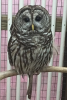
Having already tackled the burrowing owl and the eastern screech owl, today I’m going to lump together three larger North American owl species that I’ve work with: the barred (one raptor rehab center, one non-AZA zoo, one AZA zoo), the great horned (one raptor center, one AZA zoo), and the barn (one non-AZA). I have a tiny bit of experience with snowy owls, but not enough to really make any meaningful observations about their care and welfare.

The vast majority of the larger owls I’ve worked with have been ambassador owls, and as such have had some sort of debilitating injury that prevented them from surviving in the wild. For example, I worked with two barred owls at the raptor rehab center, each missing a wing – one the left, the other the right (we used to joke that we were going to duct-tape them together to make one functional owl). I’ve typically found barred owls to be more inclined to sit patiently on the glove (maybe because they are smaller and less dominant than great horns), with great horns more inclined to bate, or spend the entire presentation panting, looking around for escape routes. Native-born owls are very popular as ambassadors – more so than as exhibits, I would say – though I’ve recently come to question how suitable these birds are as program animals. Some thoughts from animal training expert Steve Martin on the subject, which helped shape my thinking:

https://naturalencounters.com/wp-content/uploads/2020/04/Thoughts-on-Ambassador-Owls.pdf

upload_2025-5-29_14-58-55.png
Two barred owls being weathered on ring perches at the raptor center

Ambassador owl holding tends to be fairly straightforward, a simple mew with a few perches, sometimes indoors (as in the raptor center), sometimes outdoors (at the AZA zoo). There’s a danger, I’ve come to realize, in rescuing animals from the wild – because they were certainly going to die without your providing them with a place to live, there almost comes a tendency to allow their care to be somewhat minimalistic, as if you don’t have to try harder to justify keeping them, as you would for an exotic species bred to be in a zoo. The truth is, in my opinion these animals require more stringent care than many conventional zoo animals. A spectacled owl born and raised in zoos is comfortable around people and will be more tolerant of our nonsense. A wild barn owl is constantly on edge, and probably needs a little more consideration for its comfort – like a larger enclosure to have more distance from the keeper, certainly from the public.

upload_2025-5-29_15-0-33.png
A great horned owl in holding (note the jesses) in the mews of an AZA facility

Being native, these owls are mostly tolerant of all the weather found in our area. The one exception I found were the barred owls that were missing entire wings each. These owls were more susceptible to chills, as the wings naturally formed a warm cloak to protect the sides of the bird, and without a wing, the cold would bother their exposed sides. The great horned owls I’ve found to somewhat less tolerant of heat, and seemed to benefit from misters and fans in the summer.

I don’t want to give the impression that I thought they were miserable all of the time, or that they hated us. The barred owls in particular I’ve always found to fairly tolerant, sometimes I even got the impression that they would solicit scratches or rubs, or let me clean their beaks. I’d often practice my barred owl call on them, to which they never responded. When you do work with owls, the relationship between owl and presenter should be one of respect and patience – you ask the owl to voluntarily step up on your glove, for instance, rather than push it on. That requires a new way of thinking for many folks. I was making diets in our zoo kitchen one day when I looked out a window at our mews, and saw an elderly docent chasing (slowly) a flight-restricted barred owl around the floor of the mew (8’ x 8’) in circles, trying to get it on her glove. I watched, dumbfounded, for a bit, before going out and telling her, gently but firmly, that it seemed like that owl didn’t want to go out today, but I would show her how to get a different one to step up for her.

Diet for the owls consisted of a rotation of rat, mouse, chick, and chicken, sometimes some rabbit. Looking back, this struck me as fine for the barn owl and great horned owl. I would have liked to try a little more variety for the barred owl – fish, frogs, etc – to more accurately reflect their diet. I’ve heard of some wild barred owls that have eaten so many crayfish that the white feathers on their breast have turned pink like a flamingo, and a puckish part of me always wanted to try this. As with other owls, you can be sure to have pellets to clean up after feeding owls. If you’re primarily feeding mice or day-old chicks, you won’t have a lot of excitement sifting through the pellets – the bones of these animals tend to be small enough and (especially for the chicks) soft enough that they dissolve, leaving nothing to find in the pellet.

The most interesting of the three large owls I worked with was the lone barn owl – I’m not entirely sure what her story was, as she was fully flighted and seemed to be in good condition, so it’s possible she was captive bred (the only thing murkier than animal acquisitions at this zoo were the animal dispositions). She was kept in a shed painted to look like a barn, a common motif for exhibiting this species, with visitors standing on the outside and peering in at her through the mesh that screened in the entrance. I did not care very much for this exhibit, as it allowed no access to natural light, wind, rain, etc, nor was it especially large. I spent a decent amount of time trying to build a positive relationship with this bird, but with little success (and the few times I had to catch her up were very unpleasant – man, can these guys shriek).

upload_2025-5-29_15-4-51.png
The barn of our barn owl exhibit. The front doors, normally open to allow visitor viewing, are shut do to an oncoming storm

Taken as a whole, these are species which I think could benefit from some fresh thinking in housing and welfare, and perhaps where that starts is being a bit more selective as to which animals are accepted into collections (we want to save them all, but there are definitely some owls out there which, while they could be kept alive for years and years, would probably be better served with euthanasia). Then, we need to change our philosophy from acting like we’re doing the owls a favor by keeping them, and whatever we give them is better than the alternative they were facing, and really focusing more on the question of what would be the optimal captive life for them. That might be larger enclosures and a focus more on exhibition rather than ambassador roles.

So many visitors have never seen a wild owl. When I was dealing with a spectacled owl escape (Post 202), I was receiving a flood of calls from folks in our community who had suddenly looked up at night and saw or heard an owl, hadn’t realized we had native owls, and called us, convinced that it was our escapee. Exhibiting native owls properly offers great opportunities to educate visitors about these unique birds, their special adaptations, and what behaviors we can change to improve their survival in the wild.
 

Attachments

  • upload_2025-5-29_14-58-55.png
    upload_2025-5-29_14-58-55.png
    587 KB · Views: 112
  • upload_2025-5-29_14-59-32.png
    upload_2025-5-29_14-59-32.png
    958 KB · Views: 5
  • upload_2025-5-29_15-0-33.png
    upload_2025-5-29_15-0-33.png
    972.3 KB · Views: 123
  • upload_2025-5-29_15-4-51.png
    upload_2025-5-29_15-4-51.png
    117.8 KB · Views: 119
Glad to see this thread is still going! I haven't been online much the past month so I'm behind on reading a lot of these posts, but all of this is still very interesting :)

Sad as your experience with the Spotted Skunks ended up being, I'm glad you had an opportunity to work with them; for whatever reason they seem exceedingly rare in captivity compared to their striped cousin, so I imagine few zookeepers ever get a chance.

By some unspoken decree, all of the staff vowed never to speak of it, for fear that the skunk would be euthanized for rabies testing (rabies vaccines are not considered very effective for skunks, and we were worried that state authorities would require the animal’s destruction.

And despite that risk Striped Skunks are incredibly common in zoos and used as ambassador animals! Are there other rabies-prone mammals for which vaccines aren't very effective?

Native-born owls are very popular as ambassadors – more so than as exhibits, I would say – though I’ve recently come to question how suitable these birds are as program animals. Some thoughts from animal training expert Steve Martin on the subject, which helped shape my thinking:
https://naturalencounters.com/wp-content/uploads/2020/04/Thoughts-on-Ambassador-Owls.pdf

I didn't realize how much trouble rescued owls had adapting to ambassador life... it really does throw a lot into question, given how ubiquitous the practice is. If anything it could give a good excuse for increasing the number of captive-bred owls for use as ambassador animals (maybe expanding the number of exotic species we have available in the US?) while focusing more on welfare, display and (when possible) rehabilitation of the native owls.

The point about euthanasia is well-taken too. There's a much wider debate to be had about captive animal euthanasia than could take place in this thread - and it's frequently rooted in deep-seated philosophical views about our relationship to animals and our ability to make decisions on their behalf - but it's something I'd hope more facilities continue revisiting as our understanding of animal welfare evolves.
 
In her book ‘Understanding Owls’, Jemima Parry-Jones advises that wild disabled owls should be allowed to live quietly and not handled. Here in UK there are plenty of captive bred owls, both native and exotic, available for training if required.
 
@Coelacanth18, I think most zoos feel that, since their ambassador skunks are kept secure from exposure to wild mammals, there’s little cause to worry about infection from wild sources. Laws vary widely from state to state, however. I was recently flabbergasted to hear one state would not allow zoos to use Virginia opossums – a species that is considered extremely unlikely to carry rabies because of its body temperature – as ambassadors for that reason. One month after hearing that, I was at the AZA Midyear in Memphis, where keepers with an ambassador opossum were cheerfully working a crowd, no concerns. Besides skunks, I often hear concerns about the vaccine expressed about procyonids.

And the point about owls is well-taken. I think part of the issue is that zoo folks obviously love animals, and there is a desire to save as many animals as we can, so rescuing a great horn slated for euthanasia otherwise hits differently than breeding a milky eagle owl. It can be rough to turn down an animal in need. I once had a rehabber (kind of a crazy lady – she was the same person who brought me the skunk that was fed friend chicken – she fed all of her patients fried chicken) show up to our front gate one busy Saturday, pull a great horn out of a box, and start loudly proclaiming that she’d have to kill it if I didn’t take it, after I’d already told her that we simply didn’t have room for another non-releasable owl.

When I wrote about pygmy rattlesnakes, I said that those were my main experience with venomous snakes – which is true. But it wasn’t my only. That is because, in part, the definition of what counts as a venomous snake has been increasingly tweaked over the past several years. I’d worked with a lot of eastern hognoses, for instance, which I never thought of as venomous, though now they are considered to be.

Today, we’ll take a look at two exotic, mildly-venomous colubrids I’ve worked with, each in a different AZA zoo. One is an extremely common species in zoo reptile houses. The other is something of a rarity – besides the specimen that I worked with, I’ve only seen one other.

First off, we have Erpeton tentaculatum, the tentacled snake (compared to bird and mammal keepers, aquarists and herp keepers love using Latin names – partially for simpler communication, but also I think because we like to prove to each other how smart we are… and to argue about pronunciation. I once wasted valuable seconds in an emergency because a coworker ran up to me to tell me that the pallida had escaped… and it took me a while to realize he meant a spitting cobra). This is easily one of the most unusual snake species in the world. I could see an argument being made either way for it being one of the best and one of the worst exhibit snakes out there. The best because they are so unearthly looking, and generally out and visible – the worst because their camouflage is so good that few visitors realize they are right in front of them.

Entirely aquatic (some zoos provide land areas, but I’ve never heard of one being used), tentacled snakes are managed in aquarium tanks. I think ours was 60 gallons or so, with some deadfall and floating aquatic plants, and some duckweed at the surface of the water. For this species, surface area is more important than depth, provided the snakes can comfortably submerge. Substrate was gravel, but I think more for aesthetics – I never saw the snake touch the floor of the tank. The back and sides of the glass tank were painted black to give the snake a secure backdrop. The lid was tightly clamped shut on each side – our boss had a fear that the snake might weasel its way out (perhaps because keepers might not secure the lid, thinking that the snake wouldn’t leave the water) and get out, then dry out on land. We only had a single specimen on display, but I’ve seen several housed together at other zoos.

upload_2025-5-30_10-45-38.png
A tentacled snake (not the one I worked with) being free-handled by a keeper I was visiting at another zoo.

The tank had a filter pump, and we periodically did water quality tests using a little home use kit. Some larger zoos, and certainly aquariums, have specialized water quality staff, but we did not back in the day – I’d be surprised if that zoo didn’t have them by now. We also regularly checked water temperature, since you don’t get those ambient hotspots that you achieve in terrestrial exhibits with heat lamps. There was also white lighting.

Food was provided in the form of small live fish, such as goldfish, with a few other species added for variety. I’ve heard that the will also eat amphibian larvae in the wild, and I wonder if captive-produced bullfrog tadpoles would also be of interest to them. They can be quite voracious feeders; unlike the other snakes, where we fed them once a week or every other week, these guys constantly had fish in their tank, and as soon as the larder was low, we’d add more, though for as often as we fed them, I rarely saw them strike. On exhibit, the fish – colorful, moving, more visible – are often the bigger draw than the snakes themselves.

This species is rear-fanged. Though nominally venmomous, it seems that the venom is particular to fish, though some humans report a reaction that results in a mild itch (though like all venoms – beestings included – some folks may have unexpectedly bad reactions). I’ve never met anyone who’s been bitten, and while I used a short snakestick, many people I know simply free handle this guys with no problem.

The other species I worked with was Langaha madagascariensis, the leaf-nosed snake. This long, slender, arboreal snake is from Madagascar (as you may have deduced from the species name), and was kept in a densely-planted exhibit about 4’ x 4’ x 4’ with Madagascar tree boas and tomato frogs. The snake was generally easy to find, as it was often draped loosely through the branches of the exhibit in a cat’s cradle, as opposed to the boas which were often to be soon curled up in compact balls.

The most interesting thing about this snake is its sexual dimorphism. Males have bolder patterning - brown on the back, yellow ventrally, whereas females are gray – but also have a different shape to their nose. The male snout is long and pointed. The female’s is shaped like a leaf, flattened and a bit frilly. Our specimen was a female, one of several of her species that had been obtained from a dealer a few years earlier (wild caught, I’m certain), but the only one to survive. (It’s interesting that one of the few other dramatically sexually dimorphic snakes I can think of is also an African rear-fanged colubrid, though a far more venomous one – the boomslang).

Even though the species is venomous, we took no extra precautions with caring for her. What surprises me the most, looking back at it, is that the exhibit was front-opening. We didn’t service it from a back keeper area, but the front glass simply swung open into the lobby of the building, and we’d frequently service the exhibit – misting the frogs, feeding the snakes – with visitors in the lobby, and nothing but air between the snake and the public. She never seemed inclined to leave her perching which, is keeping with the natural behavior of saying in trees and simply swaying back and forth, waiting for prey to come.

This species feeds on lizards and frogs (our tomato frogs were far too big for her) in the wild, and we primarily fed frozen/thawed anoles off of tongs. There are some reptile/amphibian specialist feeders which can successfully be switched over to rodents, but from what I’ve heard, this species is not one of those. In fact, looking through some articles as I refreshed my memory for writing this, a lot of folks seem to think that they will only eat live lizards, so perhaps we had something of an accomplishment getting our girl to take dead ones. Maybe that’s why she was the only member of her cohort to live for very long in our collection.

The species has been bred in captivity, but not by us, and only rarely. Individuals are occasionally seen for sale, but they’ll generally be wild caught. Which brings me to the only other specimen I’ve seen, about 15 years after I worked with one, in a pet store.

This pet store had a reputation for having lots of herps that it probably shouldn’t be selling, but it was the only pet store in our town, and I needed to get feeders for my personal pets from somewhere, so I was forced to go. I always made a point of walking the aisle to see what they had this month – a horned lizard? A sailfin dragon? – when I was stopped in my tracks at the sight of the Langaha. What surprised me all the more was the fact that nowhere on the label did it mention the fact that the species is venomous. Sure, they won’t kill you, but from what I read, the bite can be quite painful. Also, venomous reptiles were illegal as pets in our state. Also, it didn’t say anything about the specialized care – I could imagine some idiot trying to finger-feed it a pinky mouse.

upload_2025-5-30_10-46-23.png
The leaf-nosed snake at the pet store. I was equal parts thrilled to see this species after so many years, and horrified to think of what would happen to it, and baffled as to what it was even doing in that store.

On my way out of the store, I mentioned those concerns to the cashier. Next time I came back, the snake was gone, but to what end I do not know.
 

Attachments

  • upload_2025-5-30_10-45-38.png
    upload_2025-5-30_10-45-38.png
    1.2 MB · Views: 112
  • upload_2025-5-30_10-46-23.png
    upload_2025-5-30_10-46-23.png
    960.8 KB · Views: 120
Today, I’ll talk about two species of Asian antelope, very common in the private sector, but largely absent from AZA these days – the nilgai and the blackbuck. Both were species that I worked with at the same non-AZA facility, and both shared a multi-acre enclosure with a variety other hoofstock and ratites.

The paddock was a sprawling meadow with some low hills and valleys, a strip of woodland on either side of a small creek that ran along one side. Most of the rest of the exhibit was open grassland, with an open-fronted barn in the center and a few concrete culverts (we just called them the Tubes) sunk into the side of a hill for additional shelter. The animals were outdoors year-round. Running in a loop through this paddock was a road along which we drove tractor-pulled wagon tours, from which visitors could feed the animals grain. There were large hayracks stationed throughout the yard, along with troughs in which grain was fed.

upload_2025-6-2_10-37-21.png

The nilgai were a trio of females, which kept to themselves for the most part in their own little clique. A male had been introduced to the herd shortly before I started working there, and then removed – it’s not an uncommon practice at safari park settings like this to bring in a male for breeding and then remove it, as males of different species are likely to be more aggressive than females and fight with exhibit-mates. A male calf was born to one of the females not long after I started. Nilgai are hiders, so the mother left the calf in the tall grasses and would occasionally come by for nursing. One of the keepers, the one primarily responsible for the section, was constantly fretting that the mother wasn’t spending enough time with the calf, and was always sneaking over to try to bottle feed it more. We did a lot of hand-rearing of domestic ungulates at that facility, and I think there was a bit of a Dunning-Kruger effect going on, where he thought he would be just as easily about to supplemental-rear the nilgai. Looking back on it, I suspect he probably made things worse for the calf, which was probably doing fine on its own. The calf did not end up surviving. I had very little to do with the calf – he was very jealously guarding it from the rest of us – but I did pick up on the fact that there was some diarrhea, so perhaps the milk formula wasn’t appropriate for the species.

The nilgai cows were fairly indifferent to both us and the other animals in the paddock. They’d often stand together in a little knot, watching up clean the exhibit (usually done by raking around the barns and hay racks, dragging the rest of the field with a chain-link gate) and seldom participating in the wagon feedings. No matter how busy or slow we were, they’d ignore the wagons, and we’d have to feed them at the troughs, even if all of the other animals in the yard were nearly comatose with grain. I suspect that’s part of why the owner eventually decided to send them away, to make room for animals that would be more interactive. He swapped them to another facility for a pair of common wildebeest which, if they proved to be just as unwilling to come to the wagons for food, at least had the advantage of being more striking in appearance and interesting to the guests.

Apart from the fallow deer and maybe the rheas, the blackbucks were the most numerous animals in the paddock, with about a dozen individuals present. They seemed to get along with just about everyone, the males sometimes sparring with each other, but it was a big paddock with lots of room to get away. They’d approach the wagons sometimes, but usually only at the end of busy days when the dominant species in the yard were all glutted and not coming up anymore, which would allow the blackbuck to sneak in and timidly take food.

The blackbuck bred very well in the exhibit, and there were few sights that we all found more amusing than the pregnant females – sausages on sticks, we’d call them, with their bloated bodies held up by their tiny, toothpick legs. Young dropped with some frequency in the spring, and I’m actually quite amazed that we raised virtually all of them, without losing any to foxes.

upload_2025-6-2_10-38-7.png

Male nilgai and male blackbuck are both handsome animals with striking coloration and, in the blackbuck, at least, impressive horns. They are hardy animals that breed well (and raise their young fun, provided no idea tries to bottle feed one without any clue what he’s doing) and largely get along with other species. It’s no wonder that they are so popular both in the private sector, both for zoos and ranches. It’s ironic, but the first wild antelope I ever saw (not counting that other “antelope” the pronghorn) was years before I went to Africa the first time – it was a pair of blackbucks in west Texas.

(A brief note on antelope horns. Taken as a whole, I am much more afraid of hoofstock that have relatively short, sharp horns rather than ones that are bigger and more ornamental. Little horns are like stilettos, whereas bigger horns are like samurai swords. The little horns an animal can use quickly and in close quarters without a lot of need to maneuver, and an aggressive animal can be much more precise with them – they’re also less likely to get tangled up or caught on things. I once read an account of a fight between a male ibex and a male chamois at a European zoo – the ibex reared up, showing his big, curved, powerful horns – and the chamois darted in and stabbed him in the chest.)

I consider them something of a victim of the geographicization (I made up that word) of zoos, as Asian exhibits tend to be more focused on Southeast Asian rainforests or Himalayan Highlands, leaving the savannah exhibits to Africa (where these exhibits often feature bongo, addax, addra gazelle, and other non-savannah species). But, should AZA zoos ever decide to go all in on South Asia, these species are there, and quite available.
 

Attachments

  • upload_2025-6-2_10-37-21.png
    upload_2025-6-2_10-37-21.png
    1.1 MB · Views: 87
  • upload_2025-6-2_10-38-7.png
    upload_2025-6-2_10-38-7.png
    1.3 MB · Views: 96
I’ve worked with three bear species over the course of my career, and since my experience with polar bears was long ago and fairly limited, I’ll be talking about the other two in this thread. In today’s post, we’ll look at that most ubiquitous of species in North American zoos, the American black bear. I’ve worked with this species at two facilities. The first was at an AZA zoo, where I worked with a lone, older male. The second was at a non-AZA zoo.

The AZA bear was living in an old-style concrete bear grotto, the sort of habitat that was all the rage a few decades ago, when barless and naturalistic were still considered synonyms. Even at the time I worked with him it was considered a fairly unsuitable habitat for bears, and he was to be the last bear kept in this exhibit – but as he was pretty old, it was judged adequate for his needs as a retirement home. The exhibit consisted of multiple levels of fake rockwork, leading down to a deep, waterfall-fed pool. Efforts had been made to liven up the concrete with sections of mulch and other softer substrates, as well as logs and a few other bits of furniture. The rockwork at the back of the exhibit contained a series of dens. To access the exhibit, we’d lock the bear in the dens, and then take a little doorway into the exhibit.

The accommodations weren’t great, but they were miles ahead of the non-AZA bear exhibit. It was originally a small, concrete pad, enclosed with iron-bars, maybe 20’ x 20’, which was later expanded with a small chain-link yard tacked on to the front of the old dens. No pool. No climbing structures. The best it had to offer was that it had some natural substrate, and a little bit of furniture. The two halves of the exhibit were connected by a small gate that keepers lifted with a pulley.

My first day working in this exhibit, I was raking up the bear poop so I could have a clean place to put down food, when I happened to turn around. There was the bear, in the exhibit with me, slowly, almost casually strolling straight for me. I’m not exactly sure what happened next. I feel like I blinked, and the next thing I knew, I was outside of the exhibit, with the door locked, and the bear sitting on the other side of the door looking at me curiously. I don’t even remember how I got out. I did leave the rake and shovel in the exhibit, which the bear thoughtfully broke in half while I went to my apartment (I lived on zoo grounds at this job) to go and change my pants (kidding about that last part… or am I?). When I went to report what happened to the zoo’s owner, he rubbed his chin for a moment before saying, “Oh, we forgot to tell you. Louie (the bear) knows how to open the gate into the yard. There’s a little piece of chain you have to wrap around it and clip to keep that from happening.

upload_2025-6-3_9-59-56.png
Louie, the American black bear at the non-AZA zoo. Photo taken from outside the exhibit, but basically this is what I turned around to see that one near-fateful day​

I was to learn that, shortly before I’d started at that zoo, there had been a second American black bear in that cage as well, a female (lord knows how they both fit in there). A keeper had left the door open one night, and both had escaped. The male was successfully herded back into the cage, the female was shot dead, and that’s how the job opening that I filled came to be.

Years later, when I was again at an AZA zoo and working with bears there, keepers were puzzled why I refused to service the bears until we’d thoroughly, carefully gone through the entire shifting process.

Diet at both zoos were fairly similar in terms of basic components, if not the quality of the ingredients. American black bears are the ultimate omnivores, and their diet reflected that – dog chow, fruits, vegetables, and meat. At the AZA zoo, there was a bit more variety (produce at the non-AZA zoo seemed solely to consist of apples, sweet potatoes, and carrots), as well as more “treat” items, such as peanut butter and honey. In their wild state, bears spend a very large percentage of their time foraging, so I tried to scatter-feed as much as possible, with the obvious limitations of the exhibit size and construction (cement floors being a key factor). There also ideally should be seasonally variation in the amounts and types of food offered, something that was not done at either zoo, but is now recognized as desirable for bear welfare.

A note about bear poop. It’s gross. The poop of both bears was always somewhat loose – I don’t mean diarrhea, but soft, like light-brown mashed potatoes, with visible chunks of produce in it. When I’d see a bear poop, the poop would hit the ground and literally splatter. If I had to guess, I’d say that we weren’t providing nearly as much dietary fiber as we should have been, and wild bears due eat lots of fibrous plants and chitin-coated inverts; wild bear feces I’ve seen have been much better formed.

Some zoos allow their American black, Asian black, or brown bears to enter winter torpor (not a true hibernation). Others don’t. It varies based on the institution, its facilities, and its culture, as well as the individual bears. Geography and climate don’t necessarily dictate it. Last year I was at the Bronx Zoo in February, and their brown bears were out and about on a brisk day (it would snow heavily that night). A month later, I was at a zoo several hours to the south, and their brown bears were still in the dens for the winter. Given the choice, I’d opt to let the bears chill for the winter (maybe even have a den camera installed for visitors to watch). It better replicates natural conditions through much of their range… and it’s a few months of the year in which the animals are basically packed up in storage and you don’t need to worry about them.

This isn’t a solid rule, but I’ve noticed that the vast majority of black bears that I’ve seen in AZA zoos are wild born animals – orphaned cubs or nuisance animals – whereas the majority that I’ve seen in non-AZA zoos are captive-bred, perhaps to satisfy the demand for exhibit animals. It may be that state wildlife agencies just aren’t willing to place bears in some of these shoddier facilities. I frequently see posts on the AZA listserv about black bear cubs that need placement or they’ll face euthanasia. Many zoos want to take in these bears, both to rescue the animals and to provide exhibits of native wildlife (unlike brown bears, virtually every mainland-US zoo can boast of black bears as a native species). Some zoos, such as Naples and Turtle Back, have excellent exhibits themed around peacefully co-existing with our burgeoning black bear population. In non-geographic exhibits, however, these non-endangered bears do compete for space with the managed program species – sloth bear and Andean bear.

Bears as a group are a conundrum for zookeepers. On one hand, they are among the easiest of animals to keep – as in, keep alive. Decades ago, in the shabbiest of conditions, many zoos were successfully keeping bears of a variety of species alive for thirty years or so, often with few health problems. Most species often breed readily; my childhood zoo kept bears in a row of small, sterile barred cages, kept seven of the world’s eight bear species, and bred at least four of them. Most are cold-hardy, most will eat just about anything, they can be easily trained, and they are beloved by visitors. It’s no surprise that bears seem to have been among the first wild animals kept in captivity for non-domestication/food purposes. That being said, their inherent toughness has masked the fact that they are behaviorally complex creatures that can develop severe stereotypy in unsuitable exhibits – pacing, head-rolling, tongue sucking, paw sucking, self-mutilation. So bears are easy to keep. They’re just hard to keep well.
 

Attachments

  • upload_2025-6-3_9-59-56.png
    upload_2025-6-3_9-59-56.png
    542.7 KB · Views: 87
I’ve worked with three bear species over the course of my career, and since my experience with polar bears was long ago and fairly limited, I’ll be talking about the other two in this thread. In today’s post, we’ll look at that most ubiquitous of species in North American zoos, the American black bear. I’ve worked with this species at two facilities. The first was at an AZA zoo, where I worked with a lone, older male. The second was at a non-AZA zoo.

The AZA bear was living in an old-style concrete bear grotto, the sort of habitat that was all the rage a few decades ago, when barless and naturalistic were still considered synonyms. Even at the time I worked with him it was considered a fairly unsuitable habitat for bears, and he was to be the last bear kept in this exhibit – but as he was pretty old, it was judged adequate for his needs as a retirement home. The exhibit consisted of multiple levels of fake rockwork, leading down to a deep, waterfall-fed pool. Efforts had been made to liven up the concrete with sections of mulch and other softer substrates, as well as logs and a few other bits of furniture. The rockwork at the back of the exhibit contained a series of dens. To access the exhibit, we’d lock the bear in the dens, and then take a little doorway into the exhibit.

The accommodations weren’t great, but they were miles ahead of the non-AZA bear exhibit. It was originally a small, concrete pad, enclosed with iron-bars, maybe 20’ x 20’, which was later expanded with a small chain-link yard tacked on to the front of the old dens. No pool. No climbing structures. The best it had to offer was that it had some natural substrate, and a little bit of furniture. The two halves of the exhibit were connected by a small gate that keepers lifted with a pulley.

My first day working in this exhibit, I was raking up the bear poop so I could have a clean place to put down food, when I happened to turn around. There was the bear, in the exhibit with me, slowly, almost casually strolling straight for me. I’m not exactly sure what happened next. I feel like I blinked, and the next thing I knew, I was outside of the exhibit, with the door locked, and the bear sitting on the other side of the door looking at me curiously. I don’t even remember how I got out. I did leave the rake and shovel in the exhibit, which the bear thoughtfully broke in half while I went to my apartment (I lived on zoo grounds at this job) to go and change my pants (kidding about that last part… or am I?). When I went to report what happened to the zoo’s owner, he rubbed his chin for a moment before saying, “Oh, we forgot to tell you. Louie (the bear) knows how to open the gate into the yard. There’s a little piece of chain you have to wrap around it and clip to keep that from happening.

View attachment 797332
Louie, the American black bear at the non-AZA zoo. Photo taken from outside the exhibit, but basically this is what I turned around to see that one near-fateful day​

I was to learn that, shortly before I’d started at that zoo, there had been a second American black bear in that cage as well, a female (lord knows how they both fit in there). A keeper had left the door open one night, and both had escaped. The male was successfully herded back into the cage, the female was shot dead, and that’s how the job opening that I filled came to be.

Years later, when I was again at an AZA zoo and working with bears there, keepers were puzzled why I refused to service the bears until we’d thoroughly, carefully gone through the entire shifting process.

Diet at both zoos were fairly similar in terms of basic components, if not the quality of the ingredients. American black bears are the ultimate omnivores, and their diet reflected that – dog chow, fruits, vegetables, and meat. At the AZA zoo, there was a bit more variety (produce at the non-AZA zoo seemed solely to consist of apples, sweet potatoes, and carrots), as well as more “treat” items, such as peanut butter and honey. In their wild state, bears spend a very large percentage of their time foraging, so I tried to scatter-feed as much as possible, with the obvious limitations of the exhibit size and construction (cement floors being a key factor). There also ideally should be seasonally variation in the amounts and types of food offered, something that was not done at either zoo, but is now recognized as desirable for bear welfare.

A note about bear poop. It’s gross. The poop of both bears was always somewhat loose – I don’t mean diarrhea, but soft, like light-brown mashed potatoes, with visible chunks of produce in it. When I’d see a bear poop, the poop would hit the ground and literally splatter. If I had to guess, I’d say that we weren’t providing nearly as much dietary fiber as we should have been, and wild bears due eat lots of fibrous plants and chitin-coated inverts; wild bear feces I’ve seen have been much better formed.

Some zoos allow their American black, Asian black, or brown bears to enter winter torpor (not a true hibernation). Others don’t. It varies based on the institution, its facilities, and its culture, as well as the individual bears. Geography and climate don’t necessarily dictate it. Last year I was at the Bronx Zoo in February, and their brown bears were out and about on a brisk day (it would snow heavily that night). A month later, I was at a zoo several hours to the south, and their brown bears were still in the dens for the winter. Given the choice, I’d opt to let the bears chill for the winter (maybe even have a den camera installed for visitors to watch). It better replicates natural conditions through much of their range… and it’s a few months of the year in which the animals are basically packed up in storage and you don’t need to worry about them.

This isn’t a solid rule, but I’ve noticed that the vast majority of black bears that I’ve seen in AZA zoos are wild born animals – orphaned cubs or nuisance animals – whereas the majority that I’ve seen in non-AZA zoos are captive-bred, perhaps to satisfy the demand for exhibit animals. It may be that state wildlife agencies just aren’t willing to place bears in some of these shoddier facilities. I frequently see posts on the AZA listserv about black bear cubs that need placement or they’ll face euthanasia. Many zoos want to take in these bears, both to rescue the animals and to provide exhibits of native wildlife (unlike brown bears, virtually every mainland-US zoo can boast of black bears as a native species). Some zoos, such as Naples and Turtle Back, have excellent exhibits themed around peacefully co-existing with our burgeoning black bear population. In non-geographic exhibits, however, these non-endangered bears do compete for space with the managed program species – sloth bear and Andean bear.

Bears as a group are a conundrum for zookeepers. On one hand, they are among the easiest of animals to keep – as in, keep alive. Decades ago, in the shabbiest of conditions, many zoos were successfully keeping bears of a variety of species alive for thirty years or so, often with few health problems. Most species often breed readily; my childhood zoo kept bears in a row of small, sterile barred cages, kept seven of the world’s eight bear species, and bred at least four of them. Most are cold-hardy, most will eat just about anything, they can be easily trained, and they are beloved by visitors. It’s no surprise that bears seem to have been among the first wild animals kept in captivity for non-domestication/food purposes. That being said, their inherent toughness has masked the fact that they are behaviorally complex creatures that can develop severe stereotypy in unsuitable exhibits – pacing, head-rolling, tongue sucking, paw sucking, self-mutilation. So bears are easy to keep. They’re just hard to keep well.
Hi Aardwolf, I've worked only with Asiatic Bears and my first day was also one of most frightening as a keeper. Myself and another keeper (my mentor),prepared the food for the bears which was put into a large plastic barrel which we carried to the bears enclosure. Once there we established that there were no bears in the outdoor enclosure and that they were still in the indoor bear dens from the night before. To access the indoor dens ,which were underground, you had to climb down a steel ladder to a depth of about 8 feet. Although there was a light down there the dens ran circular, so we lowered the barrel of food down on a rope, knowing that if a bears/had got out into the corridor they would soon have their heads into the barrel and so we would be forewarned. The coast was clear, so we climbed down. Because, I was the new boy I was tasked with cleaning the outside. I unlocked the door and out I went ,with a bucket and shovel. About half way into the enclosure, I heard the sound of a slide being raised, I froze and then I heard laughter, just as I realised what had happened. Firstly, I saw two keepers laughing and then I saw all of doors to the indoor dens were still shut! The sound that I heard was the keeper inside dragging the barrel . According to the keepers who were in hysterics,my face went from absolute horror, to a look of embarrassment!!. Needless, to say, my first day working with the bears, went around the zoo like wildfire. One of the bears, Inca,lived to a very old age, she was 38 years old when she died in 1998.
 
Sometimes, you don’t work with an animal for very long, but it still leaves quite an impression on you. That was my experience with lowland paca. I worked with this species at one non-AZA.

No sooner had I successfully banished our office-fennec fox to the newly built aardvark exhibit then we received our newest resident, a female lowland paca… who promptly moved right into our office. I remember the day we let her out of her crate. She stood shyly in the open doorway, looking out at as serenely - she even walked slowly over the outstretched leg of a keeper who was sitting on the floor as she exited the crate.

That was the last good look we were to get of her for several days.

upload_2025-6-4_8-49-36.png

Unlike the fennec, which acted like he owned the place (and was sure to urine mark everything to prove it) the paca was a fairly furtive little beast. One day at lunch, I accidentally knocked my apple core off the breakroom table. Like a red-and-white blur, the paca darted out from under our staff lockers, grabbed the apple core, and dashed back into what seemed like an impossibly small space, from which I soon heard the enthusiastic crunching.

After that, I set myself to trying to make friends with the little gal. I’d take small chunks of apple or carrot, each about the size of the end of my thumb, and leave little trails out to encourage her to come out and spend time where I could see her. She would come out, but only for as long as it took to grab the food, and then she’d dart back to safety. We never got to the point of trying to have food offered to her by hand – and as quickly and fiercely as she chomped the food with her dine-and-dash every time, I don’t think that I would have dared to, anyway.

So, this is obviously not an ideal living situation for a paca – she hid all day, emerged at night, there were many frustrating experiences of searching for her poop (and more frustrating experiences of unexpectedly finding her poop). It seems like I spent a lot of each day moving things off the floor that I was worried she’d chew on. As the newest keeper in this set up, I didn’t have much say in where animals were housed (the fennec was an unexpected victory of mine), but the paca seemed inexplicably stuck here. It wouldn’t seem like there’s much to learn from this species except the repeated questionable wisdom of keeping animals in office spaces. So why did this animal make an impression on me? Why bother including her in this notebook?

It’s because of the lesson that lesson that I learned from the death of a paca.

We eventually obtained a male, and the decision was made to put them on exhibit together (why we didn’t do this earlier when we just had the female, I don’t know. Mysterious are the ways of private zoo owners). The pair were moved into an enclosure with our squirrel monkeys – an outdoor exhibit, grass substrate in some places, dirt in others (in was a fairly small exhibit, maybe 12 x 12) with a lot of perching for the monkeys overhead, as well as a nestbox on the ground for the pacas. The pair were moved in, and I was happy to see the female, long cooped up inside, enjoying natural sunlight, fresh air, and more stimulation.

She died before too long.

We couldn’t recognize any symptoms, and so I hit the books – it seemed like it must have had something to do with the change of enclosure and living situation. And, it turns out, it did. It seems that paca are very susceptible to vitamin D toxicity – and the standard prepared commercial zoo diets of New World primates are very high in vitamin D. She’d been scarfing down food that the squirrel monkeys were dropping, which resulted in D3 poisoning. A paper that I found in the Journal of Zoo and Wildlife Medicine reported several such cases among pacas and agoutis at a few major zoos – in the late 1980s and early 1990s. This was over 15 years before my paca died. A forgivable, understandable cause of the death for the first zoo to experience it. Maybe the second as well. After the first few occurrences, it should be a recognized danger.

upload_2025-6-4_8-49-16.png

The paper that I read also mentioned agoutis being susceptible to D3 toxicity. Years later, I successfully was keeping agoutis with cotton-top tamarins; and I’ve seen agoutis and pacas mixed with primates at other zoos, seemingly without problem. If you know the risk of the toxicity, there are ways to make the cohabitation work successfully, such as feeding the D3 rich portion of the diet in a location where the rodents won’t be able to access it (which, to be fair, can be tricky to plan for, given the tendency of primates to carry their food around).

The surviving paca was moved to a small, rather dull little enclosure – shavings in a box, essentially – until it was shipped out. The boss had a tendency to rapidly loose interest in animals that didn’t seem to be working out.

So, lessons from this? Besides the obvious. First, when planning mixed species exhibits, there are a lot of factors for safety and wellbeing that should be considered rather than the first one that jumps to mind, will the animals deliberately kill/attack one another? There’s a lot of other potential threats and factors to consider. Secondly, the importance of research cannot be overstated when adding new species to the collection, and planning major husbandry changes.
 

Attachments

  • upload_2025-6-4_8-49-16.png
    upload_2025-6-4_8-49-16.png
    1.2 MB · Views: 79
  • upload_2025-6-4_8-49-36.png
    upload_2025-6-4_8-49-36.png
    582.6 KB · Views: 77
Sometimes, you don’t work with an animal for very long, but it still leaves quite an impression on you. That was my experience with lowland paca. I worked with this species at one non-AZA.

No sooner had I successfully banished our office-fennec fox to the newly built aardvark exhibit then we received our newest resident, a female lowland paca… who promptly moved right into our office. I remember the day we let her out of her crate. She stood shyly in the open doorway, looking out at as serenely - she even walked slowly over the outstretched leg of a keeper who was sitting on the floor as she exited the crate.

That was the last good look we were to get of her for several days.


Unlike the fennec, which acted like he owned the place (and was sure to urine mark everything to prove it) the paca was a fairly furtive little beast. One day at lunch, I accidentally knocked my apple core off the breakroom table. Like a red-and-white blur, the paca darted out from under our staff lockers, grabbed the apple core, and dashed back into what seemed like an impossibly small space, from which I soon heard the enthusiastic crunching.

After that, I set myself to trying to make friends with the little gal. I’d take small chunks of apple or carrot, each about the size of the end of my thumb, and leave little trails out to encourage her to come out and spend time where I could see her. She would come out, but only for as long as it took to grab the food, and then she’d dart back to safety. We never got to the point of trying to have food offered to her by hand – and as quickly and fiercely as she chomped the food with her dine-and-dash every time, I don’t think that I would have dared to, anyway.

So, this is obviously not an ideal living situation for a paca – she hid all day, emerged at night, there were many frustrating experiences of searching for her poop (and more frustrating experiences of unexpectedly finding her poop). It seems like I spent a lot of each day moving things off the floor that I was worried she’d chew on. As the newest keeper in this set up, I didn’t have much say in where animals were housed (the fennec was an unexpected victory of mine), but the paca seemed inexplicably stuck here. It wouldn’t seem like there’s much to learn from this species except the repeated questionable wisdom of keeping animals in office spaces. So why did this animal make an impression on me? Why bother including her in this notebook?

It’s because of the lesson that lesson that I learned from the death of a paca.

We eventually obtained a male, and the decision was made to put them on exhibit together (why we didn’t do this earlier when we just had the female, I don’t know. Mysterious are the ways of private zoo owners). The pair were moved into an enclosure with our squirrel monkeys – an outdoor exhibit, grass substrate in some places, dirt in others (in was a fairly small exhibit, maybe 12 x 12) with a lot of perching for the monkeys overhead, as well as a nestbox on the ground for the pacas. The pair were moved in, and I was happy to see the female, long cooped up inside, enjoying natural sunlight, fresh air, and more stimulation.

She died before too long.

We couldn’t recognize any symptoms, and so I hit the books – it seemed like it must have had something to do with the change of enclosure and living situation. And, it turns out, it did. It seems that paca are very susceptible to vitamin D toxicity – and the standard prepared commercial zoo diets of New World primates are very high in vitamin D. She’d been scarfing down food that the squirrel monkeys were dropping, which resulted in D3 poisoning. A paper that I found in the Journal of Zoo and Wildlife Medicine reported several such cases among pacas and agoutis at a few major zoos – in the late 1980s and early 1990s. This was over 15 years before my paca died. A forgivable, understandable cause of the death for the first zoo to experience it. Maybe the second as well. After the first few occurrences, it should be a recognized danger.

View attachment 797764

The paper that I read also mentioned agoutis being susceptible to D3 toxicity. Years later, I successfully was keeping agoutis with cotton-top tamarins; and I’ve seen agoutis and pacas mixed with primates at other zoos, seemingly without problem. If you know the risk of the toxicity, there are ways to make the cohabitation work successfully, such as feeding the D3 rich portion of the diet in a location where the rodents won’t be able to access it (which, to be fair, can be tricky to plan for, given the tendency of primates to carry their food around).

The surviving paca was moved to a small, rather dull little enclosure – shavings in a box, essentially – until it was shipped out. The boss had a tendency to rapidly loose interest in animals that didn’t seem to be working out.

So, lessons from this? Besides the obvious. First, when planning mixed species exhibits, there are a lot of factors for safety and wellbeing that should be considered rather than the first one that jumps to mind, will the animals deliberately kill/attack one another? There’s a lot of other potential threats and factors to consider. Secondly, the importance of research cannot be overstated when adding new species to the collection, and planning major husbandry changes.
Hi Aardwolf, what are the protocols in American zoos, with regards to the death of zoo animals now ?are pm's done after all unexpected deaths. I agree, that research is very important, especially if you want to mix different species. For example, some years ago, a person, who should have known better, excitedly told me of his plans to house squirrel monkeys with common marmosets. I told him what a disaster that would be. He ,clearly had no idea that squirrel monkeys carry HVT, herpovirus tamarinus,which causes a mild herpetic infection in squirrel monkeys, but is fatal in not only marmosets and tamarins but owl monkeys as well.
 
@Strathmorezoo , necropsies are standard at AZA zoos, though they can be variable in their occurrence in non-AZA zoos. To get a Class C exhibitors license from the USDA (which all zoos need to operate, accredited or not), it's necessary to have a written program of veterinary care. Like most USDA requirements, this is maddeningly vague, which allows some shoddiness to persist across many facilities.

Today, a look at one of the most commonly-kept of shorebirds in American zoos, the masked lapwing. This species is a mainstay of Australian exhibits – its hardy, breeds readily, and appeals to visitors with its unusual appearance, striking call, and confiding nature. It also works well in a variety of mixed-species exhibits, and is frequently included in walk-through aviaries.

I’ve worked with this species at one AZA facility, where the birds were occupants of a new Australian aviary we’d built. We received a male-female sibling pair from a zoo about 7 hours away; the zoo in question had been especially frustrating to deal with in booking the shipment, so in a pique of irritation, a coworker and I just decided to drive out there, spend the night with a keeper friend of mine who worked at that zoo, and then drive back the next day with the birds. By the time they finished quarantine, the new exhibit was ready for them.

upload_2025-6-5_10-11-8.png

The exhibit was about 20’ x 20’, fairly tall, too, not that the lapwings ever took advantage of it. It was shared with a pair of kookaburras and a single tawny frogmouth. It was well-perched (for the other birds), with some rocks and logs on the ground for the lapwings, as well as a small, shallow pool. Substrate was a mixture of grass and bare earth. Towards the back of the exhibit was a wooden holding building we’d erected – not much bigger than a wardrobe, but the birds rarely had to be locked in. There were two access doors for birds cut into the walls of the building – one up high for the kookaburras and frogmouth, one at ground level for the lapwings.

If there was one thing that frustrated me, it was that, unlike any of the bird species in either of the two Australian aviaries, they would absolutely not, under any circumstances, go into their indoor winter quarters on their own accord. I would wait until late at night, sometimes into the 20’s, and there they would be in the light of my flashlight, hunkering down in their (circulating) pool, when they had a toasty shelter just ten feet away. It got to the point where I would constantly push back their temperature limit, only bringing them in (with a net – they were far too canny to let themselves be herded in, even with two keepers) if it was going to be below 20 degrees. The SSP coordinator recommended 40 degrees as their cut-off, but honestly they seemed to do fine with this temperature regime, and never seemed too cold or uncomfortable.

The diet for these birds was a simple mix of Mazuri flamingo (no, they never turned pink for it), mealworms (sometimes supplemented with other inverts), Nebraska Bird of Prey diet, and some finely diced produce, served in a tiny saucer dish. Every once in a while a kookaburra would swoop down and grab a little of the meat, but that happened infrequently enough that we never felt like we needed to develop a plan to address it.

Based on their namesake masks, which suggested superheroes to us, and their twin sibling status, we decided on the drive back to name them Wanda and Pietro (though ironically, neither of those super heroes – the Scarlet Witch or Quicksilver – wears a mask in the comics). Unless divine inspiration strikes or there is a special sentimental reason, I often leave the naming of animals to other keepers – it helps foster a spirit of care, I find. That being said, after eight hours out and eight hours back in the car, my coworker and I were running out of conversational topics, so we eventually started discussing names for the birds. When I wrote the sign for the exhibit, I focused in on the superhero theme, describing how lapwings went to heroic lengths to protect their eggs and chicks – not just aggressively standing up to predators much larger than themselves, including people, but faking injuries to lure predators away from the nest, not unlike our North American killdeer.

upload_2025-6-5_10-10-34.png

As Wanda and Pietro were a sibling pair, they never got a breeding recommendation. It would have been interesting to have a breeding pair, just to see the behavioral changes – that and the chicks look adorable (the eggs are gorgeous too – when we were picking them up at their old zoo, one of the keepers showed us one that she kept after it was blown out). Still, given the reputation for how… assertive this species can be at nesting season, I feel like the keepers wouldn’t have thanked me too much for unleashing that upon them.
 

Attachments

  • upload_2025-6-5_10-10-34.png
    upload_2025-6-5_10-10-34.png
    911.3 KB · Views: 64
  • upload_2025-6-5_10-11-8.png
    upload_2025-6-5_10-11-8.png
    713.9 KB · Views: 66
Back
Top