
Rizz Carlton
Well-Known Member
It's attributed to how widespread there are in both captivity and the also in the wild in Indonesia. Here there are dozens of crocodiles farms/facilities across the country that are used for multiple purposes, either to held rescued crocodiles or to be skinned for the fashion industry (Yikes!). There's a lot of cases of crocodiles entering urban territories, especially during floods, attributing to how bloated some of the population of these farms. It's probably where a lot of Indonesian zoos get their salties, but older zoos like Ragunan apparently have crocodiles that might be over half a century old.The amount of Saltwater Crocodile exhibits that Konstantin and I saw in Southeast Asian zoos must have been a staggering number, and here we saw yet another bunch of outdoor enclosures for big 'salties'. Crocs are arguably more popular than hippos in SEA!
Aside from that, a lot of zoos get their salties from confiscation or wild-caught, in the pretense of "rescues", which most often than not never released back into the wild due to "safety concern". For example, Taman Safari Bogor have an saltie named Kojek, who used to be a very obese croc and was kept by a family for years. It once had it own exhibit in the Crocodile Park (The one near the Komodo Dragon Island and Bird of Prey show stage), but Kojek's distinguishing features (I.e large belly) faded away and now becomes pretty much indistinguisable from other crocs.
There should be 14 sun bear exhibits, the 15th exhibit hosted an Sri Lankan sloth bear. It's exhibit was near a toilet in one of the sun bears complex, located in first from the left part of the complex. The exhibit was signed as 'sun bears' for some reason, I wonder why, are they trying to hide that they once had sloth bears? Or they might be aging (And potentialy, dying)?It was a tight competition for a while, but Sun Bears fell to second place with only FIFTEEN exhibits. Insanity....and again with basically every enclosure having a single Sun Bear.
Some of the Sun Bear exhibits have a bright green backdrop and remind me of photos of Madrid Zoo with cement in all directions.
Short story, there were two sloth bears, alongside two Sri Lankan leopards, that were imported from the Sri Lankan National Zoo or the Dehiwala Zoo in 2003, in exchange for orangutans from Ragunan. The bears used to live in what is now the American black bear exhibit (They used to be in one of the exhibits in the sun bear complex). As of 2025, it appears there's only one sloth bear on-display and age might slowly came up to it sadly.
Though, honestly if that's the case in why they treat the sloth bear that way, it's either really depressing or respectful depending on your views, I guess I'm in the middle.
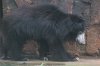
The single sloth bear is held in an exhibit titled by @snowleopard as exhibit #2. The bear definitely shows stereotypical stress behavior, with a lot of pacing back and fort.

The single sloth bear, as of February 2025.

It's might be a case of a lot of breedings, something also seen in Taman Safari Bogor for their carnivoras and also Surabaya Zoo in the case of their proboscis monkeys. Though, a lot of zoos often bringing in confiscated animals, most often are sun bears, or rescues.And, in truth, very few of the 15 Sun Bear exhibits are anything but mediocre. Why are there so many Tigers and Sun Bears here? Are some ex-pets? Are they bred for other zoos?
I think it's the mindset on how a lot of Indonesian zoos view conservation. Apparently, according to @Mossman Joe, "conservation" in these zoos are often just how succesful of them in managing and breeding certain (sub)species so that taxa are maintained at the zoo for as long as they could or want to, essentialy keeping the population of certain taxa that head. There's a reason why "protection" & "preservarion" are often what these zoos advertise about, without doing to many efforts in actual conservation and research or even just making a better living conditions for these animals.
It might be the similar case for the carnivoras of Ragunan.
Yes, Ragunan is probably the only Indonesian zoo that assigned their lions to a subspecies level. I'm pretty sure most of the lions (Excluding the white lions) are more than likely pure, since there apparently been a lot of imports for lions South Africa and elsewhere on the continent, with Gembira Loka Zoo with five lions as recent as 2024.The lions at the zoo are listed as Masai Lions, which I believe might be unique in Indonesian collections.
A lot of lions in Indonesian zoos are either the South African krugeri (I.e Batu Secret Zoo, Gembira Loka Zoo, and some others) and potentialy nubica (Taman Safari Indonesia parks and others that get their lions from them).
They sadly no longer have Sri Lankan leopards anymore in these exhibits. They're instead replaced by Sumatran tigers, which might be more pressing considering the condition of those two exhibits. I have no idea where the leopard (Javan and Sri Lankan) go, I'm aware they have atleast four of them, probably three since I recall that they sent an female leopard to Singapore some years ago.Sri Lankan Leopards and even a Jaguar (see below) can also be seen at the zoo, in rather dire, old-fashioned cages.
According to Zootierliste, Ragunan received an jaguar from Omaha's Henry Doorly Zoo in the 80's. It would be very interesting if this is the same jaguar from all those years ago (Considering how old a lot of the animals are there). It also appears that the jaguar might sadly have vision impairment.
Taman Margasatwa Ragunan on Instagram: "Kegiatan dokter hewan di saat libur satwa, salah satunya adalah hari ini merapihkan kuku satwa Jaguar. Potong kuku satwa apa lagi yaa #ragunanzoo #dkijakarta #tamanhutandki #jaguar"
It's a harrowing sight indeed, tons of primates that have essentialy prisons as their home, where it would be a gamble wether or not they're sent to the Schmutzer Primate Centre or the exhibits at the main zoos.It's all rather dismal, and reminiscent of the god-awful primate cages I reviewed in part one. This whole area is not accessible to the public, but it's very easy to take photos from the surrounding fence. Rows of gibbon cages, loads of macaques, and apparently a whole bunch of Tarsiers off-show as well. Zero signage anywhere.
They have some other off-display holdings for other groups (I.e tapirs, deers, etc.) that are far better than what the primates have. Their primates collection definitely doesn't handled quite well in term of living conditions.
As for tarsiers, from what I could understand, they're almost exclusively off-display animals. I'm aware that they have the Horsfield's tarsier and likely the only Siau Island tarsiers in captivity as of now.
It's sad a zoo that big and prominent, also being THE zoo of Jakarta, have a very outdated layout and infrastructures, with exhibits that essentialy a leftover from the early 20th Century. The fact that Ragunan are often seen as THE Indonesian zoos here as well is either sad or humiliating.Remember when I said that Ragunan Zoo takes 8 hours to see and that's pretty much non-stop walking the entire time? It literally is the Berlin Tierpark of Indonesia, with so many repetitive exhibits that even though there's around 60 mammal species, there could be so many more if there was a greater variety of species. All those Tiger, Sun Bear and Orangutan (both Bornean and Sumatran) exhibits take up a lot of space. On top of those, by my count the zoo technically has FIVE Asian Elephant exhibits.
All of those lands, if revitalized and managed profesionaly, could make Ragunan one of the world's finest zoos. But, as the management mentioned, revitalization of Ragunan potentially might cost billions of Rupiah, mixing with the status of Ragunan as a city-managed zoo, would make it very hard to ever achieve the true potential of Ragunan.
Either that, or being held in small barns or even worse tired up all days. I'm not aware of there's any Indonesian zoos with a large elephant free-roaming area.It's remarkable to see the Elephant Barns in Southeast Asian zoos, as they are partially open to the elements and rather small everywhere you go. Perhaps the elephants have 24/7 access to their outdoor enclosures at some of the zoos, and the exhibit below is a decent size for the two elephants residing there.



 I think one of the reasons we teamed up for this extreme trip is our similarly fast pace when exploring zoos. When we met in Sweden in 2022, we subconsciously sensed that we were capable of a multi-zoo adventure together.