Chlidonias Goes To Asia, part seven: 2024-2025

No, I wasn't going to bother. I just took photos of the ones I thought were interesting to look at.
If you don't want to do it personally you can 'outsource the work' and just post them on iNaturalist with eg. a high level ID of Lepidoptera and wait for people to identify them, think you should post them there anyways as it never hurts to have more data.
 
Alishan, day three


The room at my hotel comes with breakfast, which is at one of the restaurants on the other side of the tourist village, and with the cost of the hotel and the restaurants here I wasn't going to waste a "free" meal. The only problem was that it didn't start until 7am.

Hence this morning I started a bit later than yesterday - about 8am - and the birds along the boardwalk were much more plentiful. I'm not sure whether this was because the time was better, or if it was because unlike the previous drizzly and foggy days today was cloudless and warm, or indeed if it was just random chance.

Just the second bird of the day (after the ubiquitous Taiwan Yuhina) was a lifer. I saw the bird fly up and land on an exposed branch, got my binoculars on it, and saw a bullfinch. I knew there were two species of bullfinch here - the endemic Taiwan Bullfinch and the non-endemic Brown Bullfinch - but I couldn't remember which was which, only that one had a prominent black mask. I hadn't seen either species before, so whichever it was would be new for me. The bird I saw was perched in full view so I had a clear view of its mask. Then it flew across and down the boardwalk, followed by several more bullfinches which had been in the tree unseen.

I went down to see if I could find them again, and instead found a Eurasian Jay which posed obligingly for photos. I looked up the bullfinch later and it was the endemic Taiwan Bullfinch.

full

Eurasian Jay


Just a bit further along, I glanced down from the boardwalk and saw what I thought was a muntjac on the slope below. It looked a bit hefty for a muntjac but that must be the angle. I pointed my camera down at it and saw that its lower legs were orange. That didn't seem right. Then it lifted its head and turned it in profile. It was a Taiwan Serow!

full


I had, of course, been hoping to see a Serow while here but I didn't really expect it to happen. But to see one in broad daylight right in plain sight, which then just carried on feeding unconcerned by my presence, that was gob-smacking.

full


A lot of animal watching is just down to luck. If I hadn't had a late start I wouldn't have seen it. If I hadn't looked down from the boardwalk at that exact point I wouldn't have seen it. If the Serow had been standing a bit to the right behind some ferns I wouldn't have seen it.

Today was getting off to a great start!

full


My plan for the day was to go around the Giant Trees Boardwalk, then head up the trail leading along one of the rail tracks towards the Tashan Viewing Area, and then go back to the Zhushan Viewing Area.

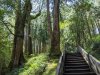
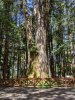
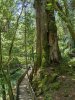
The Giant Trees Boardwalk has a pretty self-explanatory name. The mountains of Taiwan used to be covered in huge cedar forests - both the forests and the cedars themselves were huge. During the Japanese settlement period the forests were surveyed and intensively logged so most of the big trees are gone now, replaced in many areas by Japanese cedars. The Giant Trees Boardwalk covers an area which still has a number of really big trees which escaped the logging. They really are gigantic - not Sequoia size but still enormous. Photos don't relate the scale of them very well.

I saw quite a few Pallas' Squirrels in this area (I hadn't seen any on the previous two days) but not many birds. Apart for the usual ones there was a Snowy-browed Flycatcher, White-tailed Robin, and by one of the bridges a pair of Little Forktails.

full

White-tailed Robin


Going back up to Zhushan I side-tracked to Duegaoyue Station which is on the way. Where the sharp U-bend is at the 4km mark (where I would always see lots of birds) the rail track to Duegaoyue Station is at that bend. There is a footpath alongside the tracks to the station and if you continue on further still, about 500 metres past the station, there is the trailhead for the Duegaoyue Viewing Point.

This was another steep trail, much more so than the previous one. Most of the trail goes upwards - maybe the first three-quarters of it is steeply upwards - and then it drops down sharply into a valley and straight up the other side. I heard muntjac calling a couple of times while on the trail. At the top is a covered viewing platform, and there were Taiwan Niltavas in the trees next to it.


The platform for Duegaoyue Station overlooks a valley and turned out to be a very good bird-watching spot, with all the usual birds as well a new one for my Alishan list with Grey-chinned Minivets. Those are common birds though, found in lots of Asian countries. Better was when two small brown birds plumped down in the rank grass right in front of me. I assumed they would be bush-warblers of some kind but luckily one of them remained in view and proved to be a Taiwan Fulvetta - I even managed to get a photo although in it the bird looks like something owned by Jon Arbuckle.

full

Taiwan Fulvetta, looking like Odie!

Then there was the flock of bullfinches which landed in the top of a cypress down the slope a bit. These looked different to this morning's bullfinch. They weren't close enough to see the face clearly, but the white on the sides and wings was very obvious. I looked them up that night to be sure, and they were the Brown Bullfinches - both bullfinch species in one day!


Up at Zhushan no further birds were seen, but a muntjac bolted across the road by the botanic gardens, presumably the same individual as yesterday.

I waited around on the viewing platform until dark, and then walked down the road. It's about 5km and nothing was seen! I heard giant flying squirrels calling a couple of times - they make a loud EEP! noise like a bird. I saw one giant flying squirrel briefly in the park at the bottom, and another in the usual place on the boardwalk.
 
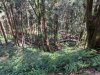
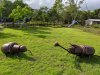
Forest at the Giant Trees Boardwalk. If you look closely there's a person in that last photo for some sort of scale.

PXL_20250508_020242680.jpg PXL_20250508_022632574.jpg PXL_20250508_035255690.jpg PXL_20250508_014700160.jpg PXL_20250508_023406828.jpg
 

Attachments

  • PXL_20250508_020242680.jpg
    PXL_20250508_020242680.jpg
    346.3 KB · Views: 113
  • PXL_20250508_022632574.jpg
    PXL_20250508_022632574.jpg
    335.1 KB · Views: 110
  • PXL_20250508_035255690.jpg
    PXL_20250508_035255690.jpg
    210.5 KB · Views: 118
  • PXL_20250508_014700160.jpg
    PXL_20250508_014700160.jpg
    207.6 KB · Views: 109
  • PXL_20250508_023406828.jpg
    PXL_20250508_023406828.jpg
    208.5 KB · Views: 124
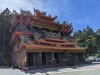
The fancy Shouzhen Temple outside the entrance for the Giant Trees Boardwalk.

PXL_20250508_012706367.jpg


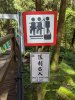
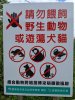
And a sign on the boardwalk. It's good advice, although personally I'd just wait for a seventh man to come along and then overtake them. It'd be perfectly legal.

PXL_20250508_013444112.jpg
 

Attachments

  • PXL_20250508_012706367.jpg
    PXL_20250508_012706367.jpg
    207.2 KB · Views: 113
  • PXL_20250508_013444112.jpg
    PXL_20250508_013444112.jpg
    157.3 KB · Views: 111
Alishan, final day


I was taking the train back to Chiayi today at 11.50am (which is the only train each day). It takes four hours and is more expensive than the bus - although still only about NZ$33 - but I'd been on the bus from Fenqihu to Alishan and it wasn't fun with the winding roads and crazy driver.

With only the morning for birding I just went to the Duegaoyue Station. which had been really good the day before. It was a bit quiet to start with, but the end at the toilet block proved to be where the birds were today, with a showy pair of Collared Bush-Robins (showy not really translating into good photos though!), Grey-chinned Minivets and Eurasian Jays, and the Taiwan Fulvettas were down there as well.

full

Male Collared Bush-Robin

full

Female Collared Bush-Robin

The Collared Bush-Robin has a remarkably bland name. It does have a collar, it is true, but it should be called the Amazing Bush-Robin or Fabulous Bush-Robin or something like that.

full


The birds were moving around a bit so when it went quiet I'd walk along the path to find where some more birds were, then back when they left, and so on. On one of these transitions I looked sideways and there was a shockingly bright Taiwan Rosefinch sitting in the short grass. I had no idea they would be that vibrant in real life. I got photos of both male and female.

full


full


It was a good way to end the stay at Alishan.

full


The train winds down the mountain in loops because the slopes are too steep for raised bridges. On each section the train will stop, the tracks will get switched over, and the train will go down the next slope. It's really juddery - I mean, really juddery - but better than a bus. Maybe. For four hours it got to be a little much to be honest.

When I was booking a hotel in Chiayi I had the site set to NZ Dollars and the cheapest one listed was the Back Home Hotel at NZ$60. But it was discounted from NZ$300! I wondered what a NZ$300 hotel would be like. It turned out to be bog-standard. I don't actually know what was up with that listing because the hotel's own tariffs posted on the door of my room said it was 2600 TWD which is about NZ$145. I mean, I still got it for less than half the cost, and it was the cheapest hotel listed for those days so I would have stayed there anyway, but it's a bit odd.

It was a hassle to get to though, unlike the previous hotel I'd had in Chiayi (the Yes Hotel which was right across the road from the train station). This hotel was only about twenty minutes walk from the train station but it was 30 degrees and I had a heavy pack to carry, and Taiwanese cities don't necessarily believe in having usable sidewalks so often you're walking on the road itself trying to avoid getting hit by motorbikes. Google Directions told me to catch a particular bus at 3.56pm which didn't have an English name or number, so when a bus came along at that time I showed the driver my phone and asked if this was the bus and he said yes. It wasn't. I got off at a transit station and asked at a service desk inside which bus I could get from there. Luckily a bus was coming along right then which went near the hotel. The closest stop was about ten minutes walk, so I only saved about half the walking but it took an hour to get there with all the stuffing around with the buses.
 
View from the Duegaoyue station platform - the final day when it was fine.

PXL_20250509_040949004.MP.jpg


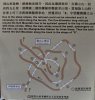
Map of the looping route of the Alishan Forest Train.

PXL_20250521_013119500.jpg


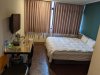
The room at the Back Home Hotel.

PXL_20250509_084145889.jpg

And this the view you get from a "$300" room...

PXL_20250509_084545105.jpg
 

Attachments

  • PXL_20250521_013119500.jpg
    PXL_20250521_013119500.jpg
    114.8 KB · Views: 122
  • PXL_20250509_084145889.jpg
    PXL_20250509_084145889.jpg
    125.3 KB · Views: 117
  • PXL_20250509_084545105.jpg
    PXL_20250509_084545105.jpg
    100.9 KB · Views: 117
  • PXL_20250509_040949004.MP.jpg
    PXL_20250509_040949004.MP.jpg
    139.6 KB · Views: 122
Taitung


Taitung is a town on the southeast coast of Taiwan. Basically I was doing a rough loop of the island from Taipei - down the west coast, and then up the east coast from Taitung to Yilan to Taipei again.

The main reason for having Taitung on my itinerary was to visit nearby Lanyu Island (aka Orchid Island) which is a two hour ferry ride away. There are several species of birds there which are either not found on the Taiwan "mainland" or are just much easier to see there. The main bird of interest to me was the Japanese Paradise Flycatcher, but there was also the Whistling Green Pigeon which is common on the island but rare on the "mainland", a local subspecies of Brown-eared Bulbul, and a couple of Philippine birds (Lowland White-eye and Philippine Cuckoo-Dove) which are extralimital here.

In the town itself I was wanting to visit the Taitung Forest Park because it was home to Styan's Bulbuls (which I had since seen in Hengchun) and Taiwan Hwamei (which I still hadn't seen). Whistling Green Pigeons were also seen there quite often, and Swinhoe's Pheasants apparently although having been there that does seem unlikely.


By train it is three hours from Chiayi to Taitung. The hotel I'd booked was in the downtown area, quite a way from the train station but close to the Taitung Forest Park (about fifteen minutes walk away). There was a bus from the train station to right by the hotel but the next one wasn't for another hour, so I caught a different bus to the bus station instead, which is about twenty minutes walk from the hotel. It wasn't as hot here as yesterday in Chiayi, but I was still drenched with sweat by the time I got there.

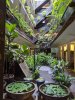
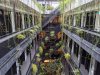
The Norden Ruder Hostel was an interesting place. It is a renovation of an abandoned hotel, where they removed the roof above the centre of the building so now it is open to the sky and every level has plants cascading down the railings. I'll put some phone photos of it in the following post. The rooms are tiny but it was a pleasant stay.


I left my pack at reception (it was still two hours before check-in time) and walked over to the Forest Park to look for Taiwan Hwamei. The first birds seen there, before I even got to the entrance gate, were a pair of Grey-capped Pigmy Woodpeckers and a Styan's Bulbul.

The park is quite big and shaped like a distorted rectangle. A road passes over the middle, so you go through a pedestrian tunnel from one side to the other. While not exactly "forest" the park is certainly well-treed and it has several lakes. There were a lot of people pedaling around on hire bikes, but I just walked.

There are a lot of birds at the park. The lawns would be covered in flocks of Javan Mynahs with lesser numbers of Common Mynahs and Red Collared Doves; Black Drongos hawking from the trees; and clouds of swallows swooping through the air. Styan's, Black, and Chinese Bulbuls were everywhere. Of course I saw a Malaysian Night Heron soon after arriving which wasn't surprising. A Black-naped Oriole was unexpected though.

full

Malaysian Night Heron


At Pipa Lake, at the south end of the park (the right end on the map), I was surprised to find a group of Brown-eared Bulbuls because I expected them to only be on Lanyu Island. I couldn't see them on any of the eBird lists for the Forest Park, so I'm not sure if they aren't supposed to be here. However, reading up on this, it seems that the subspecies isn't restricted to Lanyu after all but is also a rare resident in southern Taiwan. The subspecific name is in dispute - usually they are called Hypsipetes amaurotis harterti but apparently that name is preoccupied and the "correct" name is H. a. nagamichii.

full

Brown-eared Bulbul, with spiderweb adornment


An Emerald Dove flying up from beside the path also surprised me as another bird I thought I'd only see on Lanyu, although they are more widespread than that in Taiwan in reality.

I was looking out mainly for the Taiwan Hwamei and Whistling Green Pigeons but saw neither.


I returned to the Forest Park early next morning and spent half the day there. Ring-necked Pheasants are common here, calling all the time, and this morning I managed to see some males. The pure subspecies are really nice compared to the mongrel birds introduced to places like New Zealand.

full


Near Pipa Lake is a long rectangular reservoir called Flowing Pond (or Flowing Lake on the map), which looks like it had maybe once been a water treatment pond. I had tried to go there yesterday but the gate I found was chained. Today I found the other gate at the far end of the reservoir which was open. The "no swimming" signs were being soundly ignored by a number of people.

I headed along the road which runs parallel to Flowing Pond. There were Chestnut Munias in the grass and Grey Treepies in the trees. On the other side of the road is the south side of the river estuary where there were a few egrets and nothing else. Lots of stray dogs everywhere, but none were threatening. There were signs up warning people not to feed them.

Coming back round the Flowing Pond I found the gate was now locked! I had a look at the nearby road to see if there was a way out that way, but it was a busy highway with no sidewalk. I went back and headed down to the next gate, the one which had been locked yesterday, which was still locked today. Back to the first gate and I saw that there was a bit at the side which people obviously used to skirt around it over a pile of old branches, so I was free!


I made my way back around to Pipa Lake where I spied a Common Kingfisher, a male White-rumped Shama, and a Black-naped Monarch on a nest. I thought I had a pair of Taiwan Hwamei fly across the path but they turned out to be Taiwan Scimitar-Babblers.

full

Common Kingfisher

full

White-rumped Shama


At Ocean Theatre (i.e. the beach) there were Whiskered Terns. Coming back to Pipa Lake I finally saw a Taiwan Hwamei, not for long but I saw it well enough as it was singing inside some bushes. It was bigger than I expected it to be, which just makes it more surprising that they are so difficult to find!

Coming back to the northern part of the park through the pedestrian tunnel, I took the Forest Road around the edge of park, and on to Egret Lake where there were no egrets (and there had been no Pipa Toads at Pipa Lake, but I hadn't really expected those). There was signage for egrets and other birds implying that they breed here in season. More Malaysian Night Herons were seen amongst the trees around the lake, and there were a lot of Chinese Stripe-necked Turtles in the water.

full


The third day was also spent at the Forest Park. I started by going to Egret Lake, then Pipa Lake again. Taiwan Scimitar-Babblers were seen again and I briefly saw a couple of Taiwan Hwamei - if these were my first I wouldn't have even counted them because the sighting wasn't good enough. Crested Goshawk and Crested Serpent-Eagle were seen overhead.


I saw 43 species of birds in total at the Taitung Forest Park. The second day was the highest count with 34 species. There were three species I saw on the first afternoon which I didn't see on the second day, and another six on the third day which hadn't been seen on either of the other two days.


full

African Giant Snail at the Taitung Forest Park


On the previous evening I had wondered what the birds with weird calls were above the hotel foyer at night - I assumed they were some kind of day-bird like mynahs trying to sleep because the foyer is open to the sky and brightly lit. This night as I was coming back from eating I heard the same call, looked up and a nightjar fluttered past overhead. That made more sense! No wonder I hadn't known what the call was - the only nightjars I have heard (knowingly) before were the wood-chopping ones. I had a look on eBird to listen to the calls to make sure it was a Savannah Nightjar.


I never made it to Lanyu Island in the end. I had originally been going to stay there, but the only places available were on the other side of the island which was too inconvenient. Then I decided to just do it as a day-trip, but the weather forecast kept changing which put me off. If it was somewhere I was going by bus then that'd be different because it would only be a few dollars wasted if the weather turned bad, but the ferry is 2300 TWD return which is about NZ$120.

The bird site called Flycatcher Creek (where the Japanese Paradise Flycatchers in particular are found) is about 10km from the ferry terminal, so between 1.5 and 2 hours walk depending on how hot it was and how many birds were being seen along the way, or about 30 minutes by bicycle according to the Google Directions. There may be a bus but information was sketchy and it didn't appear to run in connection with the ferry timetable which was bizarre. There may be bike rentals at the terminal but I couldn't confirm that. If neither of those options worked then I would walk, which would mean I'd only have an hour at the site itself before having to walk back. If the weather was bad then it would be a pretty pointless waste of money because the walk would be miserable and there probably wouldn't be any birds out.

I kept thinking, yes I'm going, then I would change my mind after looking at the weather forecast again and thinking about the cost of the ferry. In the end I just dropped it, spent all three days at the Forest Park, and then caught a train up to Yilan.

I saw the Brown-eared Bulbul at the Forest Park, I still had a couple of other places I'd be visiting where the Japanese Paradise Flycatcher and Whistling Green Pigeon could potentially be found, and the Philippine birds can just wait until I get to the Philippines. There is another bird on the island of "importance", which is the Lanyu Scops Owl, but I generally can't find owls anyway and especially not very often in the daytime!

Annoyingly, I found out when I was back in Taipei that the Taiwan subspecies of Ryukyu Flying Fox is on Green Island off Taitung (it is the closer of the two islands, it's an easy day-trip, and it's the one most tourists go to). I knew from Mammalwatching that the bats could - rarely - be seen in the town of Hualien, but were otherwise on Guishan Island which has limited accessibility, so I hadn't bothered because I'd seen the species in Japan. Apparently Green Island is their stronghold in Taiwan though! Maybe if I ever come back I can go there.
 
Photos of the Norden Ruder Hostel.

PXL_20250511_080522339.jpg
PXL_20250512_223435015.jpg
PXL_20250511_080611773.MP.jpg


The first photo is the whole room, taken from the door (you can see the room number on it - the bathroom is on the left). I also took a photo with my sweatpants on the bed, so you can see that my legs do fit on it. The rest of me though...

PXL_20250511_080420030.jpg

PXL_20250511_082829635.jpg
 

Attachments

  • PXL_20250512_223435015.jpg
    PXL_20250512_223435015.jpg
    164.8 KB · Views: 85
  • PXL_20250511_080522339.jpg
    PXL_20250511_080522339.jpg
    276.4 KB · Views: 88
  • PXL_20250511_080611773.MP.jpg
    PXL_20250511_080611773.MP.jpg
    111.2 KB · Views: 85
  • PXL_20250511_080420030.jpg
    PXL_20250511_080420030.jpg
    85 KB · Views: 86
  • PXL_20250511_082829635.jpg
    PXL_20250511_082829635.jpg
    73.1 KB · Views: 85
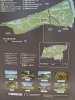
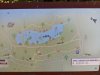
Map of Taitung Forest Park. Flowing Pond is the long rectangle at top right, Pipa Lake is below it, and Egret Lake is at the left end of the map.

PXL_20250513_022140547.jpg


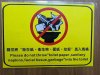
No feeding the stray dogs...

PXL_20250512_232245604.jpg


And just a phone photo of how you can see Malaysian Night Herons in pretty much any urban park in Taiwan. This one is by Egret Lake.

PXL_20250512_035716841.jpg
 

Attachments

  • PXL_20250512_035716841.jpg
    PXL_20250512_035716841.jpg
    245 KB · Views: 92
  • PXL_20250512_232245604.jpg
    PXL_20250512_232245604.jpg
    177.6 KB · Views: 82
  • PXL_20250513_022140547.jpg
    PXL_20250513_022140547.jpg
    93.5 KB · Views: 84
Last edited:
Yilan, day one


The train from Taitung to Yilan takes about three hours. The main reason I had come to Yilan was to visit the Fushan Botanic Gardens for Chestnut-bellied Tits. I'd also had a look on eBird for somewhere to spend another day and picked out the Dingliao Ecological Park which, with 268 species, is the second-highest site for the Yilan region.

The Mucha Boutique Hotel was the first hotel in a long time where I could check in just as soon as I arrived at 2pm (check-in time was 3pm).

The Dingliao Ecological Park is quite a way south of the central city - it would take quite a long time to get there and I thought I'd be spending hours there given that it seemed to be a major site based on species numbers - so I had looked on the eBird map for somewhere closer to the hotel which I could go to easily for the last few hours of the day after I arrived in Yilan. I found a few sites, but the buses didn't work for most (i.e. they ran too infrequently), so I settled on the Yilan Science Park (also spelled Ilan Science Park, because that's how Yilan is pronounced). Painted Snipe and Pheasant-tailed Jacana were two particularly interesting birds I saw on the eBird list which might be seen at this time of the year.

I caught the #771A bus from the Yilan Transfer Station, which is on the other side of the train station, and then walked for about twenty minutes from the closest bus stop. Most of the way was past rice fields - Yilan seems to basically be surrounded by rice fields. I saw a pair of Crested Mynahs by the road when I got off the bus. The very first mynah I saw in Taiwan was a Crested Mynah but since then I have only seen Javan and Common Mynahs, with the latter being outnumbered by the former at a ratio of about twenty to one. The Crested Mynahs are native to Taiwan, unlike the Javan Mynahs which were introduced and seem to be outcompeting them. They still appear to be common around Yilan though.

The Science Park wasn't what I was expecting. I thought it might be a museum with surrounding grounds in which the birding was happening. Instead it was a whole bunch of office buildings for tech companies (hence the name). There were some ponds and rice fields around them but it was basically exactly the same as the rest of the area which I walked past to get there, and the birds I saw were the usual open-country / wetland birds like prinias and munias and swallows, and the Black-crowned Night Heron pictured below.

full


I wandered around the roads trying to figure out what I was missing, but it doesn't seem like much of an area at all. I think it might be more of a winter place when the fields would be open water or mud for waders and waterfowl. Right now all the fields have either high grass or high rice hiding the water.

I was a little surprised not to have seen any Malaysian Night Herons while walking around - and then I saw one. Of course.

full


Google Directions gave me a bit of a run-around on which buses went back to town and from which stops but eventually I caught the #1776 bus back to the station.
 
Some statues seen around Yilan. The first ones were on the road to the Yilan Science Park, and the guy with the fish bowl was opposite the Yilan train station.

PXL_20250514_073841669.jpg PXL_20250514_073901664.jpg PXL_20250515_064935468.MP.jpg
 

Attachments

  • PXL_20250514_073841669.jpg
    PXL_20250514_073841669.jpg
    270.6 KB · Views: 82
  • PXL_20250514_073901664.jpg
    PXL_20250514_073901664.jpg
    313.2 KB · Views: 77
  • PXL_20250515_064935468.MP.jpg
    PXL_20250515_064935468.MP.jpg
    149.5 KB · Views: 76
Yilan, day two


Up in the hills to the west of Yilan is the Fushan Botanical Gardens, which was another site mentioned to me by @CMP, in this case as a site for the Chestnut-bellied Tit which is a mid-elevation endemic. I'd been to Baxianshan earlier to look for them without success, so this was round two.

Public transport is a little tricky to get here. There is a bus, the number 753, which runs from Yilan station, but only as far as Shuanglianpi, and it only runs three times a day so timing is critical (7.25am, 1pm, and 4pm from Yilan; and 8.25am, 2pm, and 5pm back).

There is a very handy website for Taiwan which has information on places like this (Fushan Botanical Garden > Yilan County > Tourism Administration, Republic of China (Taiwan)), which includes the closest bus stops. In this case it says the closest stop to the Fushan Botanical Gardens is Shuanglianpi2 at 3.96 km away. That's an easy walk. It turned out there are a couple of slightly closer stops as well (Shuanglianpi2 is not the terminus stop), but it also turned out - when I put the walking directions into Google - that it was actually 9.9 km from the gardens!

The other necessary thing to know is that although entry to the gardens is free, you need to register online beforehand because visitor numbers are capped. I tried to do this the morning of my visit (during the week it would never be full I don't think) but I couldn't fill in the fields to its satisfaction. You need a cell phone number and a landline number entered. I left off the landline and submitted but it wouldn't accept it. I put in the hotel's landline and submitted, and then it wouldn't accept my cell phone number because it's a NZ number - it seems you need a local number.

I just left it then because I figured I'd see if they would let me in anyway, and secondly I wasn't sure if I'd even make it as far as the gardens. If the Chestnut-bellied Tits are in the gardens I reasoned they will also be in the forest outside the gardens along the road, so I might just see them before even getting there. I had a look at the nearby sites on eBird, which didn't have as solid results for the tits as the gardens themselves but likely that is just because most people are only going to the gardens. One of the listed sites, Shuanglian Pond, was right by the Shangpi stop (the one after the Shuanglianpi2 stop), which meant I could go there first and maybe save a long walk!

The #753 bus can be caught from outside the front of the Yilan train station or at the Yilan Transfer Station (which is on the opposite side of the station and down the road a short way). The Transfer Station is the first departure point, so even though the other stop was closer to my hotel I went to the Transfer Station in the morning to make sure I caught it. Good thing I did, because the "bus" was just a car. It was painted like the buses but I'm pretty sure that if I'd been waiting at the other stop I wouldn't have even registered that this was a "bus" until it had already passed. Coming back the other way in the afternoon, it was a regular bus instead. Maybe they just don't expect to have more than a couple of passengers for the 7.25am bus.


Shuanglian Pond was my first port of call. It is right beside the Shangpi bus stop. The road to your right goes to the Fushan Botanical Gardens (there's another bus stop a bit further along that road as well) but if you walk straight ahead you can circle the pond (big pond or small lake, depending on your viewpoint). The eBird list for Shuanglian Pond has the tits recorded in various months. Maybe I'd waste an hour looking here first, or maybe I'd save myself hours of walking by looking here first - I wouldn't know until I tried. The first part is fields, but then there is forest surrounding the other end. I saw a Taiwan Blue Magpie on the other side and then flying overhead. Just after the first fields there is a very short track leading uphill, ending in a long-locked gate with a rusted chain, and up here I saw Morrison's Fulvettas and White-bellied Erpornis. I hung around here for a bit thinking that if those birds were here then maybe some tits were as well, but nothing else showed up.

With Shuanglian Pond producing nothing new, I carried on my way along the road leading to the botanic gardens. It's a straightforward walk, just follow the road with the white lines along either side and ignore any side-roads. The first fifteen minutes or so are through fields, and then at a junction with a sign for what appeared to be a fish farm there is a sign for the gardens on your left (all in Chinese) and from that point it is all forest. It's also all uphill, although not steep.

It is quite a busy road. Cars were going past regularly, and this was a week-day. I think you'd probably be able to hitch up or down easily if you wanted.

It was hot though: really really hot. I checked the weather on my phone when I was back at the bus stop later and it said "28 C, feels like 38 C" - that seemed about right! Literally the only bird I saw while walking along this road (after the fish sign) was a female Grey-chinned Minivet. There were a lot of dragonflies and damselflies about though, in all sorts of colours, and I started trying to photograph these in lieu of birds.

full


After a while I came to a walking track beside the road. It had a wooden gate across it locked with a big silver chain, but there were two cars parked beside it and there was a gap on either side for people to walk around. A wooden post just inside had Chinese characters on it but my phone couldn't discern them for translation. I found it on Google Maps later, and it is listed on eBird as the Ayu Forest Road with a total of just 24 species from 11 checklists.

This track went uphill as well, more steeply than the road itself, and it was nice forest. There were more Odonata in here, and even a little snake - Maki's Keelback (Hebius miyajimae). Still very few birds around - I just saw some more White-bellied Erpornis and a Bronze Drongo (remarkably my first one in Taiwan!).

full

Maki's Keelback


Coming back to main road I continued walking towards the gardens, but when I reached a sign saying that there was a control post 200 metres ahead and to have your documents ready I turned back because I didn't have any. This is marked on the Google map as "Fushan Research Center Control Post". It's about half way to the gardens - I think maybe the "3.96 km" of that website I linked earlier is to this checkpoint and not the actual gardens. The walking track I was on just before that (Ayu Forest Road) is also marked on Google Maps just north of the Control Post marker.

I was 0 for 2 with the Chestnut-bellied Tits. I still had a hope that I might find some at Wulai a few days from now, although that hope was dim.

I had half an hour before the bus was scheduled to arrive at the Shangpi stop. I decided not to go back to the nearby lake to check for Chestnut-bellied Tits again, because I wasn't confident in the reliability of the bus arriving when either Google or the signboard said and I didn't want to miss it, although it did in fact arrive right when the bus sign said it would.
 
Yilan, day three - Dingliao Ecological Park


The Dingliao Ecological Park is easy to reach. I took the train a few stops from Yilan station to Luodong station, then bus #1791 to the Longde Industrial Park stop. The Dingliao Ecological Park is about fifteen minutes walk from here. There are a handful of buses which run along here but all are pretty infrequent.

This site has 268 species listed on eBird, the second-highest tally for the Yilan area. But, as is often the case, it was not what I expected when I got there. It's really small for one thing. From the Google map it looked like it might extend quite a distance, but it is basically just a long rectangular pond (or small lake) with a path around it. The path is mostly through thick undergrowth, especially pandanus, with the lake only being visible in a few spots and I saw no birds at all on the water. At one end of the lake the path goes between it and a smaller pond, and there are a few viewing platforms on one side of the main lake, but apart for the main path all the smaller trails are fully overgrown and impassable.

Looking closer at the eBird checklist it is noticeable that there are a lot of winter waterfowl, and a lot of intermittent waders and gulls bulking up the numbers. I set the list for just May and the number reduced from 268 to 147 (and only one duck remained, the Eastern Spot-billed Duck). A fair bunch of the remainder are also rarely reported. Regardless, the main bird of interest to me here was the Japanese Paradise Flycatcher which I haven't seen before. There are two blocks during the year when they are reported here, in April/May and September/October. Given that the site seems to be frequently-visited throughout the year I think that means that they just aren't here at all during the rest of the year. The Japanese Paradise Flycatcher was my main reason for wanting to go to Lanyu Island, so if I could see it here then I'd be happy.


It was, again, excessively hot today. Even standing still in the shade I would be pouring with sweat. It was horrible. However I had a better bird day than at Fushan yesterday.

I entered the site on a gravel road running down the side of a premises which I thought was some sort of museum, but I just looked it up and the name on Google -- 綺麗珊瑚寶石觀光工廠 -- translates as something like Qili Coral Gemstone Tourism Factory. Although the times on the gate said 11am to 6pm, it was still closed when I left the park.

The gravel road took me to the top-right corner of the rectangular pond (if looking at it on the map which I'll post a photo of after this), so I worked my way around the lake anti-clockwise until I reached the viewing platform (up a set of stairs from the lake track), then I went along the road at the bottom of the park and up the road on the left end trying to get to the second viewing area, but the track to there was blocked so I kept going and reached the beach which I guess is where all the gulls and such on the eBird list come from, then returned to the viewing platform and reversed my path before leaving. I didn't try to use any of the overgrown tracks because it was so hot that it seemed like really great snake weather, and indeed coming back from the beach I saw a "huge" snake crossing the road - no idea what it was because it was too quick, but I'm thinking probably a rat snake (which are harmless, but there are a lot of venomous snakes in Taiwan as well).

I didn't see a lot of birds while at the park, but there were some new ones for my Taiwan list. Walking along the "top" side of the lake (if looking at the map) I was wondering if this was the area where the Japanese Paradise Flycatchers were found. It seemed like it might be good for them, with its dense thickets.

A couple of Swinhoe's White-eyes flew over the track and suddenly the bushes were alive with birds. They were tricky to get a fix on because they were all inside the bushes and moving rapidly, but eventually I saw enough bits and pieces to identify them as Vinous-throated Parrotbills. Of course once I'd managed to establish that then they started coming out fully into the open where they could be plainly seen (but not photographed very well because they didn't stay still for long enough).

full

Vinous-throated Parrotbill


Then, out popped a female Japanese Paradise Flycatcher! I think I'd seen it a minute earlier but it was so brief that I'd thought it more likely to have been a female Black-naped Monarch. This time it perched right in the open, flicking its tail, its blue eye-ring shining brightly in the sun. Then it was gone.

My attention was distracted by an Oriental Cuckoo perched in a nearby tree, calling "boop boop". Cuckoos can be difficult to see so I watched it until it flew away, and then went back to the small birds in the undergrowth. I saw the flycatcher again, but couldn't photograph it.

Continuing along the track to where it led between the two ponds I saw a Grey Treepie, and then the female flycatcher again. Or a second one, or maybe it was even a third one. It seemed very mobile to be just one bird. I decided to go back to where the parrotbills were - if there was one or more female paradise flycatchers here then there should be a male somewhere. I have seen lots of Asian Paradise Flycatchers in southeast Asia, where the males are either brown with a black head, or pure white with a black head. The male Japanese Paradise Flycatcher is completely black apart for the white belly. I wanted to see that - the female would do, but a male would be better.

The parrotbills were just as active, this time joined by Rufous-capped Babblers, and there was a Pallas' Squirrel running about through the trees as well for the daily mammal quota.

I couldn't find any male paradise flycatchers, so I continued around to the other side of the pond where somehow the whole flock of parrotbills and babblers had beaten me there. They must have flown straight across, or maybe there were two different flocks on either side? There was a female paradise flycatcher amongst them again! Bird number four, or still bird number one? Who knew.

I was getting good views of all these birds as they jumped in and out of the bushes but I gave up trying to get photos because they were just too quick. The two photos I've posted here were the only shots I got that were passable.

full

Rufous-capped Babbler


I made a brief stop at the main viewing platform, with a view over the whole park and the sea beyond, then went along the road to emerge at the beach where it was cooler due to the breeze but birdless, then went back the same way, seeing some Taiwan Scimitar-Babblers, an Emerald Dove, and the big unidentified snake along the way.

Back on the track by the pond I came across a beautiful Swinhoe's Giant Snail (Nesiohelix swinhoei), an unexpected find in this heat!

full


Dingliao Ecological Park was a pretty disappointing site for me. I don't know if it is the time of year or just this specific day was too hot, but I only saw about a dozen bird species there. However the main reason I was there was to try and see the Japanese Paradise Flycatcher which I succeeded at, even if I didn't see a male, so it was still a good day.
 
Last edited:
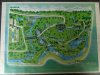
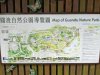
Map of the Dingliao Ecological Park.

PXL_20250516_013750308.jpg


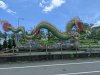
Dragon statue on the main road nearby.

PXL_20250516_025920455.MP.jpg


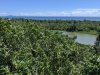
View from one of the platforms, showing the main pond with the ocean beyond. If you look closely you can see an island whose hat is like a shark fin.

PXL_20250516_014211930.MP.jpg
 

Attachments

  • PXL_20250516_013750308.jpg
    PXL_20250516_013750308.jpg
    112.1 KB · Views: 67
  • PXL_20250516_025920455.MP.jpg
    PXL_20250516_025920455.MP.jpg
    187.6 KB · Views: 71
  • PXL_20250516_014211930.MP.jpg
    PXL_20250516_014211930.MP.jpg
    281.2 KB · Views: 71
Back in Taipei again


Nearly at the end of the Taiwan accounts, just the last few days in Taipei left - but I've gone through five countries since leaving Taiwan so there is still quite a bit to go in the thread before I'm all caught up!

Hong Kong, China, and Thailand; and then Australia and New Zealand which don't actually count but they are real countries allegedly

In Taipei I was staying back at The Dealer Hotel, in a different room on a different floor but with the same Smiling Bears bed spread. It must be in every room. There was a different bird painting in the hallway of this floor (Taiwan Blue Magpies rather than fruit doves).

When looking to book a hotel back in Taipei it was surprising how many of them didn't have 24-hour reception, or had self-check-in (i.e. no reception), or required you to call the day before checking in (even though you were booked), or even where the check-in address wasn't the hotel address (which I find really weird). So The Dealer Hotel it was.
I arrived early, left my pack at the hotel, and went off to the Guandu Nature Park which is easy to reach by metro. I'd picked this off the eBird map based on species list and location. There was an entry fee here (60 TWD). Again much smaller than I expected it to be. I only saw 19 species of birds here, including Vinous-throated Parrotbills amongst the other more-commonly seen birds, but I did finally manage to get photos of Taiwan Scimitar-Babblers.

full


I saw four Malayan Night Herons, two being adults and two juveniles (and one of the juveniles was begging at one of the adults).

full


full


In general not a great visit, most of the water areas couldn't be viewed very well, and one whole section of the park was closed off.

full


After leaving the Guandu Nature Park I walked up the road a bit and along the river. In one direction it was mangroves but they were too thick to see anything, so I went the other way. Mudskippers were seen, my first ones in Taiwan because I haven't really been to any suitable mangrove areas before this, but otherwise the most interesting bird was a Common Sandpiper.

full


full


In the evening I went back to Fuyang Eco Park to look for those Taiwan Red Giant Flying Squirrels - if you recall I had been here twice when in Taipei the first time and seen a Taiwan Ferret-Badger but no flying squirrels.

On this visit I saw two Masked Palm Civets almost immediately, one of which walked across a branch crossing overhead of the path. Both animals were very calm and not bothered by the torchlight in the slightest. It wasn't until later when writing up my lists that I realised these were a lifer. Somehow I haven't seen them anywhere else in the wild, but I have seen so many in zoos that I didn't even realise.

Going up the steps to the top platform I saw another ferret-badger. It was scuttling through a thicket beside the steps and I got a very good view of its bottom so I saw the fur colour and the tail. I think it was a different animal from the first one I'd seen here because it looked smaller.

There were still no flying squirrels in evidence.
 
A couple of maps of the Guandu Nature Park, and another sample of vending machine items. The can in the middle translates as being rice pudding. The one on the right might be dolphin juice, I'm not sure.

PXL_20250517_051337491.jpg PXL_20250517_051444109.jpg PXL_20250517_061916708.jpg
 

Attachments

  • PXL_20250517_051337491.jpg
    PXL_20250517_051337491.jpg
    185.6 KB · Views: 50
  • PXL_20250517_051444109.jpg
    PXL_20250517_051444109.jpg
    197.2 KB · Views: 48
  • PXL_20250517_061916708.jpg
    PXL_20250517_061916708.jpg
    125.2 KB · Views: 50
Back
Top