Amur leopard's Summer travels

Back with quick run-through of this weekend:

Saturday (05/07)

I had to sort out a few things in the morning but decided afterwards that I would try and see the two remaining Mandai parks (plus BP a second time) on that day. It was, as ever, fairly hot but at least the sun wasn't out as much. Anyway, here goes.

Rainforest Wild Asia

I have absolutely no clue what to think about this place. It's honestly a pretty weird concept for the most part, interspersed with world class exhibits, immersion and also a smattering of not so great stuff. Zooish and honeybadger among others have posted great exhibit photos already, so would advise to refer to those for some visual aid.

As a brief summary, the idea behind the park as far as I can tell is to have one circular elevated boardwalk that as a loop around the zoo, and then at the ground level a series of trails in the forest. Most enclosures are viewable from either or. I like this idea I think, I know some people were complaining about it being a little muddy at the bottom, but generally I thought the idea worked well.

Another thing that was excellently executed was, big surprise, the primate exhibitry. In probably the singular best primate exhibit I've every seen you have siamang, douc and javan langur (apparently mixed, though this might be a clever illusion, plus Philippine spotted deer at the ground level) in some of the tallest trees I have ever seen. It's glorious. Siamangs vocalising at the summit of those trees, doucs closer to the boardwalk, deer at the bottom and so on. Lovely experience, great stuff. Up there with the best primate exhibits I've ever seen, and a bunch of those are at another Mandai park incidentally...

Another thing that was astonishingly well executed was the cave. I've been lucky enough to go into some pretty incredible caves in my life - this was an entirely fake cave and yet it completely looks the part to be honest. You go in, there's immediately a couple of pools for Soro brook carp and Cave blind fish (didn't notice this in there but maybe the only species not actually found in Asia). Then follows a pretty long stretch of cave with pretty much nothing, which is an experience in itself to be honest. There are off-shoots for pretty huge areas for Cave racer snakes, the largest Asian forest scorpion exhibit ever (with a UV light to make them glow) and so on. It's excellent, a great experience, and fantastic for photos as well. There's also viewing over the neighbouring crocodile bridge, which is also great, by the by. I wish it was Rainforest Wild Eurasia so they could import some olms :P. As ever, it's pretty much incomparable to other such exhibits I've seen - Osnabrueck's underground exhibit is ridiculously good but not on the same scale, nor with the same huge investment in cave realism. The amount of educational material on not just the cave wildlife but also the geology of the caves themselves is astounding.

However, I'm a bit puzzled by the rest of the park. In the bottom corner of the zoo, for most people the first thing they see is the Karst mountains area. This is modelled after regions of Vietnam etc where you'd find Delacour's langur for example (not sure if the langur-karst thing extends to other species or locales actually?). Anyway, the investment on this area must have been huge. The karst mountains are replicated pretty nicely, and visitors essentially loop around this lower central karst peak on an island on their own karst mountain-side area via a bunch of boardwalks, staircases and swing bridges. It's pretty hard to describe but here's a photo (courtesy @Nadchew_ ) to better explain. So the vast majority of the actual Karst bit is the visitor area, and the langur exhibit is viewable from all sides and most angles.

full


While the exhibit maybe lacks a little bit of privacy, the weirder thing for me was nothing to do with it - there's a whole climbing trail thing around the karst mountain that you can do for a extra fee. It was relatively popular I think by the looks, but I wonder how profitable it actually is given all the extra cost to making the karsts and the numerous staff employed to even run it at all. It's an interesting concept, but I wonder what came first - was it the 'let's make a langur karst exhibit' or 'let's fit in a climbing activity somewhere' and the langurs were a thought later down the line? I honestly have no clue - the climbing route is pretty extensive and looks really fun, but also kind of odd to be climbing and abseiling right next to people visiting the zoo. Remains to be seen whether other places will adopt such ideas. That sort of thing isn't limited to that area - there's also a bungee jump somewhere else in the zoo too, and some trampoline area too. I have no idea what to think about this, I find it weird and kind of innovative and tailored to a good chunk of their visitor-ship all at the same time. Would love to hear other people's thoughts.

The rest of the zoo is mostly fairly typical rainforest exhibits, with above average signage + educational material for the most part (although there was Luzon hornbill unsigned in the myna-pheasant aviary if I'm not mistaken). I wasn't a huge fan of the tiger exhibit, but objectively it seems fairly good, and this goes for most of the other exhibits really. Tortoises are in excellent quarters and babirusa similarly. One of the sun bear exhibits seemed a little small - I really wish they applied a similar approach with their carnivores to that with their primates at Mandai, but I guess it's seen as unnecessary risk, and carnivores are also less likely to show.

The one concern I have is the Malayan tapir exhibit. I really don't think it's very good at all. I was really surprised by this. Most of the rest of the park is of a high standard, with bits that are outstanding, but these couple of exhibits are poor. There's zero privacy, especially for one that is viewable from every side and the tapir was squished into the wall both times I passed where it was least visible. For a pretty shy animal, and a brand new zoo, it was inexplicably bad, especially when you see the standard set by the rest of the place.

In summary, how does it compare to the other Mandai parks? It's better than River Safari for me, but that'll be in a later post. Bird Paradise is by far the best Mandai park for me, upon revisit, but also beforehand *. And for the other two it's a bit of a toss-up, but the experience at Night Safari is largely unrivalled. So tentatively BP > NS > SZ = RWA > RW. I really wonder what Singaporean members think though, as those are all single visits for now except BP. Would love to hear opinions on Rainforest Wild Asia.

* A little note on this, my BP revisit was great because I got to spend a lot more time in the largest aviaries, go on all the paths and so on. I think Heart of Africa might be the best single aviary in the world, and is the best single zoo exhibit I've ever seen I reckon. Genuinely stunning, cannot recommend it highly enough.
 
Back with quick run-through of this weekend:

Saturday (05/07)

I had to sort out a few things in the morning but decided afterwards that I would try and see the two remaining Mandai parks (plus BP a second time) on that day. It was, as ever, fairly hot but at least the sun wasn't out as much. Anyway, here goes.

Rainforest Wild Asia

I have absolutely no clue what to think about this place. It's honestly a pretty weird concept for the most part, interspersed with world class exhibits, immersion and also a smattering of not so great stuff. Zooish and honeybadger among others have posted great exhibit photos already, so would advise to refer to those for some visual aid.

As a brief summary, the idea behind the park as far as I can tell is to have one circular elevated boardwalk that as a loop around the zoo, and then at the ground level a series of trails in the forest. Most enclosures are viewable from either or. I like this idea I think, I know some people were complaining about it being a little muddy at the bottom, but generally I thought the idea worked well.

Another thing that was excellently executed was, big surprise, the primate exhibitry. In probably the singular best primate exhibit I've every seen you have siamang, douc and javan langur (apparently mixed, though this might be a clever illusion, plus Philippine spotted deer at the ground level) in some of the tallest trees I have ever seen. It's glorious. Siamangs vocalising at the summit of those trees, doucs closer to the boardwalk, deer at the bottom and so on. Lovely experience, great stuff. Up there with the best primate exhibits I've ever seen, and a bunch of those are at another Mandai park incidentally...

Another thing that was astonishingly well executed was the cave. I've been lucky enough to go into some pretty incredible caves in my life - this was an entirely fake cave and yet it completely looks the part to be honest. You go in, there's immediately a couple of pools for Soro brook carp and Cave blind fish (didn't notice this in there but maybe the only species not actually found in Asia). Then follows a pretty long stretch of cave with pretty much nothing, which is an experience in itself to be honest. There are off-shoots for pretty huge areas for Cave racer snakes, the largest Asian forest scorpion exhibit ever (with a UV light to make them glow) and so on. It's excellent, a great experience, and fantastic for photos as well. There's also viewing over the neighbouring crocodile bridge, which is also great, by the by. I wish it was Rainforest Wild Eurasia so they could import some olms :p. As ever, it's pretty much incomparable to other such exhibits I've seen - Osnabrueck's underground exhibit is ridiculously good but not on the same scale, nor with the same huge investment in cave realism. The amount of educational material on not just the cave wildlife but also the geology of the caves themselves is astounding.

However, I'm a bit puzzled by the rest of the park. In the bottom corner of the zoo, for most people the first thing they see is the Karst mountains area. This is modelled after regions of Vietnam etc where you'd find Delacour's langur for example (not sure if the langur-karst thing extends to other species or locales actually?). Anyway, the investment on this area must have been huge. The karst mountains are replicated pretty nicely, and visitors essentially loop around this lower central karst peak on an island on their own karst mountain-side area via a bunch of boardwalks, staircases and swing bridges. It's pretty hard to describe but here's a photo (courtesy @Nadchew_ ) to better explain. So the vast majority of the actual Karst bit is the visitor area, and the langur exhibit is viewable from all sides and most angles.

full


While the exhibit maybe lacks a little bit of privacy, the weirder thing for me was nothing to do with it - there's a whole climbing trail thing around the karst mountain that you can do for a extra fee. It was relatively popular I think by the looks, but I wonder how profitable it actually is given all the extra cost to making the karsts and the numerous staff employed to even run it at all. It's an interesting concept, but I wonder what came first - was it the 'let's make a langur karst exhibit' or 'let's fit in a climbing activity somewhere' and the langurs were a thought later down the line? I honestly have no clue - the climbing route is pretty extensive and looks really fun, but also kind of odd to be climbing and abseiling right next to people visiting the zoo. Remains to be seen whether other places will adopt such ideas. That sort of thing isn't limited to that area - there's also a bungee jump somewhere else in the zoo too, and some trampoline area too. I have no idea what to think about this, I find it weird and kind of innovative and tailored to a good chunk of their visitor-ship all at the same time. Would love to hear other people's thoughts.

The rest of the zoo is mostly fairly typical rainforest exhibits, with above average signage + educational material for the most part (although there was Luzon hornbill unsigned in the myna-pheasant aviary if I'm not mistaken). I wasn't a huge fan of the tiger exhibit, but objectively it seems fairly good, and this goes for most of the other exhibits really. Tortoises are in excellent quarters and babirusa similarly. One of the sun bear exhibits seemed a little small - I really wish they applied a similar approach with their carnivores to that with their primates at Mandai, but I guess it's seen as unnecessary risk, and carnivores are also less likely to show.

The one concern I have is the Malayan tapir exhibit. I really don't think it's very good at all. I was really surprised by this. Most of the rest of the park is of a high standard, with bits that are outstanding, but these couple of exhibits are poor. There's zero privacy, especially for one that is viewable from every side and the tapir was squished into the wall both times I passed where it was least visible. For a pretty shy animal, and a brand new zoo, it was inexplicably bad, especially when you see the standard set by the rest of the place.

In summary, how does it compare to the other Mandai parks? It's better than River Safari for me, but that'll be in a later post. Bird Paradise is by far the best Mandai park for me, upon revisit, but also beforehand *. And for the other two it's a bit of a toss-up, but the experience at Night Safari is largely unrivalled. So tentatively BP > NS > SZ = RWA > RW. I really wonder what Singaporean members think though, as those are all single visits for now except BP. Would love to hear opinions on Rainforest Wild Asia.

* A little note on this, my BP revisit was great because I got to spend a lot more time in the largest aviaries, go on all the paths and so on. I think Heart of Africa might be the best single aviary in the world, and is the best single zoo exhibit I've ever seen I reckon. Genuinely stunning, cannot recommend it highly enough.
Glad to see another thorough review of Rainforest Wild Asia on this site and it is always great to see how people perceive this very intriguing park. I think I have stated this in other posts before but Rainforest Wild (both Asia and Africa) were always planned to have adventure or ride-themed elements incorporated into the park along with the animals. The upcoming Rainforest Wild Africa will have a suspended track ride as well. The main purpose of having these non-animal related experiences (besides monetary gain) was to allow younger or less experienced guests to experience more thrilling activities in a more controlled environment. The rock wall at the karst and cave exploring in one section of the Cavern have been planned from the start as they are activities people can do outside of Mandai in their respective habitats in different parts of the world. It is more or less to give people either their first taste into this adventurous activity or for those who can't travel elsewhere to get a chance to try. Additionally a lot of the park was built around retained natural trees to ensure most of the natural heritage is kept intact, so thats why the pathways (both above and on ground) seem so winding. The tapir exhibit is small for this reason apparently. But there are plans to expand the habitat sometime in the future.
 
I have no idea what to think about this, I find it weird and kind of innovative and tailored to a good chunk of their visitor-ship all at the same time. Would love to hear other people's thoughts.

The rest of the zoo is mostly fairly typical rainforest exhibits, with above average signage + educational material for the most part (although there was Luzon hornbill unsigned in the myna-pheasant aviary if I'm not mistaken).

I find the extra (paid) activities look great though, still align with the nature/adventure theme without being too “theme park-ish”. As @Nadchew_ pointed out - there is a certain demographics that may want to try these experience. Some of my non zoo-goers friends are interested with these activities. The luzon hornbill is a recent addition hence the lack of signage. I agree with you about the tapir exhibit, a bit puzzled to see a new park with Mandai’s resources come up with such enclosure.

But there are plans to expand the habitat sometime in the future.

Glad to hear that they acknowledge the issue and there are plans to rectify it. Hopefully it is in the *near* future. :D
 
And continuation of the post above:

River Wonders

I can't really give a concrete judgement on River Wonders because I arrived really quite late in the day so had to speed through most of it. However, I will say that I didn't particularly like it for the most part. The manatee exhibit is great, and the giant catfish are exceedingly impressive, but otherwise I wasn't a huge fan.

It didn't really feel contiguous at all to me, even the Amazon zone which is effectively the entire right half of the zoo feels so disjointed. But again, I raced through pretty quickly, so all with a pinch of salt. Either way, the boat ride: for me, not great. I thought the boat ride itself was pretty pleasant, but everything else about it was pretty poor. For the most part the enclosures are pitifully small and passed far too quickly. I think the premise is not a bad one, Chester has a similar sort of thing but with two huge differences: 1) there is zero compromise on animal welfare, if you don't see the animal you don't see it, and 2) there's also a walking path so you can go see all of those species in your own time, and the boat ride just offers a different perspective. I'm not entirely sure how much other people visiting enjoyed it, though, I'm sure it doesn't particularly matter anyway because everyone is bound to go on it any way given pretty much a quarter of the zoo is only visible through it.

In the entire Amazonian zone the only exhibit that was great was the manatee exhibit, very impressive stuff, and some nice side exhibits for other fish. I don't remember the otter exhibit's ground portion well enough to pass any judgement but that area was mostly very good. Aside from that the rest of the Amazonian sector isn't terribly well designed for me and has a number of flaws.

Onto the left side. The best part about the panda exhibit is the gust of cold air you receive upon entry. Besides that it's largely pretty disappointing, but again if I ignored animal welfare I'd probably love it. Unfortunately that is not the case and the red panda exhibit is pretty puny, the giant panda exhibits largely similarly, but I do appreciate that exhibiting them is such a hot country is maybe not easy, but also pandas still occur in regions that get fairly hot in summer no? Not sure, either way, for the sum of money that must have been spent, pretty middling.

The rest is predominantly various other rivers in the world explored fairly briefly for the most part. The most impressive exhibit here is the Mekong one, with the catfish specimens being pretty spectacular. There's also a few tanks like the mudskipper one which I liked a fair bit too. I'm not a huge fish guy and I was also pretty rushed through this section so I'm probably the last to make a fair evaluation but there wasn't anything particularly impressive here for me. In short, not entirely convinced for the most part - promising concept, but a lot of money clearly went towards stuff that either hasn't stood the test of time too well or wasn't fantastic to begin with.

Either way, quite the range in Mandai. One park which is consistently excellent and has some of the best zoo exhibits in the world, two with similarly stellar exhibits but some shortcomings too, one which is pretty incomparable to any other zoo experience I've had and then this one, which is mostly fine but looks like it was meant to be much more I guess.

Sunday

Very quiet day, only went to Jurong Lake Gardens. It's a pretty recently renovated park on the outskirts of the city with some lovely scenery, although some of the trees have yet to grow in a little. Bits of it make a lovely walk or evening next to the lake though.

The main draw here for me was a Sunda brush cuckoo that had been hanging around the gardens parasitising off a pied fantail. I'd say most people know about this parasitic behaviour but I'm not fully sure how common it is to actually see it, so felt very cool witnessing the 'chick' mimic the calls and be fed by a bird half its size. Cuckoos are also very beautiful birds in their own right I find - the barring on this particular species is lovely.

Turns out there was also a second (younger) cuckoo chick parasitising off the same species not far away! So was lucky enough to see it twice at slightly different stages. Was also lucky to see two parakeet species, including the slightly rarer but very vocal Long-tailed parakeets that hang around certain areas of Singapore. I also had an unsuccessful attempt at hunting around for nightjar in fallen leaves, but either their camouflage was very much working or they weren't present on the day. Will have to return another day and see if I can change that!

Also went to a Michelin-starred hawker-stall-turned-restaurant which is typically cheap for Singapore, although it wasn't quite as good as maybe expected.
 
Very briefly - today went to Singapore Quarry directly after work with the explicit aim of seeing a Barred eagle owl that's been hanging around there for the past few years and is currently raising a chick. It's a bird that's been seen so much, but that is so impressive, that the local birders have gotten seeing it down to a bit of an art, with its ordinary perches, best vantage points and so on all firmly established.

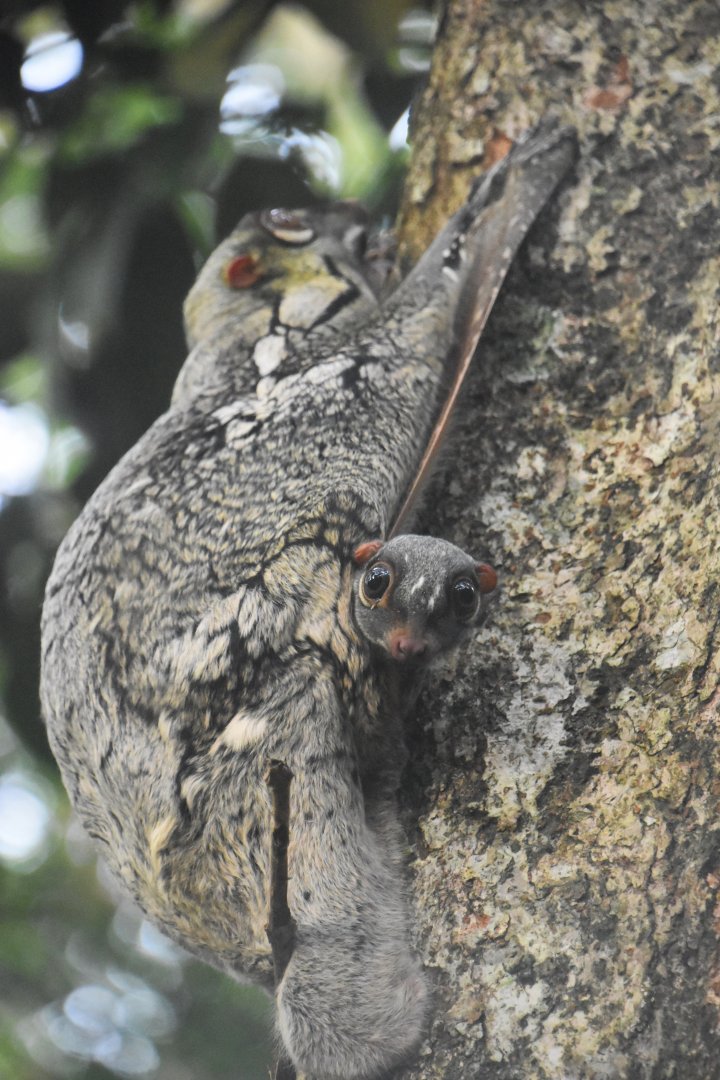
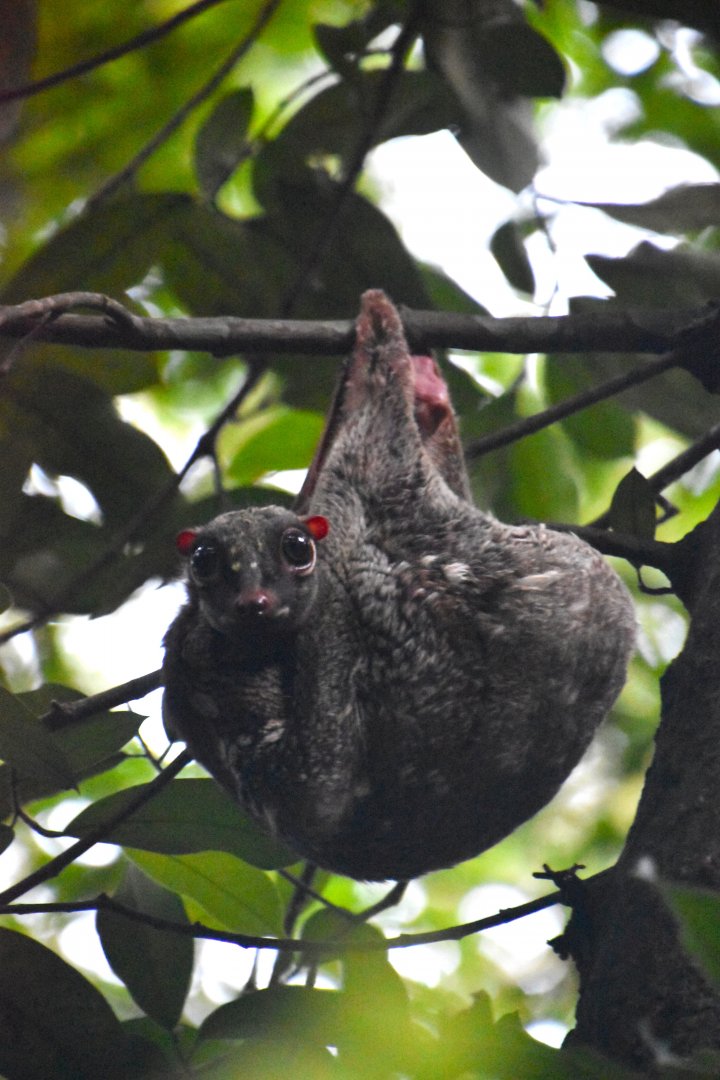
I made my way over as the sun was dropping. On the way through the parking lot outside the MRT station I was incidentally thinking about colugos, as you do. I looked up from my reverie and right there, just a few metres away, was not only one colugo but one with a baby! It was really close - in fact if I strayed off the trail and jumped it would have probably been possible to touch it. The baby was very diligent in following my every movement while the mother stayed largely unfazed. I really wonder if the baby's movements are a little dangerous for the mother with regards to birds of prey and so on. The camouflage is pretty spectacular, with the fur tightly resembling that specific tree type. It's a very cute and strange animal, and very glad to have finally seen one, and in such great circumstances too!


Then I turned the corner and immediately there was a family of four or five wild boar just down the road. Was beginning to think I was going to see every mammal species in Singapore in rapid succession! I did in fact go on to see at least two more mammal species (two bat species, although one of them unidentified), but not the owl, although myself and the other birders present did hear both the juvenile and the adult several times in fairly close proximity. Unfortunately, hearing the owl and seeing it in pretty thick jungle are two very different prospects, so empty-handed on that front unfortunately tonight, but will be back for sure!
 
Very briefly - today went to Singapore Quarry directly after work with the explicit aim of seeing a Barred eagle owl that's been hanging around there for the past few years and is currently raising a chick. It's a bird that's been seen so much, but that is so impressive, that the local birders have gotten seeing it down to a bit of an art, with its ordinary perches, best vantage points and so on all firmly established.

I made my way over as the sun was dropping. On the way through the parking lot outside the MRT station I was incidentally thinking about colugos, as you do. I looked up from my reverie and right there, just a few metres away, was not only one colugo but one with a baby! It was really close - in fact if I strayed off the trail and jumped it would have probably been possible to touch it. The baby was very diligent in following my every movement while the mother stayed largely unfazed. I really wonder if the baby's movements are a little dangerous for the mother with regards to birds of prey and so on. The camouflage is pretty spectacular, with the fur tightly resembling that specific tree type. It's a very cute and strange animal, and very glad to have finally seen one, and in such great circumstances too!


Then I turned the corner and immediately there was a family of four or five wild boar just down the road. Was beginning to think I was going to see every mammal species in Singapore in rapid succession! I did in fact go on to see at least two more mammal species (two bat species, although one of them unidentified), but not the owl, although myself and the other birders present did hear both the juvenile and the adult several times in fairly close proximity. Unfortunately, hearing the owl and seeing it in pretty thick jungle are two very different prospects, so empty-handed on that front unfortunately tonight, but will be back for sure!

The owl will be a different subspecies to the ancient one at Tierpark Berlin too!
 
Very briefly - today went to Singapore Quarry directly after work with the explicit aim of seeing a Barred eagle owl that's been hanging around there for the past few years and is currently raising a chick. It's a bird that's been seen so much, but that is so impressive, that the local birders have gotten seeing it down to a bit of an art, with its ordinary perches, best vantage points and so on all firmly established.

I made my way over as the sun was dropping. On the way through the parking lot outside the MRT station I was incidentally thinking about colugos, as you do. I looked up from my reverie and right there, just a few metres away, was not only one colugo but one with a baby! It was really close - in fact if I strayed off the trail and jumped it would have probably been possible to touch it. The baby was very diligent in following my every movement while the mother stayed largely unfazed. I really wonder if the baby's movements are a little dangerous for the mother with regards to birds of prey and so on. The camouflage is pretty spectacular, with the fur tightly resembling that specific tree type. It's a very cute and strange animal, and very glad to have finally seen one, and in such great circumstances too!


Then I turned the corner and immediately there was a family of four or five wild boar just down the road. Was beginning to think I was going to see every mammal species in Singapore in rapid succession! I did in fact go on to see at least two more mammal species (two bat species, although one of them unidentified), but not the owl, although myself and the other birders present did hear both the juvenile and the adult several times in fairly close proximity. Unfortunately, hearing the owl and seeing it in pretty thick jungle are two very different prospects, so empty-handed on that front unfortunately tonight, but will be back for sure!

Baby Colugo - what a memorable moment!
 
Yesterday was a late start (just like today so far...) - headed directly to Thomson Nature Park on the Eastern side of the big Central Catchment area of forest in Singapore. Thomson is probably the quietest nature reserve I've been to on the island and it was a real pleasure to walk around for the most part. The objective of the day was to see Raffles' banded langurs, as either this park or Lower Pierce Nature Reserve are generally accepted as their most frequent haunts on the island.

Raffles' banded langurs are highly endangered primates - there are give or take 300 on Earth, and only around 70 in Singapore. Despite this, Singapore is a fairly reliable place to see them, but still requires a lot of luck and perseverance typically. I was also going at probably the least likely time for them besides nighttime, so I hadn't exactly maximised my odds. Either way, I had the whole afternoon free.

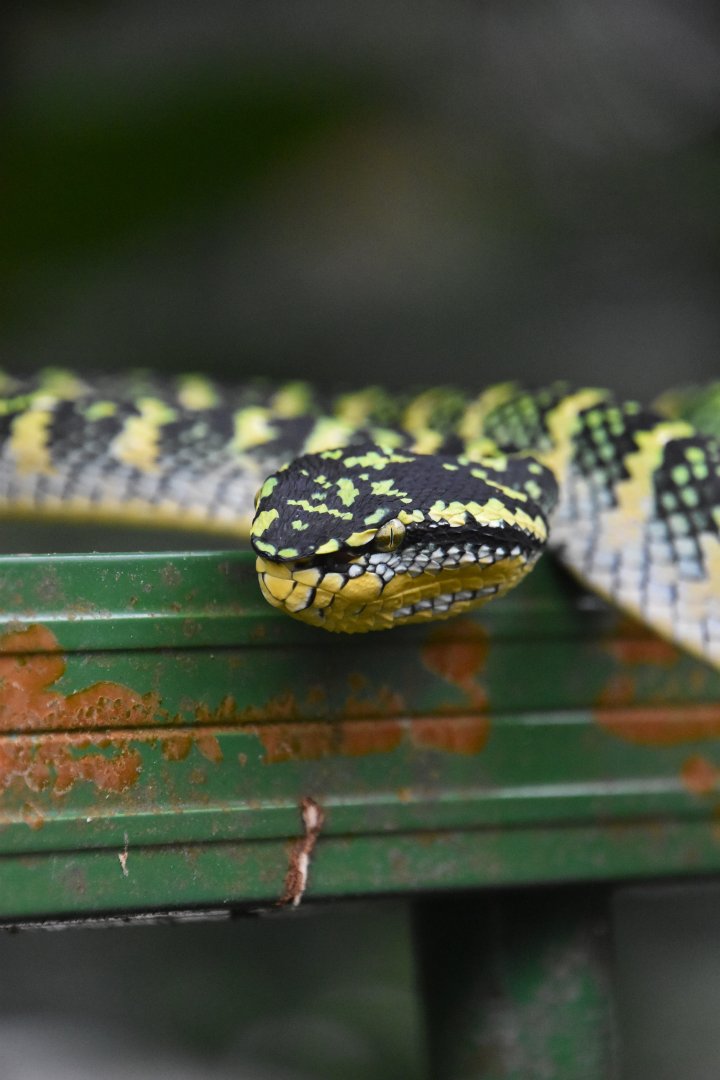
Thomson started very well indeed. Turning into the entrance, someone pointed out a Wagler's pitviper sitting on a railing. Didn't want to get too close, as I'm a bit of a venomous snake rookie (only seen keelback and adder in the wild, not quite the resume of an Australian), but what a beautiful snake! A real pleasure to photograph. According to a man I met further into Thomson they will often stay in the same spot for up to a month, so if anyone is in the area, definitely worth the trip!


Thomson otherwise was pretty quiet, but this seems to be the case across all nature reserves in Singapore in the early afternoon. Saw Long tailed parakeet again, but otherwise the only new species was Orange bellied flowerpecker. Lots of swiftlets, and some lovely invert life which I have no shot at identifying, but nothing in the way of primates, not even the largely ubiquitous macaques.

Then I serendipitously met a man who's been coming to Thomson and Lower Pierce for the best part of 30 years. Naturally he knew a thing or two about the langurs and where they hang out. According to him he sees the langurs in Lower Pierce about one in four/five days and 'once in a blue moon' in Thomson, but that there is a particular lamp-post over Old Upper Thomson Rd where they tend to cross between the parks. The accuracy of the instructions I've received from various locals has been astounding.

We walked together out of Thomson via the 'Langur Trail', which didn't really look like it could ever really have langurs to me, at least at the time. What's handy about most of these parks is how interconnected they are. There is a direct road (which is more of a connector, and closed at night for all but pedestrians) linking Thomson with Lower Pierce and Upper Pierce, but also these sorts of trails go between pretty much every nature reserve in the country. It's quite an impressive network and they're all quite pleasant. The night closures are to protect the likes of pangolins, pythons and mousedeer who are nocturnal and have trouble crossing roads, and I think is a very good policy.

We eventually reached Lower Pierce, at which point he went home and I went in. Lower Pierce was at first very unproductive, but possibly as it was still mid-afternoon at that point. I spent around three-four hours in this park, and the first hour I saw virtually nothing at all. It has a bunch of very audible frogs, but they're largely invisible. Then things started to pop up, or maybe I was more patient. Either way, I saw a White rumped shama tending to a nest in a tree hollow, a number of orioles (which are truly lovely birds) and whole host of macaques at one point passing through. But still no langur.

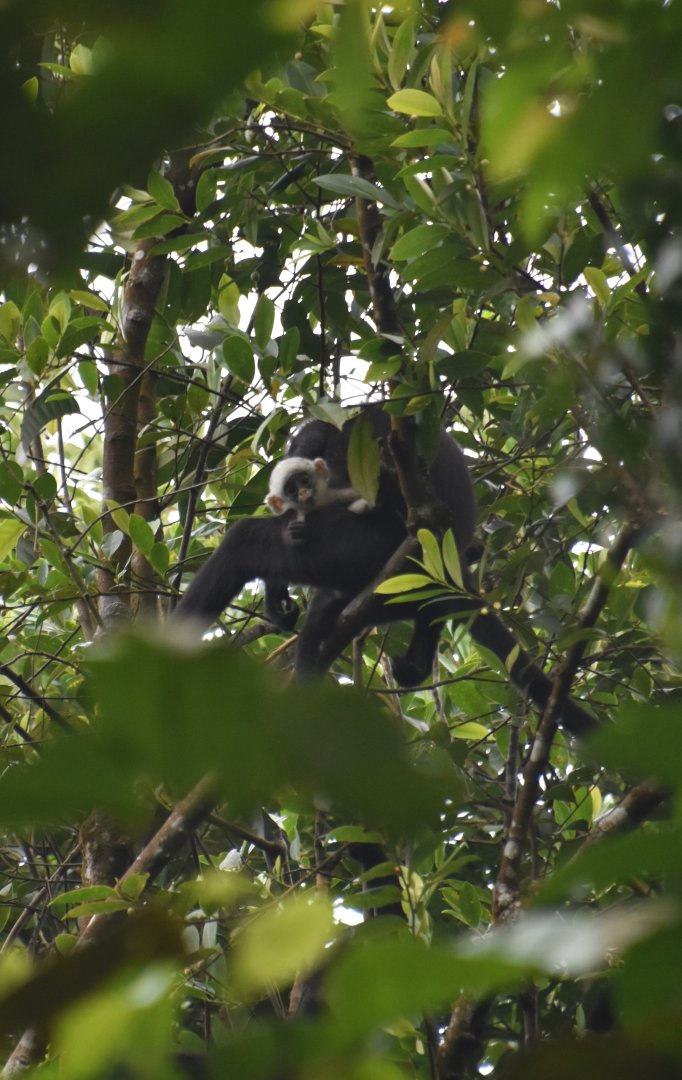
Then they showed up. I hadn't expected to see them at all really, but they not only showed up, they showed up in big numbers (hard to count, but it was double figures I reckon, or about 3% of the entire worldwide population). And what's more they had a couple of juveniles and a tiny baby with them. It was such a joy to watch them, and they stuck around, moving gradually towards the exit, far above. Photos were largely precluded by the backlighting and the thick canopy but occasionally you'd get lucky and get a really good look at them from afar:


For the most part, if they're vaguely nearby, they're pretty hard to miss. They make a lot of noise, not so much vocal but movement-wise. Even so, it was stunning how many people were just walking through without looking, even when they were pointed out to them. Surely if you're in a nature reserve you at least have a modicum of care about the animals within? Or at least that's what I thought. Odd.

I spent the entire time with the langurs also talking with a couple who were from London like me but had lived in Singapore for a while. They were really nice to talk to, and generous with what they knew, and it was great to hear about their experiences. Fingers crossed I'll be able to go on a couple more wildlife outings with them as they seem to be fairly experienced at spotlighting. On the way out spotted a second colugo in two days after having them elude for three weeks, plus a tiny mousedeer as the sun was setting in the undergrowth. Drew a close to a pretty nice day of wildlife watching, all in all :).

 
Hampstead Wetlands Park

Not too much to say here except that it's a great place for Buffy fish owl, and that there's currently a pair raising a chick that are fairly readily viewable. It also has lovely ambiance in the late afternoon as the sun gets a little lower. Also saw Moustached parakeet and White throated kingfisher quite well.

Singapore Oceanarium

I really liked this place besides one pretty substantial factor (ignoring entry fee, which, when contextualised with London SeaLife, is actually very sensible). Starting with the good: it has a strong collection, presented in a thoughtful way with generally very good design with minimal cross viewing for the most part and good lighting.

The reef mantas are undoubtedly the highlights of any visit - for me a first, spectacularly large and very active, doing backflips in columns of bubbles. Other highlights were the guitarfish (in huge numbers), the multitude of deep sea animals I'd never seen, a very strong opening area for jellies and generally very good design ideas. I liked the ancient seas bits and I thought the whale fall was also nice.

The main issue with the place is undoubtedly the consistently missing or insufficient species signage. It starts off very strong with the jellyfish gallery, but then rapidly trails off throughout the rest. As far as I could see there was no signage at all for the (very numerous) species in the Open Ocean tank, and many tanks containing clearly 10-20 species had only a single one or two signed. While I know that not all the aquarium was updated in the renovation, it was still somewhat disappointing that newer areas were also crowded with omissions. As such my attempt at a species list petered out quickly.

Again I don't know how much of a problem this is for the majority of visitors, but I can imagine that it's still pretty strange when you're faced with a tank with a bunch of angelfish and tangs and the only signage is for a coral or goby. I don't think there's really an excuse for not being able to sign every species in a newly updated aquarium anyway, so for me it's the main problem with the place.

Besides this though, I really enjoyed it, and thought the new bits in particular were well done, with spacious tanks and very nice species. The huge jelly tank in particular was great.
 
Last edited:
Back
Top