
You are using an out of date browser. It may not display this or other websites correctly.
You should upgrade or use an alternative browser.
You should upgrade or use an alternative browser.
Parc de Branféré Parc de Branféré
- Thread starter vogelcommando
- Start date

0.1 Northern White-cheeked Gibbon will come soon to enrich the primate collection of Branféré.
Parc de Branféré on Instagram: " ́ : Un nouvel arrivantAujourd'hui, Alexandre notre directeur zoologique répond à la question d’un abonné : " ’ ́ ̀ ? ". Bonne nouvelle ! Une femelle gibbon à favoris blancs rejoindra bientôt notre parc, juste avant la réouverture. Hâte d’en savoir plus sur cette arrivée ? Dites-le-nous en commentaire ! #parcanimalier #branféré #parcdebranfere #animauxsauvages #animaux #animal #bienetreanimal #gibbonfavorisblanc #primate #bretagne #tourisme #famille #morbihan"
Could be from Osnabrück. They have a new one from Usti since mid February and gave their female away.
Gab_1
Well-Known Member
(0.2) guanacos (Lama guanicoe) will join the park from Zurich. They will eventually host a (0.4) group.
Parc de Branféré on Instagram: "Après le fourmilier géant, voici la deuxième espèce qui rejoindra bientôt la nouvelle plaine Amérique du Sud… Les guanacos ! Deux femelles, Yanira et Yéyé, venues du zoo de Zurich, s’installeront dans ce nouvel espace dès le mois de juin. Le guanaco sera la plus grande espèce de cette nouvelle zone, il mesure entre 1m50 à 2m de long. Bien qu’il soit très abondant au Pérou et au Chili, notamment le long des Andes, il se fait rare dans le Chaco où il est localement considéré comme menacé, notamment au Paraguay. Nous accueillerons un groupe non reproducteur composé de 4 jeunes femelles, et avons hâte de vous les faire découvrir très bientôt. Restez connectés : d’autres révélations arrivent très bientôt : Sandro Schönbächler du @zoozuerich #branféré #parcanimalier #animaux #nouveauté #guanaco"
Parc de Branféré on Instagram: "Après le fourmilier géant, voici la deuxième espèce qui rejoindra bientôt la nouvelle plaine Amérique du Sud… Les guanacos !
Deux femelles, Yanira et Yéyé, venues du zoo de Zurich, s’installeront dans ce nouvel espace dès le mois de juin. Le guanaco sera la plus grande espèce de cette nouvelle zone, il mesure entre 1m50 à 2m de long. Bien qu’il soit très abondant au Pérou et au Chili, notamment le long des Andes, il se fait rare dans le Chaco où il est localement considéré comme menacé, notamment au Paraguay. Nous accueillerons un groupe non reproducteur composé de 4 jeunes femelles, et avons hâte de vous les faire découvrir très bientôt. Restez connectés : d’autres révélations arrivent très bientôt : Sandro Schönbächler du @zoozuerich #branféré #parcanimalier #animaux #nouveauté #guanaco"
Gab_1
Well-Known Member
Gab_1
Well-Known Member
Gab_1
Well-Known Member
Branfere planned to welcome Chacoan peccary (Catagonus wagneri), bush dogs and white-nosed coati (Nasua narica) to integrate them into the new South American zone. The indoor building will be opened to public. The opening is scheduled to june.
The seals left because Branféré learned that their dermis is not adapted to fresh water. This departure means that the penguin enclosure can be doubled in size.
https://parc.branfere.com/wp-content/uploads/sites/2/2025/03/CP-NOUVEAUTES-2025-1.pdf
The seals left because Branféré learned that their dermis is not adapted to fresh water. This departure means that the penguin enclosure can be doubled in size.
https://parc.branfere.com/wp-content/uploads/sites/2/2025/03/CP-NOUVEAUTES-2025-1.pdf
Gab_1
Well-Known Member
 Une photo de coati s’était glissée à la place du chien de buisson dans notre précédente publication… Merci à tous ceux qui ont participé, vous avez l’œil !
Gab_1
Well-Known Member

Haliaeetus
Well-Known Member
choeropsis-fan
Member

Tamandua56
Well-Known Member
Opening of the new South American zone.
Parc de Branféré on Instagram: " C’EST OUVERT ! Le nouvel espace Sud-Américian vous accueille dès aujourd’hui à Branféré Partez à la rencontre de nos nouveaux pensionnaires venus de loin : tapirs, fourmiliers géants, chiens de buisson… et bien d’autres surprises à découvrir dans un espace de 3,5 hectares entièrement repensé Une immersion totale au cœur des paysages sud-américains, pensée pour petits et grands aventuriers. Venez vivre cette nouvelle expérience dès maintenant, réservez vos billets ici : https://branfere.qweekle.com/shop/branfere/multi/billet-date-web?lang=fr #Branfere #ParcAnimalier #Nouveauté2025 #AmériqueDuSud #Tapir #FourmilierGéant #ChiensDeBuisson #Bretagne #Tourisme #Morbihan #Ouverture #ImmersionNature #Famille"
From the map, it can be seen that this area encompasses the tapir/capybara/rhea enclosure, as well as the llama enclosure and the two forest enclosures of the Visayan wild boars and Parma wallabies.
The wallabies have moved near the cassowaries, but unfortunately, I saw no signs of wild boars on the map. We can speculate that they have moved to another park.
The area is home to 10 animal species, including five new ones.
Species already present in Branféré include the capyabra, the lowland tapir, the rhea, the Chilean flamingo, and the southern screamer.
New species include the Chacoan peccary, the guanaco, the giant anteater, the white-nosed coati, and the bush dog.
For those who are interested, here is the new map of the park:https://parc.branfere.com/wp-content/uploads/sites/2/2025/06/2506-Plan-web-img.jpg
Parc de Branféré on Instagram: " C’EST OUVERT ! Le nouvel espace Sud-Américian vous accueille dès aujourd’hui à Branféré Partez à la rencontre de nos nouveaux pensionnaires venus de loin : tapirs, fourmiliers géants, chiens de buisson… et bien d’autres surprises à découvrir dans un espace de 3,5 hectares entièrement repensé Une immersion totale au cœur des paysages sud-américains, pensée pour petits et grands aventuriers. Venez vivre cette nouvelle expérience dès maintenant, réservez vos billets ici : https://branfere.qweekle.com/shop/branfere/multi/billet-date-web?lang=fr #Branfere #ParcAnimalier #Nouveauté2025 #AmériqueDuSud #Tapir #FourmilierGéant #ChiensDeBuisson #Bretagne #Tourisme #Morbihan #Ouverture #ImmersionNature #Famille"
From the map, it can be seen that this area encompasses the tapir/capybara/rhea enclosure, as well as the llama enclosure and the two forest enclosures of the Visayan wild boars and Parma wallabies.
The wallabies have moved near the cassowaries, but unfortunately, I saw no signs of wild boars on the map. We can speculate that they have moved to another park.
The area is home to 10 animal species, including five new ones.
Species already present in Branféré include the capyabra, the lowland tapir, the rhea, the Chilean flamingo, and the southern screamer.
New species include the Chacoan peccary, the guanaco, the giant anteater, the white-nosed coati, and the bush dog.
For those who are interested, here is the new map of the park:https://parc.branfere.com/wp-content/uploads/sites/2/2025/06/2506-Plan-web-img.jpg
Tamandua56
Well-Known Member
In addition to Monday's message,
My local newspaper featured an article about the new South American plain in Branféré. I read that the enclosures follow the rotation principle, with the animals alternating between enclosures throughout the day.
This principle still seems underrepresented in French zoos, and it's good news that my local zoo is experimenting with it.
My local newspaper featured an article about the new South American plain in Branféré. I read that the enclosures follow the rotation principle, with the animals alternating between enclosures throughout the day.
This principle still seems underrepresented in French zoos, and it's good news that my local zoo is experimenting with it.
Gab_1
Well-Known Member

jopif
Well-Known Member
I visited the park yesterday,
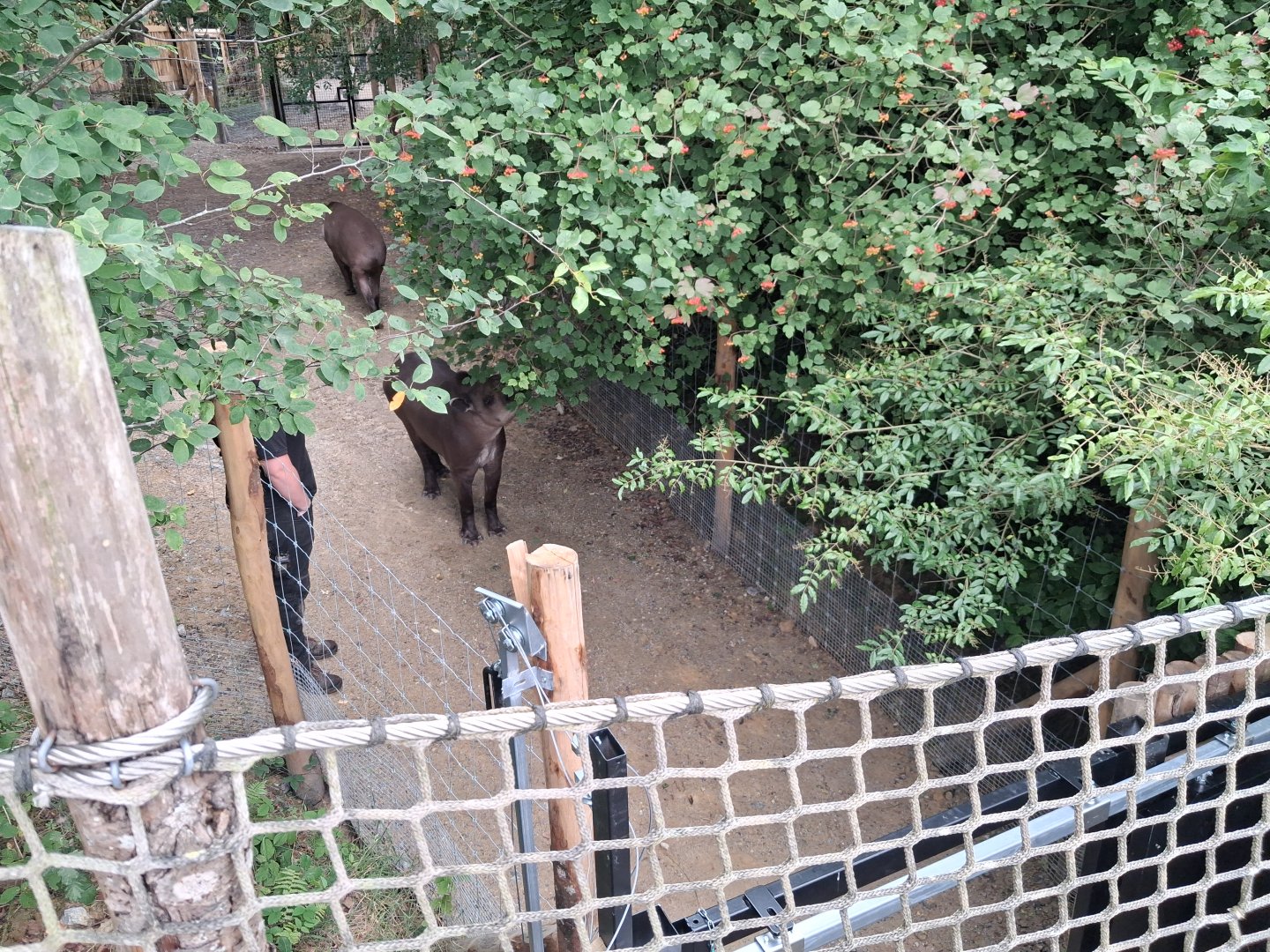
The new South American zone is very nice because the two biotopes are quite distinct (3 Chaco plains enclosures in rotation with South American tapirs, greater rheas, giant anteater, guanaco, Chacoan peccary, capybara and Southern screamer and two forest enclosures, one for bush dogs and one for white-nosed coatis). I've added photos to the park gallery. The rotation principle is interesting, but if I understand correctly, one of the plain enclosures is not visible to visitors. In fact, during my visit, I went into the area several times and only saw the tapirs, peccaries and rheas. I think the rotation principle takes time to set in, hence the many absences (especially as in the rest of the zoo, it's generally very easy to observe the different species on display).
These capricious tapirs took over 10 minutes to reach one of their outdoor enclosures...
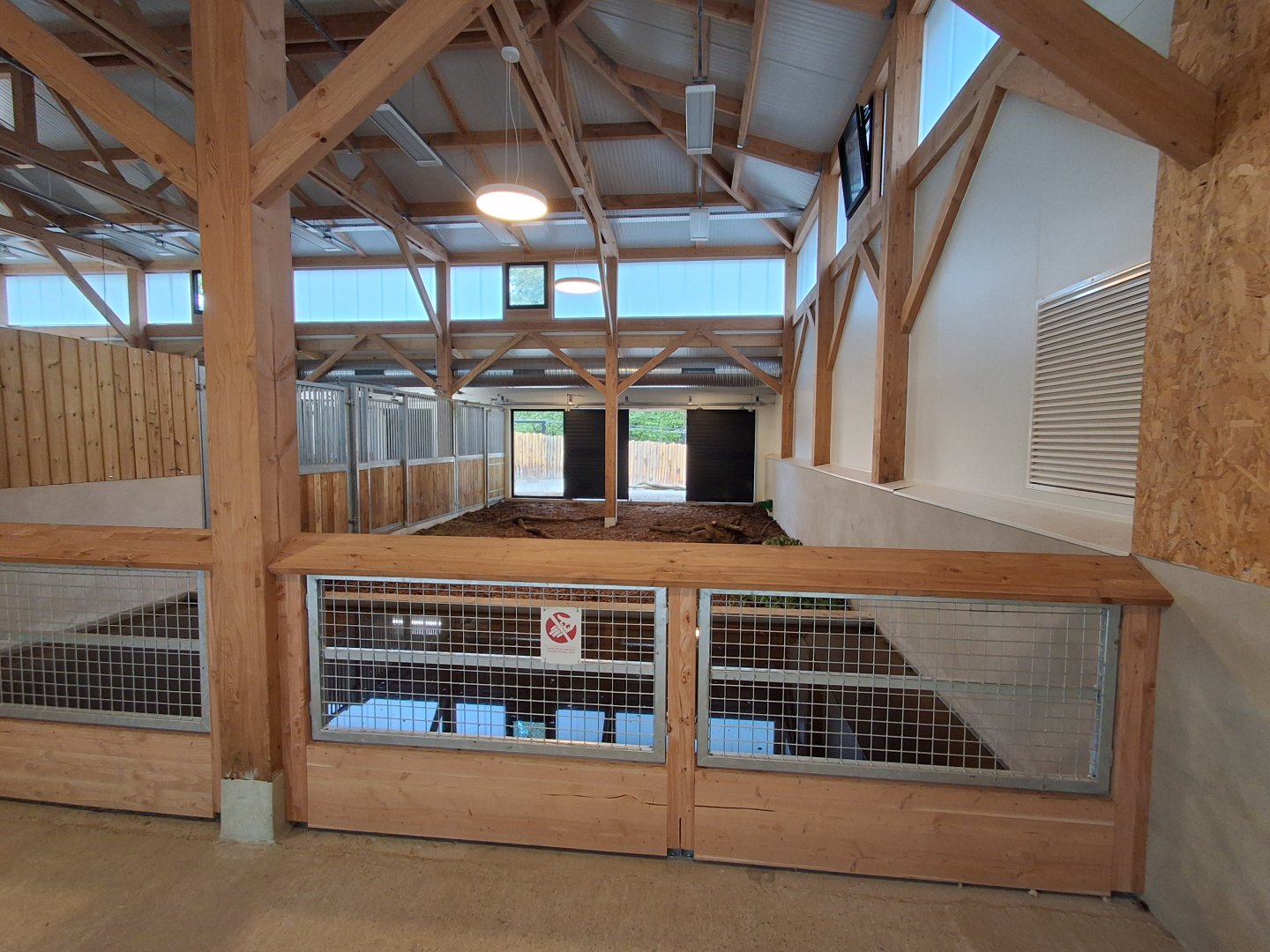
...but it's true that their indoor enclosure looks cosy !
It was my first visit to the zoo and I loved it, I've never felt such a bucolic atmosphere in a park like this before. I started at the top of the archipelago area and it was so great to be surrounded by dozens of wallabys, mara, muntjacs, cranes, countless anatidae (I think I saw 30-40 different species) and other aquatic birds. Added to this were over a hundred wild birds (grey herons, white storks, mallards, gulls, etc.). It's also one of the most beautiful monkey islands I've ever seen, with real trees of many species, age and forms. This has to be one of my favorite zoo exhibit of all time with the Doué aviaries.
Apart from that, here's a bit more information :
Asian aviary species list and count:
Scientific aviary species list (every species where easy to spot) :
- Marbled teal (Marmaronetta angustirostris)
- Eurasian Oystercatcher (Haematopus ostralegus)
- Eurasian Spoonbill (Platalea leucorodia)
- Little egret (Egretta garzetta)
- Pied avocet (Recurvirostra avosetta)
- Black-winged stilt (Himantopus himantopus)
- Ruff (Calidris pugnax)
- Squacco heron (Ardeola ralloides)
If you want to visit the zoo, don't miss the show, which is not only very nice but also features many species not seen elsewhere in the zoo, such as Psittacidae, ibises and birds of prey (one of which whas the Ural Owl, which was not listed on ZtL).
A final question : I was wondering if anyone knows if Barking deer (Muntiacus muntja) are still present in the park ? On the map, the muntjacs are referred to as “Chinese muntjacs” and I imagine they are Reeves' muntjacs. I thought I saw some muntjacs behind the Indian plain (in an off-stage exhibit), maybe it was the barking ones. (They looked more “orange” which seems to confirm it, but I might be crazy).
The new South American zone is very nice because the two biotopes are quite distinct (3 Chaco plains enclosures in rotation with South American tapirs, greater rheas, giant anteater, guanaco, Chacoan peccary, capybara and Southern screamer and two forest enclosures, one for bush dogs and one for white-nosed coatis). I've added photos to the park gallery. The rotation principle is interesting, but if I understand correctly, one of the plain enclosures is not visible to visitors. In fact, during my visit, I went into the area several times and only saw the tapirs, peccaries and rheas. I think the rotation principle takes time to set in, hence the many absences (especially as in the rest of the zoo, it's generally very easy to observe the different species on display).
These capricious tapirs took over 10 minutes to reach one of their outdoor enclosures...
...but it's true that their indoor enclosure looks cosy !
It was my first visit to the zoo and I loved it, I've never felt such a bucolic atmosphere in a park like this before. I started at the top of the archipelago area and it was so great to be surrounded by dozens of wallabys, mara, muntjacs, cranes, countless anatidae (I think I saw 30-40 different species) and other aquatic birds. Added to this were over a hundred wild birds (grey herons, white storks, mallards, gulls, etc.). It's also one of the most beautiful monkey islands I've ever seen, with real trees of many species, age and forms. This has to be one of my favorite zoo exhibit of all time with the Doué aviaries.
Apart from that, here's a bit more information :
Asian aviary species list and count:
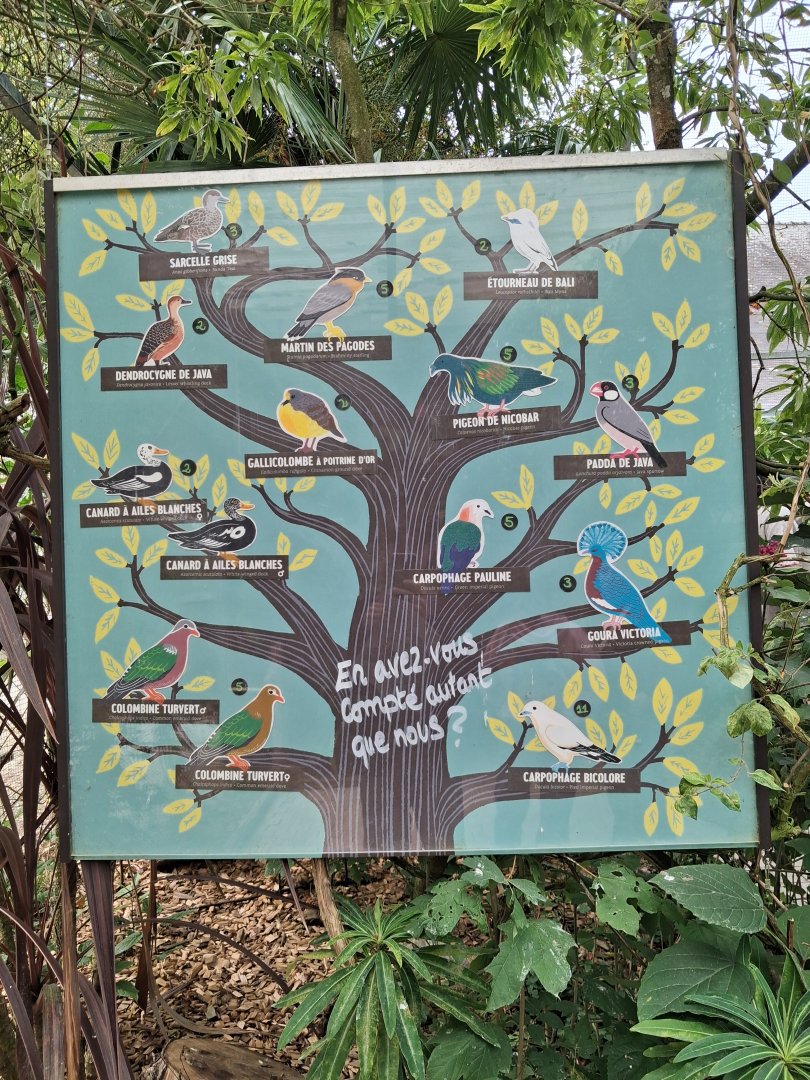
Scientific aviary species list (every species where easy to spot) :
- Marbled teal (Marmaronetta angustirostris)
- Eurasian Oystercatcher (Haematopus ostralegus)
- Eurasian Spoonbill (Platalea leucorodia)
- Little egret (Egretta garzetta)
- Pied avocet (Recurvirostra avosetta)
- Black-winged stilt (Himantopus himantopus)
- Ruff (Calidris pugnax)
- Squacco heron (Ardeola ralloides)
If you want to visit the zoo, don't miss the show, which is not only very nice but also features many species not seen elsewhere in the zoo, such as Psittacidae, ibises and birds of prey (one of which whas the Ural Owl, which was not listed on ZtL).
A final question : I was wondering if anyone knows if Barking deer (Muntiacus muntja) are still present in the park ? On the map, the muntjacs are referred to as “Chinese muntjacs” and I imagine they are Reeves' muntjacs. I thought I saw some muntjacs behind the Indian plain (in an off-stage exhibit), maybe it was the barking ones. (They looked more “orange” which seems to confirm it, but I might be crazy).
Gab_1
Well-Known Member
Birth of a two white-bellied spider monkeys (Ateles belzebuth) and of a red-crowned crane (Grus japonensis).
Parc de Branféré on Instagram: " De nouvelles naissances porteuses d’espoir à Branféré ! @evandebretagne vous emmène à la rencontre des derniers bébés du parc : manchots de Humboldt, saïmiris, grue du Japon et… un bébé atèle à ventre blanc, une espèce en danger critique d’extinction. Ces naissances incarnent 60 ans d’engagement de Branféré pour la conservation des espèces à travers de nombreux programmes ex-situ européens . Grâce à ces efforts, chaque naissance devient une victoire pour la biodiversité. ️ Venez les découvrir de vos propres yeux : https://branfere.qweekle.com/shop/branfere/multi/billet-date-web?lang=fr Et vous, quel bébé vous touche le plus ? Dites-le-nous en commentaire ! #Branfere #Naissances #ParcAnimalier #Cute #bienetreanimal"
Parc de Branféré on Instagram: " De nouvelles naissances porteuses d’espoir à Branféré ! @evandebretagne vous emmène à la rencontre des derniers bébés du parc : manchots de Humboldt, saïmiris, grue du Japon et… un bébé atèle à ventre blanc, une espèce en danger critique d’extinction. Ces naissances incarnent 60 ans d’engagement de Branféré pour la conservation des espèces à travers de nombreux programmes ex-situ européens . Grâce à ces efforts, chaque naissance devient une victoire pour la biodiversité. ️ Venez les découvrir de vos propres yeux : https://branfere.qweekle.com/shop/branfere/multi/billet-date-web?lang=fr Et vous, quel bébé vous touche le plus ? Dites-le-nous en commentaire ! #Branfere #Naissances #ParcAnimalier #Cute #bienetreanimal"
Gab_1
Well-Known Member
Haliaeetus
Well-Known Member
Haliaeetus
Well-Known Member
Gab_1
Well-Known Member
There were already males present.