Maybe they just wanted to display elephants as a draw card, Having 4 cows would have been far easier than holding a bull which would require its own yard and barn and also more dangerous to work with than a cow, I believe in general only the most senior elephant keepers actually get to work with adult mature bull elephants, Perhaps all the talk about captive breeding was more wishful thinking than anything elseVery true. They imported 2019, when there was three young bulls in the region who were clearly surplus to requirements:
1.0 Man Jai (2013)
1.0 Sabai (2016)
1.0 Jai Dee (2017)
I acknowledge the premature deaths of two of these bulls renders this point moot; but they could have created a bachelor facility for these bulls, freeing up space at the open range zoos. We’ve since had an additional bull calf (Roi-Yim), with the chance of up to six more bull calves to come within the next five years (Anjalee’s calf due December; up to three at Werribee; and up to two at Monarto).
Clearly acquiring cows they could have free contact with was one of Australia Zoo’s intentions; but now they’re a non-breeding protected contact facility, there’s no doubt energetic and majestic bulls would be a greater visitor attraction than the four cows they hold.
Alternatively, Australia Zoo could have imported surplus cows from Europe. They easily could have been supplied with a bull from within the region by now had they chosen to do so.
You are using an out of date browser. It may not display this or other websites correctly.
You should upgrade or use an alternative browser.
You should upgrade or use an alternative browser.
Australian Asian Elephant Population 2025
- Thread starter Zoofan15
- Start date

Maybe they just wanted to display elephants as a draw card, Having 4 cows would have been far easier than holding a bull which would require its own yard and barn and also more dangerous to work with than a cow, I believe in general only the most senior elephant keepers actually get to work with adult mature bull elephants, Perhaps all the talk about captive breeding was more wishful thinking than anything else
That’s certainly a possibility. They spoke of plans to import bulls after the cows had settled and they’d had time to build a bull barn hard. It’s now been six years and although I acknowledge we’ve had Covid in between that time, I believe if bulls were to be imported, it would have happened by now.
The younger cows are 11 and 16 years old, so they’ve got around a decade before the youngest is pushing the upper limits of breeding for the first time.
The point of importing two bulls (presumably unrelated) was to enable breeding of the second bull with first generation cows; but Australia Zoo would have to have managed their own surplus since no other zoo in the region is interested in holding Sumatran elephants. This could well have been a contributing factor towards canning the plans for a breeding herd.
I believe if they were serious about breeding they would of imported 1.3 to start with considering how difficult it is to actually import them that would have been logical and sensible way to do itThat’s certainly a possibility. They spoke of plans to import bulls after the cows had settled and they’d had time to build a bull barn hard. It’s now been six years and although I acknowledge we’ve had Covid in between that time, I believe if bulls were to be imported, it would have happened by now.
The younger cows are 11 and 16 years old, so they’ve got around a decade before the youngest is pushing the upper limits of breeding for the first time.
The point of importing two bulls (presumably unrelated) was to enable breeding of the second bull with first generation cows; but Australia Zoo would have to have managed their own surplus since no other zoo in the region is interested in holding Sumatran elephants. This could well have been a contributing factor towards canning the plans for a breeding herd.

Frankie_number_1_fan
Well-Known Member
Even if they had imported a bull, there is absolutely zero purpose in forming essentially their own breeding program that will just run itself into the ground. Even if they brought in two bulls to sustain the population for a handful of decades, they'd have nowhere to place bull calves and ultimately just have a potentially large group of animals that cannot participate in any program.
If their keepers aren't trained to work with bulls, than I feel the better option would've been to bring in post-reproductive cows such as Burma, Permai, etc.
The situation is such a strange management decision that still makes me frustrated to this day...
If their keepers aren't trained to work with bulls, than I feel the better option would've been to bring in post-reproductive cows such as Burma, Permai, etc.
The situation is such a strange management decision that still makes me frustrated to this day...
Even if they had imported a bull, there is absolutely zero purpose in forming essentially their own breeding program that will just run itself into the ground. Even if they brought in two bulls to sustain the population for a handful of decades, they'd have nowhere to place bull calves and ultimately just have a potentially large group of animals that cannot participate in any program.
If their keepers aren't trained to work with bulls, than I feel the better option would've been to bring in post-reproductive cows such as Burma, Permai, etc.
The situation is such a strange management decision that still makes me frustrated to this day...
Very true. It certainly wouldn’t have been a self-sustainable option by any means; and I doubt Taman Safari would have wanted the surplus bull calves sent back!
Another missed opportunity in my opinion was for Taronga to have sent their cows to Australia Zoo. Their decision to phase out was publicly was announced a couple of years after the Indonesian import, but had presumably been in discussion for some time prior. Australia Zoo could have acquired Pak Boon and Tang Mo and then potentially received a recommendation to acquire Pathi Harn or Putra Mas once bull facilities had been built.
Of course, I’m glad to have Monarto as a facility, but there’s no reason they couldn’t have still joined in the last year with the intention of taking on bulls.

There was quite a few herds in Europe that could have done a matriline split at the time, I think it was just purely Terri's connections to Indonesia and Australia Zoo jumping at the opportunity to get their hands on Sumatran Elephants specifically.Very true. They imported 2019, when there was three young bulls in the region who were clearly surplus to requirements:
1.0 Man Jai (2013)
1.0 Sabai (2016)
1.0 Jai Dee (2017)
I acknowledge the premature deaths of two of these bulls renders this point moot; but they could have created a bachelor facility for these bulls, freeing up space at the open range zoos. We’ve since had an additional bull calf (Roi-Yim), with the chance of up to six more bull calves to come within the next five years (Anjalee’s calf due December; up to three at Werribee; and up to two at Monarto).
Clearly acquiring cows they could have free contact with was one of Australia Zoo’s intentions; but now they’re a non-breeding protected contact facility, there’s no doubt energetic and majestic bulls would be a greater visitor attraction than the four cows they hold.
Alternatively, Australia Zoo could have imported surplus cows from Europe. They easily could have been supplied with a bull from within the region by now had they chosen to do so.
Due to Australia wanting to operate in free contact, I never believe there was ever the intention to breed. The elephants are likely purely there as display animals. Still, Madrid (one of the only other facilities with Sumatrans outside of Asia) has a young five year old bull who's at the age where he'll likely be transferred out. Australia should put their hands up..
I believe you are correct its highly likely they were only interested in having them for display as for them importing a bull I believe its very unlikely its ever going to happen!There was quite a few herds in Europe that could have done a matriline split at the time, I think it was just purely Terri's connections to Indonesia and Australia Zoo jumping at the opportunity to get their hands on Sumatran Elephants specifically.
Due to Australia wanting to operate in free contact, I never believe there was ever the intention to breed. The elephants are likely purely there as display animals. Still, Madrid (one of the only other facilities with Sumatrans outside of Asia) has a young five year old bull who's at the age where he'll likely be transferred out. Australia should put their hands up..
I believe you are correct its highly likely they were only interested in having them for display as for them importing a bull I believe its very unlikely its ever going to happen!
When I visited the zoo in 2005, they had the three elephants on loan from Bullens: Siam (1957-2013), Sabu (1958-2019) and Bimbo (1959-2013). They became hugely popular with the visitors following their arrival in 2003 and I would regard this era (early 2000’s up until Steve’s death in 2006) as the zoo’s golden age in terms of development and aspirations.
The elephants had one of the best exhibits in the region (along with Melbourne’s newly opened Trail of the Elephants); and while three retirement age elephants didn’t make the use of the facilities a younger herd would of, they arrived prior to breeding kicking off and there being a reasonable surplus of elephants in the region.
I had however hoped that long term they would aspire to join the regional breeding programme and it seems like we all agree an opportunity to do so was missed here.
Yes liked all the "big ticket" species such as Tigers, elephants, Gorilla and Orangs its such a shame that the latter two species never appeared there as planned!When I visited the zoo in 2005, they had the three elephants on loan from Bullens: Siam (1957-2013), Sabu (1958-2019) and Bimbo (1959-2013). They became hugely popular with the visitors following their arrival in 2003 and I would regard this era (early 2000’s up until Steve’s death in 2006) as the zoo’s golden age in terms of development and aspirations.
The elephants had one of the best exhibits in the region (along with Melbourne’s newly opened Trail of the Elephants); and while three retirement age elephants didn’t make the use of the facilities a younger herd would of, they arrived prior to breeding kicking off and there being a reasonable surplus of elephants in the region.
I had however hoped that long term they would aspire to join the regional breeding programme and it seems like we all agree an opportunity to do so was missed here.
All the elephant moves I've followed seem to have gone without a hitch, as the preparations have always been so careful and thorough. The four females at Twycross in the UK who moved a few years ago to Blackpool Zoo were a case in point. They brought in a specialist Elephant expert in transportation as adviser. Months of crate training took place and (I think) because there were only two transport crates available the moves were staggered with one pair moving some weeks or months before the others. They were cows admittedly, but bulls seem to move zoos without problem too. Nothing like the distance from Perth to Monarto obviously, but still...
Putra Mas has been crate training for over a year now (with a brief interruption during his annual musth cycle). Training sessions are held daily and by all accounts, he’s responding well.
There have been numerous transfers of elephants between Australasian zoos in the last decade:
2.2 from Taronga to Dubbo (2015) - two trips
1.0 from Taronga to Dubbo (2018)
1.0 from Dubbo to Melbourne (2020)
0.1 from Auckland to Monarto (2024)
0.1 from Perth to Monarto (2025)
0.2 from Taronga to Monarto (2025)
2.7 from Melbourne to Werribee (2025) - three trips
All were reported to have gone off without a hitch. Fingers crossed that Putra Mas will transfer successfully also.
At this point, I have no doubt he’ll get in the crate on the day; but how he’ll react to the transit part itself is an unknown. His crate training sessions aren’t necessarily indicative of how he’ll react to being loaded by crane onto a truck; and then confined for 40 hours+ on a moving vehicle. Others zoos have reported the elephants found the motion calming, so let’s hope that’s the case for Putra Mas.
Werribee Update:
Roi Yim (who's soon to be three) is growing up quite quickly and has already begun one on one interaction sessions with his father, Luk Chai.
From Member's news:
A key element of Zoos Victoria’s elephant welfare philosophy is about giving all members of our herd opportunities that reflect their natural biology at their various life stages.
For male calf, Roi-yim it is important for him to have social opportunities with other male elephants; to play with, spar, test strength, as well as observing and learning appropriate social and life skills. Eventually male calves move out of their natal herd and often spend time with other males.
Werribee Open Range Zoos Elephant Keepers have begun to facilitate some more social opportunities for male calf Roi-yim, to spend time with his dad Luk Chai to help build his confidence and resilience which will help support him when he one day transitions out of his natal herd.
Roi-yim is quick to follow his dad around and has been enjoying testing his sparring skills with him! Roi-yim has grown tremendously in his confidence around Luk Chai and is quick to gravitate towards him and spends a great deal of time interacting with him.
Roi Yim (who's soon to be three) is growing up quite quickly and has already begun one on one interaction sessions with his father, Luk Chai.
From Member's news:
A key element of Zoos Victoria’s elephant welfare philosophy is about giving all members of our herd opportunities that reflect their natural biology at their various life stages.
For male calf, Roi-yim it is important for him to have social opportunities with other male elephants; to play with, spar, test strength, as well as observing and learning appropriate social and life skills. Eventually male calves move out of their natal herd and often spend time with other males.
Werribee Open Range Zoos Elephant Keepers have begun to facilitate some more social opportunities for male calf Roi-yim, to spend time with his dad Luk Chai to help build his confidence and resilience which will help support him when he one day transitions out of his natal herd.
Roi-yim is quick to follow his dad around and has been enjoying testing his sparring skills with him! Roi-yim has grown tremendously in his confidence around Luk Chai and is quick to gravitate towards him and spends a great deal of time interacting with him.
Werribee Update:
Roi Yim (who's soon to be three) is growing up quite quickly and has already begun one on one interaction sessions with his father, Luk Chai.
From Member's news:
A key element of Zoos Victoria’s elephant welfare philosophy is about giving all members of our herd opportunities that reflect their natural biology at their various life stages.
For male calf, Roi-yim it is important for him to have social opportunities with other male elephants; to play with, spar, test strength, as well as observing and learning appropriate social and life skills. Eventually male calves move out of their natal herd and often spend time with other males.
Werribee Open Range Zoos Elephant Keepers have begun to facilitate some more social opportunities for male calf Roi-yim, to spend time with his dad Luk Chai to help build his confidence and resilience which will help support him when he one day transitions out of his natal herd.
Roi-yim is quick to follow his dad around and has been enjoying testing his sparring skills with him! Roi-yim has grown tremendously in his confidence around Luk Chai and is quick to gravitate towards him and spends a great deal of time interacting with him.
It’s good to hear Roi-Yim’s confidence has grown to the extent he can have one on one interactions with his sire. It’s hard to imagine this happening pre-Werribee.
It’s not hard to imagine Werribee will look at undertaking breeding introductions next year, with the intention of having calves on the ground 2028. This would be an ideal target to work towards with regards to managing Roi-Yim’s transition out of the matriarchal herd. Having a bull on the verge of adolescence around newborn calves isn’t ideal and while I note Man Jai was tolerated beyond this age, there were no (surviving) calves born until he was nine years old and spending the majority of his time with Luk Chai.
I seem to remember Ongard was around the same age when he first began to spend time with Bong Su in late 2013. By the following year, they were essentially grouped together more often than not and grew quite close. I know Ongard still slept with the cows overnight, but it seems his actual interactions with the herd were limited by that point.It’s good to hear Roi-Yim’s confidence has grown to the extent he can have one on one interactions with his sire. It’s hard to imagine this happening pre-Werribee.
It’s not hard to imagine Werribee will look at undertaking breeding introductions next year, with the intention of having calves on the ground 2028. This would be an ideal target to work towards with regards to managing Roi-Yim’s transition out of the matriarchal herd. Having a bull on the verge of adolescence around newborn calves isn’t ideal and while I note Man Jai was tolerated beyond this age, there were no (surviving) calves born until he was nine years old and spending the majority of his time with Luk Chai.
Ongard was very independent though; Roi Yim obviously is much the opposite, so I too am glad Roi Yim's managed to grow his confidence. When I visited a few months ago, he was spending the afternoon with Aiyara and Kulab, so perhaps the new Werribee site has allowed him to explore and be more independent.
I imagine that by the point that the next calves are born, Roi will be spending most (if not all) of his time with Luk Chai. Man Jai certainly had the beneficiary of no additional calves during his time with the matriarchal herd. He was only five though when he was essentially kicked out, so still on the younger side. Had Willow survived, I imagine we would have seen Man Jai transition out much earlier too.
I seem to remember Ongard was around the same age when he first began to spend time with Bong Su in late 2013. By the following year, they were essentially grouped together more often than not and grew quite close. I know Ongard still slept with the cows overnight, but it seems his actual interactions with the herd were limited by that point.
Ongard was very independent though; Roi Yim obviously is much the opposite, so I too am glad Roi Yim's managed to grow his confidence. When I visited a few months ago, he was spending the afternoon with Aiyara and Kulab, so perhaps the new Werribee site has allowed him to explore and be more independent.
I imagine that by the point that the next calves are born, Roi will be spending most (if not all) of his time with Luk Chai. Man Jai certainly had the beneficiary of no additional calves during his time with the matriarchal herd. He was only five though when he was essentially kicked out, so still on the younger side. Had Willow survived, I imagine we would have seen Man Jai transition out much earlier too.
It’s possible that Ongard’s confidence could be attributed to size. He was nine months younger than Mali, but very quickly overtook her in size. Compare this to Pathi Harn, who was dwarfed by Luk Chai from birth and had a reserved personality in this younger years.
Man Jai was born just over three years after Ongard, who was still with in the matriarchal herd at that point. While the cows would have regulated their interactions, the older bull calf would have dominated every interaction.
Roi-Yim was initially reserved; but his change in demeanor has coincided with him exceeding his female peers in size significantly, which I’m willing to bet is no coincidence (as well as his male hormones beginning to kick in). It was reported when Pathi Harn severely injured his keeper as a two year old that his testosterone levels were higher than Gung’s that week!
There is a new video on Channel 7 news Facebook page of the bull Putra Mas at Adelaide zoo referring to his up coming move to Monarto it appears his tusks have been trimmed back some?Putra Mas has been crate training for over a year now (with a brief interruption during his annual musth cycle). Training sessions are held daily and by all accounts, he’s responding well.
There have been numerous transfers of elephants between Australasian zoos in the last decade:
2.2 from Taronga to Dubbo (2015) - two trips
1.0 from Taronga to Dubbo (2018)
1.0 from Dubbo to Melbourne (2020)
0.1 from Auckland to Monarto (2024)
0.1 from Perth to Monarto (2025)
0.2 from Taronga to Monarto (2025)
2.7 from Melbourne to Werribee (2025) - three trips
All were reported to have gone off without a hitch. Fingers crossed that Putra Mas will transfer successfully also.
At this point, I have no doubt he’ll get in the crate on the day; but how he’ll react to the transit part itself is an unknown. His crate training sessions aren’t necessarily indicative of how he’ll react to being loaded by crane onto a truck; and then confined for 40 hours+ on a moving vehicle. Others zoos have reported the elephants found the motion calming, so let’s hope that’s the case for Putra Mas.
There is a new video on Channel 7 news Facebook page of the bull Putra Mas at Adelaide zoo referring to his up coming move to Monarto it appears his tusks have been trimmed back some?
Here’s the link:
https://www.facebook.com/watch/?v=766580659543520&vanity=7NEWSAdelaide&http_ref=eyJ0cyI6MTc2MDI0MjIxOTAwMCwiciI6Imh0dHBzOlwvXC93d3cuZ29vZ2xlLmNvbVwvIn0=
He does have his tusks regularly trimmed, but looking also at a video from August 2025, it seems they have gone slightly shorter yet. Presumably to minimise any risk of breakage in transit.
This is him from 2018 for comparison:

Attachments
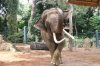
That would be necessary for the move, to ensure his safety whilst in the crate.There is a new video on Channel 7 news Facebook page of the bull Putra Mas at Adelaide zoo referring to his up coming move to Monarto it appears his tusks have been trimmed back some?
Ongard was still the more reserved out of him and Mali. It's interesting as as Mali matured, she certainly grew out of being the social butterfly that she was as a calf. Num Oi too was also very social in her younger years, but I've also noticed she's become more independent over the last decade or so.It’s possible that Ongard’s confidence could be attributed to size. He was nine months younger than Mali, but very quickly overtook her in size. Compare this to Pathi Harn, who was dwarfed by Luk Chai from birth and had a reserved personality in this younger years.
Man Jai was born just over three years after Ongard, who was still with in the matriarchal herd at that point. While the cows would have regulated their interactions, the older bull calf would have dominated every interaction.
Roi-Yim was initially reserved; but his change in demeanor has coincided with him exceeding his female peers in size significantly, which I’m willing to bet is no coincidence (as well as his male hormones beginning to kick in). It was reported when Pathi Harn severely injured his keeper as a two year old that his testosterone levels were higher than Gung’s that week!
I'm sure Ongard's move out of the main herd had more or less to do with the arrivals of Sanook, and later Man Jai. Most bulls aren't really the most careful around younger calves (Sabai, for example), so a separation whilst the calves aren't as robust yet is important.
That would be necessary for the move, to ensure his safety whilst in the crate.
Ongard was still the more reserved out of him and Mali. It's interesting as as Mali matured, she certainly grew out of being the social butterfly that she was as a calf. Num Oi too was also very social in her younger years, but I've also noticed she's become more independent over the last decade or so.
I'm sure Ongard's move out of the main herd had more or less to do with the arrivals of Sanook, and later Man Jai. Most bulls aren't really the most careful around younger calves (Sabai, for example), so a separation whilst the calves aren't as robust yet is important.
Num-Oi was noted by keepers to have the strongest maternal instincts out of the cows, so her engagement with the herd during her younger years could have influenced by her desire to be around the calves. She had her first calf three years after Mali was born; and when he died at 10 months of age, she found Man Jai (born the week Sanook died) to be a positive distraction. This was the case again when Willow died.
Fast forward a decade and Num-Oi has had her own (surviving) calf. Calves are no longer a novelty to her and she’s occupied with her own calf. Kulab remains closest to Num-Oi; but as I recall you saying, has positive interactions with all members of the herd (standing her in good stead for becoming matriarch one day).
Long term, it’s possible we’ll see the divide of Dokkoon’s line and Num-Oi’s line widen. Mek Kepah is the glue holding the herd together, but she’s getting on in years and by the time she passes, Num-Oi will hopefully have the support of a adult daughter (and Dokkoon two).
I had assumed that was the reason!That would be necessary for the move, to ensure his safety whilst in the crate.
Ongard was still the more reserved out of him and Mali. It's interesting as as Mali matured, she certainly grew out of being the social butterfly that she was as a calf. Num Oi too was also very social in her younger years, but I've also noticed she's become more independent over the last decade or so.
I'm sure Ongard's move out of the main herd had more or less to do with the arrivals of Sanook, and later Man Jai. Most bulls aren't really the most careful around younger calves (Sabai, for example), so a separation whilst the calves aren't as robust yet is important.
That's not a bad set of tusks for a captive elephant to have hopefully we get to see more of his genes passed on yet!Here’s the link:
https://www.facebook.com/watch/?v=766580659543520&vanity=7NEWSAdelaide&http_ref=eyJ0cyI6MTc2MDI0MjIxOTAwMCwiciI6Imh0dHBzOlwvXC93d3cuZ29vZ2xlLmNvbVwvIn0=
He does have his tusks regularly trimmed, but looking also at a video from August 2025, it seems they have gone slightly shorter yet. Presumably to minimise any risk of breakage in transit.
This is him from 2018 for comparison:
View attachment 833416