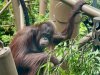
Australasian Orangutan Population

Charlie has lived with a total of seven adult females while at Auckland Zoo:

0.1 Dara (1977-2000): 1984-2000 (died)
0.1 Indra (1980): 1984-2005 (exported)
0.1 Intan (1989-2013): 1989-2005 (exported)
0.1 Wanita (1979-2022): 2001-2022 (died)
0.1 Gangsa (1989): 2001-2009 (exported)
0.1 Melur (1988): 2001- (alive)
0.1 Daya (2012): 2023- (alive)

As a generalisation, Charlie hasn’t been overly discerning. The zoo once had signage detailing the apes likes and dislikes and one of Charlie’s likes was ‘females’, which I’d agree is pretty accurate. The only one of the above females he showed no interest in was Wanita (hysterectomised female), who also held no attraction for the other Auckland males.

Charlie was the youngest of Auckland’s original quartet and Indra considered him something of a nuisance during his adolescence and sub-adult years. I know nothing of his relationship with Dara during that time; but it’s reasonable to assume his advances were unwanted during the infant and juvenile years of her son Datuk. Unlike Indra, she didn’t breed again for 11 years, so potentially thawed towards Charlie in her final years, especially as he developed into a flanged male. Either way they produced the female infant that died shortly after birth (followed by Dara’s own death).

The Taronga imports were apparently welcomed by Indra as a diversion of Charlie’s attention from her. Intan also favoured Horst, possibly due to her mother’s relationship with Charlie.

Melur’s relationship with Charlie has varied from amicable to fair depending on whether she’s been raising young at the time. The keepers have said ‘preoccupied’ sums up Melur best, which I fully agree with.

Of the above females, Gangsa was the most obsessed with Charlie by far. Personality surely had an influence, but demographically speaking, she had no dependent offspring to divert her attention; and upon arriving as an adolescent, no doubt found the prime aged (and fully flanged) Charlie highly attractive.

Daya is a relatively new arrival, so it’ll be interesting to see how her relationship with Charlie tracks. My assumption is her interest will decline upon the birth of her first infant; but with Bahmi turning four years in March, perhaps Melur will soon have more time for Charlie. Daya’s infant could time perfectly in that regard.

Thanks for the information about the females Charlie has lived with! Of all of them, he seemed to have formed the strongest bond with the Taronga imports, although Wanita's connection to Charlie didn't have the element of mating due to her no longer being fertile.

I've mostly witnessed Melur being relaxed and even affectionate with Charlie, usually displayed with marathon grooming sessions, often near the windows (which is a constant source of fascination for the visitors). But if she is preoccupied with Bahmi or if Charlie attempts mating, I've seen her get quite aggressive with him.

Daya seemed quite intimidated by Charlie when she first arrived and appeared to give him a wide berth most of the time, but now that he appears to be viewing her as an adult female, she seems content for him to sit and eat with her, and she will sometimes groom him as Melur does. With her now at peak fertility according to keepers, things are definitely looking up for Charlie and Daya!
 
Old footage of Auckland Zoo’s orangutans:

Episodes | The Best of The Zoo | Television | NZ On Screen

First of all thanks to @Abbey for finding this. It’s a link to old episodes of The Zoo. All the episodes make fascinating viewing, but I thought people would be particularly interested to see the orangutan epsiode (Episode 9), which includes footage of Orangtuan Park (1987-2017), including the dens and playroom.

The content jumps about a bit. The first segment covers changeover day and was filmed in late 2000 for the second season of The Zoo. Dara (and her infant Darli) had died that June and adult males Charlie and Horst were rotating access fortnightly to Indra and her offspring Intan and Isim (ignore the narrator stating all three of these are females).

The third segment was filmed early 2001 for the third season of The Zoo and details a health concern for Indra. Six year old Isim is seperate from Indra, who is put under anaesthetic to investigate stomach problems. Pregnancy is ruled out and the cause is revealed to be abscesses which were successfully treated. So soon after the loss of Dara and Darli, I can only imagine how relieved the keepers were it was nothing more serious.

The second segment was filmed circa 2002. Isim looks to be around eight years old (clearly not as young as six like he was in the other two segments) and is seen wrestling with a young Gangsa. The orangutans are undergoing conditioning to assist with moving them between the outdoor exhibit and the dens. Indra’s stomach issues (from the third segment) are referenced.
 
Isim has sired an infant at Los Angeles Zoo:

For those who follow Auckland Zoo’s Bornean orangutan colony, Isim has just become a father to a male infant at the Los Angeles Zoo. Fantastic and long awaited news.

Isim was born 1994 at Auckland Zoo to Horst and Indra and is the only surviving offspring of both his parents. This is their first surviving grandchild. Isim was exported to the United States in 2015.

From the Los Angeles Zoo socials:

The L.A. Zoo is excited to share the news that Bornean orangutans Kalim and Isim have welcomed a new baby boy!

Born on Oct. 10, the infant and his mother, Kalim, have been bonding behind-the-scenes.

Guests can now see Kalim, Isim, and their baby on exhibit at the Red Ape Rain Forest.
 
Auckland Zoo - Update on Breeding Plans

An official announcement from Auckland Zoo that they’re undertaking breeding with their Bornean orangutans Charlie and Daya. This was previously reported by @ApeLadyNZ, though I commend Auckland Zoo on their transparency in announcing this.

It’s an exciting time with Auckland Zoo welcoming the region’s first (surviving) orangutan infant in a decade with the birth of Bahmi in 2022; and now gearing up to welcome another infant as soon as next year, remaining the only zoo in the region to be currently breeding orangutans.

From socials:

We’ve got great news this Orangutan Caring Week! Bornean orangutans Charlie and Daya have started showing exciting signs of courtship!

Recently, 13-year-old Daya came off her contraceptive pill and since then, she and Charlie have been spending lots of time together – shadowing each other, grooming, and even resting side by side in their nests. These behaviours are a positive sign of a healthy and developing relationship.


Daya is now at the right age for her first breeding, and pairing her with Charlie – a genetically valuable male helps strengthen the European breeding programme. The goal of this programme is to maintain a genetically healthy and sustainable advocacy population outside of the world or ex situ and support the species’ conservation in the wild. Auckland Zoo is proud to be the only zoo in Australasia region, caring for this Critically Endangered great ape species, as part of the European Association of Zoos & Aquaria (EAZA) Bornean orangutan breeding and advocacy programme.
 
Auckland Zoo - Update on Breeding Plans

An official announcement from Auckland Zoo that they’re undertaking breeding with their Bornean orangutans Charlie and Daya. This was previously reported by @ApeLadyNZ, though I commend Auckland Zoo on their transparency in announcing this.

It’s an exciting time with Auckland Zoo welcoming the region’s first (surviving) orangutan infant in a decade with the birth of Bahmi in 2022; and now gearing up to welcome another infant as soon as next year, remaining the only zoo in the region to be currently breeding orangutans.

From socials:

We’ve got great news this Orangutan Caring Week! Bornean orangutans Charlie and Daya have started showing exciting signs of courtship!

Recently, 13-year-old Daya came off her contraceptive pill and since then, she and Charlie have been spending lots of time together – shadowing each other, grooming, and even resting side by side in their nests. These behaviours are a positive sign of a healthy and developing relationship.


Daya is now at the right age for her first breeding, and pairing her with Charlie – a genetically valuable male helps strengthen the European breeding programme. The goal of this programme is to maintain a genetically healthy and sustainable advocacy population outside of the world or ex situ and support the species’ conservation in the wild. Auckland Zoo is proud to be the only zoo in Australasia region, caring for this Critically Endangered great ape species, as part of the European Association of Zoos & Aquaria (EAZA) Bornean orangutan breeding and advocacy programme.

It's wonderful to have an official confirmation of Auckland Zoo's breeding plans! Although it's taken a while, with Daya initially preferring the company of Melur and Bahmi and seeming rather intimidated by Charlie at first, and with Charlie seeming to regard Daya as a juvenile when she first arrived. It's heartening to not only see Charlie regarding Daya as an adult female, but to see that Daya is so at ease in his company.
 
It's wonderful to have an official confirmation of Auckland Zoo's breeding plans! Although it's taken a while, with Daya initially preferring the company of Melur and Bahmi and seeming rather intimidated by Charlie at first, and with Charlie seeming to regard Daya as a juvenile when she first arrived. It's heartening to not only see Charlie regarding Daya as an adult female, but to see that Daya is so at ease in his company.

It’s also encouraging to hear that Daya was on the contraceptive pill, which means she could conceive as soon as a month after coming off it.

The alternative being she’d been fitted with a contraceptive implant and they were merely allowing it lapse, which could take a year or more.

Fingers crossed for an infant anytime from mid-2026!

Bahmi was born 2022, so bar Intan and Datuk, who were born two months apart in 1989; four years would be the shortest gap Auckland Zoo has had between surviving infants:

0.1 Intan (1989)
1.0 Datuk (1989)
1.0 Isim (1994)
0.1 Darli (2000) Died as neonate
0.1 Unnamed (2002) Died as neonate
1.0 Madju (2005)
1.0 Bahmi (2022)
 
It’s also encouraging to hear that Daya was on the contraceptive pill, which means she could conceive as soon as a month after coming off it.

The alternative being she’d been fitted with a contraceptive implant and they were merely allowing it lapse, which could take a year or more.

Fingers crossed for an infant anytime from mid-2026!

Bahmi was born 2022, so bar Intan and Datuk, who were born two months apart in 1989; four years would be the shortest gap Auckland Zoo has had between surviving infants:

0.1 Intan (1989)
1.0 Datuk (1989)
1.0 Isim (1994)
0.1 Darli (2000) Died as neonate
0.1 Unnamed (2002) Died as neonate
1.0 Madju (2005)
1.0 Bahmi (2022)

That is encouraging news! It will also mean that Bahmi will be able to be a playmate for the new infant when he or she is old enough. Having two young orangutans will be a massive drawcard for Auckland Zoo, especially since no other zoo in the Australasian area currently holds juvenile or infant orangutans.
 
That is encouraging news! It will also mean that Bahmi will be able to be a playmate for the new infant when he or she is old enough. Having two young orangutans will be a massive drawcard for Auckland Zoo, especially since no other zoo in the Australasian area currently holds juvenile or infant orangutans.

It’s a recommendation in the husbandry guidelines that juvenile orangutans are provided with peers for social interaction. I know this often surprises people, who think of this species as solitary or semi-social; but the juveniles and thrive on social connections within the colony and if deprived of peers, will seek it out from adults (Wanita and Madju being a prime example).

It was good seeing old footage from The Zoo from 2001 (second post down on this page), which showed the then seven year old Isim play fighting with 12 year old Gangsa. With Intan and Melur both aged 13 at the time, it would have been an exciting time within the colony.

I think it’s a shame there’s no current plan for Melur to breed again. Assuming Bahmi is to be retained as Auckland’s next breeding male, he’d likely sire Daya’s next infant unless Charlie lives long enough to see Daya’s infant weaned. It would mean a birth interval of around seven years between Daya’s offspring if waiting for Bahmi to mature.
 
It’s a recommendation in the husbandry guidelines that juvenile orangutans are provided with peers for social interaction. I know this often surprises people, who think of this species as solitary or semi-social; but the juveniles and thrive on social connections within the colony and if deprived of peers, will seek it out from adults (Wanita and Madju being a prime example).

It was good seeing old footage from The Zoo from 2001 (second post down on this page), which showed the then seven year old Isim play fighting with 12 year old Gangsa. With Intan and Melur both aged 13 at the time, it would have been an exciting time within the colony.

I think it’s a shame there’s no current plan for Melur to breed again. Assuming Bahmi is to be retained as Auckland’s next breeding male, he’d likely sire Daya’s next infant unless Charlie lives long enough to see Daya’s infant weaned. It would mean a birth interval of around seven years between Daya’s offspring if waiting for Bahmi to mature.

Very good points. Bahmi would be about 4 years old presuming an infant is born in 2026, and that's about the age gap between the famous Pairi Daiza brothers, who have always been playmates. I must catch up on that old zoo footage from Auckland, too!

I am personally hoping that Bahmi will stay as breeding male - not only because I am so fond of him, but because it would be easier to bring in a new female than to try and integrate a new male with Melur and Daya. And I too think it's a shame there's no current plan to breed from Melur again. She would still be of a suitable age to breed once Bahmi is weaned, and although her dam Yasmin's line is well represented, her sire Laki's is much less so.
 
Auckland Zoo Update

Update from my visit (14/11/2025):

1.0 Charlie (21/03/1981) Zabu x Girlie
0.1 Melur (11/06/1988) Laki x Yasmin; Imported 1995
0.1 Daya (27/05/2012) Bako x Jewel; Imported 2023
1.0 Bahmi (20/03/2022) Charlie x Melur

I know a number of us are interested in plans for the future of the colony, so I asked about this on my visit yesterday:

Melur has been retired from breeding:

Melur was put on contraception recently and Bahmi will be her last infant. The reason I was given for retiring Melur from breeding was her age (37 years old).

My comments:

While I note females older than Melur have bred (most notably her own mother last year), the breeding programme as a whole has had close to three decades to breed with Melur since her import by Taronga Zoo in 1995. During that time, she’s produced three infants (two of which survived); and her adult son has sired young in the US. Her three descendants (and counting) will hopefully be sufficient to ensure the continuation of her lineage.

Bahmi to transfer out:

The current plan is not for Bahmi to remain at Auckland Zoo to breed with Daya. Bahmi will remain with his mother for eight years or so and then the plan is for him to be exported overseas. A new male will be brought in at that point to breed with Daya.

My comments:

This comes as some surprise since I know many of us have assumed Bahmi would be retained to breed with Daya.

For this reason I really hope Daya produces a female infant next year, as she would be unrelated to the future breeding male and could hopefully remain at Auckland Zoo. A female infant born 2026 would be 14 years her mother’s junior and therefore their reproductive years would overlap. Aside from the benefit of having two breeding females in the colony, it’s the best chance at increasing the size of the colony. The only alternative would be to bring in a third unrelated female, which I can’t see happening.

Daya:

upload_2025-11-15_15-54-9.jpeg

Melur and Bahmi on the high ropes:

upload_2025-11-15_15-53-56.jpeg
 

Attachments

  • upload_2025-11-15_15-53-56.jpeg
    upload_2025-11-15_15-53-56.jpeg
    106.5 KB · Views: 32
  • upload_2025-11-15_15-54-9.jpeg
    upload_2025-11-15_15-54-9.jpeg
    207.1 KB · Views: 29
Melur was put on contraception recently and Bahmi will be her last infant. The reason I was given for retiring Melur from breeding was her age (37 years old).
That's a shame - but obviously that's a decision that's been made with Melur's health in mind. I know the Australasian region are quite strict on replicating wild birth intervals with orangutans, so it's possible they've determined Melur will just be too old once Bahmi's five or six years of age.
The current plan is not for Bahmi to remain at Auckland Zoo to breed with Daya. Bahmi will remain with his mother for eight years or so and then the plan is for him to be exported overseas. A new male will be brought in at that point to breed with Daya.
I wonder whether Melur's retirement and Bahmi's genetic value plays a big part in this. Transferring him to a facility where he could have multiple females to breed with will be best to ensure maximum representation.

If he was to remain at Auckland, he'd only have Daya to breed with - and the zoo would be in a predicament if Daya's next infant was a female; ie. that female would be a half sister of Bahmi.

If Daya's next infant is a male, it's possible we could see this changed. That male could then be transferred out - with Bahmi then paired with Daya, perhaps with another female imported eventually.
 
That's a shame - but obviously that's a decision that's been made with Melur's health in mind. I know the Australasian region are quite strict on replicating wild birth intervals with orangutans, so it's possible they've determined Melur will just be too old once Bahmi's five or six years of age.

I wonder whether Melur's retirement and Bahmi's genetic value plays a big part in this. Transferring him to a facility where he could have multiple females to breed with will be best to ensure maximum representation.

If he was to remain at Auckland, he'd only have Daya to breed with - and the zoo would be in a predicament if Daya's next infant was a female; ie. that female would be a half sister of Bahmi.

If Daya's next infant is a male, it's possible we could see this changed. That male could then be transferred out - with Bahmi then paired with Daya, perhaps with another female imported eventually.

While plans can and do change (it’ll be another five years before Bahmi is eight years old), the plan to transfer him out has been made independently of knowing the gender of Daya’s first infant. This makes me think they’ll be unswayed in the decision to export Bahmi and I agree with you the plan could be for him to go somewhere with multiple breeding females (as opposed to one). He’s a genetically valuable male via his paternal line and transferring him young to either North America or Europe would assist facilitating him across multiple facilities too if required throughout his lifetime.

Yes, two trends that seem to be prevalent in Australasia right now with breeding orangutans is adherence to the natural birth interval of eight years (an extension of the captive birth interval by at least three years); and the delay of breeding from females until their mid-teens. If Daya produces a female infant, it’ll be a rare example of a female (her theoretical daughter) reaching her mid-teens while her mother is still in her late-twenties.
 
While plans can and do change (it’ll be another five years before Bahmi is eight years old), the plan to transfer him out has been made independently of knowing the gender of Daya’s first infant. This makes me think they’ll be unswayed in the decision to export Bahmi and I agree with you the plan could be for him to go somewhere with multiple breeding females (as opposed to one). He’s a genetically valuable male via his paternal line and transferring him young to either North America or Europe would assist facilitating him across multiple facilities too if required throughout his lifetime.

Yes, two trends that seem to be prevalent in Australasia right now with breeding orangutans is adherence to the natural birth interval of eight years (an extension of the captive birth interval by at least three years); and the delay of breeding from females until their mid-teens. If Daya produces a female infant, it’ll be a rare example of a female (her theoretical daughter) reaching her mid-teens while her mother is still in her late-twenties.

While this is deeply saddening news for me on a personal level - both to hear that Melur will not breed again and that the intention is for Bahmi to transfer out (the joyous news of his birth helped me get past a difficult time in my own life) I can see the practicalities of such events. Having a larger pool of breeding females would be beneficial to Bahmi's lineage, especially since breeding opportunities are more limited for Madju at present.

I am therefore hopeful that Daya will produce a daughter. While I am concerned about the impact integrating a new male might have on the ageing Melur, I am certain the breeding programme will recommend a gentle male much like our Charlie. Perhaps, like Madju on his journey to the USA, he'll be imported as an adolescent and be easier to integrate than an already flanged male would be.

A male infant from Daya might mean reconsidering the export of Bahmi, but as @Zoofan15 has mentioned, that seems unlikely, perhaps because they would want Bahmi breeding as soon as possible, whereas it would take a longer time for his potential half-brother to mature and transfer out.

Also, I am wondering if Bahmi's temperament is being considered in all this. Although he will likely eventually mellow into another gentle giant, he is showing the same signs of mischievous and precocious behaviours as his older brother Madju did at a similar age. By the time Madju was 8 or 9, he was already starting to challenge Charlie, and if Charlie is still alive when Bahmi matures, he will not be able to stand up to such behaviours in the way he could with the adolescent Madju.
 
While this is deeply saddening news for me on a personal level - both to hear that Melur will not breed again and that the intention is for Bahmi to transfer out (the joyous news of his birth helped me get past a difficult time in my own life) I can see the practicalities of such events. Having a larger pool of breeding females would be beneficial to Bahmi's lineage, especially since breeding opportunities are more limited for Madju at present.

I am therefore hopeful that Daya will produce a daughter. While I am concerned about the impact integrating a new male might have on the ageing Melur, I am certain the breeding programme will recommend a gentle male much like our Charlie. Perhaps, like Madju on his journey to the USA, he'll be imported as an adolescent and be easier to integrate than an already flanged male would be.

A male infant from Daya might mean reconsidering the export of Bahmi, but as @Zoofan15 has mentioned, that seems unlikely, perhaps because they would want Bahmi breeding as soon as possible, whereas it would take a longer time for his potential half-brother to mature and transfer out.

Also, I am wondering if Bahmi's temperament is being considered in all this. Although he will likely eventually mellow into another gentle giant, he is showing the same signs of mischievous and precocious behaviours as his older brother Madju did at a similar age. By the time Madju was 8 or 9, he was already starting to challenge Charlie, and if Charlie is still alive when Bahmi matures, he will not be able to stand up to such behaviours in the way he could with the adolescent Madju.

It’s interesting to compare and contrast Bahmi (Bornean orangutan) with Cahya (Sumatran tiger). Their births in 2022 and 2024 respectively saw them become two of the zoo’s animal stars of the 2020’s and both are intended to transfer out at adolescence. I enjoy seeing them on my visits, but feel mostly excitement for Cahya’s transfer. Not only will she be going immediately into a breeding situation; but it’ll free up her parents to breed again as soon as she leaves. In contrast, Bahmi is the end of the line for Melur’s breeding and represents the removal of an integral part the zoo’s colony.

Aside from acknowledging that it’s good news if Bahmi can go overseas and sire infants of his own (I know we’ve all enjoyed hearing news of Auckland Bornean orangutan exports Madju and Isim becoming fathers in the US), I think we’ll all feel better if Daya delivers a daughter. One of them (Bahmi or his half-sibling) going was always going to be inevitable; but by retaining a daughter of Daya, Auckland Zoo has a decent shot of establishing a larger colony.

Melur is 37 years old and if we’re lucky, she could live up to 60 years (rivalling Puan’s 62 years at Perth Zoo). If Daya had offspring at 14 (2026), 22 (2034) and 30 (2042); and she began with a daughter, said daughter could welcome her first infant in 2040 (in between her mother’s second and third offspring). Combined with the possibility Melur could still be alive heading into the 2040’s (she’d be 52 in 2040) and the zoo could have a sizeable colony. Who knows, they might even open up the second ape exhibit to Bornean orangutan in that time. Hamilton Zoo have an elderly pair of Siamang, whose inevitable passing would provide an avenue of transferring out Auckland’s pair if they so desired.
 
It’s interesting to compare and contrast Bahmi (Bornean orangutan) with Cahya (Sumatran tiger). Their births in 2022 and 2024 respectively saw them become two of the zoo’s animal stars of the 2020’s and both are intended to transfer out at adolescence. I enjoy seeing them on my visits, but feel mostly excitement for Cahya’s transfer. Not only will she be going immediately into a breeding situation; but it’ll free up her parents to breed again as soon as she leaves. In contrast, Bahmi is the end of the line for Melur’s breeding and represents the removal of an integral part the zoo’s colony.

Aside from acknowledging that it’s good news if Bahmi can go overseas and sire infants of his own (I know we’ve all enjoyed hearing news of Auckland Bornean orangutan exports Madju and Isim becoming fathers in the US), I think we’ll all feel better if Daya delivers a daughter. One of them (Bahmi or his half-sibling) going was always going to be inevitable; but by retaining a daughter of Daya, Auckland Zoo has a decent shot of establishing a larger colony.

Melur is 37 years old and if we’re lucky, she could live up to 60 years (rivalling Puan’s 62 years at Perth Zoo). If Daya had offspring at 14 (2026), 22 (2034) and 30 (2042); and she began with a daughter, said daughter could welcome her first infant in 2040 (in between her mother’s second and third offspring). Combined with the possibility Melur could still be alive heading into the 2040’s (she’d be 52 in 2040) and the zoo could have a sizeable colony. Who knows, they might even open up the second ape exhibit to Bornean orangutan in that time. Hamilton Zoo have an elderly pair of Siamang, whose inevitable passing would provide an avenue of transferring out Auckland’s pair if they so desired.

I too feel mostly excitement at the wonderful future opportunity that Cahya will soon be getting, despite having enjoyed seeing her on my visit. My own attachment to Bahmi runs far deeper than my attachment to Cahya, however, and while I will no doubt be excited for his future breeding opportunities when his time to depart New Zealand arrives, it still hurts to receive the news that he will leave. I will make sure to get in plenty of visits over the next 5 years or so!!!

It will indeed mark the end of an era for Auckland Zoo in the way that Cahya's departure will not. Bahmi is Melur's last offspring, and I had hoped she would be allowed to produce at least one more. Daughters to both Melur and Daya would have been a most wondrous occurrence for the zoo!

I agree, Daya having a baby girl will be the best possible scenario we have going forward - she will be the best chance to grow the orangutan colony without having to bring in an unrelated female.

I also like your idea of possibly transferring Intan and Kera to Hamilton once Itam and Peggy pass on. As much as I love our current siamang pair, I've always maintained that their current habitat is wasted on a non-breeding pair. The exhibit could indeed be opened for more Bornean orangutans, or at least, a new breeding pair of siamang could be brought in. Perhaps the idea of integrating orangutans and siamang gibbons could even be revisited in the future with new animals, since the challenging factors of the personalities involved - Intan and Daya's potential clashes, specifically - wouldn't be an issue.
 
I too feel mostly excitement at the wonderful future opportunity that Cahya will soon be getting, despite having enjoyed seeing her on my visit. My own attachment to Bahmi runs far deeper than my attachment to Cahya, however, and while I will no doubt be excited for his future breeding opportunities when his time to depart New Zealand arrives, it still hurts to receive the news that he will leave. I will make sure to get in plenty of visits over the next 5 years or so!!!

It will indeed mark the end of an era for Auckland Zoo in the way that Cahya's departure will not. Bahmi is Melur's last offspring, and I had hoped she would be allowed to produce at least one more. Daughters to both Melur and Daya would have been a most wondrous occurrence for the zoo!

I agree, Daya having a baby girl will be the best possible scenario we have going forward - she will be the best chance to grow the orangutan colony without having to bring in an unrelated female.

I also like your idea of possibly transferring Intan and Kera to Hamilton once Itam and Peggy pass on. As much as I love our current siamang pair, I've always maintained that their current habitat is wasted on a non-breeding pair. The exhibit could indeed be opened for more Bornean orangutans, or at least, a new breeding pair of siamang could be brought in. Perhaps the idea of integrating orangutans and siamang gibbons could even be revisited in the future with new animals, since the challenging factors of the personalities involved - Intan and Daya's potential clashes, specifically - wouldn't be an issue.

Though I anticipate Bahmi’s departure would be timed with the new breeding male coming in, that itself is dependant on numerous factors - not least how much longer Charlie will be with us. Optimistically, he could even be around long enough for Daya to have a second infant, especially if they were willing to reduce her birth interval to the theoretically possible 3-5 years. She’s approaching her prime and better placed to cope with such an interval than a female Melur’s age.

I wouldn’t expect Bahmi to go into a breeding situation until he was 10-12 years, so depending on how long he’s tolerated by Charlie (or the new male if there’s a changeover before his departure) could extend his stay. I suspect like his older brother, he’ll be pushing the limits with Charlie sooner than previous males like Isim.

If the Siamang don’t go to Hamilton, I’d like to see them consider either housing them in the old tiger exhibit; or connecting that to the bear pit red panda exhibit with a smaller aerial pathway.
 
Though I anticipate Bahmi’s departure would be timed with the new breeding male coming in, that itself is dependant on numerous factors - not least how much longer Charlie will be with us. Optimistically, he could even be around long enough for Daya to have a second infant, especially if they were willing to reduce her birth interval to the theoretically possible 3-5 years. She’s approaching her prime and better placed to cope with such an interval than a female Melur’s age.

I wouldn’t expect Bahmi to go into a breeding situation until he was 10-12 years, so depending on how long he’s tolerated by Charlie (or the new male if there’s a changeover before his departure) could extend his stay. I suspect like his older brother, he’ll be pushing the limits with Charlie sooner than previous males like Isim.

If the Siamang don’t go to Hamilton, I’d like to see them consider either housing them in the old tiger exhibit; or connecting that to the bear pit red panda exhibit with a smaller aerial pathway.

Indeed, those are good points. Madju did not transfer out until he was 10 years old, which is more realistic for a breeding male than eight years of age. Hopefully that means Bahmi can remain at Auckland Zoo a little longer. And yes, a lot does depend on Charlie's longevity. Perhaps the zoo might consider a shorter birth interval for Daya, rather than choosing to breed from Melur again. Two more infants sired by Charlie would be of great benefit, especially if at least one was female.

I like your ideas for the siamang pair, too, if they don't end up going to Hamilton or to another zoo. With the size of their present habitat being what it is, it would be better used to expand the orangutan colony with further infants born here and future imports, or to at least establish a family of siamang with a new breeding pair.
 
Indeed, those are good points. Madju did not transfer out until he was 10 years old, which is more realistic for a breeding male than eight years of age. Hopefully that means Bahmi can remain at Auckland Zoo a little longer. And yes, a lot does depend on Charlie's longevity. Perhaps the zoo might consider a shorter birth interval for Daya, rather than choosing to breed from Melur again. Two more infants sired by Charlie would be of great benefit, especially if at least one was female.

I like your ideas for the siamang pair, too, if they don't end up going to Hamilton or to another zoo. With the size of their present habitat being what it is, it would be better used to expand the orangutan colony with further infants born here and future imports, or to at least establish a family of siamang with a new breeding pair.

It’s interesting how breeding from Auckland Zoo’s Bornean orangutan colony has evolved over the decades.

1980’s:

The founders arrived and there appears to have been no set plan beyond allowing them to breed as soon as they reached sexual maturity. Intan and Dara gave birth to their first infants in 1989 aged eight and eleven years respectively. Both infants were sired by Horst, who was three years old than Charlie and the first of the males to reach sexual maturity.

1990’s:

Coordinated breeding programmes were in full swing, with zoos using contraception to restrict breeding of great apes (including chimpanzees at Auckland and Taronga). Indra was permitted to have a second infant five years after her first; but Dara was placed on contraception. Indra presumably was given preference as she was a genetic match for both males (Horst and Dara were half-siblings) and the management of the colony at this time involved rotating the males’ access to the females on a fortnightly basis.

2000’s:

In 2000, it was stated the zoo were managing their colony by breeding every 6-8 years. Charlie and Dara were given a breeding recommendation and welcomed the zoo’s first infant in six years. Sadly Dara and the infant both died within days of the birth.

In 2001, three new females were brought in and Melur produced a non-surviving female infant in 2002. Due to the number of orangutans on site, I assume this birth was unplanned; but it was in the mid-2000’s that Auckland Zoo made the decision to switch to Sumatran orangutans. All females were on contraception in 2005, but Melur had an unplanned pregnancy that resulted in Madju being born later that year.

2010’s:

No breeding occurred this decade. Following the export of three Bornean orangutans in 2009, another three followed in 2015. The zoo was taking active steps to phase them out and the possibility of exporting their remaining 1.1 Bornean orangutans to a zoo in Turkey was even explored at one point.

In 2016, the Bornean orangutan was upgraded to critically endangered, influencing the zoo’s decision to continue with them. Their trio (including a hybrid female) were loaned to Orana Wildlife Park while a new exhibit was built.

2020’s:

The new exhibit opened in 2020 and Charlie and Melur welcomed the zoo’s first infant in 17 years in 2022. Bahmi was born as a result of a planned pregnancy following a breeding recommendation.

The colony grew with the arrival of Daya from the Netherlands in 2023. The region now follows recommendations to delay first time breeding from females until their mid-teens; so despite being of reproductive age when she arrived, Daya was placed on contraception.

Daya has now come off contraception and has a breeding recommendation to breed with Charlie.

Melur has been retired from breeding, following her last birth at 34 years of age.
 
It’s interesting how breeding from Auckland Zoo’s Bornean orangutan colony has evolved over the decades.

1980’s:

The founders arrived and there appears to have been no set plan beyond allowing them to breed as soon as they reached sexual maturity. Intan and Dara gave birth to their first infants in 1989 aged eight and eleven years respectively. Both infants were sired by Horst, who was three years old than Charlie and the first of the males to reach sexual maturity.

1990’s:

Coordinated breeding programmes were in full swing, with zoos using contraception to restrict breeding of great apes (including chimpanzees at Auckland and Taronga). Indra was permitted to have a second infant five years after her first; but Dara was placed on contraception. Indra presumably was given preference as she was a genetic match for both males (Horst and Dara were half-siblings) and the management of the colony at this time involved rotating the males’ access to the females on a fortnightly basis.

2000’s:

In 2000, it was stated the zoo were managing their colony by breeding every 6-8 years. Charlie and Dara were given a breeding recommendation and welcomed the zoo’s first infant in six years. Sadly Dara and the infant both died within days of the birth.

In 2001, three new females were brought in and Melur produced a non-surviving female infant in 2002. Due to the number of orangutans on site, I assume this birth was unplanned; but it was in the mid-2000’s that Auckland Zoo made the decision to switch to Sumatran orangutans. All females were on contraception in 2005, but Melur had an unplanned pregnancy that resulted in Madju being born later that year.

2010’s:

No breeding occurred this decade. Following the export of three Bornean orangutans in 2009, another three followed in 2015. The zoo was taking active steps to phase them out and the possibility of exporting their remaining 1.1 Bornean orangutans to a zoo in Turkey was even explored at one point.

In 2016, the Bornean orangutan was upgraded to critically endangered, influencing the zoo’s decision to continue with them. Their trio (including a hybrid female) were loaned to Orana Wildlife Park while a new exhibit was built.

2020’s:

The new exhibit opened in 2020 and Charlie and Melur welcomed the zoo’s first infant in 17 years in 2022. Bahmi was born as a result of a planned pregnancy following a breeding recommendation.

The colony grew with the arrival of Daya from the Netherlands in 2023. The region now follows recommendations to delay first time breeding from females until their mid-teens; so despite being of reproductive age when she arrived, Daya was placed on contraception.

Daya has now come off contraception and has a breeding recommendation to breed with Charlie.

Melur has been retired from breeding, following her last birth at 34 years of age.

Thanks for the timeline! It seems a lot got derailed due to the decision to phase out Borneans in favour of Sumatrans, then the reversal of that decision... and before that, the passing of Dara and Darli. It would have been interesting to think of what might have happened had Dara and Darli survived, or if Auckland Zoo had decided to keep on with Bornean orangutans regardless, and allowed Melur to breed in between Madju and Bahmi.
 
Thanks for the timeline! It seems a lot got derailed due to the decision to phase out Borneans in favour of Sumatrans, then the reversal of that decision... and before that, the passing of Dara and Darli. It would have been interesting to think of what might have happened had Dara and Darli survived, or if Auckland Zoo had decided to keep on with Bornean orangutans regardless, and allowed Melur to breed in between Madju and Bahmi.

The decision to phase out Bornean orangutan was deeply regrettable (not to mention pointless), causing breeding to stagnate for many years. By the time the decision was reversed, six of the zoo’s eight Bornean orangutans had been exported to US zoos.

Even without the threat of a phase out, I don’t anticipate all eight of those orangutans would have been retained. There were four males (Horst, Charlie, Isim and Madju) and it wouldn’t surprise me if Horst and Madju (once mature) were sent to the US in favour of retaining Charlie, Isim and the four females (Indra, Intan, Melur and Gangsa) in two groups of 1.2 orangutans. All hypothetical of course. Intan died in the US in 2013 and there’s also the hybrid female (Wanita) to factor in. No overseas zoo would have wanted a hybrid, so she’d have lived out her life at Auckland Zoo.

Nonetheless, I remain curious if Auckland would have designed their new complex to manage a larger number of orangutans (including multiple groupings) had their numbers not been reduced to a trio. The colony, while reliant on the apes to maintain a cohesive grouping, is steadily increasing with Daya hopefully producing its fifth member next year.
 
Back
Top