Chlidonias presents: Bustralia

Mount Isa


I arrived in the town of Mount Isa at 10.30am. My accommodation here was the Central Point Motel which was maybe 200 metres from the Greyhound stop. This is the most expensive place I’ve stayed at on this trip, at NZ$172 per night (although it sleeps three people, so if I was in a group it would be a lot cheaper per person). There was a place “nearby” which was cheaper but it was a couple of kilometres from the bus stop and I was expecting it to be really hot here so I chose the closer one. It’s always a balance between cost and convenience, especially in places with no public transport!

Without actually working it out, I think my accommodations on this trip are probably averaging at about NZ$100 a night. The hotels have ranged between NZ$76 and this $172 one, but I have also stayed for the equivalent of two weeks in dorms with beds ranging from $46 to $67. You can probably tell from that how rates vary widely across Australian towns and cities, with the dearest dorm bed being almost as expensive as the cheapest single room (and I’m using NZ dollars because that’s what I usually book them in).

It’s worth noting as well that most of my bus rides have been overnight ones, so I have saved on hotel bills for six nights so far – and given the bus pass cost AU$799 that’s the bulk of the pass being made back on hotels let alone on the cost of the bus rides themselves.


I could check into the motel early at 11am, which is always a handy thing. It wasn’t actually as hot as I thought it would be here, so even though mid-afternoon is never a great time for birding I went out anyway because I was only here for two nights. The temperature today was 30 degrees – still hot but much less so than Pine Creek and it didn’t feel very hot, especially because there was a nice breeze most of the time. The next day was a bit hotter. The third day, however, got up to 37 degrees.

If on foot in Mount Isa the only real birding site available is the track in the hills by the water tanks at the end of Pamela Street. In particular, this is where both the Kalkadoon Grasswren and the Purple-necked Rock Wallaby can be found. Pamela Street is really close to my motel and walking to the end where the water tanks are only took twenty minutes.

I again had no camera. I turned it on to check it before leaving the motel and it was dead again. There will therefore be no bird photos in this post. Tomorrow’s post will have photos though because when I came back to the motel I managed to get the camera working with one of the “quick fixes” I mentioned earlier. The battery was half-drained despite having been fully charged yesterday and not having been used since.


Mount Isa is often described as “the Alice Springs of Queensland”, and that’s not meant as a compliment. The town has one of the highest crime rates in Queensland and I wasn’t particularly looking forward to walking around the streets. However, just like Alice Springs, there wasn’t really any sign of this. I had been warned not to go out at night, but during the day it seems okay.

I remained wary while walking to the Pamela Street water tanks this afternoon. I don’t know if this is a bad neighbourhood. Many of the houses were pretty rough, but with the effects of the heat and sun in outback towns every street looks run-down. It did look like the kind of neighbourhood where dogs might be lurking but I only saw a couple and they were behind gates.

After having sussed out the route today, the next day I was more relaxed about the walk.


At the end of Pamela Street the road suddenly becomes very steep, and then there is a barrier for cars. The paved road continues upwards past three huge water tanks (called reservoirs on the signs) and on up to the top of the hill where there are two power stations.

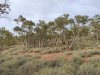
The hills are all very dry and rocky, almost scree-like, covered in ball-shaped clumps of spinifex grass and with scattered eucalyptus. The lower area around the water tanks has more trees than further up.

My directions for the area were that a little way after the first water tank there is a “well-defined track” to the right which leads through the hills. I think I had got this from David Andrew’s “The Complete Guide to Finding the Mammals of Australia”.

Directly after the first water tank there was a well-defined “track” which immediately turned into a very rough track as it went up a ridge. The book was published in 2015 though – a full decade ago – so for all I knew this may have been well-defined back then. In any case it was going uphill through rocks and trees, and that was good enough for me. The only bird I saw was a female Mistletoebird.

There were droppings of both rock wallabies and Euros (judging by the size difference) all over this ridge. I was continuously scanning everywhere looking for them but saw nothing. I couldn’t imagine where the rock wallabies were hiding. Well, amongst the boulders obviously, I hear you say. But there aren’t really any boulders here. There is an outcrop or two, but the slopes are largely covered in small rocks. I assumed they must be using the spinifex for cover – but that then left the puzzle of where the Euros were at because they are very large macropods.


While making my way up the ridge I had seen the actual “well-defined track” running along the bottom of it, so after reaching the top of the ridge I back-tracked a bit and then cut down the hill onto the track. The entrance to it is directly before the second water tank where the paved road curves to the right, which would have been a better description of how to find it than saying it was “x distance from the first water tank”.

The track isn’t very long. It runs by a gully alongside the ridge I was on and then splits, with the right track curling around the end of that ridge before petering out, and the left track going up the opposite slope to the paved road higher up (leading to the power stations). It turned out to be a very birdy area though, despite seeming quite desolate – there was not so much activity today in the afternoon but certainly tomorrow morning there were a lot of birds.

All the hills are covered in spinifex which looks like harmless piles of grass. But it’s not. Each blade is like a dagger, so sharp that it stabs your legs right through your trousers. If I didn’t know any better I’d think the name means something like “spine-maker”. It’s not the kind of habitat where it’s very pleasant to just go wandering off-track.


I took the right-hand fork in the track initially because I could see a big outcrop on another hill in that direction and figured there might be wallabies hiding there. Just as I started along the track a bird dashed off the side into the grass clumps. It’s kind of bewildering that spinifex is sharp enough to feel through trousers yet the birds dive straight through it, somehow without losing their eyes.

The bird had looked grasswren size, but I didn’t think my luck was that good. I kept my binoculars trained on the spot where the bird had gone in, waiting. Nothing happened. I snuck up closer until I was right beside it. I could hear the bird still in there – and then it suddenly popped out and sat on top of the spinifex singing. It was a Spinifexbird, which is a bird that lives almost solely in arid spinifex grassland. Hence the name.

The Spinifexbird remained where it was for about a minute, literally two metres away from me, then jumped up into the bare branches of a sapling where it sat for another few minutes singing. It’s true that when you don’t have a camera you get the best views of birds!

I was surprised how common the Spinifexbirds were, and also how easy they were to see! I saw three today and then another three the next day (and even got photos then, albeit not as good as they would have been of this first bird), and heard them calling all the time.


Further along the track I stayed for ages looking at that outcrop. It looked great for rock wallabies, with all sorts of crevices, but nary a one did I see. However, while watching, I saw several groups (or maybe one group coming and going) of Painted Firetails using the outcrop as a resting point. This is another bird like the Spinifexbird which is found in the arid spinifex grasslands of inland Australia, and was another bird ticked off my Mount Isa “wanted” list.


I next headed up the other track to the paved road and went to the top where as well as the two power station buildings there was a very large open area (it looked like there used to be a transmission tower there) with a view over the surrounding countryside – which was basically just flat for miles.

On the way up, while scanning the hills for wallabies, I was taken aback to see a herd of camels in the distance on the edge of the town. Surely they couldn’t be wild ones? It didn’t look like they were contained from my view, just wandering across an open field. I figured they had to be someone’s property, and sure enough when I did a Google search later they are owned by a local person.

Coming back down the road I found a third bird from my list, a Spinifex Pigeon. This was a bird I missed at Alice Springs, so I was hoping I would see it here. It is a fantastic-looking pigeon. I highly recommend googling a photo – the one at Mount Isa is the white-bellied subspecies leucogaster. The facial pattern and colour is amazing when seen close up in real life.

The pigeon flushed from beside the road as I walked by, but re-landed about three metres away from me and then just pottered about totally unconcerned. Once again I wished I had my camera with me!


Birds are all well and good but I still needed to see a Purple-necked Rock Wallaby. I had reached the lower section of the road by the second water tank, so there was nothing for it but to go back up the dirt track.

Part way up I caught a glimpse of “something” dashing behind a spinifex on the opposite slope. It had looked small and dark, maybe a grasswren I thought. I checked out the spot with my binoculars, and saw another quick movement but this time I saw it was a wallaby tail disappearing behind the next clump of grass.

I waited, and waited, but the wallaby didn’t come out the other side. I decided to go after it. Picking my way down the side of the gully and back up the other side was slow – the stony ground is unstable and the spinifex is sharp – and of course I was trying to do it quietly. When I reached the spot the wallaby had already gone, vanished via a rain-cut channel down the slope.

But then it reappeared – two of them in fact – bolting out of the grass lower down and bounding along the bed of the gully before vanishing under more spinifex. It seemed my supposition that they shelter under the spinifex rather than amongst the rocks was correct, or at least they probably do both.

Because I had no camera I didn’t bother trying to relocate them. I had seen them pretty well as they were hopping away.


I saw just 16 species of birds today:

Black Kite, Nankeen Kestrel, Feral Pigeon, Crested Pigeon, Spinifex Pigeon, Peaceful Dove, Australian Red-winged Parrot, Black-faced Cuckoo-Shrike, Spinifexbird, Magpie-Lark, White-breasted Woodswallow, Mistletoebird, Yellow-throated Miner, Painted Firetail, House Sparrow, Australian Magpie.
 
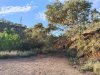
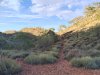
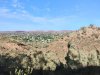
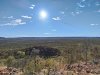
The top of the track where it forks, illustrating the spinifex habitat here, and then the next two photos are looking west towards town and looking east from the top of the hill by the power stations (taken in the morning obviously).

IMG20251112070108.jpg IMG20251112074326.jpg IMG20251112075138.jpg
 

Attachments

  • IMG20251112070108.jpg
    IMG20251112070108.jpg
    229.2 KB · Views: 46
  • IMG20251112074326.jpg
    IMG20251112074326.jpg
    207.8 KB · Views: 52
  • IMG20251112075138.jpg
    IMG20251112075138.jpg
    190.7 KB · Views: 45
Coming back down the road I found a third bird from my list, a Spinifex Pigeon.
The pigeon flushed from beside the road as I walked by, but re-landed about three metres away from me and then just pottered about totally unconcerned. Once again I wished I had my camera with me!

Pleased you saw the Spinifex pigeon. I remember the ones we saw near Alice Springs, there were 4 and they came running towards us like domestic chickens would and gobbled bits of food we proffered. Beautiful little birds. No Gouldian finches then?
 
Mount Isa


I had my camera working again, had left the battery charging overnight, and was ready to go. To avoid any complications I left the battery out until I got to the water tanks, then put it in, turned on the camera and just kept it on the whole time, tapping the shutter button every so often to keep it active. I figured that way I wouldn’t find that it was refusing to turn on when I needed it. This worked well enough but it’s a bit annoying not having a properly working camera.

I saw Varied Lorikeets flying overhead while walking along Pamela Street this morning, so even if I had missed them at Pine Creek I would have still got them here. It’s always the way with birds that you can look for a species for ages with no success, but as soon as you do finally see one then you start seeing them everywhere.

In the open bit of ground just by the car barrier at the first water tank there were two finches hopping about. I hoped they might be Painted Firetails but they were Zebra Finches. Just after that I spotted a Little Woodswallow perched on a dead tree which was the first lifer of the day.

full

Little Woodswallow


The trees around the second water tank and the start of the birding track were full of birds this morning. I was sure I saw a Spotted Bowerbird (or more than one) flying back and forth but couldn’t pin it down to be a hundred percent certain, so the next lifer of the day went to the Grey-headed Honeyeaters which turned out to be very common around this patch.

full

Grey-headed Honeyeater


I had heard Spinifexbirds calling as I walked further along the track, and had seen just one briefly. It looked like I wasn’t going to get any views like I had yesterday, but eventually I saw one which was cooperative and got some photos as it worked itself through a spinifex clump. None were as “unobstructed” as I’d have liked – there were spinifex blades in the way in all the shots – but they are good enough.

full

Spinifexbird


I went up the paved road to the power station buildings, seeing a pair of Red-backed Kingfishers on the overhead wires. At the top a Nankeen Kestrel I’d seen yesterday was still present. The main station is at the very end of the road, but just below the top there is a paved stretch off to the left which leads to the smaller building, and directly opposite is a dirt track which goes to the big cleared area I mentioned in the last post (where I’d taken a photo of the landscape to the east).

I went down to that smaller building and started scanning over the ground on the facing slope. In my head I was imagining writing about how I had been “hopelessly looking at dirt and rocks when a Kalkadoon Grasswren hopped through my binocular view between the spinifex clumps” – and just then a Kalkadoon Grasswren hopped through my binocular view between the spinifex clumps!! Unbelievable!

There was actually a pair of them. They moved across the open ground, across another patch, and then were obscured by some trees in the foreground. I quickly scooted around in the direction they were heading, thinking I might be able to get some photos as they emerged. They wouldn’t have been close photos but maybe they would be okay. I didn’t see them again. I don’t know if they doubled-back or what, but I waited for almost an hour and never saw them. However, my first wild grasswren!

Grasswrens are renowned as being amongst the hardest of Australian birds to find (in general – some are easier than others of course, and the difficulty is more that they are mostly inland birds and often have restricted ranges). There is a nice link here which has a map showing the distributions of all the species, plus photos of them all: Grasswrens


Back down at the water tanks I had my fourth lifer of the day, although it took a bit to work out what it was. When I first glimpsed it through the branches I thought it might be a Grey Shrike-Thrush because it seemed quite big. Then when I got a real look at it in the open I was still puzzled. It looked kind of like a female White-winged Triller, but also not. I took a bunch of photos and looking at those it struck me that it might be a songlark.

The name songlark is a bit of a misnomer (as Australian bird names often are) because it is in the genus Cincloramphus. In other words it is the same genus as thicketbirds and is also related to grasshopper-warblers and the New Zealand Fernbird (and the Spinifexbird as it happens). It doesn’t look like its relatives though, it really looks like a messed-up lark. No wonder I was confused.

full


From the photos I took (one of them shown above) I determined that the bird was a Rufous Songlark. On eBird the text even likens it to a female White-winged Triller. Later in the day I got better photos which showed the characteristic chestnut rump more clearly.


Because I had a working camera today I wanted to get photos of the Purple-necked Rock Wallabies. I did another circuit of the track and back up the paved road. Half way up I suddenly saw a rock wallaby, just sitting on the rocks next to the road in the open. I took some shots from where I was – and then the camera decided now was when it wanted to fail again! It was still on, but showing an error message on the screen and making whirring noises. I flicked it on and off, took the lens off and put it back on, and got it working again. I took a few more photos and then the wallaby decided I was a little bit too strange and quickly left.

full


I had another look for the grasswrens at the top but no luck. On the way back down the road I was also on the lookout for that Spinifex Pigeon, but no luck with that either. However, right down the bottom by the second water tank – a pair of grasswrens! Most likely it was the same pair of grasswrens as from earlier in the morning. They weren’t very close but I got of a couple of photos before I lost them. Both photos were bad but the one below was the “least bad”, and it’s a crop of course.

full

Kalkadoon Grasswren


Around midday I went back to the hotel to have lunch and a little sleep, but I returned to the water tanks track in the late afternoon. This is when I got the better shots of the Rufous Songlark and some shots of a pair of Black-faced Cuckoo-Shrikes.

full

Rufous Songlark

full

Black-faced Cuckoo-Shrike


I also met two birders on the trail, who were both curatorial ornithologists. One was Leo Joseph of CSIRO’s Australian National Wildlife Collection, and the other was Brian Smith from the American Museum of Natural History. They had a conference in Perth but had made a grasswren detour on the way, as one does.

I passed on some of my wisdom, in particular where I saw the grasswrens in the morning, then they went off to try and find those while I stayed around the trees near the bottom looking for Spotted Bowerbirds and Grey-fronted Honeyeaters (which are different to the Grey-headed Honeyeaters which I had seen earlier).

Eventually we met up again at the power substation and I showed them exactly where I had first seen the grasswrens. Then we walked back down the road, finding a Spinifexbird on the way, and at the second water tank finally some Spotted Bowerbirds – lifer number five of the day.

It was quite late in the day by now. At the clearing by the first water tank we spotted a rock wallaby on the hill and it paused long enough to allow me to take some photos.

full


Then we got distracted by Brian seeing Cloncurry Parrots, which was a bird we all wanted. He initially saw them in a tree, I only saw them as they flew away – although their strange pale-green colour is very distinctive – and Leo missed them.

The Cloncurry Parrot is a subspecies of the Australian Ringneck. There are four subspecies, each with its own common name (and in former times all treated as distinct species). I had already seen three of them – the Twenty-eight Parrot, the Port Lincoln Parrot, and the Mallee Ringneck. The Cloncurry Parrot has the most restricted distribution, being found only in a small area of northwest Queensland and just over the border into the Northern Territory.

It is named after the town of Cloncurry (just east of Mount Isa), which is named after the Cloncurry River, which was named in 1861 by the famed explorer Robert O’Hara Burke (one third of Burke and Wills and camels) after his Irish cousin Lady Elizabeth Cloncurry.

The two parrots Brian had seen had flown further back into the trees rather than flying away altogether, so we used our binoculars to search through the canopies. I managed to refind them perched in a tree and got a good look at them, but they left again before Leo saw them. He therefore struck off across the hill and eventually got views of them.

Leo and Brian gave me a lift back to my hotel, which was not only nice in itself but then they asked if I wanted to go with them tomorrow morning to look for Carpentarian Grasswrens at a site outside town. I had to think about it for a few seconds.


I saw 32 species of birds today:

Black Kite, Nankeen Kestrel, Feral Pigeon, Crested Pigeon, Peaceful Dove, Little Corella, Galah, Australian Red-winged Parrot, Cloncurry Parrot, Varied Lorikeet, Red-backed Kingfisher, Rainbow Bee-eater, Black-faced Cuckoo-Shrike, White-winged Triller, Grey-crowned Babbler, Kalkadoon Grasswren, Spinifexbird, Rufous Songlark, Willy Wagtail, Magpie-Lark, White-breasted Woodswallow, Little Woodswallow, Mistletoebird, Brown Honeyeater, White-plumed Honeyeater, Grey-headed Honeyeater, Yellow-throated Miner, Little Friarbird, Zebra Finch, House Sparrow, Spotted Bowerbird, Pied Butcherbird.
 
Last edited:
Nice lists and Leo Joseph has done some interesting work on Psittacidae, so birding with him (and chatting over a beer) could be interesting. Always interesting to see how remote some of the species that are common in captivity live. Painted firetails are fun little waxbills.
 
Always interesting to see how remote some of the species that are common in captivity live. Painted firetails are fun little waxbills.

Yes, I'm familiar with several of the Australian finches and other small seedeaters from Aviculture. Apart from Zebra finch some of the others seem to have pretty restricted ranges but then its a vast continent.
 
Mount Isa


Leo and Brian picked me up at 5.15am for our morning trip to Gunpowder Road to look for Carpentarian Grasswrens. It gets light at about 5.30am in Queensland at the moment – there’s a half-hour time difference between here and the Northern Territory where it gets light at 6am.

In Australia almost all the states have different times. Currently Western Australia is 1.5 hours behind the Northern Territory, which is half an hour behind Queensland, which is half an hour behind South Australia, which is half an hour behind the south-eastern states (NSW, ACT, Victoria and Tasmania).

These differences aren’t constant though, because Western Australia, the Northern Territory and Queensland don’t observe daylight savings whereas the others do. That’s why the Northern Territory and South Australia have a one hour time difference (currently) despite being longitudinally positioned, and likewise for Queensland and NSW.


The traditional site for Carpentarian Grasswrens near Mount Isa was a place called McNamara Road which was restricted access and is now closed to birders. The “new” site at Gunpowder Road also requires advance permission to access. I don’t know how to do this because I was just tagging onto a pre-arranged trip, but there are no gates (because it’s the outback) and I suspect a lot of people just look where the eBird pins are and go. Needless to say – don’t do this! I think all this area is mining country and if people are ignoring the “do not enter” signs and driving into sites without permission then access for everyone will be blocked.

The Gunpowder Road site is only about half an hour drive north of Mount Isa. Easy in a car, but basically impossible without because it’s a distance of 50-odd kilometres. Turning off the Barkly Highway onto the dirt Gunpowder Road, we soon arrived at our destination. The sky was yellow, the temperature mellow. The habitat here looks exactly the same as at the Pamela Street water tanks in town, all red stony ground covered in hummocks of spinifex under scattered eucalyptus.

We headed up the hill in front of us, using some indistinct tracks which were probably formed by cattle. Not many birds were in evidence. We saw a male Purple-backed Fairy-Wren, and Leo noted the call of a Black-tailed Treecreeper which would be a lifer for me but we couldn’t locate it.

After winding around the hillside for a bit, we moved back down towards the flat ground. The treecreeper was found and I saw it, lifer number one for the day. I’ve seen two other Australian treecreepers before (White-throated and Rufous) but they were years ago so in my head I was imagining a bird the size of a Eurasian Treecreeper (which is totally unrelated but that’s the treecreeper I’m more familiar with, ironically). Instead they are about twice that size.


Once on the flat ground, almost immediately I heard a call which I thought sounded like a Carpentarian Grasswren, and then Brian and Leo saw them. I was a little way behind them because I’d been trying to see some other bird which I can’t remember now. I rushed over to them (“rushed” through the spinifex!), and got a blurred glimpse of a bird going behind a spinifex clump, then another glimpse as it darted to another clump.

I was afraid that was it, but luckily the grasswren jumped up onto a dead snag low to the ground – with its partner so there were two birds together – and they sat there singing in full view before flying quickly across the spinifex to another low branch where they posed for another short while, and then repeated that a third time. The fourth time they flew took them out of our view.

We were all breath-taken by how well we had seen them. They are beautiful birds too. The Kalkadoon Grasswren is a sort of rusty-grey colour with white streaking but the impression when seeing the bird in the flesh is really of a dull brownish bird with (in the female) a red belly. The Carpentarian Grasswren in contrast looks really brightly-coloured with its chestnut body, black and white streaked head, and pure white throat.

Because we had walked in a vague loop over the hillside, where we saw the grasswrens was only about 100m from the car. If you can get here, you don’t need to walk far to find them!


While walking back to the car we saw several Grey-fronted Honeyeaters – lifer number three for the day (and my final one for Mount Isa).

Today was my last day at Mount Isa. My bus wasn’t until 7pm but I had to be back at the motel by 10am for check-out. It was still early though – I think it was only around 8am at this point – so we had plenty of time to have a general wander around.

There were some other nice birds in the vicinity including a flock of Yellow-rumped Thornbills, a group of Spinifex Pigeons, some Diamond Doves, and a Jacky Winter which is a type of “flycatcher” (i.e. a flycatcher-like Australasian robin related to the Yellow-bellied Flycatcher I was discussing the name of in the post about Darwin’s Lee Point Dam).

A trio of Red Kangaroos were also seen when leaving, the first I’ve seen since the Adelaide area – I really thought that with all the cross-country bus travelling through inland Australia I would have been seeing heaps of kangaroos and emus and camels and other such things, but there’s mostly nothing. I haven’t even seen any Emus at all since Adelaide.

We made a couple of stops on the way back to town, the first for Cloncurry Parrots of which we all finally got great perched views, and the second at the little Tom O’Hara Park (at the turn-off towards Lake Moondarra) where there were both Rainbow and Red-collared Lorikeets as well as Varied Lorikeets all feeding in the eucalyptus trees.


There was just one bird left unticked on my Mount Isa hit-list, the Black-chinned Honeyeater, but it was 37 degrees today and this is a really widespread bird across northern and eastern Australia so I stayed at the motel for the rest of the day instead of making another afternoon visit to the water tanks.

I had seen eleven lifers here in less than three days, and in fact almost every year-bird I saw was also a lifer (the Jacky Winter was the odd one out). In Darwin I had seen twelve lifers over two weeks.


In lieu of any photos from today, here’s one of a Yellow-throated Miner from yesterday at the water tanks:

full


And another one of a Grey-headed Honeyeater:

full


I saw 32 species of birds today:

Pied Cormorant, Dusky Moorhen, Black Kite, Feral Pigeon, Crested Pigeon, Spinifex Pigeon, Common Bronzewing, Diamond Dove, Little Corella, Australian Red-winged Parrot, Cloncurry Parrot, Rainbow Lorikeet, Red-collared Lorikeet, Varied Lorikeet, Fairy Martin, Black-faced Cuckoo-Shrike, Grey-crowned Babbler, Carpentarian Grasswren, Willy Wagtail, Jacky Winter, Magpie-Lark, Yellow-rumped Thornbill, Purple-backed Fairy-Wren, White-breasted Woodswallow, Black-faced Woodswallow, Black-tailed Treecreeper, Grey-fronted Honeyeater, Yellow-throated Miner, Zebra Finch, House Sparrow, Australian Magpie, Pied Butcherbird.
 
Mount Isa


Leo and Brian picked me up at 5.15am for our morning trip to Gunpowder Road to look for Carpentarian Grasswrens. It gets light at about 5.30am in Queensland at the moment – there’s a half-hour time difference between here and the Northern Territory where it gets light at 6am.

In Australia almost all the states have different times. Currently Western Australia is 1.5 hours behind the Northern Territory, which is half an hour behind Queensland, which is half an hour behind South Australia, which is half an hour behind the south-eastern states (NSW, ACT, Victoria and Tasmania).

These differences aren’t constant though, because Western Australia, the Northern Territory and Queensland don’t observe daylight savings whereas the others do. That’s why the Northern Territory and South Australia have a one hour time difference (currently) despite being longitudinally positioned, and likewise for Queensland and NSW.


The traditional site for Carpentarian Grasswrens near Mount Isa was a place called McNamara Road which was restricted access and is now closed to birders. The “new” site at Gunpowder Road also requires advance permission to access. I don’t know how to do this because I was just tagging onto a pre-arranged trip, but there are no gates (because it’s the outback) and I suspect a lot of people just look where the eBird pins are and go. Needless to say – don’t do this! I think all this area is mining country and if people are ignoring the “do not enter” signs and driving into sites without permission then access for everyone will be blocked.

The Gunpowder Road site is only about half an hour drive north of Mount Isa. Easy in a car, but basically impossible without because it’s a distance of 50-odd kilometres. Turning off the Barkly Highway onto the dirt Gunpowder Road, we soon arrived at our destination. The sky was yellow, the temperature mellow. The habitat here looks exactly the same as at the Pamela Street water tanks in town, all red stony ground covered in hummocks of spinifex under scattered eucalyptus.

We headed up the hill in front of us, using some indistinct tracks which were probably formed by cattle. Not many birds were in evidence. We saw a male Purple-backed Fairy-Wren, and Leo noted the call of a Black-tailed Treecreeper which would be a lifer for me but we couldn’t locate it.

After winding around the hillside for a bit, we moved back down towards the flat ground. The treecreeper was found and I saw it, lifer number one for the day. I’ve seen two other Australian treecreepers before (White-throated and Rufous) but they were years ago so in my head I was imagining a bird the size of a Eurasian Treecreeper (which is totally unrelated but that’s the treecreeper I’m more familiar with, ironically). Instead they are about twice that size.


Once on the flat ground, almost immediately I heard a call which I thought sounded like a Carpentarian Grasswren, and then Brian and Leo saw them. I was a little way behind them because I’d been trying to see some other bird which I can’t remember now. I rushed over to them (“rushed” through the spinifex!), and got a blurred glimpse of a bird going behind a spinifex clump, then another glimpse as it darted to another clump.

I was afraid that was it, but luckily the grasswren jumped up onto a dead snag low to the ground – with its partner so there were two birds together – and they sat there singing in full view before flying quickly across the spinifex to another low branch where they posed for another short while, and then repeated that a third time. The fourth time they flew took them out of our view.

We were all breath-taken by how well we had seen them. They are beautiful birds too. The Kalkadoon Grasswren is a sort of rusty-grey colour with white streaking but the impression when seeing the bird in the flesh is really of a dull brownish bird with (in the female) a red belly. The Carpentarian Grasswren in contrast looks really brightly-coloured with its chestnut body, black and white streaked head, and pure white throat.

Because we had walked in a vague loop over the hillside, where we saw the grasswrens was only about 100m from the car. If you can get here, you don’t need to walk far to find them!


While walking back to the car we saw several Grey-fronted Honeyeaters – lifer number three for the day (and my final one for Mount Isa).

Today was my last day at Mount Isa. My bus wasn’t until 7pm but I had to be back at the motel by 10am for check-out. It was still early though – I think it was only around 8am at this point – so we had plenty of time to have a general wander around.

There were some other nice birds in the vicinity including a flock of Yellow-rumped Thornbills, a group of Spinifex Pigeons, some Diamond Doves, and a Jacky Winter which is a type of “flycatcher” (i.e. a flycatcher-like Australasian robin related to the Yellow-bellied Flycatcher I was discussing the name of in the post about Darwin’s Lee Point Dam).

A trio of Red Kangaroos were also seen when leaving, the first I’ve seen since the Adelaide area – I really thought that with all the cross-country bus travelling through inland Australia I would have been seeing heaps of kangaroos and emus and camels and other such things, but there’s mostly nothing. I haven’t even seen any Emus at all since Adelaide.

We made a couple of stops on the way back to town, the first for Cloncurry Parrots of which we all finally got great perched views, and the second at the little Tom O’Hara Park (at the turn-off towards Lake Moondarra) where there were both Rainbow and Red-collared Lorikeets as well as Varied Lorikeets all feeding in the eucalyptus trees.


There was just one bird left unticked on my Mount Isa hit-list, the Black-chinned Honeyeater, but it was 37 degrees today and this is a really widespread bird across northern and eastern Australia so I stayed at the motel for the rest of the day instead of making another afternoon visit to the water tanks.

I had seen eleven lifers here in less than three days, and in fact almost every year-bird I saw was also a lifer (the Jacky Winter was the odd one out). In Darwin I had seen twelve lifers over two weeks.


In lieu of any photos from today, here’s one of a Yellow-throated Miner from yesterday at the water tanks:

full


And another one of a Grey-headed Honeyeater:

full


I saw 32 species of birds today:

Pied Cormorant, Dusky Moorhen, Black Kite, Feral Pigeon, Crested Pigeon, Spinifex Pigeon, Common Bronzewing, Diamond Dove, Little Corella, Australian Red-winged Parrot, Cloncurry Parrot, Rainbow Lorikeet, Red-collared Lorikeet, Varied Lorikeet, Fairy Martin, Black-faced Cuckoo-Shrike, Grey-crowned Babbler, Carpentarian Grasswren, Willy Wagtail, Jacky Winter, Magpie-Lark, Yellow-rumped Thornbill, Purple-backed Fairy-Wren, White-breasted Woodswallow, Black-faced Woodswallow, Black-tailed Treecreeper, Grey-fronted Honeyeater, Yellow-throated Miner, Zebra Finch, House Sparrow, Australian Magpie, Pied Butcherbird.

If you’re still after Black-chinned Honeyeater by the time you are back in Melbourne, Crusoe Reservoir which is accessible by both train and bus (about 2hrs out of Melbourne, near Bendigo) has them pretty often, it’s also just a really good spot for birding, in summer there are many species of cuckoos and in winter sometimes robins. Brown Treecreeper is another bird found here that would be a lifer for you, it’s one of the more reliable spots for Square-tailed Kite (although still tricky) and there are swarms of Yellow-tufted Honeyeaters. If you get extremely lucky like I was once, there’s potential for Chestnut-rumped Heathwren here which is an extremely difficult bird.

In my opinion Mangalore State Forest and Wychitella Nature Conservation Reserve are both better for Black-chinned Honeyeater but both those are probably inaccessible by public transport and Crusoe is the better overall birding location anyway.
 
If you’re still after Black-chinned Honeyeater by the time you are back in Melbourne, Crusoe Reservoir which is accessible by both train and bus (about 2hrs out of Melbourne, near Bendigo) has them pretty often, it’s also just a really good spot for birding, in summer there are many species of cuckoos and in winter sometimes robins. Brown Treecreeper is another bird found here that would be a lifer for you, it’s one of the more reliable spots for Square-tailed Kite (although still tricky) and there are swarms of Yellow-tufted Honeyeaters. If you get extremely lucky like I was once, there’s potential for Chestnut-rumped Heathwren here which is an extremely difficult bird.

In my opinion Mangalore State Forest and Wychitella Nature Conservation Reserve are both better for Black-chinned Honeyeater but both those are probably inaccessible by public transport and Crusoe is the better overall birding location anyway.
Thanks. I haven't seen Yellow-tufted Honeyeater either - but I saw a Square-tailed Kite just yesterday at Townsville Common.
 
A grasswren of any kind is a very impressive addition to any Australian list. Well done! I have been living vicariously through your journey while taking note of future destinations I need to plan. Loving this thread.
Mount Isa would be a good one for a quick trip because you can fly there direct from Brisbane, and if you hired a car for a couple of days could "easily" get a bunch of nice birds which aren't on the east coast. The flights aren't the cheapest, but two species of grasswrens might be persuasive.
 
Townsville


Between Mount Isa and Townsville there were a few places which I didn’t end up visiting.

First was the Riversleigh Fossil Centre in Mount Isa (the Greyhound bus stop is actually directly outside). I had wanted to see this but it sort of fell through the cracks. The entry fee is AU$19.50 which isn’t expensive in itself, but I was in an expensive hotel and it just felt like too much. Also the fossil centre at Alice Springs was free, which made $19.50 seem more than it is.

Second was an entire town, called Julia Creek. I had wanted to go here because the visitor centre apparently has live Julia Creek Dunnarts on display which I would have liked to have seen. This is a species of dasyurid (“marsupial mouse”) found only around Julia Creek and which is not in captivity anywhere else. Julia Creek is only three hours from Mount Isa and is on the main highway to Townsville, and I thought it would be an easy overnight stop on the bus. But when I tried to book it I found that the schedules are really messy, and not just because the buses aren’t daily. On some runs the east-bound bus seems to only drop off at Julia Creek (i.e. the system won’t let you book a pick up on that day) and so if you want to travel on to Townsville you have to catch a bus back west to Mount Isa first and then catch the next bus coming through - even though that bus will then pass right through Julia Creek! Alternatively, you stay in Julia Creek for four or more days until there’s a bus which picks up. In the end I dropped the idea and just went directly from Mount Isa to Townsville.

Third were two wildlife facilities in Townsville. The Great Barrier Reef Aquarium (aka Reef HQ) is very close to where I was staying but it is currently closed for renovations, and Billabong Sanctuary (which is a zoo) is outside town and there is no public transport out there.


Another random side-note, because I couldn’t fit it into the preceding posts in connection with anything else, but the tap water in Mount Isa is revolting. I don’t know what’s in it, but it tastes foul. I had to buy bottled water from the supermarket when there. I even used bottled water to make coffee because the taste of the tap water was so overpowering!


The Greyhound bus arrived in Townsville just after 6.30am. It had been scheduled for a 7am arrival, but either way I knew the hostel reception wouldn’t be open yet. I was hoping for 8am because then I could leave my pack there and go catch the 8.27am bus to the suburb of Pallarenda, which is just by the access tracks for Townsville Common, the main bird site in the city and apparently the best waterbird site in Australia. This bus (the #206) only runs once-hourly during the week so there’s a bit of a wait if you miss one. On Saturdays it only runs once every two hours, and not at all on Sundays.

All the local buses in the Northern Territory (e.g. Alice Springs and Darwin) were free. In Queensland they are almost free. A single ride is 50 cents, and an all-day ticket – for as many buses as you want - is only $1. Half the buses I've caught in Queensland don’t even take the fare, the drivers just wave people onboard.


I was staying at a place called The Pier Pods, just a minute’s walk from the bus. The Greyhound bus stop is right outside the ferry terminal (for Magnetic Island, where there are Allied Rock Wallabies) and there is also a stop there for the #206 bus. Everything was therefore conveniently in one spot, and while the hostel was still expensive because it’s Australia (AU$56.70 per night) at least pods are better than being in a regular dorm room.

Unfortunately the reception didn’t open until 9am. There was a small notice on the door saying to use the entry code sent in the booking email, but they hadn’t sent one. Another big instruction notice said in order to get the entry code to download some app called Goki and enter your booking reference. I got the app – it only had 606 reviews which seemed dodgy – entered my booking reference and it just said that I hadn’t checked in yet. I knew that – that was why I had got the app!

I went back across the road to wait at the ferry terminal where there were toilets and a cafe and sockets so I could use my laptop. I bought a pie for breakfast which was AU$8.90 (!), almost twice as expensive as the $5.10 pies at Pine Creek, but it was a much better pie at least.

A 9am I went back to the hostel where they could check me in immediately because the bed was already available (the official check-in time was 3pm). I sorted out my gear, stowed my pack in my locker, and was back at the bus stop in time to catch the 9.27am bus.

The Pier Pods is actually a really nice hostel. I recommend staying there. The “pods” are like the ones at the Tequila Sunrise in Adelaide – a bed with a curtain so you have privacy - but many of them have views of the harbour on the other side of the bed! See the photo I will attach in the next post which shows the view from my bed (there is a second curtain to draw across the window if you need to).


Random bird news: House Sparrows had re-entered the thread at Mount Isa (last seen in Adelaide!), and now in Townsville the Common Mynah has made a reappearance (last seen even earlier, in Melbourne at the very start of the thread!). Torresian Imperial Pigeons are in Townsville and I saw some every day, but they are not anywhere near as common as in Darwin. Great Bowerbirds are a street bird here as well.


The Townsville Common, as mentioned above, is said to be the best waterbird site in Australia. I am, of course, here at the wrong time of year for that. In the middle of the year, after the rains have finished and the temperatures are cooler, all the lagoons and wetlands are full of water and birds. In November the whole area is parched and the wetlands are reduced to small pools. The waterbirds have mostly departed as well.

In some parts of the world with seasonal wetlands, as the lagoons get smaller the number of birds seemingly increases because they are getting packed into smaller and smaller areas. In Australia, the birds just leave. So you have shrunken water bodies with just a few birds scattered around them. Fortunately I have seen most of the freshwater birds in Australia already. I will be missing the spectacle but not the species.

The only waterbirds I “needed” were Green Pigmy Goose and Spotted Whistling Duck, which are the only two ducks in Australia I haven’t seen, and then are some “water-adjacent” birds I haven’t seen yet like the Pale-vented Bush Hen and Little Kingfisher.


There are two main access points for the Common. Most visitors probably get there by car, driving up a long dirt road from the southern end by the airport, passing a couple of viewpoints and ending at a parking area near the bird hides further north.

The other main entrance is beside the Walter Nisbet Park in the suburb of Pallarenda, from where walking trails lead through woodland and around the lagoons to the bird hides. If without a car then this is where you start because bus #206 goes to here. You could walk there but it is a long way from the central city where you’d be staying.


From the bus on the way to Pallarenda I saw a Brush Turkey on the sidewalk, the first one for the trip now that I am on the east coast.


At the start of the trails by Walter Nisbet Park there is a signboard showing a map of the reserve, of which I’ll put a photo in the post below. I was already 10am by the time I got here so it was a bit of a short day. From the entrance I walked up the initial part of the Lagoon Trail, branched off onto the Wetland Walk (a short trail through forest which rejoins onto the Lagoon Trail further ahead), and then took the Freshwater Trail which leads to the bird hides. I had been intending to do a full loop because the Lagoon Trail and Wetland Trail meet up again eventually, but the western end of the Wetland Trail was blocked due to construction work on a bridge down there. So I retraced the trail back to the first junction and walked the eastern end of the Lagoon Trail as a “there and back” sort of thing.

There was nothing much along the first part of the trails. I met a few other birders over the next few days and they all said it was really quiet for birds lately. I saw 41 bird species total today, but they were just picked out slowly here and there, and while three were new for the trip (Australian Brush Turkey, Brolga, and Brown-backed Honeyeater) none were lifers.

When I was walking along the so-called Wetland Walk I noted the large number of pandanus here and thought it looked good like good habitat for Crimson Finches. Then I remembered I wasn’t in Darwin any more. So I was surprised when a little bit later a Crimson Finch flew out of the grass. They do occur here after all. I actually did know that, in theory, because of course I have usually gone through the eBird lists before visiting sites, but I think sometimes I just skim over birds I have seen recently elsewhere and they don’t stick in my head. In the same way I was surprised when first coming into Townsville on the bus and I saw a Torresian Imperial Pigeon.

Being at the end of the dry season, before the rains have come in to refill the waterways, the lagoon of the Lagoon Trail was mostly not there. There was a lot of long green grass so presumably the residuals of the water were hanging in there, but if so it was hidden under the grasses.

There was still some open water at the Jacana Hide and the Freshwater Hide. The cracking mud showed how much had dried up though. In front of the Jacana Hide I saw a couple of egrets and a little flock of Black Ducks, and (at a further distance) a pair of Brolgas and two juvenile Black-necked Storks.

At the Freshwater Hide, with a different viewing angle, I saw the parents of the Black-necked Storks, as well as a single Magpie Goose and a White-faced Heron.

With slim pickings on the bird front, the more interesting wildlife became the White-lipped Tree Frogs which were using the hides as shelters. In the Jacana Hide, which has dark walls, the frogs were brown. In the Freshwater Hide which has whitish walls, the frogs were the typical bright green. I saw three frogs in the Jacana Hide and seven in the Freshwater Hide. Two days later when I was back here all the frogs except one were gone.

full


full


I walked a bit further past the hides along the Freshwater Trail but came to a notice that the trail was blocked. On the way back I came across a nice group of Brown-backed Honeyeaters in the branches a fallen tree across the edge of a pool, from which they were diving down to bathe.

When I got back to the eastern-end junction with the Lagoon Trail I went up that way a short distance and found some remnant water with a lot of Magpie Geese and Cattle Egrets, and several Brolgas.


I saw 41 species of birds today:

Magpie Goose, Australian Black Duck, Great Egret, White-faced Heron, Eastern Cattle Egret, Australian Brush Turkey, Brolga, Black-necked Stork, Australian White Ibis, Straw-necked Ibis, Spur-winged Plover, Silver Gull, Whistling Kite, Brahminy Kite, Feral Pigeon, Torresian Imperial Pigeon, Bar-shouldered Dove, Peaceful Dove, Greater Sulphur-crested Cockatoo, Red-tailed Black Cockatoo, Galah, Rainbow Lorikeet, Pheasant Coucal, Rainbow Bee-eater, Welcome Swallow, White-breasted Cuckoo-Shrike, Varied Triller, Willy Wagtail, Magpie-Lark, White-breasted Woodswallow, Brown Honeyeater, Brown-backed Honeyeater, Helmeted Friarbird, Crimson Finch, House Sparrow, Common Mynah, Australian Magpie, Spangled Drongo, Australian Figbird, Great Bowerbird, Australian Raven.
 
Back
Top