Australasian Western Lowland Gorilla Population

Some exciting news I've recently learnt in correspondence with the owner of Hobart Zoo and Aquarium;

Hobart are in discussions to be a potential new holder, with them excitedly planning to acquire Gorillas via import in the near future!

Fingers crossed that this comes to fruition; the region desperately needs additional genetics.
 
Some exciting news I've recently learnt in correspondence with the owner of Hobart Zoo and Aquarium;

Hobart are in discussions to be a potential new holder, with them excitedly planning to acquire Gorillas via import in the near future!

Fingers crossed that this comes to fruition; the region desperately needs additional genetics.
That is a tremendously exciting prospect! That would be huge for a small zoo like Hobart and a great boost for the regional program.

It would be great to see a new holder join the Australasian branch of the breeding programme. We missed out on gaining Adelaide and Sydney as holders; Orana canned plans to import a breeding troop; and Taronga disbanded their breeding troop, so it’s fair to say we could do with a win at this point.

Since all reproductive females in the region (bar Johari) are from Mouila’s line, it would be good to get some females unrelated to her to increase the genetic diversity of Melbourne and Mogo’s troop in decades to come via exchanges of Australian bred gorillas.
 
It would be great to see a new holder join the Australasian branch of the breeding programme. We missed out on gaining Adelaide and Sydney as holders; Orana canned plans to import a breeding troop; and Taronga disbanded their breeding troop, so it’s fair to say we could do with a win at this point.

Since all reproductive females in the region (bar Johari) are from Mouila’s line, it would be good to get some females unrelated to her to increase the genetic diversity of Melbourne and Mogo’s troop in decades to come via exchanges of Australian bred gorillas.
Yes Adelaide U turn was disappointing and would have been ideal to have them holding a troop.
Another two possible holders that also never came to light was Seaworld at the Gold Coast and Australia zoo on the Sunshine Coast (all the Gorilla information long since removed from the zoos website).
 
Some exciting news I've recently learnt in correspondence with the owner of Hobart Zoo and Aquarium;

Hobart are in discussions to be a potential new holder, with them excitedly planning to acquire Gorillas via import in the near future!

Fingers crossed that this comes to fruition; the region desperately needs additional genetics.
Wow! I would assume that they would be held in the current cassowary and/or lion exhibit unless a new exhibit is to be built for them.
 
Wow! I would assume that they would be held in the current cassowary and/or lion exhibit unless a new exhibit is to be built for them.
A new exhibit will be built for them. The hope is for it to be built Howletts style - so it'll be interesting to see how the zoo goes about building such an exhibit, and what they elect to include/add/remove ect. .

Here's a photo of one of Howlett's enclosures for reference;

full
 
Scouring through the Melbourne news archives, I found the following articles from back when Melbourne had a baby boom of gorillas in 1999/2000.

I've included abstracts from the articles that may be of interest;

2gorilla.jpg

Buzandi and Yuska

Melbourne Zoo is delighted to announce the pregnancies of three female gorillas.

Melbourne Zoo is the only Australian zoo to have raised young gorillas.

The first gorilla born in Australia was Mzuri (June 3, 1984), who was conceived via artificial insemination.

Now Mzuri's mother, Yuska, is pregnant for the second time, and due to give birth any day between now and mid-December. This time Yuska's pregnancy has been achieved by mating with the silverback male, Motaba, recently reintroduced into the group.

The three pregnant females are:

Yuska, 28 years old

G-Anne, 20 years old

Julia, 17 years old

Yuska has been at Melbourne Zoo since 1973, but the two other females which are now pregnant arrived here in December 1997 from the Durrell Wildlife Conservation Trust on Jersey, in the Channel Islands, which is named after its founder, the noted naturalist Gerald Durrell.

Since the arrival of the Jersey females, Ulli Weiher and her Primate Department staff have worked long and hard to integrate G-Anne and Julia into the existing gorilla group. As an added complication, the group also needed to accept a new silverback, Motaba, after the death of the old male Buluman in 1998.

Motaba came to Melbourne in 1990, as a seven-year-old. Because Buluman was infertile, Motaba fathered two young earlier than usual. The mother of Motaba's first two offspring is Betsy (42 years old, arrived from Taronga Zoo with her longterm companion Buluman in 1980). Betsy and Motaba's male offspring, Buzandi, was born in 1991 and the female, Bambuti, was born in 1994.

These two youngsters have remained in the main social group with Betsy since she gave birth to them, but when Motaba became old enough to begin challenging Buluman for the leadership role he was temporarily removed from the group, to remove this source of conflict.

babyG4a.jpg


Nov 29, 1999

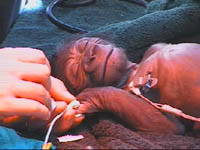
The baby Western Lowland Gorilla born at Melbourne Zoo yesterday afternoon is making good progress.

He was delivered by caesarian section after his mother Yuska had been in non-progressive labour since the previous evening.

Zoo Veterinarian Dr. Michael Lynch explains that at first, the baby was not breathing, and had to be intubated and resuscitated. His lungs were collapsed, and initially he was given supplementary oxygen. As his lung function improved, the oxygen mix was gradually reduced from 65%, and he is now breathing room air.

The baby is still in a humidi-crib, which was initially set at 36 degrees and has now been dropped to 30.5 degrees, and he is still maintaining his body heat.

The glucose drip initially provided is also gradually being reduced, as the baby took his first feed at 3am and is now taking small feeds at three-hour intervals.

Dr. Lynch says that the aim is to get the baby totally off the drip and feeding well, but that the exact timing is difficult to predict.

He is optimistic about the baby's progress: 'We are constantly monitoring his welfare, and after 24 hours he has improved greatly - he is going well.'

Dec 1, 1999

The three-day-old gorilla born on Sunday afternoon is making good progress.

After a very shaky start in life, he has recovered well, and is now coping without supplementary oxygen or the intravenous glucose drip.

Instead, he is now feeding at three-hourly intervals, taking 40ml per feed, well up on the initial 12ml feeds he first received.

Because of the extremely balmy weather on the first day of summer, the baby was moved from the humidicrib earlier than expected. Now he is resting in a cot, with soft mesh sides.

However, the humidicrib is 'on standby' for the possibility that the drop in temperature likely with the weather change due on Friday may prompt the Primate Keepers to move him back temporarily.

Zoo Veterinarians are pleased with the condition of the mother gorilla, Yuska, who is gradually recovering from the caesarian section procedure on Sunday. It is likely that she will rejoin the rest of the group in the Gorilla Rainforest exhibit within the next few days.

The Primate Keepers take the baby in to see Yuska as often as possible during the day, and in the evening and morning the baby is also shown to the rest of the gorilla group.

Keeper-in-Charge Ulli Weiher reports a mixed reaction to the baby from the other gorillas, from apparent indifference to total fascination.

The goal is to reintroduce the baby to his mother as soon as possible, but that possibility will be assessed step by step.

December 28, 1999

In the past week Yakini has put on 440 grams bringing his weight to 3660 grams. With this increased weight comes and increase in appetite and he is now drinking 105ml of milk formula every four hours.

Yakini still spends a lot of his time sleeping between feeds but when awake is showing more and more interest in his surroundings. He can now lift himself up onto his elbows allowing him to look around his surroundings. In addition Yakini can also roll from his stomach onto his back.

Yakini visits the gorilla group twice a day and in the mornings spends time in with his mother Yuska. Ulli Weiher takes Yakini to visit his mother Yuska for an hour each morning, and she is displaying a friendly interest in him, but so far she has shown no indication that she will take on a full-time mothering role. Yuska is now attempting to lift Yakini as well as groom him. The other gorillas in the group also show keen interest in him and spend time touching, mouthing and vocalising to him.

Interactions with Yuska and the rest of the group
Both Buzandi and Bambuti, Yakini’s half-brother and sister (they have the same father) are showing a lot of interest in him and frequently try to get him to play with them.

Diet
120ml milk per feed every four hours. Have now cut out his 3.30am feed and he sleeps the whole night through from 12 midnight to 7am.

Weight
5330g – has doubled his birth weight

Growth and development
Has cut his two bottom mid-incisors. When teething, like human infants, gorilla infants do suffer some discomfort. They try to relieve this by chewing everything in sight and this is accompanied by a large amount of saliva. To help him out he is provided with hard vegetables to chew as well as rusks. When his discomfort can’t be relieved in this way he is given painkillers suitable for him.

Crawling around quite a bit now.

babyX.jpg


G-anneX.jpg


The male infant was delivered at 12:10pm today. He weighed 2.88kg, making him one of the largest-ever gorilla infants on record.

G-Anne is now recovering from the surgery in her night den in the Zoo’s Gorilla House, and the baby is resting in a humidicrib.

The newborn is currently receiving oxygen and a glucose intravenous drip.

Dr. Peter Dargaville, a specialist pediatrician at the Royal Children’s Hospital, explains that ‘the baby was not breathing at birth, with a very slow heart rate, and needed fairly intensive resuscitation initially.

‘He started to take some breaths by about five minutes, and had extablished his own breathing pattern by about ten minutes, so we were able to take out the breathing tube.

‘He is experiencing continued respiratory distress, due to lung fluid being retained that would normally be expelled during a natural delivery. He will expel it himself – this is common in human infants after a caesarian delivery,’ Dr. Dargaville adds.

The Zoo’s Senior Veterinarian, Dr. Helen McCracken, says that ‘the procedure went really well, with a good result, and G-Anne came through it very nicely.’

The plan is to reintroduce the baby to his mother after she has had time to recover from her surgery.

He is now feeding every three hours. At first, he was drinking 20ml of formula at each feed, but that has now been increased to 27ml. The formula is one designed for low-birthweight human babies.

Senior Primate Keeper Heidi Wenk says the baby has an excellent appetite, and that the quantity of formula will be increased to 34ml later today.

The baby is in a humidicrib in the Zoo’s Gorilla Nursery, and he is being monitored around the clock by Primate Keepers and Zoo Veterinarians.

The temperature in the humidicrib was originally set at 37 degrees, but is now set at 33 degrees, to help the infant retain his body temperature.

After he was born, the baby initially needed supplementary oxygen and a glucose drip, but is now doing well without them.

His mother, G-Anne, is recuperating from the caesarian operation; she has recovered her appetite and Zoo Veterinarians are pleased with her progress so far.

G-Anne is resting in her night den, which is adjacent to the night den of the Zoo’s other new mother, Julia. Julia is the mother of the infant female born on Wednesday. Both Julia and G-Anne came from the U.K. in December 1997 to join the Zoo’s gorilla group.

The baby has been carried ‘next-door’ into the Gorilla House to see his mother and the other gorillas. G-Anne has shown real interest in her baby, and it is hoped that it will be possible to successfully reintroduce the baby to her, so that she raises him herself.

julia_baby6.jpg


After Julia gave birth to the female infant, it was important to give them time to bond in the seclusion of the Gorilla House.

As Julia is a first-time mother, she has needed encouragement to develop good mothering skills. Baby gorillas of course need to be fed, but they also need to be held virtually all the time, because they depend on their mothers’ body heat to maintain the right body temperature.

Now that Julia seems to be comfortable carrying the baby almost non-stop, the expert staff in the Primate Department are keen to integrate both mother and baby back into the gorilla family group.

The other group members are all displaying some curiosity about the baby, but in general are staying a respectful distance away from the new mother.

Keeper-in-Charge Ulli Weiher is very pleased with the protective behaviour displayed by the baby’s father, Motaba, the group’s silverback leader. He has intervened to move the extremely curious young female Bambuti away from Julia.

G-Anne, who gave birth by caesarian on May 29, has as yet not chosen to take care of her male infant. Primate Keepers present him to her several times a day, but during the middle of the day he will be cared for in the Gorilla Nursery while G-Anne joins Julia and the rest of the group in the Rainforest.

Since the birth of Yakini’s sister (Jumatano on the 26/4/2000) and brother (Ganyeka on the 29/4/2000) things have been very busy in the gorilla nursery. Please accept our apologies for being a bit behind in our updates. Jumatano has been able to remain with her mother, Julia, and can be seen in the African Rainforest with the rest of the gorilla group on a daily basis. Ganyeka, like Yakini, is being looked after on a 24-hour basis by myself and Ulli. He is continuing to thrive and like Yakini visits his mum, G-Ann, twice a day. We are also slowly introducing Ganyeka to Yakini and as yet Ganyeka is still too young too spend time alone with Yakini, who is now a very boisterous 6 months old.


Yakini’s interactions with Yuska and the rest of the group.
With the installation of his baby den Yakini can now visit his mother without being chaperoned. Previously Ulli Weiher, the Keeper-in-Charge of Primates, would accompany Yakini into Yuska’s den. The relationship that has developed between Yakini and Yuska is now at a stage where he can go into her den by himself. Interactions between Yakini and his mother are still closely monitored and so far their relationship continues to progress. Last week Yakini was observed being carried around the den on his mothers back, something that he has only previously done in the presence of Ulli and with her assistance.


Diet
260ml of formula per fed, 3 milk feeds per day approximately 5 hourly. Last feed is now at 5.30pm and first feed at 8am. Yakini now sleeps right through the night.

He is now also showing a lot of interest in solid food and is given a range of fruit and vegetables, cooked and raw, to choose from. He is able to feed himself and is given to him in a range of sizes from bite size to large enough for him to hold in his hand and chew on. This increased interest in solid foods has coincided with the eruption of his molars (see below)

Weight
8000g


Growth and development
As well as having his four upper and lower incisors, Yakini now has 3 of his first molars, two at the top and one at the bottom. During teething Yakini goes off his food, chews everything in sight and salivates profusely – not unlike human infants.


Whilst teething Yakini developed a mild head cold which, while resulting in a very runny nose, did not seem to affect him in any other way. During the time of his cold the nursery and, in particular, Yakini were placed under quarantine to not only allow him time to recover but to protect the younger baby gorillas from his ‘germs’!

3babies.jpg


26th June – 25th July
Well, once again I must apologise for being late with the updates! The nursery went from being busy to absolutely hectic with the advent of Jumatano joining her brothers, Yakini and Ganyeka, in the nursery. Jumatano had spent her first two and a half months with her mother Julia and whilst Julia was initially taking reasonable care of her daughter over the course on the two and a half months her maternal behaviour slowly broke down. This culminated in Julia finally putting Jumatano down and leaving her behind one morning when she went out in the rainforest. Whilst we had high hopes that Julia would continue to raise Jumatano such incidents of infant rejection in gorillas who are learning to be and cope with being first time mothers is not unusual.

With 17 bottles of milk to be made daily, introduction sessions between three baby gorillas and their prospective mums two times a day for each baby to be done, on top of them teething, learning to walk and cleaning up after them, Ulli and I definitely had our hands well and truly full! Things have slowly begun to settle down and to help us out another member of the primate staff, Ditar, has joined us in the 24-hour care of the infants.

Infant interactions with their mothers and the rest of the group
Yakini and Yuska’s bond continues to strengthen so much so that he now has access to her den overnight and can sleep in her den with her if he so chooses. Weather permitting, in the mornings Yakini joins Yuska for brief periods in the rainforest accompanied by Yuska. These forays are to help him become familiar with the rainforest prior to joining the rest of the group.

Like Yakini, Jumatano and Ganyeka also spend time with their mothers during the day, usually in the mornings and the afternoons.

Diet
Yakini continues to get three milk feeds per day as well as a range of solid foods. Jumatano is given milk feeds every three hours and Ganyeka every four hours. They only receive a small amount of solids.

Weight
Yakini (eight months old) - 9500g Ganyeka (three months old) - 4875g Jumatano (three months old) - 3410g

Growth and development
Now that Yakini is able to walk confidently he is begun to hone his running and climbing skills. Initially his little legs had trouble keeping up with his body and climbing up was proving much easier than climbing down but practice makes perfect and his running and climbing are almost perfect now.

All of his first molars have now erupted.
 
A new exhibit will be built for them. The hope is for it to be built Howletts style - so it'll be interesting to see how the zoo goes about building such an exhibit, and what they elect to include/add/remove ect. .

Here's a photo of one of Howlett's enclosures for reference;

full

It’ll be interesting to see what provision (if any) is made for bachelor males long term. Within 10-15 years, it’s inevitable males infants would have been born into the troop, which will require transferring out.

At this point in time, it’s not unreasonable to expect Werribee will be pivotal in receiving bachelor males long term. The inevitable death of Motaba will leave his two sons living alone in a massive exhibit and there’s no specific reason to believe young males couldn’t be integrated with them down the line. Mogo Zoo have Kauis (with no reasonable expectation of half-brothers on the horizon); and Melbourne Zoo could well welcome a male infant to Mbeli in the next few years. These would both be natural candidates, especially if Mbeli produces a son in the next year (close in age to Kaius).

Taronga are effectively at capacity with four bachelor males (three of which are under 15 years of age); and Orana honestly is anyone’s guess at this point.
 
It’ll be interesting to see what provision (if any) is made for bachelor males long term. Within 10-15 years, it’s inevitable males infants would have been born into the troop, which will require transferring out.

At this point in time, it’s not unreasonable to expect Werribee will be pivotal in receiving bachelor males long term. The inevitable death of Motaba will leave his two sons living alone in a massive exhibit and there’s no specific reason to believe young males couldn’t be integrated with them down the line. Mogo Zoo have Kauis (with no reasonable expectation of half-brothers on the horizon); and Melbourne Zoo could well welcome a male infant to Mbeli in the next few years. These would both be natural candidates, especially if Mbeli produces a son in the next year (close in age to Kaius).

Taronga are effectively at capacity with four bachelor males (three of which are under 15 years of age); and Orana honestly is anyone’s guess at this point.
With Orana, Taronga, Mogo and Werribee all operating as bachelor facilities to support the breeding groups, I doubt there'd need to be any provisions made for Hobart to create additional facilities to accommodate any bachelor males born into their group. In the unlikely case that they did though, I'd imagine they'd cross that bridge when need be; ie. a decade after the first offspring are born.

Mogo Zoo's also a dark horse being that they have the facilities to accommodate a bachelor troop separate to their family troop. It's of my opinion that Kaius will remain here, perhaps joined by a younger brother and perhaps even a Melbourne born male.

I can definitely foresee Werribee sticking with just Yakini and Ganyeka until further males are made available. If we go with the assumption that a group at Mogo for Kaius might be prioritised first, it might not be until the 2040's that any additional surplus males are made available within the region. By that time, Yakini and Ganyeka will both be elderly, and introducing them to younger males might not be desired.
 
A new exhibit will be built for them. The hope is for it to be built Howletts style - so it'll be interesting to see how the zoo goes about building such an exhibit, and what they elect to include/add/remove ect. .

Here's a photo of one of Howlett's enclosures for reference;

full

I was trying to work out which of the 4 enclosures at Howletts this is- I think its the one nearest the visitor entrance that was formerly Kijo's group- now Ebeki's group.

As to a new group possibly coming to Australia from abroad- there are rumours Chessington in the UK (its mainly an amusement/theme park) may be moving their gorilla group out. There were similar rumours about their last Lions and Tiger- and those have recently left. However there are also rumours of a possible future new home for the Chessington gorillas within the UK! Make of it what you will but I think a move is probably on the cards for them. Rotterdam(Netherlands) still have(afaik) two females and a baby male which is all they have left of their old group which they have been in the process of disbanding since their silverback Bokito died.
 
I was trying to work out which of the 4 enclosures at Howletts this is- I think its the one nearest the visitor entrance that was formerly Kijo's group- now Ebeki's group.

As to a new group possibly coming to Australia from abroad- there are rumours Chessington in the UK (its mainly an amusement/theme park) may be moving their gorilla group out. There were similar rumours about their last Lions and Tiger- and those have recently left. However there are also rumours of a possible future new home for the Chessington gorillas within the UK! Make of it what you will but I think a move is probably on the cards for them. Rotterdam(Netherlands) still have(afaik) two females and a baby male which is all they have left of their old group which they have been in the process of disbanding since their silverback Bokito died.
Hobart's yet to begin construction on their exhibit, and are still in early discussions, so I wouldn't think that they'd be ready to take on gorillas anytime soon. Chessington's might be a good possibility, as they can still remain at Chessington for the next few years until there's a transfer. Taronga imported a cohesive group from Apenhaul three decades ago, so it won't be the first time an entire troop has been brought across to Australia.

Rotterdam's group will probably end up finding placement sooner rather than later. I think there's a destination in mind, but not sure why they've waited this long with that situation. They're possibly letting the young male mature before introducing them to a new group.
 
Hobart's yet to begin construction on their exhibit, and are still in early discussions, so I wouldn't think that they'd be ready to take on gorillas anytime soon. Chessington's might be a good possibility, as they can still remain at Chessington for the next few years until there's a transfer. Taronga imported a cohesive group from Apenhaul three decades ago, so it won't be the first time an entire troop has been brought across to Australia.

Rotterdam's group will probably end up finding placement sooner rather than later. I think there's a destination in mind, but not sure why they've waited this long with that situation. They're possibly letting the young male mature before introducing them to a new group.

I think perhaps the Chessington situation may be resolved in a shorter term, though wherever they end up will have to build the accomodation first. (If it was to be Longleat there's no indication they would move on the existing group male group.)

In the Rotterdam case I think you have the correct reason for the delay in moving the last remnant of their group, the young male needs to be older to join another group.

I remember the Apenheul to Sydney transfer well and saw video or film of it too

Do you know where Hobart Zoo is located? I only know of the old zoo on the Domain that once held Thylacines but that closed in 1937! Presumably this relatively new one is outside the city somewhere. And is it the same as Tasmania zoo?
 
Do you know where Hobart Zoo is located? I only know of the old zoo on the Domain that once held Thylacines but that closed in 1937! Presumably this relatively new one is outside the city somewhere. And is it the same as Tasmania zoo?
The facility used to be called 'Zoodoo' but after it got new owners recently, they changed the name to 'Hobart Zoo and Aquarium'. The facility itself is located just half an hour outside of the city. Tasmania Zoo is located near Launceston (so essentially the other end of the island).
 
I was trying to work out which of the 4 enclosures at Howletts this is- I think its the one nearest the visitor entrance that was formerly Kijo's group- now Ebeki's group.

As to a new group possibly coming to Australia from abroad- there are rumours Chessington in the UK (its mainly an amusement/theme park) may be moving their gorilla group out. There were similar rumours about their last Lions and Tiger- and those have recently left. However there are also rumours of a possible future new home for the Chessington gorillas within the UK! Make of it what you will but I think a move is probably on the cards for them. Rotterdam(Netherlands) still have(afaik) two females and a baby male which is all they have left of their old group which they have been in the process of disbanding since their silverback Bokito died.
Hobart's yet to begin construction on their exhibit, and are still in early discussions, so I wouldn't think that they'd be ready to take on gorillas anytime soon. Chessington's might be a good possibility, as they can still remain at Chessington for the next few years until there's a transfer. Taronga imported a cohesive group from Apenhaul three decades ago, so it won't be the first time an entire troop has been brought across to Australia.

Rotterdam's group will probably end up finding placement sooner rather than later. I think there's a destination in mind, but not sure why they've waited this long with that situation. They're possibly letting the young male mature before introducing them to a new group.

Whatever group we end up with, I just hope it’s unrelated or distantly related to the Bongo/Mouila line.

While I appreciate we function as an extension of the
EEP and as such are part of a wider population, we know from experience that due to geographical isolation, the majority of transfers are carried out within Australasian zoos where possible. In line with this, having the ability to exchange females that are not only unrelated to the silverback of their new troop; but unrelated to the females in those troops to create a more genetically diverse population would be advantageous.
 
With Orana, Taronga, Mogo and Werribee all operating as bachelor facilities to support the breeding groups, I doubt there'd need to be any provisions made for Hobart to create additional facilities to accommodate any bachelor males born into their group. In the unlikely case that they did though, I'd imagine they'd cross that bridge when need be; ie. a decade after the first offspring are born.

Mogo Zoo's also a dark horse being that they have the facilities to accommodate a bachelor troop separate to their family troop. It's of my opinion that Kaius will remain here, perhaps joined by a younger brother and perhaps even a Melbourne born male.

I can definitely foresee Werribee sticking with just Yakini and Ganyeka until further males are made available. If we go with the assumption that a group at Mogo for Kaius might be prioritised first, it might not be until the 2040's that any additional surplus males are made available within the region. By that time, Yakini and Ganyeka will both be elderly, and introducing them to younger males might not be desired.

Though I’m of the opinion the Werribee exhibit is greatly underused by three males, let alone two when Motaba passes, the positive is it works wonders in reducing tensions that silverbacks in smaller exhibits would surely experience. With that in mind, it’s certainly possible that Yakini and Ganyeka will be able to coexist as a pair once their father dies.

In an ideal world, Werribee and Taronga would swap bachelor troops, with the younger Taronga troop surely getting maximum use of the exhibit. For the reasons listed above, it would be highly unadvisable to change the scenery for the Werribee troop (going to a smaller, considerably more public exhibit) and so it would never happen.

Orana will presumably continue with gorillas long term, though they don’t engage with their exhibit to the degree of the other troops I’ve seen in the region (they spend the vast majority of their time in the indoor area, in full view of the visitors). It wouldn’t entirely amaze me if they phase out gorillas in the future.
 
Orana will presumably continue with gorillas long term, though they don’t engage with their exhibit to the degree of the other troops I’ve seen in the region (they spend the vast majority of their time in the indoor area, in full view of the visitors). It wouldn’t entirely amaze me if they phase out gorillas in the future.
That's interesting - presumably it's a result of the cold Christchurch weather year round. I know a lot of gorillas are adverse to extreme weather conditions (high wind, rain), but then again, there's a few that actually love it. Case in point, Yakini at Werribee who despises the rain, whilst his half brother Ganyeka, adores it.
 
That's interesting - presumably it's a result of the cold Christchurch weather year round. I know a lot of gorillas are adverse to extreme weather conditions (high wind, rain), but then again, there's a few that actually love it. Case in point, Yakini at Werribee who despises the rain, whilst his half brother Ganyeka, adores it.

My last visit to Orana was on a sunny day and they were both inside, so I’m inclined to believe it’s the open design of the grass paddock. Gorillas tend to favour their indoor areas at many zoos, but the facilities where I’ve seen them make extensive use of their outdoor areas all have well shaded exhibits. Melbourne’s is the best I’ve seen, you really feel you’re in a rainforest.

Orana Wildlife Park’s gorilla exhibit (outside area):

upload_2025-11-24_17-54-58.jpeg
 

Attachments

  • upload_2025-11-24_17-54-58.jpeg
    upload_2025-11-24_17-54-58.jpeg
    202.9 KB · Views: 20
My last visit to Orana was on a sunny day and they were both inside, so I’m inclined to believe it’s the open design of the grass paddock. Gorillas tend to favour their indoor areas at many zoos, but the facilities where I’ve seen them make extensive use of their outdoor areas all have well shaded exhibits. Melbourne’s is the best I’ve seen, you really feel you’re in a rainforest.
It could be. Werribee's exhibit is rather similar, but they have huts/sheltered areas scattered across the exhibit which the males make great use of and spend most of their time in.

A lot of other zoos also have similar enclosures to Orana's; London and Lincoln Park both spring to mind, and both of their troops also prefer to remain inside a large portion of the time if given the opportunity.

To be fair, both facilities (alongside Orana), also have large dayrooms that the gorillas can make great use of. Melbourne, Taronga, Werribee ect. don't, so the gorillas don't have much of a choice but to spend most of their time out on habitat.
 
It could be. Werribee's exhibit is rather similar, but they have huts/sheltered areas scattered across the exhibit which the males make great use of and spend most of their time in.

A lot of other zoos also have similar enclosures to Orana's; London and Lincoln Park both spring to mind, and both of their troops also prefer to remain inside a large portion of the time if given the opportunity.

To be fair, both facilities (alongside Orana), also have large dayrooms that the gorillas can make great use of. Melbourne, Taronga, Werribee ect. don't, so the gorillas don't have much of a choice but to spend most of their time out on habitat.

It may also not help that Orana have only held a pair of gorillas ever since Mahali died in 2021.

Bar the brief period where Melbourne’s troop was reduced to a father and daughter, both Melbourne and Taronga’s troops contained a number of gorillas of varying ages. Taronga’s exhibit was a hive of activity on my visits last year. The three adolescent males spent the majority of their time together; with Kibale patrolling the exhibit and associating with Frala and Mbeli. Johari remained on the fringes as usual.

Taronga’s indoor area (though small) was well used with the adolescents taking themselves off there at one stage. My impression was with the males at or past the dispersal age, the two groups valued their time away from each other. I’ve observed the same in chimpanzee troops with the females enjoy time away from the chaos the males bring.
 
Scouring through the Melbourne news archives, I found the following articles from back when Melbourne had a baby boom of gorillas in 1999/2000.

I've included abstracts from the articles that may be of interest;

2gorilla.jpg

Buzandi and Yuska

Melbourne Zoo is delighted to announce the pregnancies of three female gorillas.

Melbourne Zoo is the only Australian zoo to have raised young gorillas.

The first gorilla born in Australia was Mzuri (June 3, 1984), who was conceived via artificial insemination.

Now Mzuri's mother, Yuska, is pregnant for the second time, and due to give birth any day between now and mid-December. This time Yuska's pregnancy has been achieved by mating with the silverback male, Motaba, recently reintroduced into the group.

The three pregnant females are:

Yuska, 28 years old

G-Anne, 20 years old

Julia, 17 years old

Yuska has been at Melbourne Zoo since 1973, but the two other females which are now pregnant arrived here in December 1997 from the Durrell Wildlife Conservation Trust on Jersey, in the Channel Islands, which is named after its founder, the noted naturalist Gerald Durrell.

Since the arrival of the Jersey females, Ulli Weiher and her Primate Department staff have worked long and hard to integrate G-Anne and Julia into the existing gorilla group. As an added complication, the group also needed to accept a new silverback, Motaba, after the death of the old male Buluman in 1998.

Motaba came to Melbourne in 1990, as a seven-year-old. Because Buluman was infertile, Motaba fathered two young earlier than usual. The mother of Motaba's first two offspring is Betsy (42 years old, arrived from Taronga Zoo with her longterm companion Buluman in 1980). Betsy and Motaba's male offspring, Buzandi, was born in 1991 and the female, Bambuti, was born in 1994.

These two youngsters have remained in the main social group with Betsy since she gave birth to them, but when Motaba became old enough to begin challenging Buluman for the leadership role he was temporarily removed from the group, to remove this source of conflict.

babyG4a.jpg


Nov 29, 1999

The baby Western Lowland Gorilla born at Melbourne Zoo yesterday afternoon is making good progress.

He was delivered by caesarian section after his mother Yuska had been in non-progressive labour since the previous evening.

Zoo Veterinarian Dr. Michael Lynch explains that at first, the baby was not breathing, and had to be intubated and resuscitated. His lungs were collapsed, and initially he was given supplementary oxygen. As his lung function improved, the oxygen mix was gradually reduced from 65%, and he is now breathing room air.

The baby is still in a humidi-crib, which was initially set at 36 degrees and has now been dropped to 30.5 degrees, and he is still maintaining his body heat.

The glucose drip initially provided is also gradually being reduced, as the baby took his first feed at 3am and is now taking small feeds at three-hour intervals.

Dr. Lynch says that the aim is to get the baby totally off the drip and feeding well, but that the exact timing is difficult to predict.

He is optimistic about the baby's progress: 'We are constantly monitoring his welfare, and after 24 hours he has improved greatly - he is going well.'

Dec 1, 1999

The three-day-old gorilla born on Sunday afternoon is making good progress.

After a very shaky start in life, he has recovered well, and is now coping without supplementary oxygen or the intravenous glucose drip.

Instead, he is now feeding at three-hourly intervals, taking 40ml per feed, well up on the initial 12ml feeds he first received.

Because of the extremely balmy weather on the first day of summer, the baby was moved from the humidicrib earlier than expected. Now he is resting in a cot, with soft mesh sides.

However, the humidicrib is 'on standby' for the possibility that the drop in temperature likely with the weather change due on Friday may prompt the Primate Keepers to move him back temporarily.

Zoo Veterinarians are pleased with the condition of the mother gorilla, Yuska, who is gradually recovering from the caesarian section procedure on Sunday. It is likely that she will rejoin the rest of the group in the Gorilla Rainforest exhibit within the next few days.

The Primate Keepers take the baby in to see Yuska as often as possible during the day, and in the evening and morning the baby is also shown to the rest of the gorilla group.

Keeper-in-Charge Ulli Weiher reports a mixed reaction to the baby from the other gorillas, from apparent indifference to total fascination.

The goal is to reintroduce the baby to his mother as soon as possible, but that possibility will be assessed step by step.

December 28, 1999

In the past week Yakini has put on 440 grams bringing his weight to 3660 grams. With this increased weight comes and increase in appetite and he is now drinking 105ml of milk formula every four hours.

Yakini still spends a lot of his time sleeping between feeds but when awake is showing more and more interest in his surroundings. He can now lift himself up onto his elbows allowing him to look around his surroundings. In addition Yakini can also roll from his stomach onto his back.

Yakini visits the gorilla group twice a day and in the mornings spends time in with his mother Yuska. Ulli Weiher takes Yakini to visit his mother Yuska for an hour each morning, and she is displaying a friendly interest in him, but so far she has shown no indication that she will take on a full-time mothering role. Yuska is now attempting to lift Yakini as well as groom him. The other gorillas in the group also show keen interest in him and spend time touching, mouthing and vocalising to him.

Interactions with Yuska and the rest of the group
Both Buzandi and Bambuti, Yakini’s half-brother and sister (they have the same father) are showing a lot of interest in him and frequently try to get him to play with them.

Diet
120ml milk per feed every four hours. Have now cut out his 3.30am feed and he sleeps the whole night through from 12 midnight to 7am.

Weight
5330g – has doubled his birth weight

Growth and development
Has cut his two bottom mid-incisors. When teething, like human infants, gorilla infants do suffer some discomfort. They try to relieve this by chewing everything in sight and this is accompanied by a large amount of saliva. To help him out he is provided with hard vegetables to chew as well as rusks. When his discomfort can’t be relieved in this way he is given painkillers suitable for him.

Crawling around quite a bit now.

babyX.jpg


G-anneX.jpg


The male infant was delivered at 12:10pm today. He weighed 2.88kg, making him one of the largest-ever gorilla infants on record.

G-Anne is now recovering from the surgery in her night den in the Zoo’s Gorilla House, and the baby is resting in a humidicrib.

The newborn is currently receiving oxygen and a glucose intravenous drip.

Dr. Peter Dargaville, a specialist pediatrician at the Royal Children’s Hospital, explains that ‘the baby was not breathing at birth, with a very slow heart rate, and needed fairly intensive resuscitation initially.

‘He started to take some breaths by about five minutes, and had extablished his own breathing pattern by about ten minutes, so we were able to take out the breathing tube.

‘He is experiencing continued respiratory distress, due to lung fluid being retained that would normally be expelled during a natural delivery. He will expel it himself – this is common in human infants after a caesarian delivery,’ Dr. Dargaville adds.

The Zoo’s Senior Veterinarian, Dr. Helen McCracken, says that ‘the procedure went really well, with a good result, and G-Anne came through it very nicely.’

The plan is to reintroduce the baby to his mother after she has had time to recover from her surgery.

He is now feeding every three hours. At first, he was drinking 20ml of formula at each feed, but that has now been increased to 27ml. The formula is one designed for low-birthweight human babies.

Senior Primate Keeper Heidi Wenk says the baby has an excellent appetite, and that the quantity of formula will be increased to 34ml later today.

The baby is in a humidicrib in the Zoo’s Gorilla Nursery, and he is being monitored around the clock by Primate Keepers and Zoo Veterinarians.

The temperature in the humidicrib was originally set at 37 degrees, but is now set at 33 degrees, to help the infant retain his body temperature.

After he was born, the baby initially needed supplementary oxygen and a glucose drip, but is now doing well without them.

His mother, G-Anne, is recuperating from the caesarian operation; she has recovered her appetite and Zoo Veterinarians are pleased with her progress so far.

G-Anne is resting in her night den, which is adjacent to the night den of the Zoo’s other new mother, Julia. Julia is the mother of the infant female born on Wednesday. Both Julia and G-Anne came from the U.K. in December 1997 to join the Zoo’s gorilla group.

The baby has been carried ‘next-door’ into the Gorilla House to see his mother and the other gorillas. G-Anne has shown real interest in her baby, and it is hoped that it will be possible to successfully reintroduce the baby to her, so that she raises him herself.

julia_baby6.jpg


After Julia gave birth to the female infant, it was important to give them time to bond in the seclusion of the Gorilla House.

As Julia is a first-time mother, she has needed encouragement to develop good mothering skills. Baby gorillas of course need to be fed, but they also need to be held virtually all the time, because they depend on their mothers’ body heat to maintain the right body temperature.

Now that Julia seems to be comfortable carrying the baby almost non-stop, the expert staff in the Primate Department are keen to integrate both mother and baby back into the gorilla family group.

The other group members are all displaying some curiosity about the baby, but in general are staying a respectful distance away from the new mother.

Keeper-in-Charge Ulli Weiher is very pleased with the protective behaviour displayed by the baby’s father, Motaba, the group’s silverback leader. He has intervened to move the extremely curious young female Bambuti away from Julia.

G-Anne, who gave birth by caesarian on May 29, has as yet not chosen to take care of her male infant. Primate Keepers present him to her several times a day, but during the middle of the day he will be cared for in the Gorilla Nursery while G-Anne joins Julia and the rest of the group in the Rainforest.

Since the birth of Yakini’s sister (Jumatano on the 26/4/2000) and brother (Ganyeka on the 29/4/2000) things have been very busy in the gorilla nursery. Please accept our apologies for being a bit behind in our updates. Jumatano has been able to remain with her mother, Julia, and can be seen in the African Rainforest with the rest of the gorilla group on a daily basis. Ganyeka, like Yakini, is being looked after on a 24-hour basis by myself and Ulli. He is continuing to thrive and like Yakini visits his mum, G-Ann, twice a day. We are also slowly introducing Ganyeka to Yakini and as yet Ganyeka is still too young too spend time alone with Yakini, who is now a very boisterous 6 months old.


Yakini’s interactions with Yuska and the rest of the group.
With the installation of his baby den Yakini can now visit his mother without being chaperoned. Previously Ulli Weiher, the Keeper-in-Charge of Primates, would accompany Yakini into Yuska’s den. The relationship that has developed between Yakini and Yuska is now at a stage where he can go into her den by himself. Interactions between Yakini and his mother are still closely monitored and so far their relationship continues to progress. Last week Yakini was observed being carried around the den on his mothers back, something that he has only previously done in the presence of Ulli and with her assistance.


Diet
260ml of formula per fed, 3 milk feeds per day approximately 5 hourly. Last feed is now at 5.30pm and first feed at 8am. Yakini now sleeps right through the night.

He is now also showing a lot of interest in solid food and is given a range of fruit and vegetables, cooked and raw, to choose from. He is able to feed himself and is given to him in a range of sizes from bite size to large enough for him to hold in his hand and chew on. This increased interest in solid foods has coincided with the eruption of his molars (see below)

Weight
8000g


Growth and development
As well as having his four upper and lower incisors, Yakini now has 3 of his first molars, two at the top and one at the bottom. During teething Yakini goes off his food, chews everything in sight and salivates profusely – not unlike human infants.


Whilst teething Yakini developed a mild head cold which, while resulting in a very runny nose, did not seem to affect him in any other way. During the time of his cold the nursery and, in particular, Yakini were placed under quarantine to not only allow him time to recover but to protect the younger baby gorillas from his ‘germs’!

3babies.jpg


26th June – 25th July
Well, once again I must apologise for being late with the updates! The nursery went from being busy to absolutely hectic with the advent of Jumatano joining her brothers, Yakini and Ganyeka, in the nursery. Jumatano had spent her first two and a half months with her mother Julia and whilst Julia was initially taking reasonable care of her daughter over the course on the two and a half months her maternal behaviour slowly broke down. This culminated in Julia finally putting Jumatano down and leaving her behind one morning when she went out in the rainforest. Whilst we had high hopes that Julia would continue to raise Jumatano such incidents of infant rejection in gorillas who are learning to be and cope with being first time mothers is not unusual.

With 17 bottles of milk to be made daily, introduction sessions between three baby gorillas and their prospective mums two times a day for each baby to be done, on top of them teething, learning to walk and cleaning up after them, Ulli and I definitely had our hands well and truly full! Things have slowly begun to settle down and to help us out another member of the primate staff, Ditar, has joined us in the 24-hour care of the infants.

Infant interactions with their mothers and the rest of the group
Yakini and Yuska’s bond continues to strengthen so much so that he now has access to her den overnight and can sleep in her den with her if he so chooses. Weather permitting, in the mornings Yakini joins Yuska for brief periods in the rainforest accompanied by Yuska. These forays are to help him become familiar with the rainforest prior to joining the rest of the group.

Like Yakini, Jumatano and Ganyeka also spend time with their mothers during the day, usually in the mornings and the afternoons.

Diet
Yakini continues to get three milk feeds per day as well as a range of solid foods. Jumatano is given milk feeds every three hours and Ganyeka every four hours. They only receive a small amount of solids.

Weight
Yakini (eight months old) - 9500g Ganyeka (three months old) - 4875g Jumatano (three months old) - 3410g

Growth and development
Now that Yakini is able to walk confidently he is begun to hone his running and climbing skills. Initially his little legs had trouble keeping up with his body and climbing up was proving much easier than climbing down but practice makes perfect and his running and climbing are almost perfect now.

All of his first molars have now erupted.


I hadn't realised Julia looked after her baby for two and a half months before it had to be removed. If she 'was' to become pregnant again I think its highly likely she would do better than this the second time around. That has been recorded a number of times in captive gorillas.
 
Last edited:
Back
Top