Chlidonias goes to Asia, 2009

Mt. Kinabalu, second time round

On the way back between Poring and Kota Kinabalu, I stopped off for a few more days at the Mt. Kinabalu National Park. Its good there because there are no leeches or mosquitoes. The only thing that’s of the bitey persuasion are these big horsefly type jobs with a really painful stab. It’s a fly of such a size that you can actually see it preparing its proboscis as it readies itself to jab you. They usually come in ones or twos so technically shouldn’t be as much of a problem as mosquitoes but I found them much worse because of their tenacity. Once they have you in their sights then there’s no escape. I became quite proficient at snatching them out of the air on their approach and crunching the life out of them. In the jungle its kill or be killed.

It does rain a lot there though. On my first visit it rained on me every day at one point or another, in varying amounts of intensity and duration. On my return visit, the very first day it thundered down with such ferocity that water got inside my binoculars and one lens completely misted up which, needless to say, was a trifle devastating. Going birdwatching without a decent pair of binoculars is as useless as going to play soccer without a ball, or going to watch an Adam Sandler movie. To show there were no hard feelings, for the whole rest of my visit it only rained briefly once and fortunately the binoculars unfogged themselves so all was right in the world again.

The reason I went back to Mt. Kinabalu was (surprise, surprise) to try and find some of the birds I missed last time. Two of them, the indigo flycatcher and the grey-chinned minivet, proved so common that I wondered if I’d been walking round with my eyes shut before. Last time when I’d been up the Summit Trail to Layang Layang, I vowed I wouldn’t do that again, but once back at the park I decided I wouldn’t be much of a birder if I didn’t give the Kinabalu friendly warbler a second try, so up I went. I found another bird on my list of wants, the white-browed shrike-babbler, and saw the black-breasted fruit-hunters again, but the friendly warbler was again a no-show. To compensate I achieved another of the reasons for the Layang Layang climb, to get some photos of the mountain ground squirrels which unlike the warbler are actually friendly, especially if you’ve got some biscuits for them. Lower down the mountain on the forest trails I found three Bornean stubtails which are little tiny birds that live on the ground like mice and have soft calls that sound like crickets. They’re really nice wee things, especially with the stripe above their eyes that glows gold as if they have little lights shining inside their heads. After days of wandering up and down the Bukit Ular Trail I finally found a covey of the red-breasted partridges; and I was practically knee-deep in Whitehead’s trogons (thirteen sightings in all) but the other two-thirds of the Whitehead’s bird trio – the spiderhunter and the broadbill – still couldn’t be found no matter how hard I searched.

Another item on my Kinabalu wanted list were the pit-vipers. The Kinabalu pit-viper is a ground-dweller endemic to this one mountain and the Sabah pit-viper is a montane tree-dweller found over a wider area. I actually found a Sabah pit-viper on the first afternoon as I was trudging back to the Bayu Homestay in the downpour, but it was dead in a roadside ditch. It may have drowned but I think it more likely someone had killed it and thrown it in there. I went out at night a few times in the park because its common to find the pit-vipers along the roads in there but I found none. I did find some other nice herptiles though, including the Kinabalu flying gecko which is endemic to the mountain, the poorly-known Schmidt’s reed snake which is likewise an endemic, and also the montane large-eyed litter frog which is preposterously cute.

The final animal I found that was on my list was one of my most-wanted, and it wasn’t a bird or even a vertebrate, it was the trilobite larva. Now I know what you’re thinking, trilobites are extinct, but the trilobite larva is actually a female beetle that sort of resembles a trilobite. The male is more standard and just looks like a beetle. There are several species found throughout southern and southeast Asia, all in the genus Duliticola I believe, and they’re actually much smaller than I’d imagined. They turned out to be not that uncommon either – I found three of them. They really are the most bizarre-looking insects with their body plates and spines and sharp prickly legs. At the rear of the body is a round sucking disk they use when walking, sort of like a caterpillar. Most surprising to me was the miniscule head! I’d imagined that under the large frontal body-plate there’d be a big munchy set of jaws but instead right at the tip is a little tube from which appears a head about the size of a biro nib, which retracts when danger threatens. The beetles can be found just wandering on the trails and don’t seem overly concerned about being handled, but if you turn them upside-down they curl the two ends of the body together for protection, and when you set them down again they remain in a looped position until they think they have the all-clear. Very very cool insects. I was very pleased.

Photo of one of the trilobite larvae here http://www.zoochat.com/743/trilobite-larva-duliticola-sp-104360/
 
more Rafflesia searchings

There are several species of Rafflesia scattered around southeast Asia. I’d seen R. keithii already at Poring Hot Springs of course, but at another site just near to Kota Kinabalu grows another species, R. pricei. The site is called the Tambunan Rafflesia Reserve and its also reputed to be good for birds like the blue-banded pitta and Bulwer’s pheasant. I could have (in retrospect, should have) done it as a day-trip out of KK but the first bus out didn’t go till 10am and its an hour-and-a-half trip so I decided it would make more sense to stay in Tambunan itself (only half an hour from the reserve) and then I could get their earlier. As it happened the first buses didn’t leave Tambunan till about nine so I didn’t really save much time anyway. There are only two places to stay in Tambunan, both expensive. I chose the Tambunan Village Resort Centre because it was the less expensive of the two. I’m not sure the people of Tambunan know what the word “resort” should imply but this isn’t it. Maybe once it was nice, now not so much. There’s only one eating house at the resort and the day I’d arrived it had closed early. The next closest place was 1.5km up the road in the village. That’s not far but the route is plagues by dogs. I was cautioned to carry a stick if I was walking anywhere. On the way I passed twenty dogs, and had to use my bamboo cane twice to ward dogs off. So I wasn’t exactly enamoured of the dogs in the area and I also didn’t care much for the rats that raided my room at night and ransacked my belongings in their search for food. And I really didn’t like the rat that decided to sample my elbow that night to test it for edibility.

According to the owner of the place I was staying there was a Rafflesia in bloom only five minutes walk from the reserve’s gates, which he had heard from the manager of the reserve, and which he confirmed by phone as I stood there, so that was good. The next morning I set off on the earliest bus. I had read in an internet report that the staff at the Tambunan Rafflesia Reserve have a habit of trying to rip off the visiting tourists which is unusual in Borneo in my experience, but I was fore-warned. The entry fee to the reserve is five Ringgits; the girl on the desk tried to make me pay 55 - the extra 50 was “for the government” apparently. I refused. Then it turned out that the Rafflesia wasn’t five minutes from the gate, it was three kilometres down the road and then a twenty minute walk. I went for a walk in the forest first to look for birds, of which there were none because it was too late in the day and they were all at siesta, and when I came out asked directions of the different person who was then on the desk. No no, he says, the Rafflesia is actually one and a half hours down the road, its just died today, and I wouldn’t be able to find it anyway because its not on a marked trail. So I had three different versions of the locality of the same flower, had found no birds, and had been attacked by both dogs and rats. I think its fair to say I was quite glad to leave Tambunan.

The next place I headed after Tambunan was the Crocker Range National Park headquarters just out of Keningau (not far from Tambunan) and this was a much better couple of days. Nobody seems to know of this place - in fact I’d only found out about it last week - so the accommodation rooms were all empty. As the rooms are way up on top of a hill well away from the headquarters themselves it’s a little creepy being the only person in these big deserted buildings at night. There’s only one trail in area and it runs through very degraded forest but its alive with birds. I found all sorts of nice feathery beasts in there, including at one point a flock of thirty wreathed hornbills flying over my head. Other good birds for me here were the brown barbet which although mostly brown with a peachy-coloured throat was still a very attractive thing, and also the gold-whiskered barbet which was more garish. I was also pleased to finally find the pigmy white-eyes, common here in noisy flocks; they act like other white-eyes but sure don't look like them! Apart for the birds, I also found a whole clutch of Rafflesia keithii buds, like glossy brown bowling-balls on the forest floor. In six months that patch is going to look awesome with five Rafflesia flowers all blooming at once.
 
catch-up time (from Jakarta)

In my final days in Borneo, I made visits to the Kota Kinabalu Wetland Centre (formerly known as the KK City Bird Sanctuary) where I saw a lot of common Bornean wildlife; to the Lok Kawi Wildlife Park (also known as the Lok Kawi Zoo) where I saw a lot of uncommon Bornean wildlife; and to Pulau Manukan (also known as Isle of the Damned) where I saw very little of anything.

The Lok Kawi Wildlife Park review is here http://www.zoochat.com/249/lok-kawi-review-12-september-2009-a-105387/

Pulau Manukan is an island about twenty minutes off the coast of KK. The reason birders go there is to see the Tabon scrubfowl (imagine a big brown chicken and you've got it). Most normal people go there for snorkelling. Around the jetty there are just masses of tropical reef fish -- monos, parrotfish, damselfish, garfish and all sorts of other piscine denizens of the shallows. It almost made me wish I liked the ocean. The girl at the desk (the island is part of a national park) said there was only one trail on the island, the Jogging Track. Or, as the sign at the trail called it, "jogging trek" which conjured up some interesting images. The trail was paved all the way but cluttered by fallen trees, vines and even at one point a hillside, none of which the island's operators obviously had any intention of clearing. Maybe "jogging trek" was right after all. At the end of the track I found a rough path heading up the hill through the bush, so followed it and discovered that it was a Summit Trail (I found a directional sign halfway along). It went right across the top of the island back to the headquarters, but again no attempt had been made to keep it clear. There were several very large water monitors along the route and right at the end, where else but right behind one of the headquarter buildings where I'd started from, a Tabon scrubfowl.

The next day, just one week shy of having spent two months in Borneo, I flew out to Singapore.

In between Borneo and Java I thought I'd stop over for a couple of days in Sunny Singapore. I stayed at the Cozy Corners Backpackers where I usually stay because its about the cheapest place in town. I've been going there for five years now and it hasn't changed one jot in that whole time, from the broken tap to the soccer flags on the wall. Because its Singapore there are also lots of warning signs posted everywhere about what you're not allowed to do, from spending too long on the internet to downloading illegal material to washing your clothes (!). There's even a sign in the kitchen area saying no food or drinks allowed!!

For my first day I was going to go to the zoo for two or three hours and then go to Sungei Buloh which is a bird-filled mangrove reserve I'm quite partial to, but I ended up spending seven hours at the zoo instead so never got anywhere else that day. The zoo visit is here: http://www.zoochat.com/266/visit-19-september-2009-a-107638/

On my second day I was going to go to the offshore island of Pulau Ubin and then to Sungei Buloh, but of course I spent far too long on the island and never got anywhere else that day! Pulau Ubin is great. Its like the opposite of Singapore, all dirty and unkempt instead of clean and tidy. Unfortunately it was a Sunday so it was full of other visitors meaning most of the animals were hiding away from the paths full of bicyclists. After Pulau Ubin I did manage to squeeze in a couple of hours at the Botanic Gardens in the late afternoon, which being Sunday was a miscalculation. Half the town seemed to be there walking their dogs (or in one case a bunny rabbit!) and it was also some sort of special date for getting married because there were wedding pavilions all over the gardens and too many brides for even me to keep track of! Of animal note, I managed surprisingly to get a new bird (“new” meaning a species I haven’t seen before) when a natty little red-legged crake wandered past as evening was falling, and as I was leaving I saw in one of the lakes something quite large rolling at the surface in exactly the way an otter does. There were some other people there too watching it trying to figure it out, asking if it was an otter. It sure looked like it but I couldn't see any way that there would be an otter in the Botanic Gardens. Fortunately I had my trusty binoculars and through them saw that it was actually a pair of spawning catfish, each one about four feet long! Nice way to end the Singapore section I reckon.
 
Gunung Gede-Pangrango National Park, west Java

In New Zealand in the 1980s there was a newspaper cartoon strip called Bogor about a marijuana-smoking hedgehog. I don’t know why the hedgehog was named Bogor, but now I’ve been in a town called Bogor in Java. I don’t know why the town is named Bogor either.

I flew into Jakarta on an almost empty plane from Singapore. The line for the Yogyakarta flight was full to bursting and I think the Air Asia crew were feeling sorry for us going to Jakarta because they gave everyone on board free food and water! In Java the attempted rip-offs started before I’d even left the airport. I was going to stay in Bogor figuring that it would be quieter than Jakarta (wrongly as I discovered), and I knew there was a bus that goes straight from the airport to Bogor which is rather handy. There were taxi drivers waiting at the terminal exit like vultures.
“Where are you going?” I was asked.
“To Bogor”
“I will take you there, only 500,000”
“No, I’m going on the bus”
“There is no bus”
“Of course there’s a bus”
“No, the bus isn’t running because of the Muslim holiday”
“In that case I’ll take a bus into Jakarta and catch a train to Bogor”
“No, there are no buses at all”
“Well I’ll just go ask about that at the information centre”
“Its closed…everywhere is closed!” (an all-encompassing sweep of the hand was supposed to prove to me that all the surrounding airport shops were closed when they were quite patently open for business. It was a weak ploy).
Of course the information centre was open and there was a bus going to Bogor which I caught. Bogor was insanely hectic. The Muslim holiday of which the taxi drivers spoke is the Idul Fitri which goes for an entire week. Everyone it seemed had left Jakarta and ended up in Bogor. The traffic around town was the worst I’ve ever seen in an Asian city. It was not a pleasant place.

The only thing of any interest in Bogor is the Kebun Raya (botanical gardens) and the zoological museum within the garden’s grounds. The gardens are amongst the oldest in Asia. The Dutch Governor-General von Imhoff built a summer house here in 1744 and named it Buitenzorg meaning “free of care”. It was the British though who constructed the gardens around Buitenzorg. The idea was first mooted by Stamford Raffles who had his fingers in every pie in southeast Asia, from founding Singapore to discovering the world’s largest flower. The gardens were eventually set out by Professor Reinwardt, another well-known name in Asian zoology, in 1817. Then the Dutch returned to Java and expanded the gardens even further and more magnificently to cover an area of over 200 acres. Sadly the gardens, once one of the greatest tropical gardens in the world, are no longer at their best. It seems the Javans have taken the name “free of care” a bit too literally. The amount of rubbish can be excused due to the hundreds of visitors pouring in with the holiday, but the care of the grounds themselves seems to have been almost abandoned. Some parts like the Mexican Garden and the famous avenue of giant trees are still nice, but when walking through most of it it just feels like a regular city park that’s been left to run a bit wild. It was quite sad and disappointing.

The Bogor Zoological Museum was alright for a wander around in but the two reasons I wanted to visit were both missing. One of the two Indonesian coelacanths in museums is at Bogor and I was hoping it might be on display but it was not; and there was supposed to be a Flores giant rat on display as well but that wasn’t there either. Lonely Planet had steered me wrong once again.

I only stayed in Bogor for one night and then set off for the mountains of Gede-Pangrango National Park by Cibodas. The trip there should be a breeze but the entire highway was in gridlock. It took five hours to make the two hour trip to Cipanas, and then it took two hours to travel just seven kilometers to Cibodas. What was worse was that because everyone was off work for Idul Fitri, the national park was full of people. Normally its busy there on the weekends when as a birder you’d want to avoid the place, and very quiet during the week, but now there were thousands of walkers and climbers. And the thing with Indonesians is that they always travel in big groups with radios, and they are always yelling. Not yelling to each other, just yelling and screaming at the forest apparently, for no discernible reason. Not surprisingly there were no birds along the main trail. The guards at the entrance had said I could only go to the waterfall (which was where everybody else was heading to dump their rubbish, that being the Asian way) but the hot springs and summit were off-limits, so I said I was only going to the waterfall but then just went up to the hot springs anyway because that trail was almost empty. The hot springs were really amazing, not just pools of hot water like I was expecting but actual waterfalls of boiling water spilling down the hillside enveloped in great clouds of steam. I’ve never seen boiling waterfalls before and it was quite a remarkable sight.

I was staying at Freddy’s Homestay where all the birders stay, as do most other tourists because it’s the only place listed in Lonely Planet even though there are a number of other accommodations in town. Freddy is a grand purveyor of balderdashery. Half the time I didn’t know what he was taking about and wondered if he ever knew what I was talking about. His stories changed constantly, even in the middle of conversations. His sons were both bird guides and he said that guides were a requirement in the national park. This is standard in Indonesia and I was fretting a bit about having to pay the asking price of 500,000 per day for their services but then it turned out that in actual fact guides aren’t necessary in Gede-Pangrango which was a relief.

Cibodas isn’t so much a town as a string of stalls, all selling the same items – some have avocados, some T-shirts, some little cages of rabbits, guinea-pigs and hamsters. Everywhere there are potted plants lining the roads too, but I could never figure out if they were for sale or just town beautification. There is a botanic gardens at Cibodas as well, which was established by the Dutch in 1889 for experimenting with plants in a cooler climate than that offered by the Bogor site (Cibodas being at 2000 metres and Bogor at 260 metres altitude). One of the plants famously grown there are strawberries, the ones here being very small and very sweet like they’re covered in sugar. In contrast to the Bogor gardens, the Cibodas gardens are very well-cared for and a pleasure to explore (or at least they would be when its quiet, but I was constantly being mobbed by Indonesians which made my bird-watching efforts rather difficult).

Once I could get more or less clear of the people on the smaller side trails on the mountain I started finding lots of nice birds, many of which were endemic Javan mountain birds. My favourite was the Javan tesia which like the stubtails in Timor and Mt. Kinabalu is a tiny ground-dwelling bird like a mouse, but then the tesia was eclipsed by the stunning pink-headed fruit dove which really does have an outrageously bright pink head. On the non-bird side there were mongooses, Horsfield’s tree shrews, several squirrels, and two species of leaf monkeys but sadly I didn’t see any Javan gibbons here, probably because of all the people around. One particularly cool thing I saw was on one wandering when I found a tiny little tree frog about half the size of my little fingernail, sitting on top of a dead leaf on the ground, on the underside of which was a spider three times the size of the frog. It would have made a fantastic photo but just as I was going to take it the batteries in the camera died. I quickly changed them for the spare ones, but discovered they were dead as well! Then the frog jumped and the spider rushed up onto the top of the leaf but luckily just missed his prey.

Gunung Gede-Pangrango was somewhere I could have stayed for a week longer because its just the sort of place I like (once Idul Fitri was over at least). All there is to do is get up, go the forest and wander round looking for animals all day, then go to sleep and repeat the next day. Also this was the only montane site I would be visiting in Java so anything I didn’t see here I wouldn’t see elsewhere (like the Javan hawk-eagle, which I missed out on!). But the other side of that is if I’d spent longer there I wouldn’t have enough time to visit the lowland sites, so I had to move on before Idul Fitri was over. Not the best time to be on the mountain but you make the best of things.
 
Jakarta

I had originally planned on staying in Bogor and commuting by train each morning to Jakarta for the couple of days I needed to see the essentials in the big city - the essentials of course being the zoo, the oceanarium, the bird park, the bird market and the bird reserve. However when staying there for the one night before going to Cibodas I had discovered that I did not like Bogor one little bit, so decided Jakarta couldn’t be any worse. I ended up in the backpacker haunt of Jalan Jaksa staying at a place called Borneo Hostel 31. Coming from Cibodas, in complete contrast to the trip there, the bus ride only took an hour which was a bit irregular seeing it was meant to take two, and then the train was so quick that I got into Jakarta by 10 o’clock, which should have meant that I had ample time to start the agenda. First I got the bus information for all the destinations from a tourist office (every single bit of which turned out to be wrong!), and then I headed for the local bus station to go to the Sea World Oceanarium. I had been feeling a bit iffy first thing that morning, and then on the train into Jakarta I was feeling really iffy but put it down to “train sickness”, but walking to the station my guts really started to complain about something and as soon as I got to the station I threw up in one of the gardens outside. At least it was outside the station and not after I was on the bus. (Just as an aside, the Indonesian word for vomit is “muntah” which is interestingly reminiscent of “chunder”). Proving that I’m just not as dedicated as I should be, I did the sensible thing and turned round and headed back to the hostel where I stayed for the rest of the day.

The next morning I slept in (till 6am!) but was feeling somewhat better so decided the Ragunan Zoo should be the order of the day. The first step was dissuading the local prostitutes from trying to pick me up (“Where are you going?”, “To Kebun Binatang ”, “We go together?”…without wanting to sound disparaging, why would the prostitutes want to come to the zoo?). The review of the zoo is here: http://www.zoochat.com/238/ragunan-zoo-visit-27-september-2009-a-107542/

The next day I again planned more than I achieved. Mostly this was because I was travelling round via the city bus network in order not to be forking over uncountable sums on taxis. The Transjakarta bus system is actually very easy to use; you only need one trip to work out all its intricacies and then everything is easy as pie. The only thing with it is that you often need several transfers between stations and so every trip takes time. I had been planning on going early in the morning to the Muara Angke Nature Reserve, then the Pasar Burung (bird market), then the Sea World Oceanarium, and finally Taman Mini Indonesia Indah which has a bird park. It all worked on paper, but obviously not in reality. On the day I only managed the reserve and Taman Mini, having decided with the available time that the Oceanarium and bird market would probably just depress me and were therefore dispensible. Although I had been wanting an early start to the nature reserve, it took me two hours to get there! First I travelled all the way to the Ancol bus station because the bus station people had told me that’s where I needed to go, but then I had to catch a little mini-van to the Kota station where I should have gone instead. Then there was a little bus from there to Muara Angke, although that one dropped me at a corner somewhere and I had to get yet another mini-van to Muara Angke from there. None of these trips cost much at all, just a matter of about twenty cents each, but I was starting to wonder if I’d ever get there. Once I was in Muara Angke I then had no idea where I was meant to go. I only knew the reserve was near the fish market, which it turned out it wasn’t really, and it did not help at all that my poor idiot brain went completely blank on the Indonesian term for “nature reserve”! I wandered down several streets the wrong way, getting various unhelpful directions from locals, and then ended up taking a motorbike for what a traffic cop told me was an hour’s walk but turned out to be about five minutes. Still, I got there in the end. The main reason I wanted to go there was to see a bird called the Sunda coucal which is a big swamp-dwelling cuckoo that is very very rare. The Muara Angke Nature Reserve is pretty much the only place that is easily accessible to try and see it. Try I did, succeed I did not. I didn’t really want to see it anyway. Birds are stupid.

After the nature reserve I made my way via several mini-vans and buses to the Taman Mini Indonesia Indah, which is sort of the Indonesian version of Disneyland. Review is here: http://www.zoochat.com/238/taman-mini-indonesia-107844/#post236588

And that’s what I did today so I’m now all up to date in my travels! Tomorrow I should be heading westwards, hopefully into Ujung Kulon but it may well turn out that my remaining finances will not allow it (Ujung Kulon being very expensive to visit from what I hear). My fingers and toes are crossed. I believe Krakatau is definitely out because it has been erupting a lot in the last few months and the last I heard was that all visits to the island have been banned, for both tourists and fishermen. Also that’s another very expensive destination so if I had to choose one it’d be Ujung Kulon anyway of course.
 
Ujung Kulon National Park (Java) !!!!!!

Ujung Kulon National Park sits on a tiny triangular peninsula at the extreme western end of Java. It is famous as being the last home of the Javan rhino (although actually there are two last homes of the Javan rhino, the other one being in Vietnam, but that's just nit-picking because there's only about five or ten there). Despite their common name Javan rhinos were historically found throughout southeast Asia, from India in the west, China in the north, and eastwards through the Greater Sundas to Java. They were so common in Java in the 18th century and caused such damage to plantations that in 1747 the government placed a bounty of 10 crowns on each animal killed. The bounty lasted for two years and 500 rhinos were shot. Despite this the species remained relatively common for the next 150 years. They became officially protected in 1908 but with no implementation numbers dropped rapidly due to poaching. By 1967 there were an estimated 28 left. That's twenty-eight. Total. Today there's about 50 or 60, all in Ujung Kulon (plus the few in Vietnam which were only discovered in the 1980s). They are one of the world's most critically endangered mammals. There wasn’t really much hope that I’d see a rhino if I went to Ujung Kulon but to not try is to have no hope of success, so that was where I was heading.

From the small village of Carita I had to go first to the small town of Labuan and from there to the very tiny village of Tamanjaya. I got to Labuan at 8.30am and was told the bus would be there at 9. In fact it arrived at 8.20 which I thought was all right, but we just went to another bus station where we sat until 10 before heading back to the first station where I’d been picked up where we waited for another hour. Then we were really off, at least as far as the next village where we sat for yet another half an hour. So instead of getting to Tamanjaya around noon like I’d been expecting I didn’t get there till 4pm and it was too late to get to the national park that day.

There are basically just three ways into Ujung Kulon and all of them are costly (but still cheaper from Tamanjaya than from Carita where most tourists go from). The first option is to stay on Handeuleum Island off the northern part of the peninsula, and take boats across to the adjoining mainland where you can do canoe trips on the Cigenter River for wildlife-spotting. The most expensive part should be the boat to there from Tamanjaya which is one million rupiah return, but it turned out that the ranger post on Handeuleum doesn’t have a boat of its own so I’d have to charter the Tamanjaya boat for the whole stay to get back and forth to the river which would run to 3.5 million which put the kibosh on that idea. A better notion I thought was to camp on the mainland there because the river’s right there and there’s also a grazing ground for banteng, but I was told that I would need a park ranger the whole time as well as a local guide but the ranger couldn’t be off Handeuleum at night, and in any case camping isn’t allowed in that part of the park.

The second idea was to stay on Peucang Island off the west coast, to which the boat costs two million (these are ridiculous sums for a boat ride but there’s no other way except to pay it). There’s a grazing ground there as well called Cidaon, and the ranger post has boats to get back and forth. The third and cheapest option is trekking round the south coast for which technically you’re only paying the cost of the local guide, food and park fees, but unless you turn around at the end and walk back again for another three days you still need to pay for the boat back to Tamanjaya from Cidaon, which is 1.5 million. Also it seemed to me that most of the trek was along the beaches which wasn’t much good for wildlife, and trekking’s not really my thing anyway because you just can’t keep stopping all the time to look for birds because you have to reach a certain point before each nightfall.

Considering the options I came up with a cunning plan that meant I’d stay on Peucang and pay the two million return boat fee, but stop off at the Cigenter River on the way to and from. It wasn’t ideal because it meant I wouldn’t be doing the Cigenter at dawn and dusk which was the whole point of staying on Handeuleum but you work with what you’ve got. The boat from Tamanjaya wasn’t quite what I was expecting, just a little beaten-up fishing boat with no life-boat, no life-jackets, no radio, no hope of survival. The boat ride from Tamajaya to Handeuleum took an hour and from Handeuleum to Peucang three hours. It was very odd being on the ocean in a little fishing boat and for there to not be albatrosses and petrels swirling in its wake. Apart for a few great crested terns and some flying fish (“flish”) the sea was empty.

The trips on the Cigenter River are in an actual dug-out canoe with rough-hewn wooden paddles. No mod-cons in this national park! Its a nice experience, sliding gently up-river with only the quiet sweep of the paddles through the water to break the silence of your passage. There wasn’t much wildlife to speak of because it was already 9am, well past the prime activity hour, but at several points there were great stomp-holes in the river banks where a rhino had come down to drink or had climbed out after swimming across. It made me feel like just round the next bend we’d surprise a rhino at the water’s edge, but of course we didn’t. Its definitely a place where you’ve got better odds than elsewhere though.

The headquarters where you stay on Peucang are much like those anywhere else in southeast Asia with crab-eating macaques, wild pigs and monitors roaming all over the place picking up scraps, but I wasn’t there for such common fare and headed straight over to the grazing ground at Cidaon. I was looking forward to seeing wild banteng for the first time. I thought it would be exciting, but it wasn’t. It quite literally felt no different to looking at cows in a field. The area in front of the watch-tower is mown right to the ground by the banteng, which are just sitting around in the shade under trees chewing their cud -- and it didn’t help that the cows you see in Asian fields actually are domesticated banteng and don’t really look any different to the wild ones. On the third day though there was a bull banteng at Cidaon which completely shattered the farmyard illusion. In no way did he resemble a common barn cow unless you put it on steroids and stuck a couple of giant Viking horns on its head. A most impressive animal. Apart for the banteng there were always several green peafowl sauntering around on the lawn with their chicks, a few fly-bys of pied and wreathed hornbills, and a colony of blue-throated bee-eaters nesting in holes in the ground right in front of the tower. When a cobra slid by the whole colony turned out to attack it and drive it away, and when evening approached all the adults and juveniles took to the air together in a great swirling flock which was fun to watch. And that was pretty much it for Cidaon, a bit of a let-down after the build-up my brain had given Ujung Kulon.

The birding in general was just as uneventful. For two days I wandered along the one forest trail seeing almost nothing. I don’t think I’ve ever been in a forest as difficult to find birds in as this one. Black-banded barbet and grey-cheeked tit-babbler were the sole endemics found, and everything else was common species I’d seen in dozens of other places, although seeing fifty pied hornbills taking off from one tree was a definitely a sight worth seeing!

On one of my days at Peucang a group of four tourists turned up from Carita which initially sort of annoyed me because in Carita I’d been specifically told there were no other tourists around who were going to Ujung Kulon; so I sat down and did the sums and worked out that even though I was paying twice what they each were, I was paying for four nights and they only three (one on Peucang and two on Handeuleum) and because I came through Tamanjaya I was still only paying half of what I would have been as a single traveller from Carita (because there all the tours are based on groups with a minimum of two people) so I’m sort of on the winning side.

On the last day, heading from Peucang back towards Handeuleum, our little fishing boat rounded the top of the peninsula and began battling its way valiantly into the wind, bucking and diving over the crests and troughs of the waves like a rodeo bronco. It was just like that movie A Perfect Storm, except all the crew were Indonesian and the swell was only half a metre. There were still no sightings of rhino on the Cigenter River but they’d certainly been active with even more signs along the banks than last visit. Apparently there are three or four rhinos in the immediate area. I reckon that if you had a lot of money and the time to spare, then spending a month at Handeuleum with canoe trips on the river every dawn and dusk would give you a reasonable chance of seeing a rhino. I did some rough calculations and worked out a cost of 40 million rupiah for thirty days including boat hire, guide fees, accommodation, etc. Put that into a currency conversion website and see what it is in your local money. I guess its an idea to store in the back of my head for a distant date.

The Ujung Kulon trip cost me an arm and a leg (figuratively!) and I couldn’t really afford it at this late stage of my journey, but really if I’d decided not to go or to only go for a day or two then for the rest of my life I would have been berating myself, wondering “what if?”, so it was something that simply had to be done. And when it came down to it I spent less in four full days than I had in two days to visit Sulawesi’s Nantu Reserve to see babirusa, so once again I suppose you could say I’m on the up.
 
Way Kambas National Park (Sumatra)

After the Ujung Kulon trip in Java, my first destination in Sumatra was to be the Way Kambas National Park down in the very south of the island. In Carita on Java I had run into a local chap who told me that I should hire him to take me to Way Kambas in his car because it would be easier and cheaper than using local transport. Only 1.7 million he says. When I said that was very expensive he said no it was cheap because it was in rupiah not dollars. (Everybody in Indonesia thinks that any amount of rupiah is a negligible amount to a foreigner, even if its in the millions). Why the ferry alone is 500,000 rupiah, he says, which I had a hard job not scoffing at. If the ferry was 500,000 then none of the locals would be able to afford it and it would never run! Anyway I went from Carita to the Way Kambas National Park by a combination of public transports (mini-vans, ferry, big bus and motorcycle) and it cost a total of only 180,000 rupiah in travel (about NZ$32). The ferry, incidentally, was 10,000 rupiah.

Once there I discovered that the Way Kanan part of the park where the birders go is a very expensive place to be, especially as a single traveller with no-one to share the costs. Way Kambas is another one of those parks that requires every visitor to be accompanied everywhere by a guide, although in this case it may be justified given that the park still retains a full complement of large mammals including tiger, clouded leopard, sun bear and elephant. The guide fee is 150,000 but its not for the whole day, just for two hours, and because they will only do two hours in the morning and two in the evening for night birds and because you’re completely forbidden to go anywhere outside the ranger post alone – even along the access road you came in on -- that means that you’re basically stuck almost bird-less from about 8am to 6pm every day. It was very very frustrating! The accommodation and two lots of guided walks per day added up quickly, and then there was the 350,000 fee for a boat trip to a nearby swamp called Rawa Gajah where you need to go to try and see the endangered white-winged wood duck. I had brought along what I thought was a sufficient supply of rupiah but doing the sums once finding out the costs it was obvious that I didn’t have enough, even with only one trip to Rawa Gajah with one chance at the duck, so I had to cut a whole day out of my intended stay and even then it cost me over two million rupiah.

There’s a breeding centre for Sumatran rhinos just near to Way Kanan, although they haven’t managed to produce even a single calf since it began in 1995. I would have liked to have gone along for a nosey to see how it was being operated but the visitor permit was a whopping 500,000 so it was completely out of the question.

For such a well-known birder spot Way Kanan seems to be very little visited. From the visitor registry book it was apparent that they only get two or three visitors or groups per month on average, although ironically on the Sunday I was there three separate groups turned up (none of which were composed of birders!).

Once I’d got over the annoyance of not being able to go out into the forest except for those couple of hours morning and evening, I quite enjoyed my time at Way Kanan. I spent the days trying to find birds in the trees directly around camp, accidentally straying along some paths until I got caught and ordered back, but unfortunately almost all the birds there were fairly common Asian species I could have seen elsewhere for cheaper (maybe its the excessive heat and dryness, but it was sort of a repeat of the time at Ujung Kulon). One of the few exceptions to the “ordinary bird” theme was when one of my most-wanted birds, a great hornbill, flapped overhead and landed in a nearby tree. The guided morning walks were mostly pretty quiet as well, with only a few birds worth noting such as crested fireback pheasant and black-thighed falconet (a falcon the size of a sparrow!!). The one trip I could afford to the Rawa Gajah swamp was much better, with grey-headed fish eagle and several species of kingfisher seen along the river from the boat. The swamp itself wasn’t so much a swamp anymore as a small pool, it being very much the dry season here, but on that pool were three white-winged wood ducks, which was good as it would have sucked to have paid all the money going there and not to find any! These ducks used to be found all over southeast Asia but swamp drainage and hunting have decimated their numbers and now the populations are very fragmented, being practically extinct in several of the countries they once inhabited. The ducks were much bigger than I had been expecting, and also much shyer – I only got to watch them for a minute or two before they got spooked and took off. The other special bird sought after in Rawa Gajah is the Storm’s stork, an even rarer bird. There were no storks on my visit here, but fortunately I’d already seen that particular species on the Kinabatangan River in Borneo.

The night forays after nocturnal birds went as per usual, sometimes well and sometimes not so well. Pick of the crop was a large frogmouth perched on a branch directly over the track. Also seen that night were a colugo (“flying lemur”) way up in top of a tree and a lesser mouse deer right next to the track about two feet away. On the next night I spotted a small-toothed palm civet, but in general the mammal-watching at Way Kanan was very poor despite there being loads of species present in the forests. The usual camp-goers were there (crab-eating macaques and wild pig) but apart for those and a couple of squirrels the only other mammals I saw were the short-nosed fruit bats thesize of small rats that had a colony under the roof of the entrance archway. There were plentiful signs of elephants (dung, and also the smashed bird hide at Rawa Gajah that apparently the local elephants had taken exception to!), signs of sambar deer (dung and the roaring of stags) and even signs of Sumatran rhino near Rawa Gajah (footprints and wallows), but see them I did not. Siamang were so common that every morning the forest reverberated to their calls, sometimes so close that your eardrums would just about be shaken from your skull, but always they were in trees just beyond sight and I never saw any.
 
Kerinci-Seblat National Park (Sumatra)

It wasn’t much fun getting from Way Kambas National Park in the south of Sumatra to Kerinci-Seblat National Park in the middle. I had been planning on taking a ten hour train ride from Bandar Lampung to Palembang then another ten hour train ride to Lubuklinggau followed by a ten hour bus ride to Sungai Penuh and finally a one hour bus ride to the final destination of Kersik Tuo, but from one of the film crew from Indonesian TV station Trans7 who were staying at Way Kanan I learned that there is an overnight bus from Bandar Lampung to Bangko and then its just a four hour bus to Sungai Penuh, so that is what I did. Overnight buses are good in theory because you’re saving on the cost of a hotel room for the night and you’re not wasting a day in travel, but in practice they’re not great. I had a twenty hour “overnight” bus ride in Sulawesi which was the worst trip I’ve ever had. This one was also twenty hours as it happened and while not as bad as the Sulawesi one was still very uncomfortable, largely because of the lack of room. The bus had started its trip in the town of Solo in Java (yes there’s a town in Java called Solo which by rights should have Star Wars fans making pilgrimages to visit but no-one outside Indonesia has heard of it); it was therefore already full by the time it arrived at Bandar Lampung, most of the passengers had been on it for twenty hours already, and I got the last seat. There was less leg-room than in a movie theatre. It was like spending twenty hours sitting in a television carton with a couple of other people jammed in beside you. You get a bit of sleep but the cramped conditions and the constant slamming on of brakes at near-misses on the highway make real sleep little more than a fleeting hope. Once in Bangko I had a couple of hours to grab some food before the next bus left for Sungai Penuh. This bus turned out to be a car, the 2pm departure time turned out (remarkably) to be 1.30pm, and the four hour journey turned out to be six hours. Because it was already dark when we arrived in Sungai Penuh I stayed there for the night at the Hotel Yani which is conveniently placed for everything a traveller needs except strip clubs. In the morning I took the opportunity to update my blogs and send emails because I’d been out of contact for a couple of weeks and with the recent devastating earthquake in Sumatra (over 700 dead) more or less right where my itinerary had placed me, there was some concern over my continued existence.

The next morning I continued my journey to the little village of Kersik Tuo, smack in the heart of a 6000 hectare tea plantation, apparently the largest in the world. A tea plantation is a funny thing. The plants are only a couple of feet high, the trunks and branches are all gnarled and twisted like those of ancient bonsai trees, and the tops of the bushes are completely flat because that’s where the leaves are plucked from. The effect is like having whole hillsides covered in neatly-clipped topiary.

Kersik Tuo sits at the base of Mt. Kerinci, which is the birdy place I was heading. The forest on the mountain is fantastic, easily the best I’ve seen anywhere in Indonesia and possibly all of southeast Asia. Its sort of weird though having so many different species of begonia growing all along the trails when you just automatically associate them with indoor pot-plants! The mountain is actually a volcano, and an active one at that. On the rare days when its not covered by rain clouds you can see a thick column of smoke rising from the summit, and when you’re standing on its slopes you can hear its odd almost-continuous rumblings sounding variously like a constantly-circling jet airliner or the roar from the firing up of a hot-air balloon. But there were occasions too when everything would suddenly fall silent. No noise from the volcano, no wind, no rain, no birds or insects calling, just complete and utter silence. I don’t think I’ve ever been anywhere before where there was absolutely nothing to be heard at all. It was an incredibly eerie experience every time.

There were birds everywhere on Mt. Kerinci. Often mixed flocks of little babblers and things would surge past through the undergrowth making the plants heave and writhe like they were trying to pull themselves out of the ground. A lot of the species were ones I’d already seen in other mountain forests in the region, at Mt. Gede-Pangrango on Java and Mt. Kinabalu on Borneo, but there were a number of “new” ones too like the blue-tailed trogon. Normally I’m not that great at finding trogons but the montane species seem to be much more active than lowland ones. I’d found lots of Whitehead’s trogons on Mt. Kinabalu and I found lots of blue-tailed trogons on Mt. Kerinci; and I have to say that the blue-tailed leaves the Whitehead’s in the dust as far as beauty goes, and the Whitehead’s isn’t exactly a slouch in that department. One of my favourite birds wasn’t actually in the forest but in the fields outside. The long-tailed shrike is a common bird and attractively coloured, but the reason I liked it was because of the way it pumped its tail up and down after landing as if winding itself up for its next burst of activity, and when it flew its plump body and frantically-whirring wings even made it look like one of the wind-up toys you put in the bath-tub. A day-trip to the Tapan Road section of the park, about two hours from Kersik Tuo, fixed me up with even more birds, including excellent views of a rhinoceros hornbill perched in a tree and calling for about ten minutes, another tree with about forty Sumatran green pigeons jumping around in its branches, cute little long-tailed broadbills, and a whole suite of endemic birds that I was seeking.

Apart for birds the forest here is also very mammal-y. The local subspecies of mitred leaf-monkey is very pretty, all reddish and grey like an orangutan with a tail. There were several species of squirrel and tree-shrew sighted, including the spotted giant flying squirrel (also almost-oxymoronically called the lesser giant flying squirrel!). Fresh droppings of a sun bear on the track was both exciting and unnerving at the same time given that species reputation for unpredictable aggressiveness, but I didn’t see the bear in the end. As at Way Kambas, siamang were calling every morning but I just couldn’t connect with them. I’ve seen siamang before, in Malaysia in 2006, but I was hoping to see the Sumatran subspecies as well. Interestingly, the montane siamang here start calling an hour later than the lowland ones at Way Kambas, and only call for a short sporadic period whereas the Way Kambas ones call almost through-out the day. Possibly its because there aren’t as many siamang here because there’s less forest to support larger populations. I thought I wasn’t going to get to see siamang in Sumatra at all, but in the very last hour of my very last day on Mt. Kerinci I stumbled across a pair in a tree. Maybe its my memory but they seemed much larger than the Malaysian ones I’d seen, and certainly larger than any captive ones I’ve seen. Their thick fur to cope with the cold of the mountain made them seem even bigger, like small gorillas. I was very pleased to see them. The siamang weren’t so pleased to see me though. The male hung upside-down to get a better look at me through the branches then decided I was too threatening and he and his mate took off through the trees.

The night-birding on the mountain went surprisingly well for once, with the three main target birds all seen over two nights: Salvadori’s nightjar, short-tailed frogmouth and Rajah scops owl. The nightjar is a mountain bird also found at Gede-Pangrango but it had rained every night I was there so I never managed to get out to find it. I had thought that was it for the nightjar as far as I was concerned because the field guide for the region (published 1993) says the only Sumatran record is a single specimen caught in 1878, but when I arrived at Kerinci I discovered it was easily seen here by every birder who visits. (Other Kerinci birds for which the field guide has out-of-date information are the graceful pitta, last record in 1918 according to the book but common at Tapan Road where I saw it; and the Sumatran cochoa, in the book known only from four specimens and for which the call and the appearance of the female and immature are all unknown, but which many birders see on this mountain, although I was not so lucky in that case). Unlike most nightjars, of which you normally only get flight-views, the Salvadori’s that I saw kept returning to the same perch between hunting moths so I got some really good looks at it in the torch-beam. The frankly bizarre-looking short-tailed frogmouth and the magnificently-scowling Rajah scops owl also provided excellent viewing, but a barred eagle owl refused to turn to face me so all I saw was its back.

I would like to end this entry on a happy note talking about all the fantastic animals I saw, but the Kerinci-Seblat National Park is in just as much trouble as every other natural site in Indonesia. At Mt. Kerinci the forest is being eaten away from the edges a little more each year. From Kersik Tuo, standing in the doorway of the Subandi Homestay where I was based, you can easily see how the forest is being pushed up the mountain to make way for fields to grow cabbages, tomatoes, potatoes and other temperate crops. The forest edge is now a kilometer from the entry sign, which itself is now half-demolished with what look like bullet holes in the remaining section. Every day in the forest I heard chainsaws and every evening I saw motorbikes heading back to town laden with firewood. There’s no hiding which individuals are responsible because you just need to stand there and look at the people working the fields, but there’s absolutely nothing being done to stop the destruction of this supposedly protected area. I can see a time not too far in the future when there’s no forest left on the mountain at all, but by then all the animals will have gone to the poachers anyway. Subandi says the Salvadori’s pheasant is getting harder to find, and I suspect that rather than there being a proper population there, birders are just seeing the same few individuals. The formerly-common silver-eared mesia appears to have been trapped out completely (Google Image it and you’ll see why its such a popular cage bird). On my second day, coming down from the higher slopes in the late afternoon, I ran into a pair of bird poachers which fair made my blood boil. I did briefly contemplate just walking on by but then I thought, nah to hell with that, there’s only two of them and I’ll be damned if I’m going to let poaching go unhindered right in front of me. They had a number of bamboo tubes into which long-tailed sibias were stuffed and I made them release them all, then made them empty their bag in which were more empty tubes and a small box containing a decoy green magpie which ungratefully slashed my thumb open with its unexpectedly-sharp beak as I was getting the string off its leg. I have little doubt that that particular bird was recaptured as soon as I’d left because once I’d released it and it had shot off into the undergrowth it was clear that it could no longer fly, either because it had been cooped up in a little box for too long or because its wings had been broken. Once the birds were released and their equipment smashed up into pieces there wasn’t much else I could do. If I’d done what I would have liked to have done to the poachers then I’d have been the one getting in trouble, and the conservation laws here are so pathetically weak that even if I’d dragged both of them all the way to where-ever the nearest police station is, all that would have happened was that they would have been told not to do it again and then sent home with their nets and snares, and then probably that night the police and the poachers would have got together for a drink and had a laugh about stupid interfering tourists. It’s the downside to being a wildlife traveller that its not all just looking at cute animals and pretty birds, you have to be constantly faced with seeing the destruction of the very things that you’re travelling to see. It would be like going to Egypt and seeing the locals chipping away at the face of the Sphynx with picks and not being able to do anything to stop it and knowing that they’re going to just keep chipping away until all that’s left is a shapeless chunk of worthless rock. Releasing those birds made absolutely not one iota of difference, except to the individual birds themselves. Those men would have gone right back to catching more – they’re probably out there catching birds even as you read this – but at least….well I don’t know how I’m supposed to finish that sentence, but at least “something”.
 
Bukittinggi (Sumatra)

After I had finished my stint at Mt. Kerinci, I moved on via yet another horrible overnight bus experience to the town of Bukittinggi eight hours north. Bukittinggi is a popular place for tourists to visit and all the cheaper hotels seemed to be full, although it turned out that wasn’t due to tourists but to the recent earthquake having destroyed all the hotels in Padang so all the local travellers had to come here instead. I arrived at 6am and after finding a hotel with a room (the Hotel Asia, because I’m in Asia of course) and getting some sleep (!) I headed off to the local zoo which, well…here’s the review http://www.zoochat.com/238/bukittinggi-zoo-west-sumatra-112059/

The next day was the day I had set to go to the Batang Palupuh Rafflesia Reserve just outside town. First I had to find the public car that went there, and as I was walking the streets in search of it I heard the whooping of a siamang greeting the morning. I couldn’t imagine where it could be coming from and at first wondered if the school I was passing had a pet one, but then I suddenly (or maybe that should be, slowly!) realized the zoo was on the hill nearby. When I found the car I was told it would be leaving at 10. I returned at 9 just to be on the safe side and the car did in fact leave at 9.15. You just can’t trust the Indonesians to be late anymore, tsk tsk.

Batang Palupuh is a tiny village of 400 people about twenty minutes from Bukittinggi. You can actually take any bus that passes that way and get off at the roadside, but the public car goes right into the village and fortuitously for me one of the passengers was a lovely woman named Umul who runs the local business producing kopi luwak, which for those not in the know in coffee matters is the coffee made from beans excreted by civets. The local product is better than that produced in places like Bali because there they keep the civets in cages while at Batang Palupuh the droppings are collected from wild civets in the forest. Apparently the other fruits that the civets eat in the wild makes for a tastier end-product. I had heard of kopi luwak (kopi means coffee and luwak is the local name for the civet) but I was a bit dubious as to its supposed delicious flavour, believing it to be more hype than anything, but in fact it proved to be far superior to any other coffee I’ve had in Indonesia. I even bought a packet of it to take back home to New Zealand with me to share with others (if they are very nice to me).

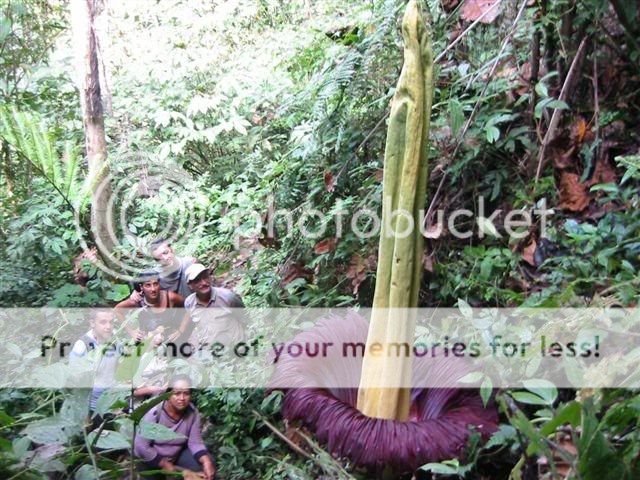
The species of Rafflesia found in the reserve here is Rafflesia arnoldi, the largest species of the genus and the largest flower in the world. As I wrote in the entry for Poring Hot Springs, where I was lucky enough to have seen R. keithii, these flowers are noted for their irregular blooming and you need to be in the right place at the right time to see one. On my first morning in Bukittinggi when I was at the Turret Café for breakfast before going to the zoo, one of the people there (it doubles as a tour outfit) phoned his friend to ask if there were any Rafflesia flowering at the moment. During the conversation I heard the words “bunga bangkai” and my ears pricked right up. Bunga bangkai is the Indonesian name for another enormous flower, Amorphophallus titanus, which is even more difficult to see in the wild than Rafflesia (although unlike Rafflesia it can be cultivated in gardens and can be seen sometimes in bloom at several Botanic Gardens around the world). It only flowers every three or four years, and after the bud growing for two weeks the fully-open flower only lasts two or three days before collapsing and rotting away. Although it is truly enormous, reaching a height of up to ten feet, it is actually a spathe and not a single flower so technically isn’t the largest flower in the world. It was one of the things I most wanted to see on this trip but also was one of the things that I thought I was most unlikely to see. Once off the phone, I was told that although there were no Rafflesia flowering at the moment there was an Amorphophallus at the reserve. To say I was excited would be an understatement, but I had been burned before so decided to just be cautiously optimistic. When the guide turned up at Umul’s house he told me that there was a Rafflesia bud as well as the Amorphophallus but that the latter was also still a bud. We went to see it anyway of course, and it really was awesome. Even though a “bud” it was still about five feet tall. I was informed that it wouldn’t be fully open for another ten days or so by which time I would have already left Indonesia, which was gutting. The Rafflesia bud was also good, obviously being much bigger than those of R. keithii. Unfortunately the bud I saw was growing at the base of a tree that had recently been uprooted in a storm so the bud was probably dead. What I found really interesting though was that, because it had been pulled up by the tree, I could see the subterranean Tetrastigma vine on which the Rafflesia is parasitic. I had been imagining that with the size of the flower, the vine must also be pretty hefty but its just a skinny little thing. There was a tiny brown ball on another section of vine that was the beginnings of another bud
 
Last edited:
Gunung Leuser National Park (north Sumatra)

Once more I was off on another overnight bus trip. Its almost like there are no other schedules on Sumatra except overnight! I had been variously told that the Bukittinggi to Medan run took 14 hours, 18 hours, 20 hours and 24 hours, so I didn’t quite know what to expect. It took 20 hours, and it wasn’t too bad of a trip actually, far more comfortable than any of the other overnighters I endured in Indonesia. The bus left Bukittinggi at 1pm, and almost the entire way up to nightfall the road went through forest. There were small villages here and there and some associated fields but the forest was right there behind them, and for a lot of the time the trees were crowding right down to the roadside. It made a big change after places like Malaysia and Java.

Medan was not as nice a town as Bukittinggi. I fact it’s a bit of a hole really, and it has this weird creepy paedophile air about it. There are shops everywhere selling lifesize stuffed toys of little girls in mini-skirts; I saw a portrait shop where all the photos on display were of little girls posing; and I saw a little boy wearing a denim jacket with a slogan on the back that read “OZ KIDS Easy To Enjoy”

There are certain things you discover as soon as you arrive in southeast Asia, one of which is that certain words on buses don’t mean anything at all, they’re just put on the signs to look nice, words like “express”, “non-stop”, even “AC”, but the bus that took the cake was one I saw in Medan that was labelled “super exclusive executive royal”. (Other words that are meaningless are “open 24 hours” and “no smoking”).

I went looking for the Hotel Alamanda, listed in Lonely Planet. It no longer exists. Neither does my second choice from Lonely Planet, Sarah’s Guesthouse. I ended up at the Pondok Wisata Angel, which was pleasant and cheap and not in Lonely Planet. I didn’t want to spend any longer than necessary in Medan so I used this first afternoon there to visit the zoo.

http://www.zoochat.com/238/medan-zoo-north-sumatra-112525/

The reason I’d gone up to Medan, apart for the obvious one of that was where my flight left from, was to visit the Gunung Leuser National Park to see orangutans. I’d arranged for a pick-up from my hotel by a public car (rather than going on the bus) on the understanding that we would be leaving at 9am, giving me plenty of time to get first to the town of Kutacane six or seven hours away and then from there to the little village of Gurah an hour further on. At 10am I was still waiting. At 11am I was still waiting. At 11.30 the car finally arrived. We drove round town for a while trying to find the hotel where another couple of passengers were waiting, then we went to the company’s office where we sat for another while longer. At 1pm we finally left the city. I was not a happy camper. It took seven hours to get to Kutacane over roads that just kept getting worse and worse, passing through villages that just kept getting progressively more and more squalid until I was beginning to doubt the wisdom of this little excursion. It was almost 8pm by the time we rolled into Kutacane, meaning I had to stay there the night.

On the way we had passed through a popular tourist town called Berastagi. All over Indonesia there are odd town statues, usually seen from the bus so one cannot take photos of them. In Bandar Lampung, down in the south of Sumatra, there is a big one featuring four elephants, each of which is resting its front foot on a soccer ball. But the most peculiar I’ve seen must surely be Berastagi’s cabbage on a pedestal.

Surprisingly, after the rough trip between Medan and Kutacane, the road the next morning towards Gurah was almost perfect the whole way. The transport was a small open-sided black truck of the sort that in the rest of Indonesia you usually see the police or military in. There were 13 people packed inside the truck along with various cargo items, 7 or 8 hanging off the back, and maybe 10 on the roof. With the good road we tore along at an exceptionally fast clip and no doubt would have arrived in record time if we hadn’t been side-swiped by a larger truck coming from the other direction at even more of an exceptionally fast clip, sending us spinning off the road, flipping the length of the vehicle, then rolling several times down a bank to end up upside-down in a river. With outstanding good luck (from my personal point of view) the only people seriously injured were people other than myself, unless you’re wussy enough to count a full-body tenderizing, various cuts and gashes and a couple of cracked ribs as serious injuries! Amazingly my cameras and binoculars survived unscathed due to my attention to always packing them correctly before travelling anywhere, and all my books and notebooks were in plastic so everything was fine. Most of the other passengers headed back to Kutacane or where-ever the nearest hospital was, but I wasn’t going to let a slight misadventure dampen my spirit, and caught another truck onwards to Gurah.

Before setting out there had been some uncertainty in my mind as to the physical status of Gurah. Nobody in Medan had even heard of it, the driver to Kutacane said Gurah and Ketambe were the same place, someone in Kutacane said they were different places: it was all very confusing, not least when I arrived and the guesthouse was called Pondok Wisata Ketambe. It turned out that Gurah is sort of like a sub-village of the village of Ketambe, as if that’s any clearer! My en-route fears about what sort of conditions I’d find in Gurah also proved unfounded. Gurah/Ketambe is a very nice little place, the Pondok Wisata Ketambe is very pleasant, and best of all there was a troop of Thomas’ leaf-monkeys frolicking in the trees right outside. They have to be one of the most attractive monkeys around, with their crisp white bellies and striped head crests.

I probably should have lain up a bit after arrival but I didn’t want to waste any of the short time I had so even though it was close to midday I struck out into the forest. Gurah is only about 500 metres above sea-level hence still pretty hot. Being midday there were no birds around so I decided to concentrate on primates instead which are active all the time. As well as more Thomas’ leaf-monkeys I soon saw the ubiquitous crab-eating macaques and the less obnoxious pig-tailed macaques, and after only two hours of searching I found a mother and baby Sumatran orangutan feeding high up in a fruiting fig tree. (Two hours means it was “easy” -- “difficult” would be several days of searching). On Sumatra orangutans are only found up in the far north, with Gunung Leuser National Park being one of the prime localities to spot them. Most tourists just go to Bukit Lawang which is only two or three hours from Medan so its an easy day-trip and you’re pretty much guaranteed of seeing orangutans because they feed them, but to me its no different to going to see them at a zoo with all the hoards of people around, the same as at the similar facilities in Borneo. I’d much rather put in the effort to get out into the back-and-beyond to see them in the real wild, the way you should be seeing orangutans. Not many people can be bothered with that though - Ketambe only sees about 150 tourists a year I was told, whereas Bukit Lawang no doubt sees several thousands. Apart for poaching and general deforestation, one of the major reasons for the endangered status of orangutans is said to be the establishment of oil palm plantations but curiously enough I saw little sign of these in Sumatra. I saw a small plantation way down in the south of the island and a couple more small ones between Medan and Kutacane, and I’ve seen some trucks laden with the fruit clusters from which the oil is processed, but the situation seems vastly different to that in Borneo where you can barely turn around without seeing another colossal palm plantation. Maybe in Sumatra they just keep them out of sight of the main roads.

There wasn’t much in the way of birds in the forest around Gurah, even in the morning it was fairly quiet, but the main reason I’d come up here was for the orangutan and Thomas’ leaf-monkey so I didn’t mind. Another north Sumatran mammal specialty that I’d hoped for was Kloss’ squirrel, but the problem I had with that one was that I hadn’t been able to find out any information on it except for its name and that it was endemic to north Sumatra. I couldn’t find any illustrations of it anywhere so didn’t even know what it looked like. I did know that some authorities consider it to just be a subspecies of the common plantain squirrel and so as its scientific name is albescens I imagined it must look like a paler version of that species. I did see a squirrel in the forest that looked like a plantain squirrel, maybe a bit paler. So was it a plantain or a Kloss’? I don’t know, but I have a sneaking suspicion that Kloss’ squirrel is a montane species that is replaced at lower altitudes by the plantain squirrel, which would mean the one I saw was just a plantain squirrel. If there are any random mammologists or sciurophiles reading this, let me know!
 
Fail. Again and again and again....

Why would anyone, just for the sake of seeing a flower, come off a nine hour bus trip and get straight onto another bus for a further 21 hours? That’s what I did. I don’t know if it can be considered intrepid, inspired, or just insane. The flower in question, of course, was the Amorphophallus titanus by Bukittinggi. When I last saw it on the 21st of October it was still a bud and it wouldn’t be in proper flower for about ten days, by which time I’d have left the country. But the more I thought about it the more I realised that to leave Indonesia without having seen such a profound rarity would be madness. MADNESS!!! You can plan a trip around orangutans or tapirs or Komodo dragons, but not around a flower that displays such obtuse unpredictability in its life-cycle. Really the only course of action available to me was to cancel my outbound flight in order to head southwards again to see the flower, even though I couldn’t actually afford to do this on what were now almost non-existent monetary funds. I couldn’t simply change the flight date because it was one of those cheap budget deals that didn’t allow that. However Fortune must have had a good run on the horses which put her in a good mood because when I went into the Malaysian Airlines office in Medan to cancel the flight the very nice lady at the desk did change my flight date giving me the extra few days needed at no extra cost, on the basis that my original morning flight had already been cancelled by the airline themselves and I’d been rebooked on the afternoon one, and therefore I’d been “inconvenienced” by that.

So after visiting Gunung Leuser National Park I took a truck for an hour to Kutacane and then a mini-van to Medan for eight hours, arriving just in time to catch the 21-hour overnight bus back to Bukittinggi (and I mean literally just in time -- I arrived at the bus station with only five minutes to spare!). The Amorphophallus was still in bud so I had a few days to wait, enabling me to finally go see someone who may or may not have been a doctor who poked me in the ribs and said “you’ll be fine”. That’s a relief….

While waiting for the flower I took in some of the natural sights around town, starting with the walk to Lembah Anai (as it turned out, the Lembah Anai waterfall and not the Lembah Anai Nature Reserve as I thought). This is a 6km walk along a railway track that I’d been told was only used on two days of the week. It was fairly obvious though that the track hadn’t been used in a very long time. At some points it was so overgrown you couldn’t even see the rails. It was a pleasant enough stroll with a few mitred leaf-monkeys and pig-tailed macaques along the way and a few birds, but where the tracks went over a highway was a bit nerve-wracking to someone not great with heights when there’s nothing to stop you falling except your own sense of balance (or lack thereof, as the case may be).

The next morning I went to the town canyon to see if I could find the colony of flying foxes that pass over town each night. (Whenever I see streams of flying foxes in the night sky I can’t help but be reminded of the scene in “Indiana Jones and the Temple of Doom” where Willy says “oh look at the big birds!” and Indy goes “those aren’t birds, sweetheart, those are giant vampire bats!!”). This wasn’t as relaxing a walk as the one yesterday, the first section being a seemingly never-ending set of steps leading straight up the canyon wall. Then there was a wander along a road between the villages of Kampung Sihanok and Koto Gadang, then back down into the canyon again where a rickety old suspension bridge sat waiting. The flying fox colony was way down in the far reaches of the canyon and although I walked for a long way, fording the river many times I couldn’t get there in the end and had to abandon the quest.

Now all there was to do was sit and wait for the Amorphophallus to open, hopefully in the next two days because I had to be on the bus back to Medan on Monday afternoon. Despite my best efforts, my attempts to see the Amorphophallus flowering came to naught. The damn thing just stubbornly refused to burst into bloom. You can't force nature's hand in matters like this. Its either too wet or too dry or too cold or too hot; the conditions need to be just right and until they are the bud just sits there biding its time. After waiting for days after the estimated flowering date, I finally had to call it quits, throw in the towel, and abandon ship. It may have flowered the next morning or it may have sat there for another week, there was no way of telling, and I had to get back up to Medan (via yet another overnight bus, this one for 20.5 hours) to catch my flight to Kuala Lumpur. A very disappointing thing but there was nothing else I could do. Ulrich, the owner of the Raja Wali Homestay where I was residing, said he would email me photos of the flower when it eventuated. And guess what -- I had only been gone an hour and they got a text message saying it was in flower! When I found out about this (a number of days later) I was practically spitting blood. We had checked with the guide Joni that morning as to the flower's status and he'd said it was still not showing which, as they come into bloom in the morning and not the afternoon, means he hadn't even bothered to check the damn thing. If he had I would have seen it! I was seriously annoyed. And just to add insult to injury, Ulrich and the other tourists he took along also saw a Rafflesia arnoldi in full bloom just 200 metres away from the Amorphophallus, despite Joni having specifically told me that there were none ready to bloom for at least several months! Double bad points for him!

Amorphophallus1.jpg

you can probably better appreciate how gutted I was when you see what the flower looks like! (photo emailed to me by Ulrich)

But before I found out any of this I was flying back into Malaysia, home of the oil palm plantations. In fact you have to fly over a big one to land at the KL airport, just by way of introduction. I'm now on the right time again; Indonesia is an hour behind Malaysia but all the buttons have fallen off my watch so I can't change the time so my entire time in Java and Sumatra it was reading wrong. How cheap am I? The next day I headed off to Taman Negara, Malaysia's premier national park. There's a hide there deep in the forest where one can stay overnight and hope to spot the Malayan tapirs that come to the wallow in front. I'd been to Taman Negara before in 2006 so this was just going to be a short visit specifically to try and see tapirs. Last time I was here it was blazing hot, it being August, and it also hadn't rained in months which didn't help. This time, being close to winter, it was only 26 degrees (that's a cool temperature!) and nights were surprisingly chilly. To get to the hide entails either a 6 or 7 hour walk, or a boat trip up-river followed by a 1 or 2 hour walk. I was going for the latter because I'd be carrying a lot of food and water. The plan was to spend the first night in one of the backpackers at the village of Kuala Tahan, and then the next two or three nights in the hide, but I never made it. In the night it started to rain and it didn't stop. For anyone thinking they wouldn't be put off by little rain then think again. Rainforest rain isn't just a "little rain", its like never-emptying monsoon buckets emptying their loads over the land. You could stand under a waterfall and get less wet. However the much more important reason was that I fell foul of some dreaded lurgy that very first night and spent the next two full days with the shivery-shakes huddled up asleep in my room, wearing every piece of clothing I had and covered in blankets to try and keep warm, while some invisible person forced sharpened matchsticks into the backs of my eyeballs. It was literally the sickest I have ever been in my life. On the third morning I tried to pack up to head back to KL but I couldn't even walk in a straight line, so it was another day in bed. The fourth morning I managed to stumble to the bus stop and make it back to KL, without even having set foot in the National Park!


Total number of birds seen: two
Total number of mammals seen: zero
Total number of reptiles seen: zero
Total number of amphibians seen: zero
Total number of fish seen: one in a tank, one on a plate

If that's not a failed visit I don't know what is!


More failures await still. I'm still too sickly to attempt any of the animal spots around KL (the zoo, aquarium or bird park) so they're all out the window. My flight home leaves from Bangkok on the 12th which is only four days away! "Thailand" of course translates as "land of Thai girls" but by the time I get up there I'll be lucky if I have one day before leaving again. The Khai Yai National Park is therefore impossible which is really annoying as I really wanted to return there as well. Basically the final three weeks or so of this trip have just been an absolute shambles.
 
I'd be putting my bets on birdflu except I haven't seen any birds lately :D
It wasn't painful enough to be dengue, and I doubt malaria. I really don't know.
I'm not feeling too bad today, I might even be able to get to the aquarium although it may be pushing my luck.
 
I'd be putting my bets on birdflu except I haven't seen any birds lately :D
It wasn't painful enough to be dengue, and I doubt malaria. I really don't know.
I'm not feeling too bad today, I might even be able to get to the aquarium although it may be pushing my luck.

OK, mate! I just hope you can put a fitting finish to an epic journey across Wallacea and beyond! Thanks again for a great journal, a gripping read!

Cheers on you!

K.B.
 
I did make it to the aquarium, and just attached a little piece onto the end of the old Aquaria KLCC thread http://www.zoochat.com/249/kuala-lumpur-aquarium-6823/#post253505

Kifaru Bwana said:
OK, mate! I just hope you can put a fitting finish to an epic journey across Wallacea and beyond! Thanks again for a great journal, a gripping read!
I think the best I'll be able to manage for an exciting end to the journey will be a thrilling expose of souvenir shopping on Khao San Road while trying not to walk too far! :D
 
lame tie-up to the trip

well I've been back in New Zealand for a week now. The whole trip really ended with a whimper rather than a roar, a bit of a fiasco actually. After the failures in Bukittinggi and Taman Negara I had to sit around in Kuala Lumpur for several days because I wasn't well enough to fly and I was afraid the airport people would quarantine me (although the birdflu scare seems to have died out while I've been over there). I managed to get to the Aquaria KLCC and that was about it. By the time I got up to Bangkok I only had a couple of days and I was still feeling pretty dodgy and all I did was go to the Dusit Zoo which was very good, and have an early morning wander round Lumphini Park where the water monitors stomp around like they're all that, but really they're nothing but eensy weensy Komodo dragons. On the way home I had a eight hour stop-over at Melbourne Airport but I couldn't leave the building because I was in transit, which was a pain.

My guesstimated totals of birds and mammals seen fell a little short. I'd been guessing at 500 bird species and 80 mammal species for the trip but ended about 30 birds and maybe 5 or 10 mammals short, largely due to not being able to get to Taman Negara or Khao Yai. I haven't got any internet at home right now but I'll put up the lists when I can (I like lists!).

Now I've got six months of Zoochat threads to catch up on....
 
Great to hear that you have returned home safe and sound.
Thank you for sharing your holiday with everyone on zoochat. Your thread was very enjoyable and easy to follow. Looking forward to reading about your next journey. Any plans yet?
 
I always have plans! ....just no money.

Its funny being back in New Zealand after spending so long in one of the most over-populated countries on Earth. Just Jakarta alone has well over twice the population of the whole of NZ. I got back and it felt like a public holiday because the country seemed deserted!

It was a great trip. I visited islands that had always been dreams, like Borneo and Sulawesi, and places like Ujung Kulon and the Danum Valley that had always been in my head. I saw animals that most people will only ever see in zoos and that I thought I would never see in my lifetime, like babirusa, anoa, tarsiers and Komodo dragons. There were lots of animals I missed out on seeing, things like Javan rhinos and Flores giant rats, but with a trip of this scope that was inevitable. Maybe they'll be there in the future to see or maybe they won't. Babirusa for example, are pretty much now only to be found at Nantu Reserve, everywhere else they are so reduced in number as to be almost unviable, and who knows if the Nantu population can hold out even with the constant armed guards patrolling the area. The Flores giant rats according to the locals aren't seen as commonly as they once were, and everyone knows the sorry story of the Javan and Sumatran rhinos.

The whole thing cost me an arm and a leg, and Indonesia was far more expensive than I'd been led to believe. I actually ran out of money a couple of weeks before the end and had to borrow some off my sister to finish. I lost 21kg of muscle, almost 20% of my body weight, which is going to take a lot of gym-work to put back on, and I think that may be why I ended up so sick, just because I was too weak for my system to fight off the bugs.

All in all though, a fantastic trip, really the trip of a lifetime, and I'm very happy I did it. My next biggish trip was going to be to Uganda (mammals are much easier to spot in Africa than Asia!) but now there are so many places in Indonesia that I want to return to that I need to sort out my plans (but first pay off all my bills :D).
 
Thanks for taking us along on your road trip with you, glad you had such a great time, untill the next one, cheers
 
Back
Top