NZ wildlife questions? Ask them here.

grrrr, I've typed this out twice already and my computer keeps losing it!!!!!! Third time lucky?

Extinct birds: you've probably seen this site already but it also includes bird songs (including the kokako):
New Zealand Birds | Birds

I prefer books to websites when it comes to the extinct birds. Three books I would recommend if you want to get hold of them, are:
"The Lost World of the Moa" by Trevor Worthy and Richard Holdaway (2002, Canterbury University Press: Christchurch). These guys are both palaeontologists, the book is huge (and quite expensive, but well worth it), and it covers EVERYTHING! Its mostly text and diagrams, with some line drawings.
"Extinct Birds of New Zealand" by Alan Tennyson and Paul Martinson (2006, Te Papa Press: Wellington). Excellent glossy "coffee-table" type book with paintings of all the species. It includes Lord Howe Island etc in the NZ region which I find misleading in terms of checklists etc, and only has currently described species, hence it leaves out the kiwi species that used to be found down the South Island's east coast but rather curiously includes an unnamed megapode that I would consider to be only hypothetical. It also only covers full species and no subspecies (and as we all know, splitting and lumping can stuff that system up pretty quick).
"New Zealand's Extinct Birds" by Brian Gill and Paul Martinson (1991, Random Century: Auckland). Sort of like an earlier version of the above book. Different author, same artist, although the paintings are much better in the 2006 book. Because its an older book it is missing a couple of species then not yet known, and includes the Chathams sea eagle which was then still considered a legitimate species.

On a related note, there are now thought to have been nine moa species not eleven, due to the massive size differences between male and female in some species.
 
Ok whats the status of the Yellow Eyed Penguin at this time, have they thought about some captive breeding with them?.

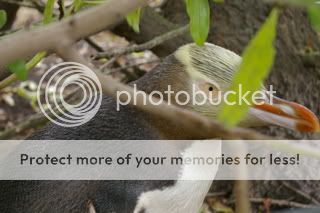
IMGP5160.jpg


I took this photo last month at Katiki Point in Otago. Although always quoted as being the world's rarest penguin, this isn't in fact true.

There are about 450 pairs on the South Island, about 150 pairs on Stewart Island, and about 1200 pairs on the subantarctic islands (mainly the Auckland and Campbell Islands). Mainland populations swing back and forth from year to year due to various factors. The subantarctic populations have no threats and are considered safe. There are none in captivity and there has never been considered any need to establish a captive population.

The Fiordland crested penguin has about 2500-3000 breeding pairs and while this is a greater population, they all breed in the southwest South Island and some on Stewart Island so are actually at greater risk.

The Galapagos penguin is the world's rarest penguin, with about 1000 pairs.
 
How are they displayed at Hamilton?

They were in a relatively small aviary... Four poles about 10 feet high, in 4m x 4m aviary with mesh on three side and 1m or so of shelter at the back... There was no floor just the earth planted out with small native bushes...
 
How is the breeding programme for all kiwi species progressing in NZ, the brown species seems to do well both in NZ and in Frankfurt and Washington. What about the other species are there many kept in NZ and would i be right in saying that the main centre for kiwi is at Otorohanga?
 
new question...

great thread chlidonias.

okay, so i wanna know about introduced species. i know that new zealand unfortunately has a host of them. most mammals i am aware of,...

brush tail possums
various wallabies
rats and mice, ferrets
various asian and american deer
chamois
himlayan tahr
european hedgehog
rabbits
ferrets, weasels and stoats
various australian frogs
an australian skink (lizard)

but what else have i missed? are there any other mammals? (don't worry about feral domestics). any other reptiles? what about birds. i know an aweful lot of globally common and australian birds were introduced to NZ (why you would introduce birds to an island of birds i don't know!)

and what about pets? chinchillas? newts? greek tortoises? i have heard all these species are available...
 
also dont forget the whole rang eof Australian bird species which have naturalised themselves in New Zealand after European settlement.
and dont forget invertebrates too, but now were getting a bit niggly
 
How is the breeding programme for all kiwi species progressing in NZ, the brown species seems to do well both in NZ and in Frankfurt and Washington. What about the other species are there many kept in NZ and would i be right in saying that the main centre for kiwi is at Otorohanga?

The only kiwi that is commonly kept in captivity is the North Island brown kiwi. Otorohanga and Mt. Bruce have pairs of great and little spotted kiwi and have both bred them in the past, while Willowbank has recently acquired a "pair" of rescued great spotteds and is planning on breeding young for release into the Arthur's Pass area (which is probably little more than a pipe-dream considering how hard this species has proved to be to breed). I think there may be another rescued great spotted at the Hokitika Aquarium. There are no Okarito or southern browns in captivity for breeding or display purposes. There are no real plans to establish captive breeding programmes for any kiwi other than the existing one for North Island browns because DoC prefers to concentrate on keeping them in the wild (and really seems bent on getting most of the adult birds in captivity now into the wild. Reportedly no more kiwi houses are being given consent for construction, although Hamilton will be getting them soon so it can't be a very strict ban). No adult kiwi are taken from the wild unless it is necessary for their survival (that is, unless they have been hit by cars or injured in possum traps, etc). However there is a programme called Operation Nest Egg (ONE), where eggs from wild birds are removed and the young reared in captivity for about six months before being released back into the wild again. This is a programme aimed at reducing the heavy losses that new kiwi chicks face from introduced predators. Kiwi chicks are out of the nest burrow looking for food within six days of hatching and are independent in around three weeks or so. Up to 95% of them are killed during this stage by stoats and cats. ONE aims at stopping chick mortality and increasing adult numbers. ONE started with North Island browns but has recently been extended to include the more endangered Okarito and Haast kiwi (Willowbank, for example, has hatched some eggs from these species in the past year)

I don't know that any one place could be called the main centre for kiwi. All the captive birds are treated as a single population and managed by DoC as such, as is the case with nearly all the NZ species kept here in captivity
 
great thread chlidonias.

okay, so i wanna know about introduced species. i know that new zealand unfortunately has a host of them. most mammals i am aware of,...

kind of took off this thread, didn't it?

OK, here we go. These are the introduced species currently established in NZ -- invertebrates not included, lol

MAMMALS

Bennett's (red-necked) wallabies in the South Island, thousands and thousands of them descended from just three individuals released in 1874.

On Kawau island off Auckland there are/were parma, tammar, brush-tailed rock, black-striped and swamp wallabies, all introduced by Governor Sir George Grey who owned the island. The island is actually an important kiwi habitat which the wallabies have been destroying so they are being eliminated (or have already been so). A large number were shipped off to Australia before the poisoning began because obviously the parma and brush-taileds are endangered and the tammars actually belong to an otherwise extinct subspecies! The tammars are also common around the Rotorua area. Tammars and brush-taileds had been previously eliminated from Rangitoto Island.

Brush-tailed possum -- HUGE pest! No predators apart from humans and cars. Destroy the forests and have been proven to eat both eggs and the female birds incubating on the nests.

European hedgehog -- long considered harmless but now known to also eat the eggs of ground-nesters like stilts and dotterels, as well as on lizards and native invertebrates.

European rabbit and hare -- yes, pests again (I know you Australians are familiar with that!)

Polynesian rat (kiore); brown (Norway) rat; black (ship) rat: house mouse -- all pests, especially the black rat which has been implicated in numerous extinctions and declines. The kiore was thought to be harmless but is now thought to have been responsible for several pre-European extinctions

Stoat, weasel, ferret, feral cat --weasels are rare in NZ, ferrets are common but live on the ground so are restricted in what they kill. Stoats are the biggest threat to NZ wildlife. They are EVERYWHERE, and can get everywhere, from the ground to the canopy. All hole-nesting birds are being wiped out by this predator because the females are cornered and killed in the nest.

Feral pig, horse, cattle -- the pig is a big pest, destroying forest habitat, eating rare invertebrates like giant snails and weta, and digging out kiwi burrows.

Chamois and tahr -- very destructive to the alpine environment, which is not adapted to supporting hooved-stock

Red deer and wapiti, fallow deer, sika, rusa, sambar, white-tailed deer -- all major pests (unless you listen to the hunter community in which case they are valued and harmless members of our fauna, lol)

Moose were introduced but haven't been seen for decades. The habitat into which they were released in Fiordland was entirely unsuitable (vertical-walled rainforest-covered valleys). There may be a few still down there

BIRDS

Black swan
Canada goose
Feral goose
Cape Barren goose
Mallard
Ring-necked pheasant
Golden pheasant (recently-established on one small island)
Feral peafowl
Feral guineafowl
Feral turkey
scattered semi-feral chickens
Californian quail
Australian brown quail
Bobwhite
Red-legged partridge
Chukar
Feral pigeon
Spot-necked dove
Barbary dove
Greater sulphur-crested cockatoo
Galah
Eastern rosella
Crimson rosella
Rainbow lorikeet (a recent introduction round Auckland that DoC/MaF has been trying to eradicate)
Little owl
Common kookaburra
European blackbird
Song thrush
Skylark
Hedge sparrow
House sparrow
Chaffinch
Greenfinch
Goldfinch
Redpoll
Cirl bunting
Yellowhammer
Red-vented bulbul (probably no longer found wild here)
Common starling
Common mynah
Australian magpie
Rook

HERPTILES

Rainbow skink Lampropholis delicata
Whistling frog Litoria ewingii (descended from someone tipping a jarfull of tadpoles into a drain in a West Coast town)
Golden bell frog Litoria aurea
Southern bell frog Litoria raniformis (these species have different names in Australia)
the green tree frog Litoria caerulea was introduced but didn't establish.

FISH

Brown trout Salmo trutta
Atlantic salmon Salmo salar
Rainbow trout Oncorhynchus mykiss
Chinook salmon Oncorhynchus tshawytscha
Sockeye salmon Oncorhynchus nerka
Brook char Salvelinus fontinalis
Mackinaw Salvelinus namaycush
Brown bullhead Ameiurus nebulosus
Goldfish Carassius auratus
European carp Cyprinus carpio
Tench Tinca tinca
Rudd Scardinius erythrophthalmus
Orfe Leuciscus idus
Mosquitofish Gambusia affinis
Guppy Poecilia reticulata
Sailfin molly Poecilia latipinna
Swordtail Xiphophorus helleri
Caudo/leopardfish Phalloceras caudimaculatus
Perch Perca fluviatilis
 
Last edited:
also dont forget the whole rang eof Australian bird species which have naturalised themselves in New Zealand after European settlement.

the only birds that have successfully established in NZ from self-colonisation since European settlement are the black-fronted dotterel, white-faced heron, nankeen night heron, Australasian coot, spur-winged plover, welcome swallow and silvereye. Cattle egrets are regular migrants but have not yet stayed to breed. The white-winged black tern MAY be breeding here, and the black swan is generally now regarded as having self-colonised at around the same time as it was introduced by man (the numbers grew too fast for it to be otherwise). [I don't think I've forgotten any, but I may have]
 
What I would consider an interesting question to Chlidonias: what native NZ birds (besides keas, Paradise Shelduck etc.) would qualify for the husbandry in European or American zoos, considering
a) international availability (so no takahe or kakapo)
b) interesting behaviour/colour in consideration of the average visitor
c) outdoor qualities i.e. having no problem in being kept outdoors most of the year in colder climates

I have a list of the species found overseas on the other thread. When it comes down to it, much as I love NZ wildlife, to your average zoo-goer they would seem a pretty boring lot of animals. Even if a zoo got takahe or kakapo, while we all would drool over it, most visitors would sort of give it a quick look and move on. Antipodes Island parakeet -- "little green parrot, wow"; kakapo -- "big green parrot...why's it in the dark? Can't they turn the lights on?"

If I had a zoo in England, say, and I wanted a NZ section (which I would), I would be trying to get Antips, NZ pigeon, tui, blue duck, kaka....but for most visitors it would just be like, "oh birds, OK, where's the monkeys"

In terms of what's over there now, it would be good to concentrate on maintaining weka, getting the numbers of blue duck and kaka up...I mean there really isn't much hope that many individuals of those species will be coming out of NZ again any time soon. So if the zoos want to keep them they better start breeding them.
 
The only kiwi that is commonly kept in captivity is the North Island brown kiwi. Otorohanga and Mt. Bruce have pairs of great and little spotted kiwi and have both bred them in the past, while Willowbank has recently acquired a "pair" of rescued great spotteds and is planning on breeding young for release into the Arthur's Pass area (which is probably little more than a pipe-dream considering how hard this species has proved to be to breed). I think there may be another rescued great spotted at the Hokitika Aquarium.

Chlidonias,

Am I correct to assume there are 4 kiwi species and 2 subspecies in either northern and southern browns? I came across this reference The New Zealand Kiwi Species on the internet and while it mentions: quote "There are two species of Kiwi's in New Zealand, the Brown Kiwi and the Spotted Kiwi. Within these two species are six varieties of Kiwi: the North Island Brown, the Okarito Brown, the Stewart Island Brown, the Haast Brown, the Great Spotted, and the Little Spotted." unquote

It then goes on to list 4 Apteryx species instead ...?!! :D: eek: I my book that would mean 4 different species and not 2 ... :)
 
in the list of introduced birds I posted earlier I inadvertantly left out a whole section of Galliformes!

Ring-necked pheasant
Golden pheasant (recently-established on one small island)
Feral peafowl
Feral guineafowl
Feral turkey
scattered semi-feral chickens

I have just added them in so this post was actually pointless. Oh well.
 
Last edited:
Chlidonias,

Am I correct to assume there are 4 kiwi species and 2 subspecies in either northern and southern browns? I came across this reference The New Zealand Kiwi Species on the internet and while it mentions: quote "There are two species of Kiwi's in New Zealand, the Brown Kiwi and the Spotted Kiwi. Within these two species are six varieties of Kiwi: the North Island Brown, the Okarito Brown, the Stewart Island Brown, the Haast Brown, the Great Spotted, and the Little Spotted." unquote

It then goes on to list 4 Apteryx species instead ...?!! :D: eek: I my book that would mean 4 different species and not 2 ... :)

that bit you quoted above is very confused. I had a quick look at that site; I don't know who set it up but while most of it's fine there are quite a few errors in it as well (factual as well as spelling etc)

There were formerly considered to be three species -- the brown kiwi (with three subspecies on North, South and Stewart Islands), the great spotted and the little spotted -- but after doing all kinds of DNA studies on them it has been determined that the brown kiwi is in fact at least three separate species.

So:
great spotted kiwi Apteryx haastii

little spotted kiwi Apteryx oweni-- these two species remain unchanged

North Island brown kiwi Apteryx mantelli in the North Island

Okarito brown kiwi (aka rowi) Apteryx rowi at Okarito on the West Coast of the South Island

Southern brown kiwi (aka southern tokoeka) Apteryx australis in southwest South Island and on Stewart Island

then there's the Haast brown kiwi (aka Haast tokoeka) which at the moment is undecided -- it may turn out to be a distinct species but it is more likely just going to remain as a distinct population of the southern brown kiwi (either a subspecies or just a different-looking form)


So you've got five true species, and a sixth undecided type.
 
Last edited:
thanks chlidonias. thats an aweful lot of (mostly australian) birds that have been introduced. birds like the kookaburra and owls seem particuarly unexpected choices for acclimatisation societies.

whats happening in terms of eradication?

the moose clearly never established itself and it supprises me so many good mammal books STILL list it as a species existing there. i'm so very glad we don't have stoats and weasels in australia. there are no confirmed colonies of ferrets here as far as i know (though they can be kept as pets) and of course we did get the red fox. i think in the end its feral cats that cause the most damage. unfortunatley for you guys brush-tail possums are more than a worthy opponent.

i get the impression that your department of conservation is actually preserving the exotic frog species. is this a fair statement?

and what about turtles? surely australian long-necks have established themselves? can't those and greek tortoises be kept as pets over there.
 
thanks chlidonias. thats an aweful lot of (mostly australian) birds that have been introduced. birds like the kookaburra and owls seem particuarly unexpected choices for acclimatisation societies.

whats happening in terms of eradication?

the moose clearly never established itself and it supprises me so many good mammal books STILL list it as a species existing there. i'm so very glad we don't have stoats and weasels in australia. there are no confirmed colonies of ferrets here as far as i know (though they can be kept as pets) and of course we did get the red fox. i think in the end its feral cats that cause the most damage. unfortunatley for you guys brush-tail possums are more than a worthy opponent.

i get the impression that your department of conservation is actually preserving the exotic frog species. is this a fair statement?

and what about turtles? surely australian long-necks have established themselves? can't those and greek tortoises be kept as pets over there.

the Acclimatisation Societies weren't exactly working by the same rules as they might if established today. They were primarily interested in "bettering" their new countries by releasing animals that could be hunted or that were considered useful. You may notice that most of the birds are actually game birds (waterfowl and Galliformes) for hunting, or small passerines which were brought in to try and control the insect populations which had boomed following the wholesale demise of the native birds. With mammals most are game animals (deer, rabbits etc) -- the mustelids were introduced to control the rabbits! Fortunately they were far-sighted enough to learn from Australia's mistake and no foxes were released here otherwise we'd have nothing left. But then some things were released simply because they weren't here already, like the wallabies and frogs. The little owls were brought in to try and control the introduced passerines which had gone out of control. The kookaburras were introduced on a whim by George Grey onto Kawau Island along with his wallabies. Others (the parrots and doves) are cage birds that have escaped or been released. Species that were introduced but never established included zebra, monkeys, emus, quolls, diamond sparrows, llamas, and dozens of others. And of course back then anyone could bring in animals and release them as they saw fit; it didn't need to be through the Societies.

Eradication is impossible for most species now in NZ. The hunting community gets all het up if the suggestion of shooting out tahr for example is brought up. (And of course the Government always pays attention to any "minority" groups -- a rather big minority group in this case! -- so while tahr could be feasibly eliminated it won't happen). The best that can happen is local control by trapping and shooting. There is talk of a possum contraceptive or virus (but obviously that's a bit of a worry in itself with Australia right next door).

I'm not sure about DoC protecting the introduced frogs. They are endangered back in Australia but I think DoC is more concerned with them spreading chytrid fungus to our native species. There aren't any laws regarding catching, keeping or selling the Australian ones.

As for exotic pets there are very strict laws about importing, but there are quite a few species here that can be kept -- probably about ten or more species of turtles and tortoises, maybe about ten or so mainly-Australian lizards, a couple of species of newts and the axolotl, as well as chinchillas, rabbits, guineapigs, etc. Lots of birds and tropical fish too. Ferrets are now illegal as pets. There are no hamsters or gerbils at all. There are reports of red-eared sliders in the wild and snake-necks are sometimes found but they don't pose any real threat.
 
I'm suprised Quolls didn't establish... How different are they from Possums..?
 
Back
Top