
so I went to Wellington Zoo last week, for the first time in several years. One of the things I noticed was the big decline in birds. Wellington used to have one of the country's best bird collections but there is very little diversity there now. One aviary even had bantams in it, and others were making do with magpies and golden pheasants. Several species were down to just one or two specimens, even from species that could be readily obtained from private aviculturists in NZ. The complete bird list (as far as I could tell) was as follows:
ostrich
emu
North Island brown kiwi
Australian pelican
little pied shag (although the sign on the aviary said little black shag)
banded rail
brolga
white heron
Himalayan monal
golden pheasant
bantam
NZ scaup
Campbell Island teal
mandarin duck
Australian shelduck
Cape Barren goose
Derbyan parrot
sun conure
red-fronted macaw
North Island kaka
kea
red-tailed black cockatoo
Leadbeater's (pink, or Major Mitchell's) cockatoo
greater sulphur-crested cockatoo
NZ pigeon
Australian crested pigeon
emerald dove (green-winged pigeon)
tawny frogmouth
morepork (apparently, in the Kiwi House)
common kookaburra
Australian magpie
Other noticeable things included the very poor signage now being used. I liked the warning signs (don't feed the animals, etc) for their amusement value, but the actual animal signs have been reduced to a photo and two sentences of information. All very well for your average visitor who is incapable of reading but for the visitors who are actually interested there is nothing to cater to them -- not even the scientific name of the animal!! In my opinion they should have the simple signs for the idiots and then some more informative ones for the others.

warning sign
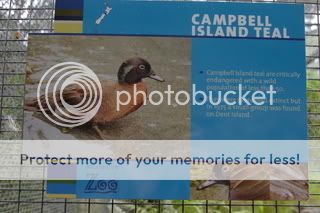
animal information sign
Where did all the bats go? There used to be dozens of little red flying foxes at the zoo, hanging all over the top of the aviary now housing cotton-tops, agoutis, sun conures and red-fronted macaws; as well as filling the enclosures in the old Kiwi House. Now there is only a handful of bats in the historic elephant house (which is now used mainly for displaying reptiles).
And speaking of the Kiwi House, the new one (now about five years old I believe?) is terrible. I work with kiwi myself and talk to lots of tourists who have visited other Kiwi Houses, and I have only ever met ONE person who has actually seen anything in Wellington Zoo's new Kiwi House. It is dark obviously, but a little too dark for visitors and for some reason there are white/blue lights arranged in such a way that whichever way you turn you tend to get them shining right in your eyes so you never get accustomed to the darkness. With this in mind, the small size of the enclosure, the fact that it is open and walk-through (so no barriers to keep down sound), and that there is only a single kiwi in there anyway, it's really a wonder that ANYONE has seen the kiwi in there!
On the good side of things they have quite a good reptile collection now (for a NZ zoo), mostly inside the historic elephant house and by the old Kiwi House; with more in a breeding room round the side of the elephant house, viewable through a window. There is a baby chimpanzee, born 22 October last year. The young male lions were very active with their dead goats. There was a family of Americans identifying the African wild dogs as wallabies (!).
ostrich
emu
North Island brown kiwi
Australian pelican
little pied shag (although the sign on the aviary said little black shag)
banded rail
brolga
white heron
Himalayan monal
golden pheasant
bantam
NZ scaup
Campbell Island teal
mandarin duck
Australian shelduck
Cape Barren goose
Derbyan parrot
sun conure
red-fronted macaw
North Island kaka
kea
red-tailed black cockatoo
Leadbeater's (pink, or Major Mitchell's) cockatoo
greater sulphur-crested cockatoo
NZ pigeon
Australian crested pigeon
emerald dove (green-winged pigeon)
tawny frogmouth
morepork (apparently, in the Kiwi House)
common kookaburra
Australian magpie
Other noticeable things included the very poor signage now being used. I liked the warning signs (don't feed the animals, etc) for their amusement value, but the actual animal signs have been reduced to a photo and two sentences of information. All very well for your average visitor who is incapable of reading but for the visitors who are actually interested there is nothing to cater to them -- not even the scientific name of the animal!! In my opinion they should have the simple signs for the idiots and then some more informative ones for the others.
warning sign
animal information sign
Where did all the bats go? There used to be dozens of little red flying foxes at the zoo, hanging all over the top of the aviary now housing cotton-tops, agoutis, sun conures and red-fronted macaws; as well as filling the enclosures in the old Kiwi House. Now there is only a handful of bats in the historic elephant house (which is now used mainly for displaying reptiles).
And speaking of the Kiwi House, the new one (now about five years old I believe?) is terrible. I work with kiwi myself and talk to lots of tourists who have visited other Kiwi Houses, and I have only ever met ONE person who has actually seen anything in Wellington Zoo's new Kiwi House. It is dark obviously, but a little too dark for visitors and for some reason there are white/blue lights arranged in such a way that whichever way you turn you tend to get them shining right in your eyes so you never get accustomed to the darkness. With this in mind, the small size of the enclosure, the fact that it is open and walk-through (so no barriers to keep down sound), and that there is only a single kiwi in there anyway, it's really a wonder that ANYONE has seen the kiwi in there!
On the good side of things they have quite a good reptile collection now (for a NZ zoo), mostly inside the historic elephant house and by the old Kiwi House; with more in a breeding room round the side of the elephant house, viewable through a window. There is a baby chimpanzee, born 22 October last year. The young male lions were very active with their dead goats. There was a family of Americans identifying the African wild dogs as wallabies (!).
Last edited:


 ...
...
