
Siegfried and Roy’s Secret Garden and Dolphin Habitat is a small zoo facility located in the grounds of the large Mirage Hotel and Casino on the Strip in Las Vegas, Nevada. It is named after the famous illusionist duo that headlined a long-running show featuring big cats at the hotel. I am not sure whether the pair owns this attraction, leases the property from the hotel, or simply licenses their names to it; I am also not sure about the ownership of the animals, although I believe that all the cats belong to Siegfried and Roy. The outdoor facility is composed of a large bottlenose dolphin exhibit complex with three display pools, a large alpaca yard, and six adjoining netted exhibits of various sizes for big cats highlighting the white tigers and lions that the duo are famous for breeding and ‘conserving’. The exhibits are set in a lush tropical style garden punctuated with large palms.
Visitors must traverse a long twisting route from the street to reach the attraction. In front of the hotel on the strip, a small plaza is called Siegfried and Roy Plaza and features a star plaque in the paving with the inscription ‘Siegfried and Roy – Magicians of the Century’. Looming over this is a garish statue grouping composed of busts of the duo and a tiger head, the trio being depicted ten times lifesize and covered with a shiny coppery finish. The three heads erupt from a rocky outcrop, and for some reason shards of giant crystals emerge from the rocks as well. The magicians were not known for subtlety and this sculpture does not disappoint, being a popular spot for photographs since its unveiling in the 1990’s when their show was at its zenith. (They stopped performing when one of them was nearly killed by a tiger during their stage show in 2003.) The extensive rocky waterfall landscape of the front of the hotel property beyond the plaza features several bronze statues of jumping dolphins that also tie into the attraction’s theme to follow. The landscape also features a very large rock outcrop that ‘erupts’ as a volcano during free nightly shows that feature smoke and fountains and flames; this large setpiece must be walked around to reach one of the several entrances to the hotel and casino complex. One of the entrances used to feature a large indoor habitat behind glass for white tigers. It was a very stylistic room with skylights bathing a dramatic garish habitat of Indian-inspired temple architecture on the edge of a large tiled swimming pool. Most of the architecture, rockwork, tilework, and even fake palm trees were painted white and it was a surreal and memorable over-the-top introduction to the property. It was also a dream for a water-loving tiger! A few years ago, this free attraction (opened with the hotel in 1989) was removed and replaced with an upscale burger restaurant with a dark interior, the antithesis of the former white tiger habitat. Ultimately, this is probably progress for animal display technique since it was essentially a concrete fishbowl, even if it was not the inhabitants permanent or even daily home (they were rotated). Another free animal habitat in the hotel is still there, behind the long registration desk near another of the entrances: it is an impressive aquarium filled with about 1000 tropical saltwater fish from around the world. Although its inhabitants are not identified with signs and visitors can not approach it beyond the counter, it is a scenic backdrop and filled with activity. It is 53 feet long, 8 feet tall, 6 feet deep, and 20,000 gallons, with most of its back wall detailed as an artificial coral reef. Visitors then navigate through the large casino and a gauntlet of restaurants and shops before remerging back outside at the rear of the property and the hotel’s extensive lush swimming pool area; the entrance to the Secret Garden and Dolphin Habitat is adjacent.
An exotic gateway stands at the entrance of the attraction, with a carved wood sign, bas-reliefs of a tiger and dolphin on each side, and statues of two tigers above the arch. Surpisingly, the attraction is fairly tasteful beyond this point, considering the duo’s stage reputation and the décor of the former free white tiger habitat and statue plaza previously mentioned. Very little in the way of tacky details is found beyond the gate. A lush tropical path leads from the gate to a small ticketbooth where admission is collected. The path then continues to curve around the perimeter of the lush hotel swimming pool area until it reaches a small canopy-covered bridge raised above an open view of the first area of animal exhibits, then descends stairs or a ramp.
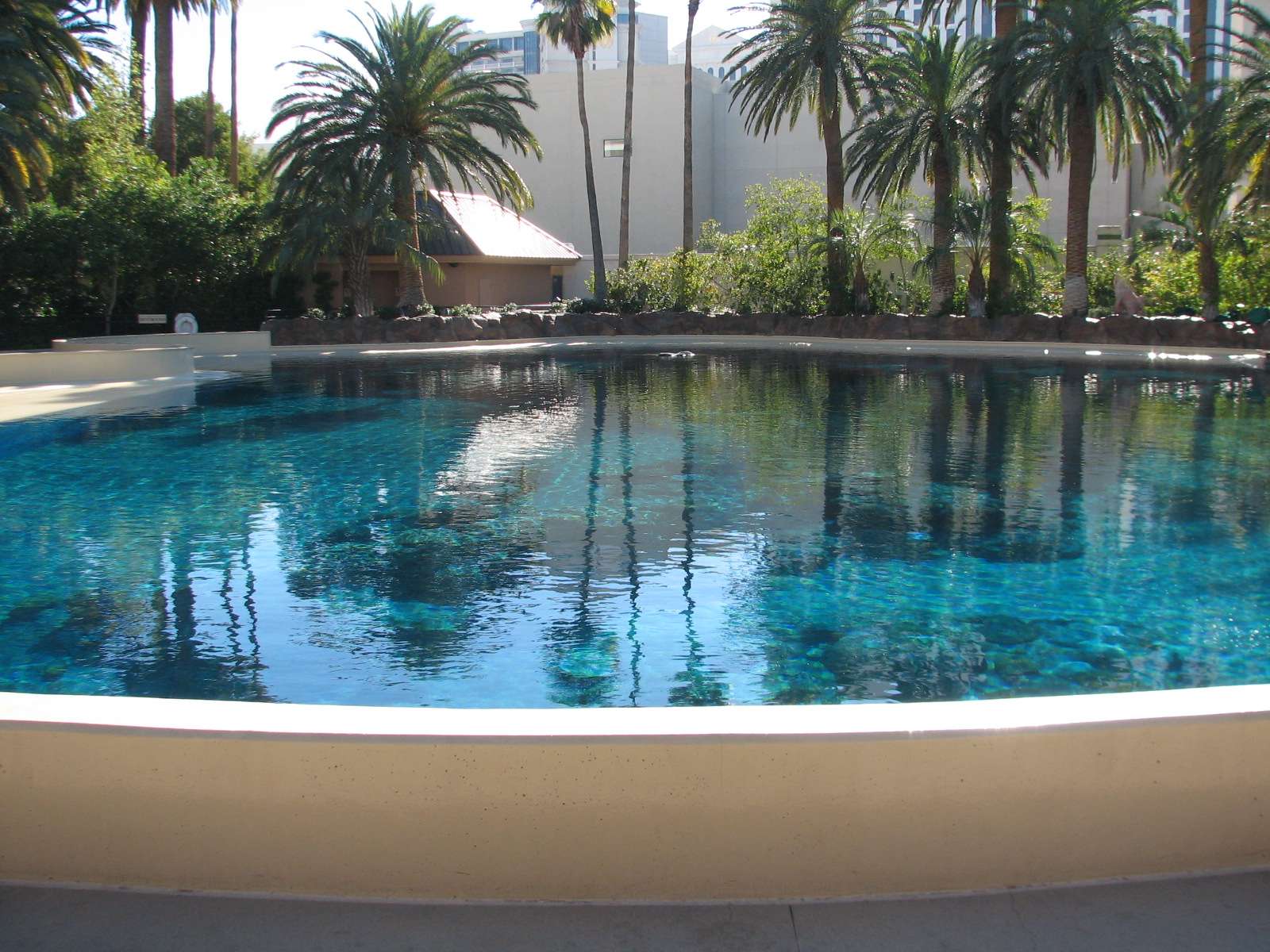
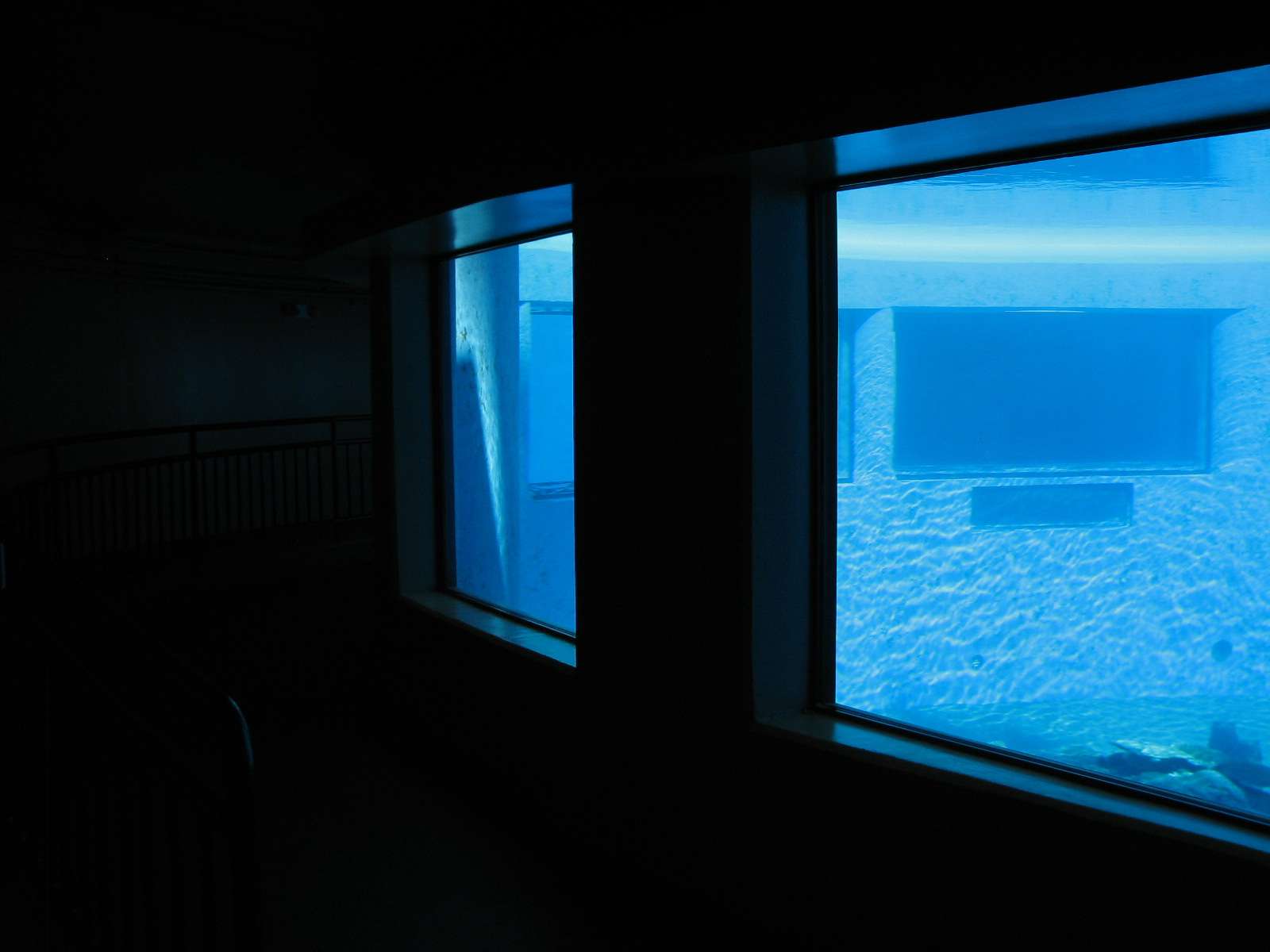
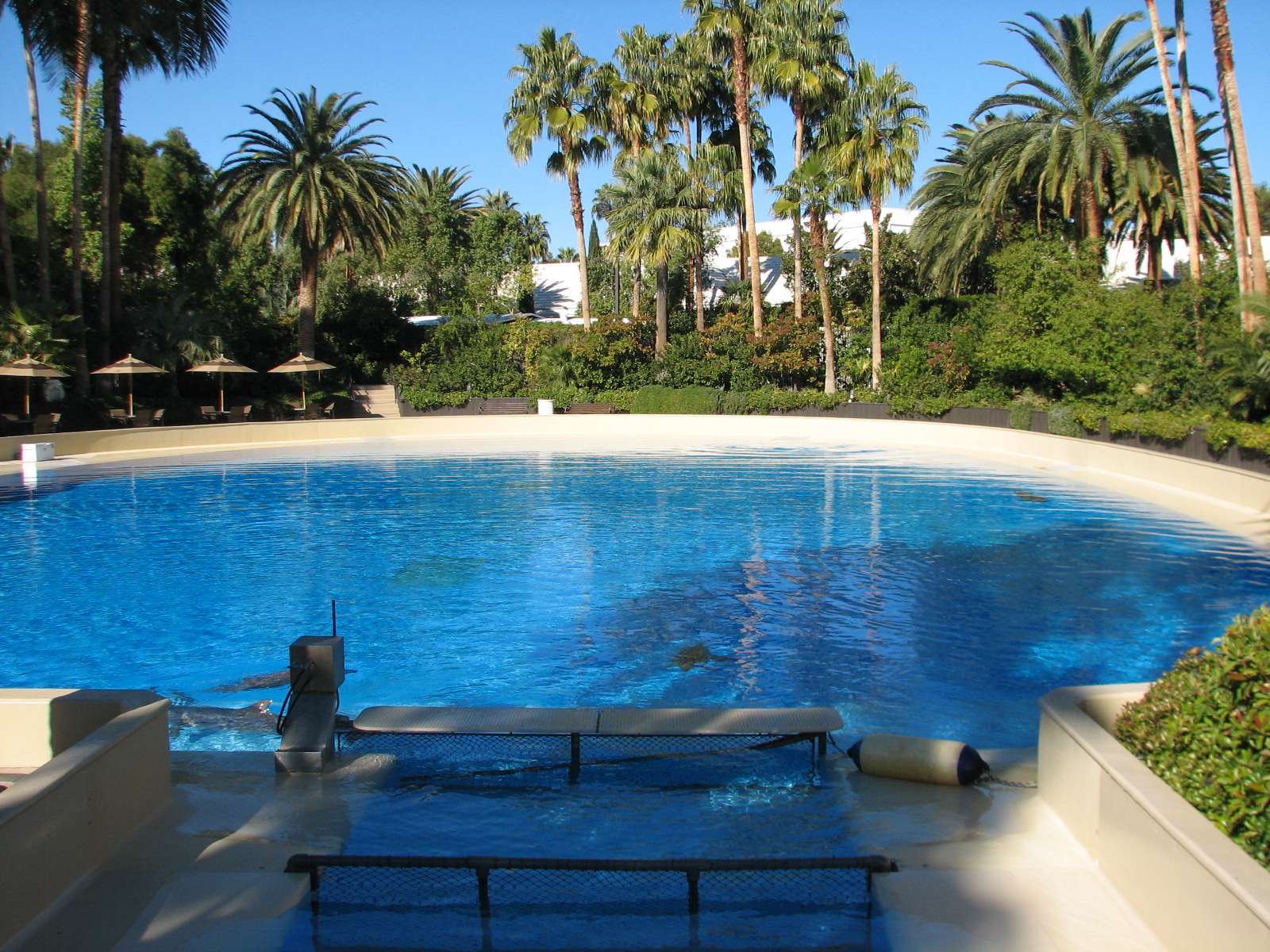
The first part of this two-part complex seen is the Dolphin Habitat. It is a series of three connected pools (a small fourth one connects two of the others in an off exhibit area just out of view) that collectively hold 2.5 million gallons. The largest and deepest pool is the Main Pool, which features several large simulated coral reef outcrops in its center that are of average theme quality. The floor of the pool features a slope with a rough simulated sandy bottom finish. The edge of this pool is a freeform curvy shape and is lined with a shallow submerged shelf that varies about 3 to 6 feet wide for trainers to walk and for occasional dolphin beaching behaviors. The edge of the pool is lined with a concrete lip about 2 feet high to keep visitors out of the pool, and about half its circumference can be walked around on the path. The far side is lined with palms and some lush plants, but the harsh backside of a nearby shopping center looms beyond. Around one side of this pool is a low nondescript building with a simple hiproof (no minarets or gold-tiled elephant columns) housing the Dolphins’ Shop and the Dolphins’ Snack Bar, with shaded tables and chairs for relaxing out front. On either side of the front area of the Main Pool is a curving ramp that descends to the underwater viewing gallery. When this passageway goes underground into the dark, the simple stucco walls feature average backlit graphics about dolphins and the habitat. Wide windows surrounding one node of the pool give good views into its depths and across its length as the passageway curves and reaches a small room with another window, this time viewing the Center Pool. It is by far the smallest of the three, and can also be seen along one side of it from the surface. It has similar edge shelves and walls to the first, but is slightly shallower (10 feet?) and does not have simulated reef outcrops. It is connected with a gated shallow sluice to the Main Pool, the off-exhibit pool, and to the last pool. The visitor walkway crosses a low bridge over the connection to this last pool, which is the Birth and Research Pool. It is the second largest, but probably shallower than the Main Pool and lacks reef outcrop scenery and underwater viewing. It is also a simpler oval shape, but its circumference can be explored entirely by visitors. It also features the same low lip separating the walkway from the pool, and an especially wide shallow shelf on one side for trainers. Collectively, the dolphin display area is attractive, roomy, and offers a variety of viewing experiences for visitors and habitat experiences for the Atlantic bottlenose dolphins that reside here fulltime. During my midday visit, there were several trainers in the pools with additional-fee customers experiencing the Trainer-For-A-Day program. They do not perform shows here, but the trainers are active most of the day and give occasional talks while demonstrating bahaviors. There were eight dolphins, separated that day in two groups, one in the Center Pool and one in the Birth and Research Pool. They have bred here, and one of them is the granddaughter of another. It appears to be a responsible program with a genuine interest in marine biology. They are not an AZA member institution, but they are an Alliance of Marine Mammal Parks and Aquariums member. The final feature of the Dolphin Habitat is a few large windows that look through the perimeter wall of the large outdoor Life Support System enclosure, with clear labels on the components such as sand filters and ozone chambers. I always appreciate the behind-the-scenes machinery of aquatic exhibits being shown and showcased this way, although it is rare. On one hand, the limited amount of exhibits in the attraction makes features like this an asset to showcase; on the other hand, it is surpising that it is shown considering the namesake founders’ affinity for ‘magic’ and illusion and artifice. But then, their focus area is the second part of the attraction.
Dolphin Habitat Main Pool:
Dolphin Habitat Main Pool underwater viewing area:
Dolphin Habitat Birth and Research Pool:
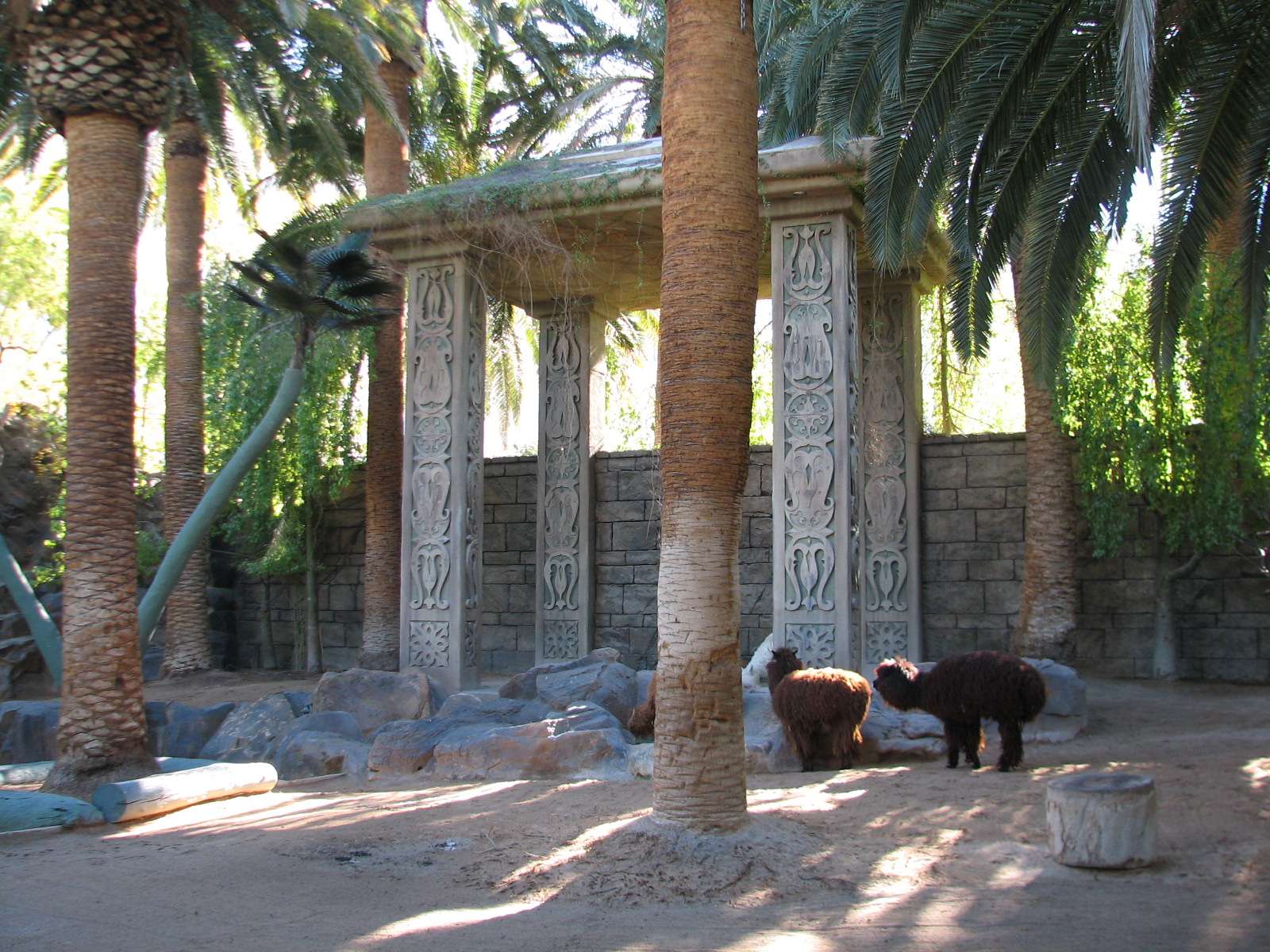
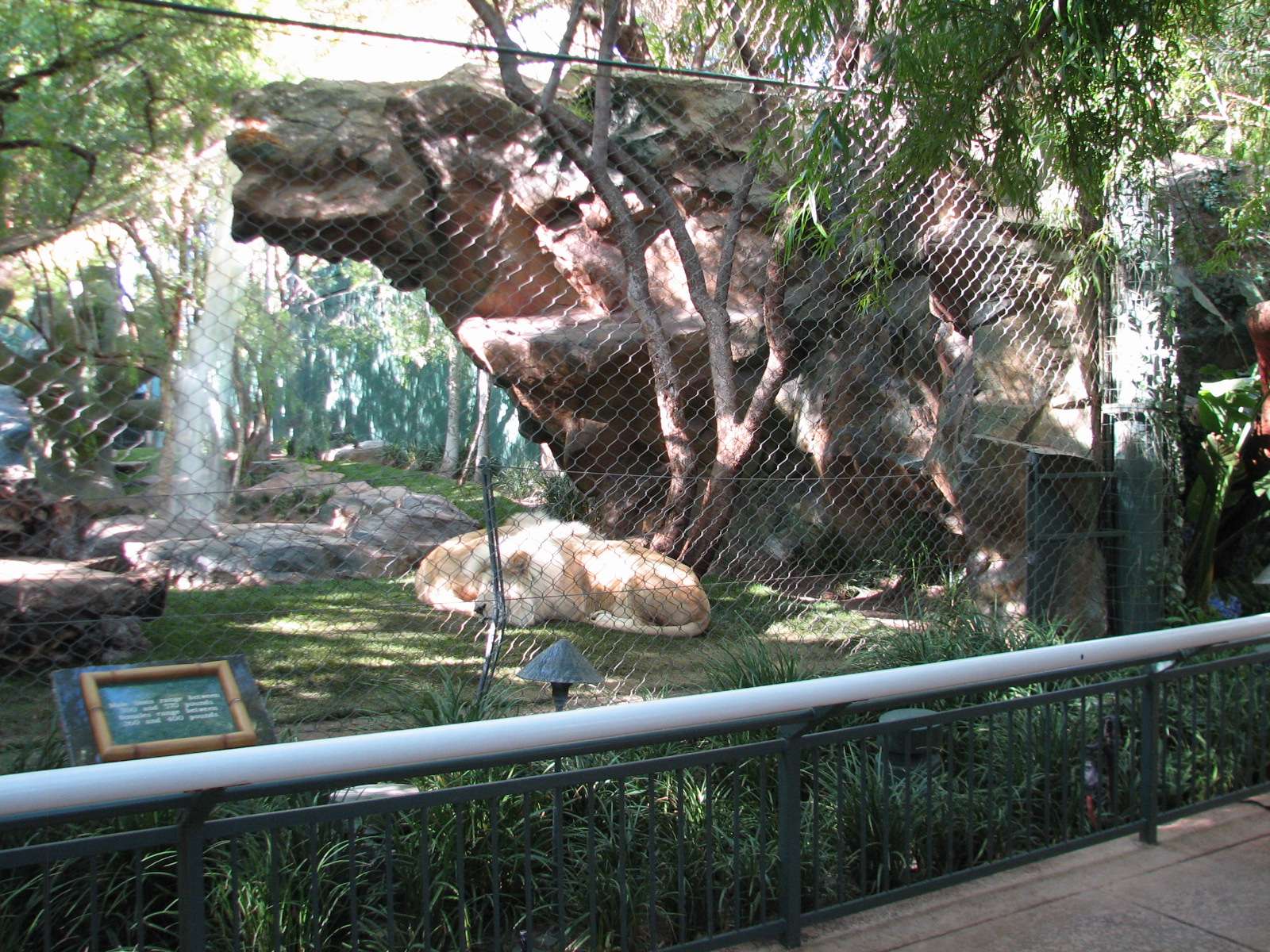
The Secret Garden is the other half of the facility and is less successful than the first. It is entered next to another small nondescript building, this time housing the Secret Garden Gift Shop with a small photo booth next to it. The path beyond is a U-shape for viewing the seven exhibits within. It is a very lush tree-shaded area and features only a few small lion and tigers statues and urns…in other words, it is not the over-the-top ode to exotica that one might expect. The left leg of the U leads to three exhibits. The far side is a large scenic yard viewed from railings across a dry moat. It is the former exhibit of a single Asian elephant who performed in the stage show, but now houses several Suri alpaca (long hair) and Huacaya alpaca (short hair) as well as a pair of unidentified swans. The habitat is dotted with large palms, features a simulated rock outcrop with a thundering waterfall into a small pool, and is contained in the back with a simulated stone masonry wall and tall temple-like roofed shelter held up by heavy carved columns. This setpiece is the only notable inclusion of themed design in the exhibits. The yard is almost entirely compacted earth except for a few areas of scattered boulders, and some large deadfall trunks form a barrier at the edge of the steep moat. It is a large exhibit space and a scenic one for this species, although it may be shadier than they prefer. The other six exhibits are for big cats, and are similar to each other: they all feature thick steel netting fronts and tops, suspended from steel poles like aviaries and rising in height away from the viewing areas until they reach the back walls of the enclosures. There are no window or moat viewing areas, and the lower 3 or 4 feet of the front netting has an additional layer of netting resulting in obscured views, further complicated by the blotches of sunlight hitting them as it filters through the tree canopy. Railings separate the path from a thin low planting barrier between them and the front of the exhibits. The interiors of the exhibits are almost entirely earth substrate that slopes gently and is planted with grass and trees, dotted with boulders. The back perimeters are a combination of simulated rock outcrops interrupting flat concrete block walls; although not entirely immersive, the flat walls are painted deep green which helps them disappear slightly in the shady background. The two exhibits at the top of each leg of the U-shape are rather small, while the other four that adjoin them are wider and much longer, resulting in average-sized enclosures. The four larger ones each feature a larger rock outcrop with a tall waterfall spilling into a rocky pool for swimming; the four falls are nearly identical and certainly not realistic but they are nice features. These six exhibits are by no means poor, but they are basically average with decent amenities. Visitor viewing could be improved however, and signage is minimal: it is limited to changeable plaques with the common species name and the displayed animal’s name with no supporting information. I suspect that the animals are rotated frequently between these six exhibits and the off-exhibit area. Looking at a satellite image of the off-exhibit area, it appears there may be over 30 holding cages! In addition, I have read that Siegfried and Roy have a large home on the outskirts of the city with more big cats, so they may travel between the two sites as well. It is likely that visitors only see a fraction of their collection here. The visitor map simply shows symbols of big cat faces in each of the exhibits. One of the smaller ones is pictured with a leopard, and the day of my visit it contained a black leopard named Shadow who was asleep on a high rocky ledge. The larger exhibit adjoining it is pictured with a lion, and the day of my visit there were two ‘White Lions of Timbavati’ sleeping together on the lawn next to their waterfall pool named Mystery and Secret. A plaque nearby proclaims an ‘International Conservation Alliance’ between Siegfried and Roy and the Johannesburg Zoological Gardens in South Africa to preserve and perpetuate the African white lion. Their habitat features an additional simulated rock outcrop that resembles large fallen tree trunks for climbing or resting. The other four exhibits are for tigers: the day of my visit, the largest one (I will call it tiger exhibit 1) was occupied by two snow white tigers (white tigers with very faint stripes) named Indira and Rajiv. Tiger exhibit 2 is the much smaller one, and was occupied by two 6-month old striped white tiger cubs named Mohan and Majestic. They were enjoying playing with a pumpkin and climbing the rocky ledges, and a trainer was inside the exhibit to answer questions from visitors outside. Tiger exhibit 3 contained a striped white tiger named Jaipur, and the very similar tiger exhibit 4 had striped white tigers Akasha and Kuma. All the tigers were very active, in contrast to the leopard and lions! I understand they have what they call heterozygous or golden tigers in the collection as well. No signs are there to explain the genetic facts of these freak cats or the species from which they come or their discovery or conservation efforts or supposed importance, so the place fails as any kind of earnest educational resource. Many will argue that it has no conservation value of course, but even with the lack of information I think that observing them closely like this impresses many visitors who are not zoo-goers and perhaps a few of them will become more interested in supporting true conservation later.
Secret Garden Alpaca Exhibit:
Secret Garden White Lion Exhibit:
Secret Garden Tiger Exhibit 2:

Siegfried and Roy’s Secret Garden and Dolphin Habitat is of average quality for what it is, but is many exhibits short of being a satisfying outing for regular zoo fans. In fact, it is noticeably light for regular visitors as well. With a general adult admission price of $15, it is $5 overpiced for regular visitors and about $7 overpiced for zoo fans. In my list of the 58 zoo facilities I have visited, it lands at number 57. A large part of that rank is the fact that there are so few exhibits here, and so little variety. None of its exhibits make my top lists, although the Dolphin Habitat as a whole is not far off my top 15 individual marine mammal exhibits. I have posted additional pictures in the gallery, which is called 'Secret Garden and Dolphin Habitat'.
Visitors must traverse a long twisting route from the street to reach the attraction. In front of the hotel on the strip, a small plaza is called Siegfried and Roy Plaza and features a star plaque in the paving with the inscription ‘Siegfried and Roy – Magicians of the Century’. Looming over this is a garish statue grouping composed of busts of the duo and a tiger head, the trio being depicted ten times lifesize and covered with a shiny coppery finish. The three heads erupt from a rocky outcrop, and for some reason shards of giant crystals emerge from the rocks as well. The magicians were not known for subtlety and this sculpture does not disappoint, being a popular spot for photographs since its unveiling in the 1990’s when their show was at its zenith. (They stopped performing when one of them was nearly killed by a tiger during their stage show in 2003.) The extensive rocky waterfall landscape of the front of the hotel property beyond the plaza features several bronze statues of jumping dolphins that also tie into the attraction’s theme to follow. The landscape also features a very large rock outcrop that ‘erupts’ as a volcano during free nightly shows that feature smoke and fountains and flames; this large setpiece must be walked around to reach one of the several entrances to the hotel and casino complex. One of the entrances used to feature a large indoor habitat behind glass for white tigers. It was a very stylistic room with skylights bathing a dramatic garish habitat of Indian-inspired temple architecture on the edge of a large tiled swimming pool. Most of the architecture, rockwork, tilework, and even fake palm trees were painted white and it was a surreal and memorable over-the-top introduction to the property. It was also a dream for a water-loving tiger! A few years ago, this free attraction (opened with the hotel in 1989) was removed and replaced with an upscale burger restaurant with a dark interior, the antithesis of the former white tiger habitat. Ultimately, this is probably progress for animal display technique since it was essentially a concrete fishbowl, even if it was not the inhabitants permanent or even daily home (they were rotated). Another free animal habitat in the hotel is still there, behind the long registration desk near another of the entrances: it is an impressive aquarium filled with about 1000 tropical saltwater fish from around the world. Although its inhabitants are not identified with signs and visitors can not approach it beyond the counter, it is a scenic backdrop and filled with activity. It is 53 feet long, 8 feet tall, 6 feet deep, and 20,000 gallons, with most of its back wall detailed as an artificial coral reef. Visitors then navigate through the large casino and a gauntlet of restaurants and shops before remerging back outside at the rear of the property and the hotel’s extensive lush swimming pool area; the entrance to the Secret Garden and Dolphin Habitat is adjacent.
An exotic gateway stands at the entrance of the attraction, with a carved wood sign, bas-reliefs of a tiger and dolphin on each side, and statues of two tigers above the arch. Surpisingly, the attraction is fairly tasteful beyond this point, considering the duo’s stage reputation and the décor of the former free white tiger habitat and statue plaza previously mentioned. Very little in the way of tacky details is found beyond the gate. A lush tropical path leads from the gate to a small ticketbooth where admission is collected. The path then continues to curve around the perimeter of the lush hotel swimming pool area until it reaches a small canopy-covered bridge raised above an open view of the first area of animal exhibits, then descends stairs or a ramp.
The first part of this two-part complex seen is the Dolphin Habitat. It is a series of three connected pools (a small fourth one connects two of the others in an off exhibit area just out of view) that collectively hold 2.5 million gallons. The largest and deepest pool is the Main Pool, which features several large simulated coral reef outcrops in its center that are of average theme quality. The floor of the pool features a slope with a rough simulated sandy bottom finish. The edge of this pool is a freeform curvy shape and is lined with a shallow submerged shelf that varies about 3 to 6 feet wide for trainers to walk and for occasional dolphin beaching behaviors. The edge of the pool is lined with a concrete lip about 2 feet high to keep visitors out of the pool, and about half its circumference can be walked around on the path. The far side is lined with palms and some lush plants, but the harsh backside of a nearby shopping center looms beyond. Around one side of this pool is a low nondescript building with a simple hiproof (no minarets or gold-tiled elephant columns) housing the Dolphins’ Shop and the Dolphins’ Snack Bar, with shaded tables and chairs for relaxing out front. On either side of the front area of the Main Pool is a curving ramp that descends to the underwater viewing gallery. When this passageway goes underground into the dark, the simple stucco walls feature average backlit graphics about dolphins and the habitat. Wide windows surrounding one node of the pool give good views into its depths and across its length as the passageway curves and reaches a small room with another window, this time viewing the Center Pool. It is by far the smallest of the three, and can also be seen along one side of it from the surface. It has similar edge shelves and walls to the first, but is slightly shallower (10 feet?) and does not have simulated reef outcrops. It is connected with a gated shallow sluice to the Main Pool, the off-exhibit pool, and to the last pool. The visitor walkway crosses a low bridge over the connection to this last pool, which is the Birth and Research Pool. It is the second largest, but probably shallower than the Main Pool and lacks reef outcrop scenery and underwater viewing. It is also a simpler oval shape, but its circumference can be explored entirely by visitors. It also features the same low lip separating the walkway from the pool, and an especially wide shallow shelf on one side for trainers. Collectively, the dolphin display area is attractive, roomy, and offers a variety of viewing experiences for visitors and habitat experiences for the Atlantic bottlenose dolphins that reside here fulltime. During my midday visit, there were several trainers in the pools with additional-fee customers experiencing the Trainer-For-A-Day program. They do not perform shows here, but the trainers are active most of the day and give occasional talks while demonstrating bahaviors. There were eight dolphins, separated that day in two groups, one in the Center Pool and one in the Birth and Research Pool. They have bred here, and one of them is the granddaughter of another. It appears to be a responsible program with a genuine interest in marine biology. They are not an AZA member institution, but they are an Alliance of Marine Mammal Parks and Aquariums member. The final feature of the Dolphin Habitat is a few large windows that look through the perimeter wall of the large outdoor Life Support System enclosure, with clear labels on the components such as sand filters and ozone chambers. I always appreciate the behind-the-scenes machinery of aquatic exhibits being shown and showcased this way, although it is rare. On one hand, the limited amount of exhibits in the attraction makes features like this an asset to showcase; on the other hand, it is surpising that it is shown considering the namesake founders’ affinity for ‘magic’ and illusion and artifice. But then, their focus area is the second part of the attraction.
Dolphin Habitat Main Pool:

Dolphin Habitat Main Pool underwater viewing area:

Dolphin Habitat Birth and Research Pool:

The Secret Garden is the other half of the facility and is less successful than the first. It is entered next to another small nondescript building, this time housing the Secret Garden Gift Shop with a small photo booth next to it. The path beyond is a U-shape for viewing the seven exhibits within. It is a very lush tree-shaded area and features only a few small lion and tigers statues and urns…in other words, it is not the over-the-top ode to exotica that one might expect. The left leg of the U leads to three exhibits. The far side is a large scenic yard viewed from railings across a dry moat. It is the former exhibit of a single Asian elephant who performed in the stage show, but now houses several Suri alpaca (long hair) and Huacaya alpaca (short hair) as well as a pair of unidentified swans. The habitat is dotted with large palms, features a simulated rock outcrop with a thundering waterfall into a small pool, and is contained in the back with a simulated stone masonry wall and tall temple-like roofed shelter held up by heavy carved columns. This setpiece is the only notable inclusion of themed design in the exhibits. The yard is almost entirely compacted earth except for a few areas of scattered boulders, and some large deadfall trunks form a barrier at the edge of the steep moat. It is a large exhibit space and a scenic one for this species, although it may be shadier than they prefer. The other six exhibits are for big cats, and are similar to each other: they all feature thick steel netting fronts and tops, suspended from steel poles like aviaries and rising in height away from the viewing areas until they reach the back walls of the enclosures. There are no window or moat viewing areas, and the lower 3 or 4 feet of the front netting has an additional layer of netting resulting in obscured views, further complicated by the blotches of sunlight hitting them as it filters through the tree canopy. Railings separate the path from a thin low planting barrier between them and the front of the exhibits. The interiors of the exhibits are almost entirely earth substrate that slopes gently and is planted with grass and trees, dotted with boulders. The back perimeters are a combination of simulated rock outcrops interrupting flat concrete block walls; although not entirely immersive, the flat walls are painted deep green which helps them disappear slightly in the shady background. The two exhibits at the top of each leg of the U-shape are rather small, while the other four that adjoin them are wider and much longer, resulting in average-sized enclosures. The four larger ones each feature a larger rock outcrop with a tall waterfall spilling into a rocky pool for swimming; the four falls are nearly identical and certainly not realistic but they are nice features. These six exhibits are by no means poor, but they are basically average with decent amenities. Visitor viewing could be improved however, and signage is minimal: it is limited to changeable plaques with the common species name and the displayed animal’s name with no supporting information. I suspect that the animals are rotated frequently between these six exhibits and the off-exhibit area. Looking at a satellite image of the off-exhibit area, it appears there may be over 30 holding cages! In addition, I have read that Siegfried and Roy have a large home on the outskirts of the city with more big cats, so they may travel between the two sites as well. It is likely that visitors only see a fraction of their collection here. The visitor map simply shows symbols of big cat faces in each of the exhibits. One of the smaller ones is pictured with a leopard, and the day of my visit it contained a black leopard named Shadow who was asleep on a high rocky ledge. The larger exhibit adjoining it is pictured with a lion, and the day of my visit there were two ‘White Lions of Timbavati’ sleeping together on the lawn next to their waterfall pool named Mystery and Secret. A plaque nearby proclaims an ‘International Conservation Alliance’ between Siegfried and Roy and the Johannesburg Zoological Gardens in South Africa to preserve and perpetuate the African white lion. Their habitat features an additional simulated rock outcrop that resembles large fallen tree trunks for climbing or resting. The other four exhibits are for tigers: the day of my visit, the largest one (I will call it tiger exhibit 1) was occupied by two snow white tigers (white tigers with very faint stripes) named Indira and Rajiv. Tiger exhibit 2 is the much smaller one, and was occupied by two 6-month old striped white tiger cubs named Mohan and Majestic. They were enjoying playing with a pumpkin and climbing the rocky ledges, and a trainer was inside the exhibit to answer questions from visitors outside. Tiger exhibit 3 contained a striped white tiger named Jaipur, and the very similar tiger exhibit 4 had striped white tigers Akasha and Kuma. All the tigers were very active, in contrast to the leopard and lions! I understand they have what they call heterozygous or golden tigers in the collection as well. No signs are there to explain the genetic facts of these freak cats or the species from which they come or their discovery or conservation efforts or supposed importance, so the place fails as any kind of earnest educational resource. Many will argue that it has no conservation value of course, but even with the lack of information I think that observing them closely like this impresses many visitors who are not zoo-goers and perhaps a few of them will become more interested in supporting true conservation later.
Secret Garden Alpaca Exhibit:

Secret Garden White Lion Exhibit:

Secret Garden Tiger Exhibit 2:

Siegfried and Roy’s Secret Garden and Dolphin Habitat is of average quality for what it is, but is many exhibits short of being a satisfying outing for regular zoo fans. In fact, it is noticeably light for regular visitors as well. With a general adult admission price of $15, it is $5 overpiced for regular visitors and about $7 overpiced for zoo fans. In my list of the 58 zoo facilities I have visited, it lands at number 57. A large part of that rank is the fact that there are so few exhibits here, and so little variety. None of its exhibits make my top lists, although the Dolphin Habitat as a whole is not far off my top 15 individual marine mammal exhibits. I have posted additional pictures in the gallery, which is called 'Secret Garden and Dolphin Habitat'.
Last edited:

