You are using an out of date browser. It may not display this or other websites correctly.
You should upgrade or use an alternative browser.
You should upgrade or use an alternative browser.
Do captive bred animals really want to be released into the wild?
- Thread starter zooman
- Start date

Maisie
Well-Known Member
Just from my own personal experience: one of my own birds has once got out (through the cat flap that was taped open for our useless cat), but only made it as far as the patio before deciding it was far too scary out there and flying back in when the door was opened. Another of mine was hand-raised in captivity, ringed and released. 2 weeks later he landed on a lady in the South of England and happily stayed on her shoulder as she went into the house.
A friend of mine has a jackdaw who comes and goes as he pleases, staying out for a few hours at a time, or (rarely) overnight, but generally comes back before dark to spend the night happily in his cage.
Granted, these examples are imprinted birds, but if captivity is all an animal has ever known, even one that's not imprited, given sufficient space to exercise, a stimulating and enriching environment and suitable quantity and variety of food will be perfectly content in captivity.
So no, I don't think an animal that's been born and raised in captivity necessarily yearns for freedom. A lot of humans see a cage as a prison. Certainly my birds see it as home, their territory, and I'm sure other captive animals are the same. Freedom means roaming without limits, but also not knowing where your next meal's coming from, whether you'll be able to find warmth and shelter in bad weather, or whether something's about to try to eat you.
A friend of mine has a jackdaw who comes and goes as he pleases, staying out for a few hours at a time, or (rarely) overnight, but generally comes back before dark to spend the night happily in his cage.
Granted, these examples are imprinted birds, but if captivity is all an animal has ever known, even one that's not imprited, given sufficient space to exercise, a stimulating and enriching environment and suitable quantity and variety of food will be perfectly content in captivity.
So no, I don't think an animal that's been born and raised in captivity necessarily yearns for freedom. A lot of humans see a cage as a prison. Certainly my birds see it as home, their territory, and I'm sure other captive animals are the same. Freedom means roaming without limits, but also not knowing where your next meal's coming from, whether you'll be able to find warmth and shelter in bad weather, or whether something's about to try to eat you.

Obviously if it is part of an important conservation project, the animals will need to be released, but putting this on the same logic of what happens in most zoo escapes (where the animal panics and just wants to get back to it's 'territory'), you can imagine they probably wouldn't be immediately pleased on being thrown into a wide dog-eat-dog where its up to them entirely! John Knowles, Marwell's founder and a renowned conservationist, made a sly remark about this in his autobiography, where he said that based on his experience, if he was a przewalskis horse in a group where individuals were being selected for reintroduction, and he knew that he would lose the comfort of a reliable food source, health care and lack of predators when he went to Mongolia, he would certainly linger to the back and keep his head down. 

Meaghan Edwards
Well-Known Member
At Toronto, I watched a pair of beavers just chilled out whlie the zoo keeper had the glass door (for viewing inside the den) open for cleaning. I believe these are captive bred animals.

Sun Wukong
Well-Known Member
Captive bread should be freed, sliced and buttered.

@Sun Wukong, I like.
I don't believe captive bred animals know that there is something like "the wild". They live in their luxorious place where there is plenty of food and shelter. The only thing that matters for an animal is to eat, but not to be eaten by others, and in the end reproduction (but the most animals don't understand that).
If you give an gnu a giant savannah area to forage en graze, with a small place where it can get hay in big proportions, just like a zoo, but where it's also more crowded with people. That wildebeest will go there where it can do "optimal foraging", highest intake with the lowest energy losses.
I don't believe captive bred animals know that there is something like "the wild". They live in their luxorious place where there is plenty of food and shelter. The only thing that matters for an animal is to eat, but not to be eaten by others, and in the end reproduction (but the most animals don't understand that).
If you give an gnu a giant savannah area to forage en graze, with a small place where it can get hay in big proportions, just like a zoo, but where it's also more crowded with people. That wildebeest will go there where it can do "optimal foraging", highest intake with the lowest energy losses.

Gerald Durrell once said, re-introducing zoo born animals to the wild was fraut with difficulty because it was like throwing someone out of a five star hotel and making them sleep on a park bench.
Durrell also recounts in the "Drunken Forest" of how he had to release most of the collection he had amassed due to a revolution. A large proportion of the animals refused to leave and some even went back into their cages.
If wild animals enjoy captivity that much, then imagine how captive-born animals would find 'the wild'.
Hix

sooty mangabey
Well-Known Member
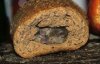
Captive bread should be freed, sliced and buttered.
Does this count as captive-bread?
Attachments
Sun Wukong
Well-Known Member
@sooty mangabey: I wouldn't slice and butter that, though.
As for the original question: I recommend to take a look at Heini Hediger's fundamental writings.
As for the original question: I recommend to take a look at Heini Hediger's fundamental writings.