
Busch Gardens Tampa – also known as Busch Gardens Tampa Bay, FL and formerly known as Busch Gardens Africa and Busch Gardens: The Dark Continent – is a huge 335-acre combination zoo and theme park located 6 miles North of downtown Tampa in the low flat terrain of Florida’s West coast. It had 4,200,00 visitors in 2010, making it the 11th most-attended theme park in the US that year. The park opened in 1959 as an adjacent attraction to one of the Anheuser-Busch breweries; it was a modest small zoo and garden originally, and grew immense through the years after the brewery was closed. It retains its Busch moniker even though it is no longer owned by that company (it is owned by SeaWorld Parks and Entertainment, which in turn is owned by an octopus-like private equity investment firm now). There were once 5 different Busch Gardens parks of various sizes, although the two that remain were always the major ones: this one, and Busch Gardens Williamsburg in Virginia (which was also known as Busch Gardens: The Old Country). The Virginia park is actually very different from this one and has only a handful of animal exhibits in its European-themed roster of attractions, while the Florida park features an African theme and many animal exhibits. In fact, without the theme park attractions, this park would still be considered a major zoo because it has about 2,700 animals exhibited in many noteworthy habitats. Thus it is certainly deserving of a lengthy review here! Although the park’s theme is Africa, that theme is not exclusive and a few areas diverge from it. I visited most recently in early November 2011, and I will describe the park according to the current map’s designations, which lists 10 themed areas. 7 of the themed areas have at least one animal exhibit and those will be the focus of my review. Some of the themed areas are organized and theme-appropriate while others are a collection of various adjacent attractions that have been lumped together for easier identification on the map but make strange bedfellows. That is a result of any park that grows a bit haphazardly over the years. Fortunately, the overall layout of the park is a giant loop path that generally leads from one themed area to the next, and I will describe the animal exhibits according to the themed lands they are in, starting with the entrance area called Morocco. From there I will describe the themed areas in a clockwise direction around the loop: Bird Gardens, Sesame Street Safari of Fun, Stanleyville, Jungala, Congo, Timbuktu, Nairobi, Cheetah Hunt, and Egypt.
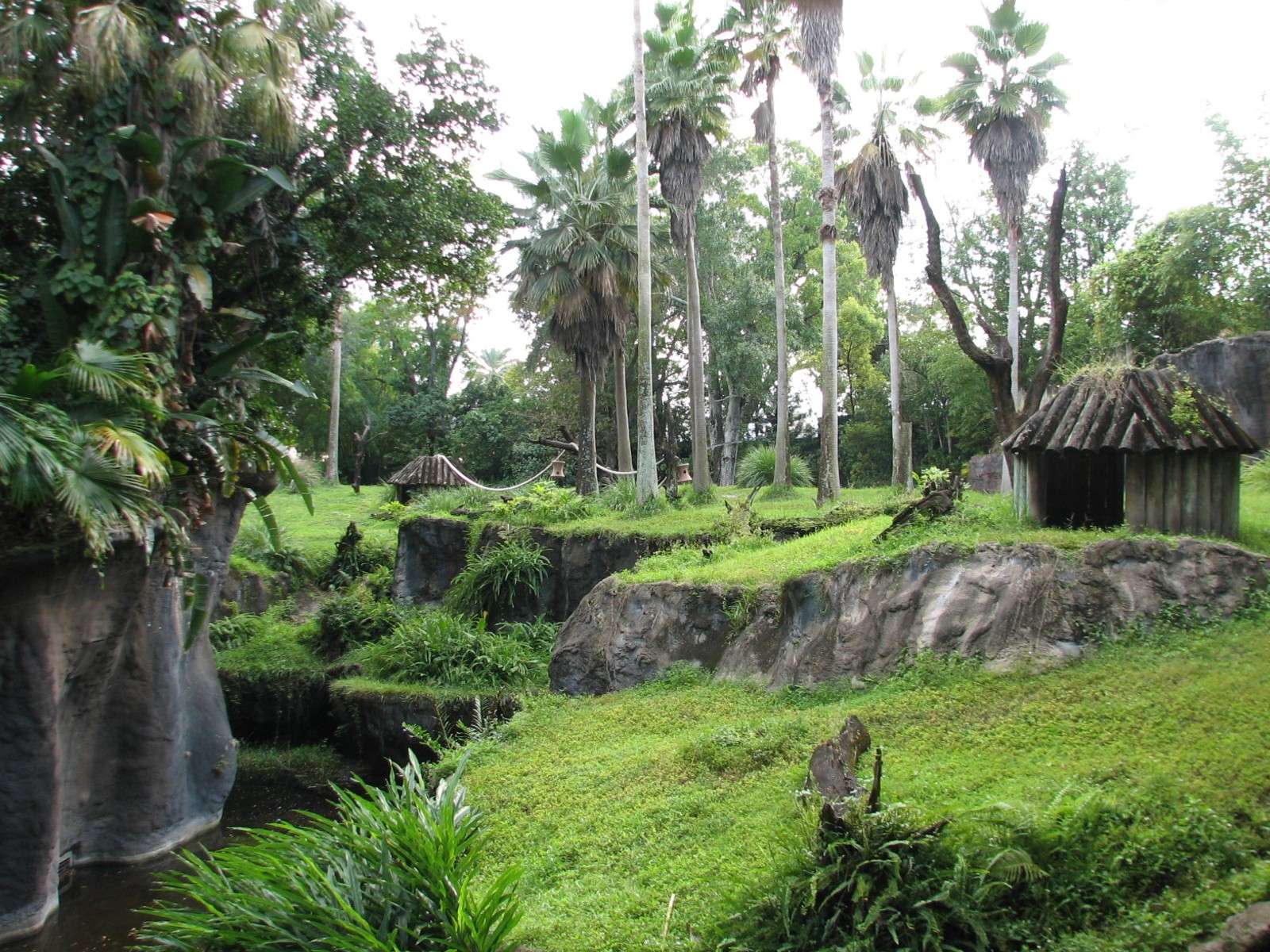
Morocco is the entrance area to the park and begins with a large entrance plaza and then a village with services and shops and restaurants and two show theaters. All these features are housed in vaguely Morrocan buildings with stepped parapets and Moorish arches and tilework; much of the architecture of the park fits the themes and I will not describe it in depth except to say that it is extensive. The detailing and ‘authenticity’ is a step down from the Disney and Universal parks, but better than most other theme parks and zoos. The theme of the first animal exhibit in this area immediately diverges however; instead of an exhibit for North African animals there is an American alligator exhibit! It is a nice one though, composed of a large open yard dominated by a large pool that is contained with a low simulated rock backwall. Forming the backdrop is a very dense lush tropical forest that is the landscape of the other exhibit in Morocco. For such a large exhibit, there are few alligators but the inhabitants are large; keepers enter the exhibit and stand just feet away from them while talking to visitors on the other side of the railing and thin planting area that separates them. Myombe Reserve is the other exhibit, entered through a pergola adjacent to the alligator exhibit. It is another example of a divergent theme, since it is an exhibit complex that recreates the African rainforest…lumped in on the park map with Morocco! It lies between this area and Nairobi, so inclusion in either area would be geographically clumsy I suppose. Either way, it is an excellent exhibit complex of two habitats: one for chimpanzee, the other for gorilla. They are set in the most lushly planted area of the park and located along an exhibit path that winds through it. At the entrance pergola, a large wall graphic announces the theme and a troop of bronze gorilla statues stands nearby upon which to climb. The path then crosses a small wooden bridge over a stream and arrives at a large but low modern shelter for viewing the chimpanzee exhibit through large viewing windows. The grassy exhibit yard has gentle slopes punctuated by clumps of taller grasses and palms and small timber shelters and deadfalls. It is contained by a tall backwall of simulated eroded riverbank topped with lush trees and plants; this rockwork is too simple to be convincing but it is not too distracting. Its application on the right side of the large exhibit, where the visitor path leaves the shelter and rounds a bend to an open-air view across a moat and next to a waterfall, is more successful as it forms some terraces that step down to the water so that the water-filled moat is not a cavern. Next to this second viewing area are bronze chimpanzee statues that look out from the forest into the exhibit. The path then crosses a nice boardwalk over a low stream and enters a large rocky overhang in the forest into the Research Outpost, an interpretive room with a scattering of average educational graphics (and in true zoo fashion, a wax-toy-making souvenir machine plopped in the room in defiance of the graphics, probably added later and not intended by the exhibit designers!). The end of the sheltered cave wall has a small opening in the rock that looks through the backside of a large waterfall that crashes into the other exhibit in the complex, for gorilla. It is a great habitat and begins as the path exits the Research Outpost and turns a corner in the lush jungle, where yet another bronze gorilla statue looks across a small curved seating amphitheater for viewing the exhibit across a rocky moat. This area of the habitat is dominated by the large waterfall mentioned earlier as it cascades down around a convincing assembly of large simulated boulders. The rockwork that contains the yard is similar and differs from the exposed riverbank type for the chimpanzees. This habitat is also lusher, backed by a higher canopy of green, and subdivided by boulders into a more complex series of spaces. The path then goes back into the jungle and descends into a dark viewing area contained in boulders and covered by a low modern shelter similar to the one for the chimpanzee viewing area. This one has a single long viewing window at grade so that the gorillas can approach it, and it views a flatter part of their terrain. A second nearly identical shelter is reached through a short passageway and offers yet another view into another node of the exhibit. The grassy ground plain inside is scattered with a few plants as well as some small shade trees and deadfalls, and the family troop seems to enjoy moving about the entire space. The path then exits this shelter and twists around to an exit out of the forest.
Chimpanzee Exhibit in Myombe Reserve:
Bird Gardens is the themed area that occupies the oldest part of the park, and is one of two that primarily focuses on animal exhibits. It is scenic and pleasant but is rather generic, and a bit of a piecemeal arrangement. The first exhibits encountered are part of a shop called Xcursions: inside is a small round column fishtank with unidentified inhabitants while outside is a simulated treetrunk and branches hanging over a small pond that is a perch for macaws. On my previous visit in 2008 there was a side path that reached Eagle Canyon, a complex of several small open-air grottos with deadfalls for injured raptors to perch on, but the path was closed and the habitat not listed on the map this time. Also closed, this time for renovation, was a very modern – for 1959 – restaurant with a lagoon in front; the lagoon was still filled with water but any resident waterfowl appeared to be gone. Nearby is the Bird Gardens Theater, a medium-sized amphitheater of metal grandstand seating covered with a canopy that is the home of the animal show, Critter Castaways. It has a nice stage set of a large simulated boat in ruins, as if it has washed ashore from a storm. I did not see the show however so I cannot comment on the content, but I understand it features rescued and shelter animals, especially dogs. Adjacent to the theater is a massive exhibit for Caribbean flamingo that is dominated by a large shallow lake filled with large koi. The shores on one side are a simple open grassy area for the birds, and the visitor path circles a large part of it. A simple wood railing is used as the barrier from the path, and it is used again on the other side of the path for three open habitats that ring the larger one: one for bar-headed goose, one for unidentified waterfowl, and a very small one with a pond for unidentified turtle. This area could use some more graphics, but it is a nice area to stroll through and is landscaped with various tropical plants and informal flower beds.
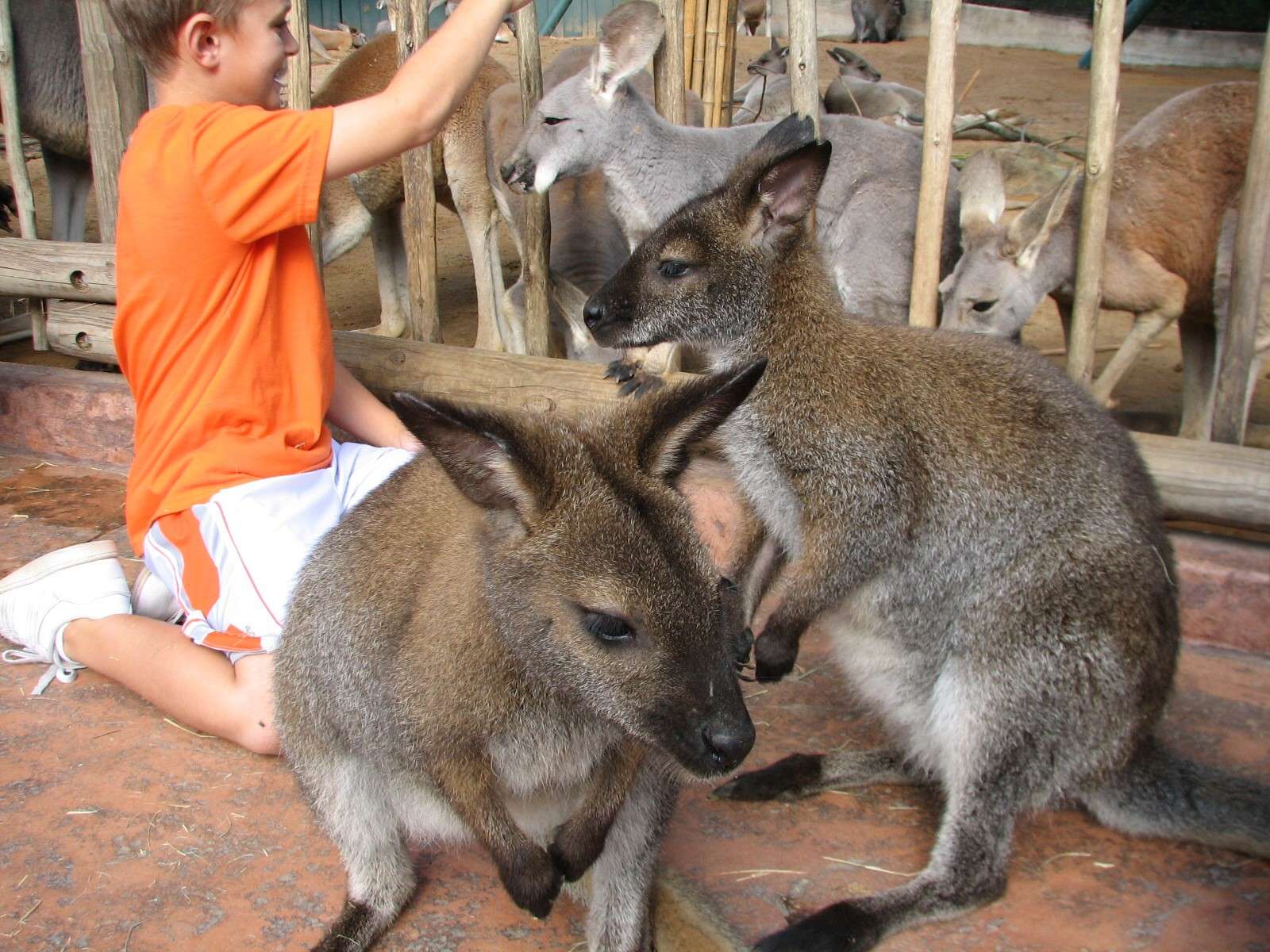
Bird Gardens has one of the park’s newest exhibit complexes, which is actually a renovation and redesign of an older area that has been rethemed to Walkabout Way. This Australian themed complex is not especially Australian in architecture or details, but it does indeed feature some animals from that continent in its two exhibits. The Kookaburra’s Nest occupies an existing aviary that has an attractive rustic timber open-air pavilion for shaded exterior viewing of the aviary. Visitors can also go inside the aviary on a short path through the medium-sized timber pole-supported mesh structure. It is lushly landscaped and has a small pond and stream. The species are unidentified and I spotted scarlet ibis and other non-Australian birds, so the theme is not consistent. Attached to one side of the main aviary is a mediocre small cage for the exhibit’s namesake, kookaburra. It’s a shame that the species selection and the showcase species are not given the appropriate treatment. The other exhibit in Walkabout Way is far more successful: a large walk-through habitat for kangaroos and wallabies called Kangaloom. Visitors enter through a gated small open-air shed; a counter on one side is called The Tuckerbox and is for purchasing kangaroo food (pellets). That’s right – at select times through the day, visitors can feed them and it is a delight! After entering the exhibit, the long visitor path is lined with rustic timber railings for its entire length until it exits the yard at the other end through a gate. The habitat is mostly bare sandy earth but does have some thin trees scattered around and surrounded by poles to prevent bark stripping. It is a very large flat habitat, contained with a high wood fence and low fenced bamboo plantings along its backside and a small lake on its frontside in which some black swans and magpie goose and other waterfowl swim. Awnings for both the residents and visitors provide additional shade, as do trees planted just outside the back fence. Although the habitat’s details are not especially evocative of the outback, the resident mob is impressive. Eastern gray kangaroo, Western gray kangaroo, red kangaroo, wallaroo, Bennett’s wallaby, and an albino wallaby compose the mob, which must number about 40! The only other captive mob I can remember seeing that is this large is at the Kansas City Zoo (one species, in a far more naturalistic walk-through exhibit, although there was no feeding opportunity). In an interesting bit of exhibit design, the gaps between the railings are spaced so that the larger inhabitants (most of them) stay outside the visitor path railings and in the larger habitat; however, the smaller inhabitants, especially the Bennett’s wallabies, can fit through the railings and spend time on the visitor path or cross into the narrower part of the habitat adjacent to the small lake. At feeding time, many of the inhabitants come up to the railing and stick their arms and heads out to be fed from the path, and most are happy to be scratched or petted between their arms. I was lucky to be able to cuddle with a few wallabies on the path as well as feed many kangaroos and it was a highlight of the visit!
Feeding Bennett's wallabies and other kangaroo species in Kangaloom, part of Walkabout Way in Bird Gardens:
Bird Gardens continues with a few more exhibits, but the relative continuity of this themed area is broken by another themed area that is just off the park’s main loop: Sesame Street Safari of Fun, an attraction complex of rides and play areas catering to children. It has no animal exhibits so I will not describe it, but in its previous incarnation it was called Land of the Dragons and an animal exhibit that was near its entrance was called Living Dragons. That exhibit is still there but is no longer labeled as such although it is much the same as it was. It is actually an older small building with four adjacent aviary-like habitats with rocky back walls. Two are viewed through wire mesh and two through glass panels. Where the exterior walls turn corners, poorly simulated tree trunks with buttress roots have been added to the façade, probably an ill-conceived attempt to update the aging building. Some of the rockwork has also been updated to be more realistic over the years too. The habitats are mediocre ones: one for turaco (unidentified species), one for unidentified iguana and tortoise (signs are not Bird Gardens’ strong point), one for Komodo dragon (too small for this species), and one for Cuban iguana (the best of the four, although I spotted another turaco in this one). After the park loop passes the children’s themed area, Bird Gardens continues with Lory Landing, a nice large walk-through feeding aviary. It is a circle, with a huge oak in the middle erupting out of a high draped mesh canopy for containment. Once inside, there is a ‘foyer’ with a shed for purchasing nectar and a macaw perch before entering the main aviary; the path splits to go to one of two entries to the main aviary, passing between four poor small cage enclosures. They contain: hyacinth macaw; unidentified; unidentified hornbill; and unidentified toucan. Fortunately the main aviary is much better, with a meandering path between decent rockwork walls and a pond for unidentified waterfowl; timber poles support draped rope perches for the very large active flock of lories that chatter in this roomy and open but nicely shaded habitat. The final exhibit in this area is a large outdoor yard viewed from an elevated walkway near the Lory Landing. It is for giant anteater, crested screamer and…Indian muntjac. So much for geographic groupings! Despite this, it is one of the best exhibits for these species in terms of size that I have seen. Although the back fences are an assortment of styles depending on which behind-the-scenes facility they adjoin, there are enough tall shrubs and trees scattered to screen them. Some mature trees provide a shady canopy over much of the yard, while a sunny open area offers an alternative. A large group of philodendrons provides a great hiding area for the muntjac.
Stanleyville does not have any animal exhibits but it does have stations for two rides that eventually view animal exhibits described later: the Skyride (it has another station in Cheetah Hunt) and the Serengeti Express train (it has stations in Congo and Nairobi).
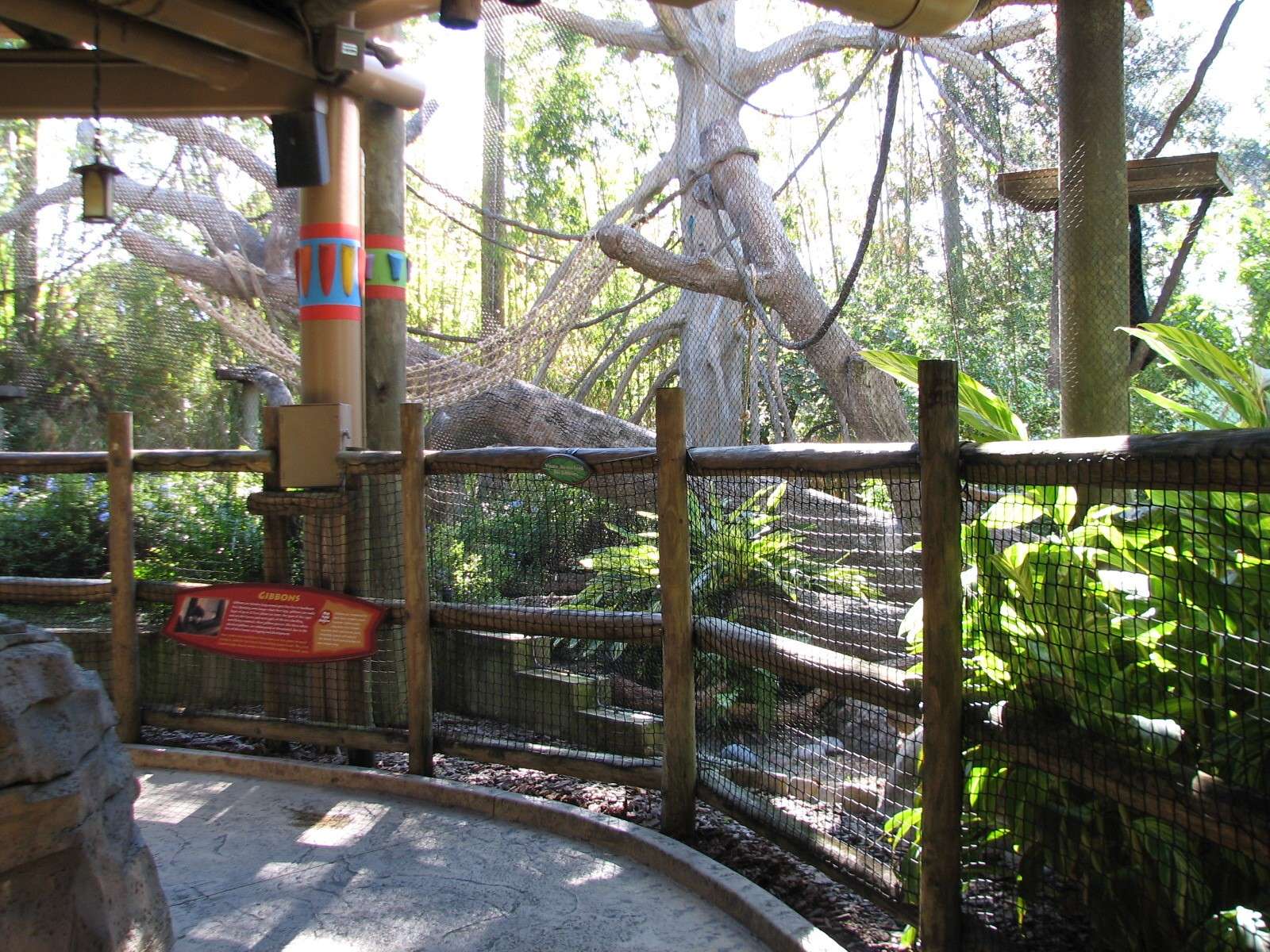
Jungala is the only themed area of the park that focuses on Southeast Asian animals, although it does not seek to recreate Southeast Asia. Instead, its exhibits and play areas and rides and restaurants and shop are designed in a cheerful contemporary take on jungle exoticism. It is well-designed and consistent for the most part, and all its elements were opened at the same time in 2008. Each element of the area has its own logo, graphics are plentiful, it is lushly planted, the rockwork is stylized, and the layout and details create a sense of adventure. There are two entrances to it off the main park loop. Tiger Trail is the name of the complex of two exhibits for Bengal tiger, including white tiger. These two fine exhibits are separated from each other by a long rocky passage for visitors. Inside is the Tiger Tunnel, a glass-walled thin passage above visitors’ heads that connects the two exhibits so that the tigers can cross from one to the other when the gates on each end are open. There are window viewing panels in the rocky passage into each exhibit as well, and next to each window is a capped feeding tube for tiger interaction when keepers are present. In fact, all the exhibits were designed with interaction in mind. I will call the exhibit on the left ‘Exhibit 1’ and the other ‘Exhibit 2’; both can be seen from many viewing areas around their entire perimeters. After exiting the passage, Exhibit 1 is seen again within a nice timber pole viewing shelter around the bend in the path. It has a tall wall of glass that extends below grade to reveal underwater views of a pool contained within rocky ledges. The viewing area steps down to the pool’s floor level to form a mini-seating area to watch the cats frolic in the water but I did not see them use it. Around another bend in the path, visitors can enter a small cave in the rockwork that has a small window into the exhibit. A few feet away is a narrow rocky passage and stairway into a tight cave that provides access to a hexagonal pop-up window within the exhibit; the tigers seem to love to lie on its top a few feet above the exhibit grade while visitors (one at a time) stick their heads up within inches of the striped fur resting on the glass above them! The path continues around to another side of the exhibit, and a feature that is present around parts of the perimeter is most noticeable here: thick simulated bamboo poles form the containment, set in two rows a few feet apart with real bamboo planted between. This occasionally affords exciting obscured views of the tigers. The last viewing area for Exhibit 1 is its most open and impressive: a bridge with rustic wood railings and course rope sides crosses over the exhibit. The other viewing areas are at or just below the exhibit ground level, but on this end rocky ledges and a waterfall drop down to an excavated grassy expanse contained with high rocky walls so that the bridge soars over the habitat. Deadfalls provide climbing surfaces for the cats to travel from one level to the other, and scattered palms provide some interest in the exhibit. The result of all this is an exhibit that is attractive and fun to explore for both visitor and animal; the downside is that the actual space for the tigers is rather small, and there is no place for them to be away from the visitors. This is especially true in the hole-like space below the bridge, where potentially tens of visitors might be hovering over the cats (I did not see them use that space). Exhibit 2 is the sunnier of the two and also features several viewpoints in addition to the rocky passage window. It has a large opening in rocky ledges, framed with a large simulated deadfall on top, that has a wire mesh screen of two layers a few feet apart for containment. A capped feeding tube passes through the screen for interaction here as well. Jungala has a gift shop called Tiger Treasures that has an interior feature of a large simulated tree trunk; a small opening in the trunk can be entered into a little curved window viewing nook that looks into Exhibit 2. Nearby is Tiger Lodge, a building with a roomy interior that has a long expanse of floor-to-ceiling windows looking into the exhibit and educational graphics. Exhibit 2 has a long narrow upper section that adjoins the window and screen viewing areas opposite the Tiger Lodge; then rocky ledges and waterfalls descend to a much larger lower level dominated by a shallow pond that covers much of the groundplane below the lodge and shop viewing windows. Again, deadfalls provide climbing surfaces down the ledges, and scattered palms provide floral interest within the habitat. Unfortunately this attractive scene is also on the small side for a tiger exhibit, especially due to the space that the shallow waterway takes. This waterway actually continues through netting on one end to the orangutan exhibit; the netting is suspended from a wooden boardwalk that offers yet another view of Exhibit 2. The boardwalk has a wood shelter on it and rustic wood railings with course rope containment, and some visitors get their first view of the fine orangutan exhibit here. The habitat has similar tall rocky ledges to the tiger exhibits, ascending in several terraces and forming several large nodes for spatial complexity within the large area. A shallow waterway (contiguous with the tiger exhibit’s) runs through the moat, which is rather deep and narrow on the sides of the exhibit but is very accesible all along the front so that it feels like open exhibit space. Small palms and some dead trunks dot the grassy landscape but it is dominated by three very tall metal shelters with ropes strung between them that the orangutans can climb and traverse for commanding views. This feature is called the Orangutan Vine: the course is 140 feet long and the shelters are 40 feet high. Orangutan Outpost is another viewpoint, this time in an enclosed small building that is built on stilts so that it extends over the waterway at the front of the exhibit. Inside are educational graphics and a floor-to-ceiling window panel and a few interactive features. A simulated deadfall trunk leans from the exhibit ground up to a ledge at floor level of the outpost; the orangutans can climb up to the ledge and be directly next to the viewing window, where a pass-through screen can be opened by keepers. There is also a small hollow tree trunk for small visitors to climb in that is against the glass so that it looks like a portion of the tree trunk outside continues indoors. In a corner, a section of the floor is glass and views down to a rope hammock suspended below that the orangutans can climb to on a series of deadfalls over the water; a capped metal feeding tube descends from the edge of the glass through the floor to the hammock. Another nice outdoor viewing area is on the long side of the exhibit, beneath the dining porch of the Orang Café, that offers the closest views of the higher ground across a deep moat. A course rope netting above the railings may dissuade visitors from throwing food into the exhibit, but the sight and smell of noisy patrons and their meals may be situated too close. While the tiger and orangutan exhibits are located away from the extensive play areas, the other two exhibits – collectively called Kulu Canopy – are not. They are in the thick of a large series of elevated bridges and net-climbing courses called Treetop Trails. However, they are both nice large tall netted exhibits, viewed from two levels. One is for flying fox (unidentified species) and is dominated by a massive simulated tree trunk that acts as the support pole for the containment netting. The viewing area on the upper level boardwalk is through glass panels at eye level, or through mesh above. The group of about 20 flying foxes were all clinging to the netting at the very top. A nice landscape of tropical plantings fills some of the ground far below, but it is mostly occupied by a sloped-bottom pool that is viewed from a few tall glass panels set in rockwork on the ground level. These windows provide a low slice of underwater viewing, but a nearby crawl tunnel of windows beneath the edge of the pool affords kids a more immersive experience. Unfortunately, the gharials that were featured in this pool are off exhibit so a small school of unidentified fish must suffice. Adjacent is the exhibit for white-cheeked gibbon that is viewed from the ground level through netting beyond a wood railing, or from a similar arrangement from the boardwalk on the second level. There is also a tiny shelter with windows reached through short crawl tubes on the second level for kids to get an intimate view. The exhibit is full of simulated tree trunks and branches and vines in a generous volume, with plenty of low tropical plants on the ground and larger ones just outside. What bothers me (but did not seem to bother the gibbons) is that one of the two rides in Jungala passes over this exhibit. It is called Jungle Flyers and is a hybrid zipline-like attraction that is boarded from a tower over the area. Visitors get in a seat suspended from a wire which lifts up and propels them along the wire until losing momentum, then the seat glides backward to the station. It is a very low capacity ride (it launches a few people every 3 or 4 minutes) of three sets of two side-by-side wires; only one set of them is suspended over the gibbon exhibit, but it seems like adding insult to injury when the boardwalk area next to them is already full of running and screaming noise.
The lower viewing area of the White-cheeked Gibbon Exhibit in Jungala:
Congo features a train station for the Serengeti Express described later, as well as two minor animal exhibits. One of the exhibits is an isolated one seen only from the train (or from a distance in an elevated play structure in Jungala). It is a large fenced yard for a small group of sable antelope, located far from the other hoofstock exhibits described later. It is very utilitarian, fenced with chainlink on one side and wood on the other, shaded by some oaks, and viewed across a dry moat adjacent to the tracks. A simple shelter in the center of the flat expanse shades a feeding station. The other exhibit is located in the queue for the Congo River Rapids ride. On one side of a large timber shelter for the line there is a mediocre habitat for squirrel monkey (you knew the Congo was in South America, right?) The L-shaped exhibit is viewed through large glass panels, above which are mounted garish African-inspired masks and crossed spears and oars. Inside is a poorly simulated rock habitat with a ceiling enclosed by wire in one area and fiberglass in the other. A fair amount of suspended branches provide climbing areas, but the few plants are all painfully sparse and fake. Detailing is far more successful in the next themed area along the park’s loop, Timbuktu, although there are no animal exhibits within it.
More to come in Part 2!
Morocco is the entrance area to the park and begins with a large entrance plaza and then a village with services and shops and restaurants and two show theaters. All these features are housed in vaguely Morrocan buildings with stepped parapets and Moorish arches and tilework; much of the architecture of the park fits the themes and I will not describe it in depth except to say that it is extensive. The detailing and ‘authenticity’ is a step down from the Disney and Universal parks, but better than most other theme parks and zoos. The theme of the first animal exhibit in this area immediately diverges however; instead of an exhibit for North African animals there is an American alligator exhibit! It is a nice one though, composed of a large open yard dominated by a large pool that is contained with a low simulated rock backwall. Forming the backdrop is a very dense lush tropical forest that is the landscape of the other exhibit in Morocco. For such a large exhibit, there are few alligators but the inhabitants are large; keepers enter the exhibit and stand just feet away from them while talking to visitors on the other side of the railing and thin planting area that separates them. Myombe Reserve is the other exhibit, entered through a pergola adjacent to the alligator exhibit. It is another example of a divergent theme, since it is an exhibit complex that recreates the African rainforest…lumped in on the park map with Morocco! It lies between this area and Nairobi, so inclusion in either area would be geographically clumsy I suppose. Either way, it is an excellent exhibit complex of two habitats: one for chimpanzee, the other for gorilla. They are set in the most lushly planted area of the park and located along an exhibit path that winds through it. At the entrance pergola, a large wall graphic announces the theme and a troop of bronze gorilla statues stands nearby upon which to climb. The path then crosses a small wooden bridge over a stream and arrives at a large but low modern shelter for viewing the chimpanzee exhibit through large viewing windows. The grassy exhibit yard has gentle slopes punctuated by clumps of taller grasses and palms and small timber shelters and deadfalls. It is contained by a tall backwall of simulated eroded riverbank topped with lush trees and plants; this rockwork is too simple to be convincing but it is not too distracting. Its application on the right side of the large exhibit, where the visitor path leaves the shelter and rounds a bend to an open-air view across a moat and next to a waterfall, is more successful as it forms some terraces that step down to the water so that the water-filled moat is not a cavern. Next to this second viewing area are bronze chimpanzee statues that look out from the forest into the exhibit. The path then crosses a nice boardwalk over a low stream and enters a large rocky overhang in the forest into the Research Outpost, an interpretive room with a scattering of average educational graphics (and in true zoo fashion, a wax-toy-making souvenir machine plopped in the room in defiance of the graphics, probably added later and not intended by the exhibit designers!). The end of the sheltered cave wall has a small opening in the rock that looks through the backside of a large waterfall that crashes into the other exhibit in the complex, for gorilla. It is a great habitat and begins as the path exits the Research Outpost and turns a corner in the lush jungle, where yet another bronze gorilla statue looks across a small curved seating amphitheater for viewing the exhibit across a rocky moat. This area of the habitat is dominated by the large waterfall mentioned earlier as it cascades down around a convincing assembly of large simulated boulders. The rockwork that contains the yard is similar and differs from the exposed riverbank type for the chimpanzees. This habitat is also lusher, backed by a higher canopy of green, and subdivided by boulders into a more complex series of spaces. The path then goes back into the jungle and descends into a dark viewing area contained in boulders and covered by a low modern shelter similar to the one for the chimpanzee viewing area. This one has a single long viewing window at grade so that the gorillas can approach it, and it views a flatter part of their terrain. A second nearly identical shelter is reached through a short passageway and offers yet another view into another node of the exhibit. The grassy ground plain inside is scattered with a few plants as well as some small shade trees and deadfalls, and the family troop seems to enjoy moving about the entire space. The path then exits this shelter and twists around to an exit out of the forest.
Chimpanzee Exhibit in Myombe Reserve:

Bird Gardens is the themed area that occupies the oldest part of the park, and is one of two that primarily focuses on animal exhibits. It is scenic and pleasant but is rather generic, and a bit of a piecemeal arrangement. The first exhibits encountered are part of a shop called Xcursions: inside is a small round column fishtank with unidentified inhabitants while outside is a simulated treetrunk and branches hanging over a small pond that is a perch for macaws. On my previous visit in 2008 there was a side path that reached Eagle Canyon, a complex of several small open-air grottos with deadfalls for injured raptors to perch on, but the path was closed and the habitat not listed on the map this time. Also closed, this time for renovation, was a very modern – for 1959 – restaurant with a lagoon in front; the lagoon was still filled with water but any resident waterfowl appeared to be gone. Nearby is the Bird Gardens Theater, a medium-sized amphitheater of metal grandstand seating covered with a canopy that is the home of the animal show, Critter Castaways. It has a nice stage set of a large simulated boat in ruins, as if it has washed ashore from a storm. I did not see the show however so I cannot comment on the content, but I understand it features rescued and shelter animals, especially dogs. Adjacent to the theater is a massive exhibit for Caribbean flamingo that is dominated by a large shallow lake filled with large koi. The shores on one side are a simple open grassy area for the birds, and the visitor path circles a large part of it. A simple wood railing is used as the barrier from the path, and it is used again on the other side of the path for three open habitats that ring the larger one: one for bar-headed goose, one for unidentified waterfowl, and a very small one with a pond for unidentified turtle. This area could use some more graphics, but it is a nice area to stroll through and is landscaped with various tropical plants and informal flower beds.
Bird Gardens has one of the park’s newest exhibit complexes, which is actually a renovation and redesign of an older area that has been rethemed to Walkabout Way. This Australian themed complex is not especially Australian in architecture or details, but it does indeed feature some animals from that continent in its two exhibits. The Kookaburra’s Nest occupies an existing aviary that has an attractive rustic timber open-air pavilion for shaded exterior viewing of the aviary. Visitors can also go inside the aviary on a short path through the medium-sized timber pole-supported mesh structure. It is lushly landscaped and has a small pond and stream. The species are unidentified and I spotted scarlet ibis and other non-Australian birds, so the theme is not consistent. Attached to one side of the main aviary is a mediocre small cage for the exhibit’s namesake, kookaburra. It’s a shame that the species selection and the showcase species are not given the appropriate treatment. The other exhibit in Walkabout Way is far more successful: a large walk-through habitat for kangaroos and wallabies called Kangaloom. Visitors enter through a gated small open-air shed; a counter on one side is called The Tuckerbox and is for purchasing kangaroo food (pellets). That’s right – at select times through the day, visitors can feed them and it is a delight! After entering the exhibit, the long visitor path is lined with rustic timber railings for its entire length until it exits the yard at the other end through a gate. The habitat is mostly bare sandy earth but does have some thin trees scattered around and surrounded by poles to prevent bark stripping. It is a very large flat habitat, contained with a high wood fence and low fenced bamboo plantings along its backside and a small lake on its frontside in which some black swans and magpie goose and other waterfowl swim. Awnings for both the residents and visitors provide additional shade, as do trees planted just outside the back fence. Although the habitat’s details are not especially evocative of the outback, the resident mob is impressive. Eastern gray kangaroo, Western gray kangaroo, red kangaroo, wallaroo, Bennett’s wallaby, and an albino wallaby compose the mob, which must number about 40! The only other captive mob I can remember seeing that is this large is at the Kansas City Zoo (one species, in a far more naturalistic walk-through exhibit, although there was no feeding opportunity). In an interesting bit of exhibit design, the gaps between the railings are spaced so that the larger inhabitants (most of them) stay outside the visitor path railings and in the larger habitat; however, the smaller inhabitants, especially the Bennett’s wallabies, can fit through the railings and spend time on the visitor path or cross into the narrower part of the habitat adjacent to the small lake. At feeding time, many of the inhabitants come up to the railing and stick their arms and heads out to be fed from the path, and most are happy to be scratched or petted between their arms. I was lucky to be able to cuddle with a few wallabies on the path as well as feed many kangaroos and it was a highlight of the visit!
Feeding Bennett's wallabies and other kangaroo species in Kangaloom, part of Walkabout Way in Bird Gardens:

Bird Gardens continues with a few more exhibits, but the relative continuity of this themed area is broken by another themed area that is just off the park’s main loop: Sesame Street Safari of Fun, an attraction complex of rides and play areas catering to children. It has no animal exhibits so I will not describe it, but in its previous incarnation it was called Land of the Dragons and an animal exhibit that was near its entrance was called Living Dragons. That exhibit is still there but is no longer labeled as such although it is much the same as it was. It is actually an older small building with four adjacent aviary-like habitats with rocky back walls. Two are viewed through wire mesh and two through glass panels. Where the exterior walls turn corners, poorly simulated tree trunks with buttress roots have been added to the façade, probably an ill-conceived attempt to update the aging building. Some of the rockwork has also been updated to be more realistic over the years too. The habitats are mediocre ones: one for turaco (unidentified species), one for unidentified iguana and tortoise (signs are not Bird Gardens’ strong point), one for Komodo dragon (too small for this species), and one for Cuban iguana (the best of the four, although I spotted another turaco in this one). After the park loop passes the children’s themed area, Bird Gardens continues with Lory Landing, a nice large walk-through feeding aviary. It is a circle, with a huge oak in the middle erupting out of a high draped mesh canopy for containment. Once inside, there is a ‘foyer’ with a shed for purchasing nectar and a macaw perch before entering the main aviary; the path splits to go to one of two entries to the main aviary, passing between four poor small cage enclosures. They contain: hyacinth macaw; unidentified; unidentified hornbill; and unidentified toucan. Fortunately the main aviary is much better, with a meandering path between decent rockwork walls and a pond for unidentified waterfowl; timber poles support draped rope perches for the very large active flock of lories that chatter in this roomy and open but nicely shaded habitat. The final exhibit in this area is a large outdoor yard viewed from an elevated walkway near the Lory Landing. It is for giant anteater, crested screamer and…Indian muntjac. So much for geographic groupings! Despite this, it is one of the best exhibits for these species in terms of size that I have seen. Although the back fences are an assortment of styles depending on which behind-the-scenes facility they adjoin, there are enough tall shrubs and trees scattered to screen them. Some mature trees provide a shady canopy over much of the yard, while a sunny open area offers an alternative. A large group of philodendrons provides a great hiding area for the muntjac.
Stanleyville does not have any animal exhibits but it does have stations for two rides that eventually view animal exhibits described later: the Skyride (it has another station in Cheetah Hunt) and the Serengeti Express train (it has stations in Congo and Nairobi).
Jungala is the only themed area of the park that focuses on Southeast Asian animals, although it does not seek to recreate Southeast Asia. Instead, its exhibits and play areas and rides and restaurants and shop are designed in a cheerful contemporary take on jungle exoticism. It is well-designed and consistent for the most part, and all its elements were opened at the same time in 2008. Each element of the area has its own logo, graphics are plentiful, it is lushly planted, the rockwork is stylized, and the layout and details create a sense of adventure. There are two entrances to it off the main park loop. Tiger Trail is the name of the complex of two exhibits for Bengal tiger, including white tiger. These two fine exhibits are separated from each other by a long rocky passage for visitors. Inside is the Tiger Tunnel, a glass-walled thin passage above visitors’ heads that connects the two exhibits so that the tigers can cross from one to the other when the gates on each end are open. There are window viewing panels in the rocky passage into each exhibit as well, and next to each window is a capped feeding tube for tiger interaction when keepers are present. In fact, all the exhibits were designed with interaction in mind. I will call the exhibit on the left ‘Exhibit 1’ and the other ‘Exhibit 2’; both can be seen from many viewing areas around their entire perimeters. After exiting the passage, Exhibit 1 is seen again within a nice timber pole viewing shelter around the bend in the path. It has a tall wall of glass that extends below grade to reveal underwater views of a pool contained within rocky ledges. The viewing area steps down to the pool’s floor level to form a mini-seating area to watch the cats frolic in the water but I did not see them use it. Around another bend in the path, visitors can enter a small cave in the rockwork that has a small window into the exhibit. A few feet away is a narrow rocky passage and stairway into a tight cave that provides access to a hexagonal pop-up window within the exhibit; the tigers seem to love to lie on its top a few feet above the exhibit grade while visitors (one at a time) stick their heads up within inches of the striped fur resting on the glass above them! The path continues around to another side of the exhibit, and a feature that is present around parts of the perimeter is most noticeable here: thick simulated bamboo poles form the containment, set in two rows a few feet apart with real bamboo planted between. This occasionally affords exciting obscured views of the tigers. The last viewing area for Exhibit 1 is its most open and impressive: a bridge with rustic wood railings and course rope sides crosses over the exhibit. The other viewing areas are at or just below the exhibit ground level, but on this end rocky ledges and a waterfall drop down to an excavated grassy expanse contained with high rocky walls so that the bridge soars over the habitat. Deadfalls provide climbing surfaces for the cats to travel from one level to the other, and scattered palms provide some interest in the exhibit. The result of all this is an exhibit that is attractive and fun to explore for both visitor and animal; the downside is that the actual space for the tigers is rather small, and there is no place for them to be away from the visitors. This is especially true in the hole-like space below the bridge, where potentially tens of visitors might be hovering over the cats (I did not see them use that space). Exhibit 2 is the sunnier of the two and also features several viewpoints in addition to the rocky passage window. It has a large opening in rocky ledges, framed with a large simulated deadfall on top, that has a wire mesh screen of two layers a few feet apart for containment. A capped feeding tube passes through the screen for interaction here as well. Jungala has a gift shop called Tiger Treasures that has an interior feature of a large simulated tree trunk; a small opening in the trunk can be entered into a little curved window viewing nook that looks into Exhibit 2. Nearby is Tiger Lodge, a building with a roomy interior that has a long expanse of floor-to-ceiling windows looking into the exhibit and educational graphics. Exhibit 2 has a long narrow upper section that adjoins the window and screen viewing areas opposite the Tiger Lodge; then rocky ledges and waterfalls descend to a much larger lower level dominated by a shallow pond that covers much of the groundplane below the lodge and shop viewing windows. Again, deadfalls provide climbing surfaces down the ledges, and scattered palms provide floral interest within the habitat. Unfortunately this attractive scene is also on the small side for a tiger exhibit, especially due to the space that the shallow waterway takes. This waterway actually continues through netting on one end to the orangutan exhibit; the netting is suspended from a wooden boardwalk that offers yet another view of Exhibit 2. The boardwalk has a wood shelter on it and rustic wood railings with course rope containment, and some visitors get their first view of the fine orangutan exhibit here. The habitat has similar tall rocky ledges to the tiger exhibits, ascending in several terraces and forming several large nodes for spatial complexity within the large area. A shallow waterway (contiguous with the tiger exhibit’s) runs through the moat, which is rather deep and narrow on the sides of the exhibit but is very accesible all along the front so that it feels like open exhibit space. Small palms and some dead trunks dot the grassy landscape but it is dominated by three very tall metal shelters with ropes strung between them that the orangutans can climb and traverse for commanding views. This feature is called the Orangutan Vine: the course is 140 feet long and the shelters are 40 feet high. Orangutan Outpost is another viewpoint, this time in an enclosed small building that is built on stilts so that it extends over the waterway at the front of the exhibit. Inside are educational graphics and a floor-to-ceiling window panel and a few interactive features. A simulated deadfall trunk leans from the exhibit ground up to a ledge at floor level of the outpost; the orangutans can climb up to the ledge and be directly next to the viewing window, where a pass-through screen can be opened by keepers. There is also a small hollow tree trunk for small visitors to climb in that is against the glass so that it looks like a portion of the tree trunk outside continues indoors. In a corner, a section of the floor is glass and views down to a rope hammock suspended below that the orangutans can climb to on a series of deadfalls over the water; a capped metal feeding tube descends from the edge of the glass through the floor to the hammock. Another nice outdoor viewing area is on the long side of the exhibit, beneath the dining porch of the Orang Café, that offers the closest views of the higher ground across a deep moat. A course rope netting above the railings may dissuade visitors from throwing food into the exhibit, but the sight and smell of noisy patrons and their meals may be situated too close. While the tiger and orangutan exhibits are located away from the extensive play areas, the other two exhibits – collectively called Kulu Canopy – are not. They are in the thick of a large series of elevated bridges and net-climbing courses called Treetop Trails. However, they are both nice large tall netted exhibits, viewed from two levels. One is for flying fox (unidentified species) and is dominated by a massive simulated tree trunk that acts as the support pole for the containment netting. The viewing area on the upper level boardwalk is through glass panels at eye level, or through mesh above. The group of about 20 flying foxes were all clinging to the netting at the very top. A nice landscape of tropical plantings fills some of the ground far below, but it is mostly occupied by a sloped-bottom pool that is viewed from a few tall glass panels set in rockwork on the ground level. These windows provide a low slice of underwater viewing, but a nearby crawl tunnel of windows beneath the edge of the pool affords kids a more immersive experience. Unfortunately, the gharials that were featured in this pool are off exhibit so a small school of unidentified fish must suffice. Adjacent is the exhibit for white-cheeked gibbon that is viewed from the ground level through netting beyond a wood railing, or from a similar arrangement from the boardwalk on the second level. There is also a tiny shelter with windows reached through short crawl tubes on the second level for kids to get an intimate view. The exhibit is full of simulated tree trunks and branches and vines in a generous volume, with plenty of low tropical plants on the ground and larger ones just outside. What bothers me (but did not seem to bother the gibbons) is that one of the two rides in Jungala passes over this exhibit. It is called Jungle Flyers and is a hybrid zipline-like attraction that is boarded from a tower over the area. Visitors get in a seat suspended from a wire which lifts up and propels them along the wire until losing momentum, then the seat glides backward to the station. It is a very low capacity ride (it launches a few people every 3 or 4 minutes) of three sets of two side-by-side wires; only one set of them is suspended over the gibbon exhibit, but it seems like adding insult to injury when the boardwalk area next to them is already full of running and screaming noise.
The lower viewing area of the White-cheeked Gibbon Exhibit in Jungala:

Congo features a train station for the Serengeti Express described later, as well as two minor animal exhibits. One of the exhibits is an isolated one seen only from the train (or from a distance in an elevated play structure in Jungala). It is a large fenced yard for a small group of sable antelope, located far from the other hoofstock exhibits described later. It is very utilitarian, fenced with chainlink on one side and wood on the other, shaded by some oaks, and viewed across a dry moat adjacent to the tracks. A simple shelter in the center of the flat expanse shades a feeding station. The other exhibit is located in the queue for the Congo River Rapids ride. On one side of a large timber shelter for the line there is a mediocre habitat for squirrel monkey (you knew the Congo was in South America, right?) The L-shaped exhibit is viewed through large glass panels, above which are mounted garish African-inspired masks and crossed spears and oars. Inside is a poorly simulated rock habitat with a ceiling enclosed by wire in one area and fiberglass in the other. A fair amount of suspended branches provide climbing areas, but the few plants are all painfully sparse and fake. Detailing is far more successful in the next themed area along the park’s loop, Timbuktu, although there are no animal exhibits within it.
More to come in Part 2!
Last edited:


 ! Also, I had arrived late at about one in the afternoon, so I only had time for the Serengeti Safari (which I took the jeep tour into the exhibit), Edge of Africa (spectacular habitat), an acrobatic show, lunch, the Rhino Rally area, and a few other scattered exhibits, such as the gators. Based on your review, though, it seems like I didn't miss out on any other fantastic animal exhibits besides Myombe Reserve (looks good based on the pictures) and Jungala. Because of this review, I really want to return to Busch Gardens sometime in the future and see the new additions - the cheetah and kangaroo exhibits sound cool! (It's ranked #3 in my list of 12 zoos)

