
Houston Zoo is located in Hermann Park, a large green space on the edge of the Museum District a few miles South of downtown and easily reached by the light rail line. The park features a Japanese garden, grassy outdoor amphitheater, playground, miniature railroad and paddleboats, and a large formal axis with a reflecting pool. If all this sounds like an ideal location for the zoo, it is not; adjacent to the grounds is the Texas Medical Center (the largest in the US) and a steady stream of medical helicopters landing on the nearby tower helipads disrupts the peace frequently. Although the layout of the zoo is fairly logical with a basic oval, its exhibits are fairly bland and largely arranged zoologically, with very few newer enclosures. Phase one of a major new immersive exhibit complex is under construction currently, The African Forest, for chimpanzees, giraffe, and white rhinos and forest antelope; it is a promising plan and is much needed to elevate the exhibit design of the zoo. Still, it is a nice varied collection and a pleasant facility in which to spend a day.
The entry complex is composed of several bland modern masonry buildings with round metal roofs and includes the gift shop, ticketing and turnstiles, Macaw Café, administration, and the first exhibit complex, the Kipp Aquarium. The aquarium is a dark interior room with a high ceiling inside one of the round buildings and has 23 tanks, most of which are small fish exhibits in a staggered arrangement, a good mix of salt and freshwater habitats. An Amazon Flooded Forest tank and a rounded center tank with a sea turtle are the two larger tanks. All feature easy viewing and it is an attractive but unimpressive complex.
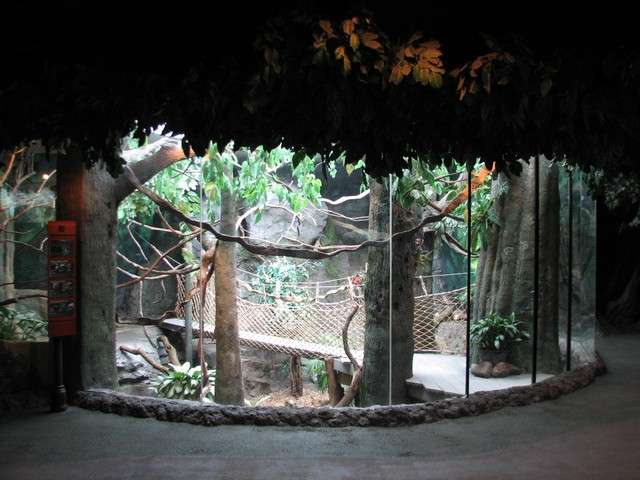
A low renovated 1960’s building adjacent to the entry complex is called Natural Encounters and is a highpoint in the zoo’s exhibit design. Most of the exhibits are inside, some with skylights, with a few outside. This complex excels in intimate mixed-species habitats for small animals with a variety of recreated habitats, and is an especially engaging experience for children without being too playground-like. Combined with the nice children’s zoo described later, this is one of Houston’s strengths. The first exhibit seen is a basic outdoor steel-and-wire enclosure filled with bushes; it is an outdoor yard for many of the species seen in the Rainforest Canopy exhibit inside. The sign in front states that weather permitting, there are cotton-top and golden lion tamarins, white-faced saki, acouchi, silver pheasant, and sailfin lizard; I also observed a Lady Ross’ turaco, and I suspect that the species mix in many of the exhibits is even more complex than the signs indicate! Inside, the first exhibit room called Entry Foyer has a rocky waterfall that spills into an open-top aquatic tank for snake-necked turtle and 6 species of freshwater fish: Boesmans rainbow fish, placostomus catfish, pictus catfish, redtail shark, sixbar distichodus, and tinfoil barb. Simulated trees create a leafy overhead canopy and lead to the next long room with many habitats. Rainforest Canopy is a skylit glassed-in exhibit room with a rocky backdrop and filled with simulated trees and vines, and an impressive mix. Species listed here include cotton-top and golden lion tamarins, white-faced saki, pygmy marmoset, owl monkey, Hoffmans two-toed sloth, Prevosts squirrel, acouchi, silver pheasant, pied imperial pigeon, and collared aracari. Next door is a darkened alcove called Bats, dominated by a bat exhibit behind glass for straw-colored fruit bat. There are also 3 wall terrariums here, one of which is imbedded in one of the trees: these are for black-headed python, Brazilian salmon pink tarantula, and some sort of cockroach I believe. Across the main room is Rivers Edge, a nice riverbank habitat with a stream and raised pool with underwater viewing for Asian small-clawed otter, Prevosts squirrel, Bengal slow loris (yay!), and blue-bellied roller. Adjacent is a set of aquatic tanks called Discovery River: first is a medium tank for pacu and red-tailed catfish, second is a medium tank for piranha with a fun crawl-through tunnel underneath, and last are three small open-top tanks on the edge of a small pier environment for freshwater ray, discus, tetra, electric eel, archerfish, and four-eyed fish. Dry Lands begins with a glassed room with a rolling desert setting for another impressive mix: rock hyrax, three-banded armadillo, antelope ground squirrel, springhaas (yay!), leopard tortoise, crowned hornbill, and vulturine guineafowl. This is a very active habitat with clear viewing. Next to it is a complex wall exhibit of multiple intertwining tunnel views for separate habitats for naked mole rat, damara mole rat, honey pot ant, and some sort of snake. Next to this is Presentation Porch, a small area for keeper contact, and next to that is Coral Reef, a nice 5,000 gallon tank with live corals and tropical fish. After exiting the building, around the corner is a nice naturalistic desert and termite mound exhibit for meerkat with multiple glass railing viewing areas. Not officially part of the complex is a mediocre indoor red panda exhibit behind glass in a building adjacent with a sheltered breezeway between the two.
Rainforest Canopy exhibit in Natural Encounters:
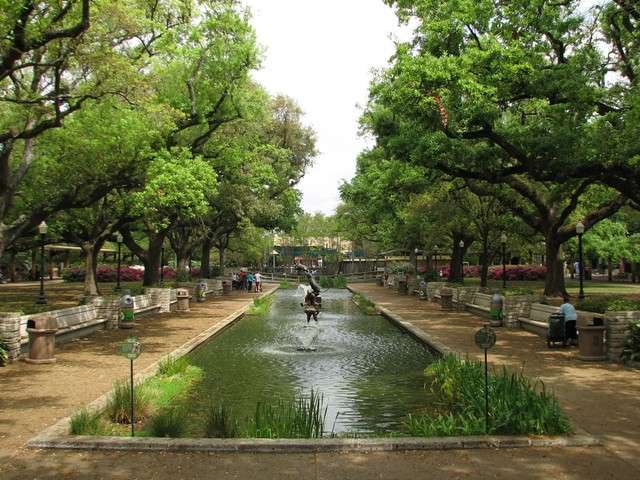
Reflection Pool is the formal landscape of the central entry area of the zoo and is composed of a long linear pool with statues, and a nice symmetrical setting of low stone walls and seats surrounded by a columned shade canopy on each side and shaded by mature trees. It is very 1950’s/60’s in style, as are the two low indoor exhibit buildings that flank it. On axis with the pool is an obsolete sea lion pool surrounded on three sides by viewing areas for demonstrations in what amounts to an unattractive pit.
Reflecting Pool:
One side of this formal area is the Reptile and Amphibian Building from 1960. Red brick on the outside, its interior is a very standard rectangular exhibit path in a darkened room. The feature exhibit is a small swamp habitat for a white American alligator, seen from both sides behind floor-to-ceiling glass. A large wall exhibit for pythons and some medium ones for various large lizards are the exception to the mostly small wall exhibits. What it lacks in glamour it makes up for in nice exhibit interiors and an even better collection, with about 70 exhibits in total. The only outdoor exhibit is a decent walled yard for Komodo dragon next to the building.
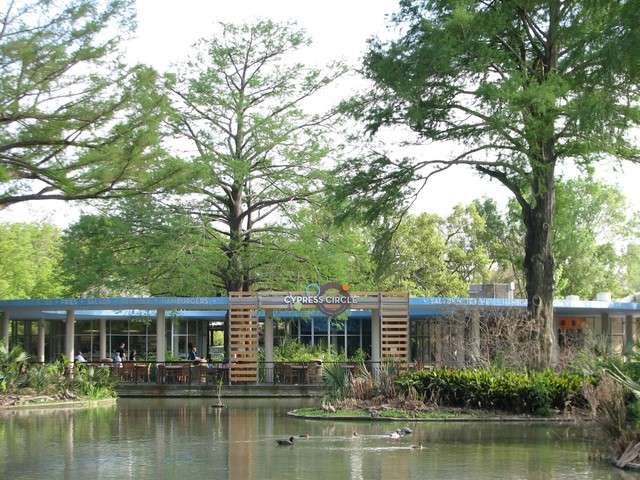
The other side of the formal area is the Tropical Bird House, with about 18 small and mostly mixed-species indoor exhibits behind glass. The rarely-exhibited golden-headed quetzal is relegated to one of these artificially-lit average enclosures. More impressive is the central walk-through aviary with a high skylit ceiling; visitors walk on a raised platform that spans between the rocky walls and a central temple-like shelter over a rocky pool and tropical forest. Highlights here include smew and helmeted curassow as well as a nice mix of others. Back outside, there are several adjacent bird exhibit areas including Fischer Bird Garden and Birds of the World, most of these housed in clusters of small wood-and-wire or steel-and-mesh enclosures, probably about 50 total. There are also average open yards for flamingo, red-crowned crane, saddle-billed stork, and 2 for cassowary. A larger aviary is currently being renovated for shoebill stork. The zoo does have a great bird collection, but its displays are mostly uninspired. Duck Lake is a highlight however, a large pond seen from many viewpoints and shaded by impressive bald cypress, filled with many species. One edge has a very 1950’s café called Cypress Circle which has been nicely restored recently and has lakeside seating.
Duck Lake and Cypress Circle:
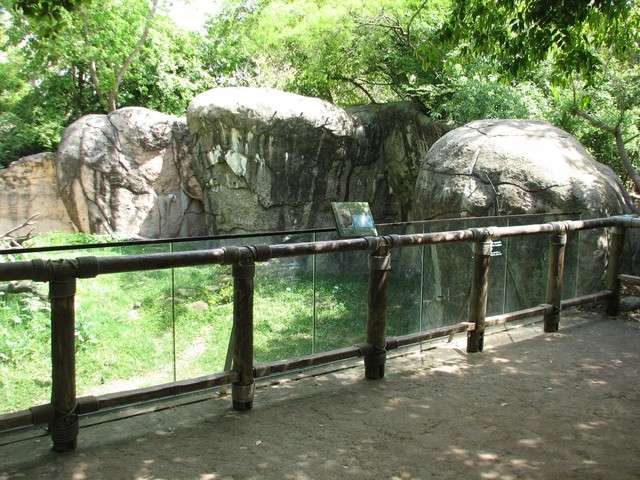
The most immersive large exhibit complex is World of Primates, an extensive loop trail of 13 exhibits through a forest with mostly good enclosures. It starts with an island for ring-tailed and red-fronted lemurs with hottentot teal and Madagascar big-headed turtle in the water moat. A medium steel cage for black howler is followed by small steel cages for pied tamarin, cotton-top tamarin, and golden lion tamarin, then a large steel cage for Coquerels sifika. Next is an open rocky-walled exhibit for Patas monkey; although not the most commonly exhibited species, they always seem to live in nice enclosures. The path rises onto a boardwalk for views of the next four larger netted enclosures: one for mandrill and Debrazzas monkey, one for red capped mangabey, one for Allens swamp monkey and Schmidts red-tailed monkey, and one for siamang and a 35 year old agile gibbon! Oddly, a bland fenced yard for babirusa is viewed, then the final exhibit is for orangutan and is an average partially-moated one with rocky walls and two viewing areas, one behind glass in a shelter. While the climbing structure is an unimaginative low timber heap, the apes may find added interest in the Malaysian giant and yellow headed temple turtles that share their moat.
Patas Monkey exhibit in World of Primates:
Carnivores is a concentration of variable exhibit styles and qualities. A large habitat with kopje outcrops and tunnels to a central window viewing area beneath the rocks is for African lion and is definitely the star. One of its viewing areas is in a long arched steel outdoor structure with glass viewing that also serves as a viewing area for the smaller but still nice rocky habitat for Malayan tiger. Both have large water moats separating other viewing areas from the cats. A long rocky wall with steel cage enclosures in the same style as the arched steel viewing structure features a set of 6 exhibits: one for leopard (unspecified), one for ocelot, two for fossa, and two for clouded leopard. On the backside of these are two more larger rocky habitats: one is a newly renovated jaguar enclosure, and one is for cougar (which has a unique but creepy twisting glass-fronted viewing window topped by steel mesh covered in vines that both contains the cats and shades the viewing area). A decent if old grotto for spectacled bear is nearby, next to one for grizzly bear that is too enclosed. Finally, what must be the ugliest fenced yard for African wild dog is nearby, surrounded by construction of the new African Forest and featuring a raised dirt mound covering two drainage-pipe concrete dens. Yuck!
African Lion exhibit and its tunnel viewing windows:
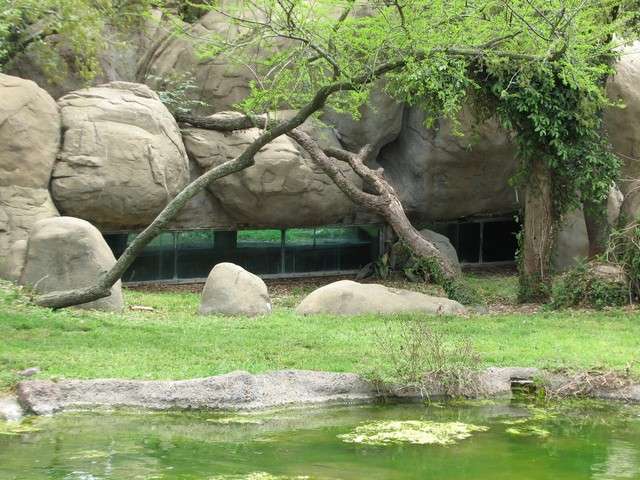
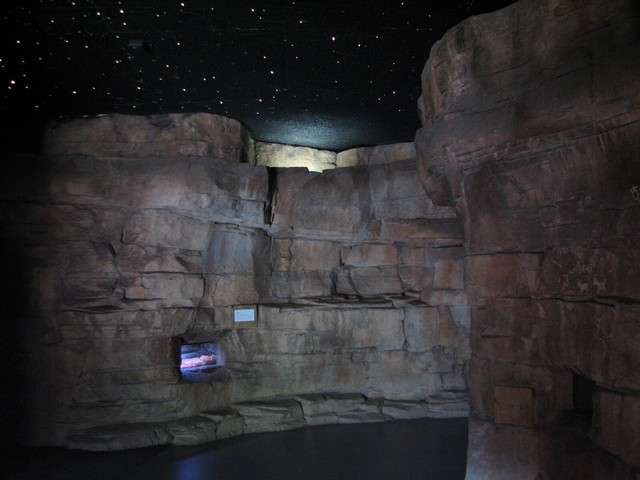
The Childrens Zoo is a nice and extensive environment with plenty of North American animal habitats. It has amenities like a carousel, small splash fountain, amphitheater, garden, playground, group pavilions, and a nice domestic contact barn and corral. Most of the animals are along an exhibit path that begins with a woodsy boardwalk around a fenced yard with a small rocky stream for white-tailed deer and Rio Grande turkey. Surrounding this are small wire enclosures for great horned owl, coati, North American porcupine, raccoon, a walk-through aviary, and a walk-through bald eagle habitat. Next is a river otter habitat viewed from three sides that features above and below water views and a unique window separating the otter waterfall from a small kids slide next to it. Then a brown pelican pond is viewed from two sides, one of which has partial underwater viewing from a boat structure portholes. The stern of this boat also has windows into an alligator snapping turtle pond. Finally, a nice rocky desert landscape is encountered, with several small outdoor yards: one is for swift fox viewed behind glass, one is empty and viewed behind wire, and one is a low railing open-top yard with three pop-up bubbles for viewing black-tailed prairie dog. Several entrances into the rocks lead to roomy cave passages with about 20 small reptile and invertebrate terrariums set in the walls, ending with a simulated starlit sky in one of the rooms and a dark habitat behind glass for Jamaican fruit bat, Pallas’ long-tongued bat, and Sebas short-tailed bat.
North American desert starlit cave in the Childrens Zoo:
The rest of the zoo is mostly a small collection of hoofstock on the perimeter of the property. Unfortunately these yards are mostly unattractive standard fenced rectangular spaces, slightly bare, many viewed from behind wire. Exhibits here include nyala, giant eland (yay!) mixed with Grants zebra and warthog, Brazilian tapir mixed with giant anteater, maned wolf, more Brazilian tapir (with a nice pond and better viewing area), bongo, okapi mixed with yellow backed duiker and Southern ground hornbill, and another exhibit of the same two antelope but with blue crane and some sort of tortoise instead. There is also an unattractive pair of Asian elephant yards and a barn, a big rectangular Masai giraffe yard, and finally a fenced yard for cheetah and Anatolian shepherd dog! There are two of each, and apparently all four are taken out for walks and talks in the zoo. They are companions, but apparently in Namibia farmers keep the dogs to scare away cheetahs from their livestock!
In my ranking of the 50 zoo facilities I have visited, Houston Zoo is number 36, so I feel it definitely needs African Forest to be a blockbuster to raise it up! None of its themed exhibit complexes or individual exhibits make my top lists, but Natural Encounters is close. Of the 40 aquarium facilities I have seen, the Kipp Aquarium is number 35; this is not because it is bad but rather because it is small and has big competition. At $11 for adult admission it is priced right, and its relatively long hours of 9 to 7 are appreciated! I have posted additional pictures in the gallery.
The entry complex is composed of several bland modern masonry buildings with round metal roofs and includes the gift shop, ticketing and turnstiles, Macaw Café, administration, and the first exhibit complex, the Kipp Aquarium. The aquarium is a dark interior room with a high ceiling inside one of the round buildings and has 23 tanks, most of which are small fish exhibits in a staggered arrangement, a good mix of salt and freshwater habitats. An Amazon Flooded Forest tank and a rounded center tank with a sea turtle are the two larger tanks. All feature easy viewing and it is an attractive but unimpressive complex.
A low renovated 1960’s building adjacent to the entry complex is called Natural Encounters and is a highpoint in the zoo’s exhibit design. Most of the exhibits are inside, some with skylights, with a few outside. This complex excels in intimate mixed-species habitats for small animals with a variety of recreated habitats, and is an especially engaging experience for children without being too playground-like. Combined with the nice children’s zoo described later, this is one of Houston’s strengths. The first exhibit seen is a basic outdoor steel-and-wire enclosure filled with bushes; it is an outdoor yard for many of the species seen in the Rainforest Canopy exhibit inside. The sign in front states that weather permitting, there are cotton-top and golden lion tamarins, white-faced saki, acouchi, silver pheasant, and sailfin lizard; I also observed a Lady Ross’ turaco, and I suspect that the species mix in many of the exhibits is even more complex than the signs indicate! Inside, the first exhibit room called Entry Foyer has a rocky waterfall that spills into an open-top aquatic tank for snake-necked turtle and 6 species of freshwater fish: Boesmans rainbow fish, placostomus catfish, pictus catfish, redtail shark, sixbar distichodus, and tinfoil barb. Simulated trees create a leafy overhead canopy and lead to the next long room with many habitats. Rainforest Canopy is a skylit glassed-in exhibit room with a rocky backdrop and filled with simulated trees and vines, and an impressive mix. Species listed here include cotton-top and golden lion tamarins, white-faced saki, pygmy marmoset, owl monkey, Hoffmans two-toed sloth, Prevosts squirrel, acouchi, silver pheasant, pied imperial pigeon, and collared aracari. Next door is a darkened alcove called Bats, dominated by a bat exhibit behind glass for straw-colored fruit bat. There are also 3 wall terrariums here, one of which is imbedded in one of the trees: these are for black-headed python, Brazilian salmon pink tarantula, and some sort of cockroach I believe. Across the main room is Rivers Edge, a nice riverbank habitat with a stream and raised pool with underwater viewing for Asian small-clawed otter, Prevosts squirrel, Bengal slow loris (yay!), and blue-bellied roller. Adjacent is a set of aquatic tanks called Discovery River: first is a medium tank for pacu and red-tailed catfish, second is a medium tank for piranha with a fun crawl-through tunnel underneath, and last are three small open-top tanks on the edge of a small pier environment for freshwater ray, discus, tetra, electric eel, archerfish, and four-eyed fish. Dry Lands begins with a glassed room with a rolling desert setting for another impressive mix: rock hyrax, three-banded armadillo, antelope ground squirrel, springhaas (yay!), leopard tortoise, crowned hornbill, and vulturine guineafowl. This is a very active habitat with clear viewing. Next to it is a complex wall exhibit of multiple intertwining tunnel views for separate habitats for naked mole rat, damara mole rat, honey pot ant, and some sort of snake. Next to this is Presentation Porch, a small area for keeper contact, and next to that is Coral Reef, a nice 5,000 gallon tank with live corals and tropical fish. After exiting the building, around the corner is a nice naturalistic desert and termite mound exhibit for meerkat with multiple glass railing viewing areas. Not officially part of the complex is a mediocre indoor red panda exhibit behind glass in a building adjacent with a sheltered breezeway between the two.
Rainforest Canopy exhibit in Natural Encounters:

Reflection Pool is the formal landscape of the central entry area of the zoo and is composed of a long linear pool with statues, and a nice symmetrical setting of low stone walls and seats surrounded by a columned shade canopy on each side and shaded by mature trees. It is very 1950’s/60’s in style, as are the two low indoor exhibit buildings that flank it. On axis with the pool is an obsolete sea lion pool surrounded on three sides by viewing areas for demonstrations in what amounts to an unattractive pit.
Reflecting Pool:

One side of this formal area is the Reptile and Amphibian Building from 1960. Red brick on the outside, its interior is a very standard rectangular exhibit path in a darkened room. The feature exhibit is a small swamp habitat for a white American alligator, seen from both sides behind floor-to-ceiling glass. A large wall exhibit for pythons and some medium ones for various large lizards are the exception to the mostly small wall exhibits. What it lacks in glamour it makes up for in nice exhibit interiors and an even better collection, with about 70 exhibits in total. The only outdoor exhibit is a decent walled yard for Komodo dragon next to the building.
The other side of the formal area is the Tropical Bird House, with about 18 small and mostly mixed-species indoor exhibits behind glass. The rarely-exhibited golden-headed quetzal is relegated to one of these artificially-lit average enclosures. More impressive is the central walk-through aviary with a high skylit ceiling; visitors walk on a raised platform that spans between the rocky walls and a central temple-like shelter over a rocky pool and tropical forest. Highlights here include smew and helmeted curassow as well as a nice mix of others. Back outside, there are several adjacent bird exhibit areas including Fischer Bird Garden and Birds of the World, most of these housed in clusters of small wood-and-wire or steel-and-mesh enclosures, probably about 50 total. There are also average open yards for flamingo, red-crowned crane, saddle-billed stork, and 2 for cassowary. A larger aviary is currently being renovated for shoebill stork. The zoo does have a great bird collection, but its displays are mostly uninspired. Duck Lake is a highlight however, a large pond seen from many viewpoints and shaded by impressive bald cypress, filled with many species. One edge has a very 1950’s café called Cypress Circle which has been nicely restored recently and has lakeside seating.
Duck Lake and Cypress Circle:

The most immersive large exhibit complex is World of Primates, an extensive loop trail of 13 exhibits through a forest with mostly good enclosures. It starts with an island for ring-tailed and red-fronted lemurs with hottentot teal and Madagascar big-headed turtle in the water moat. A medium steel cage for black howler is followed by small steel cages for pied tamarin, cotton-top tamarin, and golden lion tamarin, then a large steel cage for Coquerels sifika. Next is an open rocky-walled exhibit for Patas monkey; although not the most commonly exhibited species, they always seem to live in nice enclosures. The path rises onto a boardwalk for views of the next four larger netted enclosures: one for mandrill and Debrazzas monkey, one for red capped mangabey, one for Allens swamp monkey and Schmidts red-tailed monkey, and one for siamang and a 35 year old agile gibbon! Oddly, a bland fenced yard for babirusa is viewed, then the final exhibit is for orangutan and is an average partially-moated one with rocky walls and two viewing areas, one behind glass in a shelter. While the climbing structure is an unimaginative low timber heap, the apes may find added interest in the Malaysian giant and yellow headed temple turtles that share their moat.
Patas Monkey exhibit in World of Primates:

Carnivores is a concentration of variable exhibit styles and qualities. A large habitat with kopje outcrops and tunnels to a central window viewing area beneath the rocks is for African lion and is definitely the star. One of its viewing areas is in a long arched steel outdoor structure with glass viewing that also serves as a viewing area for the smaller but still nice rocky habitat for Malayan tiger. Both have large water moats separating other viewing areas from the cats. A long rocky wall with steel cage enclosures in the same style as the arched steel viewing structure features a set of 6 exhibits: one for leopard (unspecified), one for ocelot, two for fossa, and two for clouded leopard. On the backside of these are two more larger rocky habitats: one is a newly renovated jaguar enclosure, and one is for cougar (which has a unique but creepy twisting glass-fronted viewing window topped by steel mesh covered in vines that both contains the cats and shades the viewing area). A decent if old grotto for spectacled bear is nearby, next to one for grizzly bear that is too enclosed. Finally, what must be the ugliest fenced yard for African wild dog is nearby, surrounded by construction of the new African Forest and featuring a raised dirt mound covering two drainage-pipe concrete dens. Yuck!
African Lion exhibit and its tunnel viewing windows:

The Childrens Zoo is a nice and extensive environment with plenty of North American animal habitats. It has amenities like a carousel, small splash fountain, amphitheater, garden, playground, group pavilions, and a nice domestic contact barn and corral. Most of the animals are along an exhibit path that begins with a woodsy boardwalk around a fenced yard with a small rocky stream for white-tailed deer and Rio Grande turkey. Surrounding this are small wire enclosures for great horned owl, coati, North American porcupine, raccoon, a walk-through aviary, and a walk-through bald eagle habitat. Next is a river otter habitat viewed from three sides that features above and below water views and a unique window separating the otter waterfall from a small kids slide next to it. Then a brown pelican pond is viewed from two sides, one of which has partial underwater viewing from a boat structure portholes. The stern of this boat also has windows into an alligator snapping turtle pond. Finally, a nice rocky desert landscape is encountered, with several small outdoor yards: one is for swift fox viewed behind glass, one is empty and viewed behind wire, and one is a low railing open-top yard with three pop-up bubbles for viewing black-tailed prairie dog. Several entrances into the rocks lead to roomy cave passages with about 20 small reptile and invertebrate terrariums set in the walls, ending with a simulated starlit sky in one of the rooms and a dark habitat behind glass for Jamaican fruit bat, Pallas’ long-tongued bat, and Sebas short-tailed bat.
North American desert starlit cave in the Childrens Zoo:

The rest of the zoo is mostly a small collection of hoofstock on the perimeter of the property. Unfortunately these yards are mostly unattractive standard fenced rectangular spaces, slightly bare, many viewed from behind wire. Exhibits here include nyala, giant eland (yay!) mixed with Grants zebra and warthog, Brazilian tapir mixed with giant anteater, maned wolf, more Brazilian tapir (with a nice pond and better viewing area), bongo, okapi mixed with yellow backed duiker and Southern ground hornbill, and another exhibit of the same two antelope but with blue crane and some sort of tortoise instead. There is also an unattractive pair of Asian elephant yards and a barn, a big rectangular Masai giraffe yard, and finally a fenced yard for cheetah and Anatolian shepherd dog! There are two of each, and apparently all four are taken out for walks and talks in the zoo. They are companions, but apparently in Namibia farmers keep the dogs to scare away cheetahs from their livestock!
In my ranking of the 50 zoo facilities I have visited, Houston Zoo is number 36, so I feel it definitely needs African Forest to be a blockbuster to raise it up! None of its themed exhibit complexes or individual exhibits make my top lists, but Natural Encounters is close. Of the 40 aquarium facilities I have seen, the Kipp Aquarium is number 35; this is not because it is bad but rather because it is small and has big competition. At $11 for adult admission it is priced right, and its relatively long hours of 9 to 7 are appreciated! I have posted additional pictures in the gallery.


 Also, you mention that you've now toured 40 different aquarium facilities, but I think that you are including aquariums found inside zoos. Is that true? Keep the reviews coming......
