jbnbsn99's Exhibit Design Thread

Thank you very much. It took 15 months of design an research into South America, collection plans, exhibit design, etc.

Please, jbnbsn99, I hope you don't mind me asking: what sites or documents, etc., did you use for research on your South America exhibit? I imagine that you have to know where to look, because for the longest, I've been wanting to start re-designing all of my original exhibit ideas to make them more realistic (as they've been straight off the top of my head with almost no knowledge of the regions or animals in them). However, the most popular websites found on the Google search bar are of no help whatsoever, with the same basic information being filtered through Wikipedia, National Geographic, and similar sites. I've also wanted to get more involved with conservation, the habitats/areas and animal/plant species being conserved, conservation current events, all of the issues and threats endangered and endemic species face today, etc., to be able to present a clear message that my zoo would go by, even though it is just imaginary at the moment. My lack of knowledge when designing my humble exhibits prevents me from ever feeling satisfied with them. They never feel complete, even after countless adjustments. If you have any helpful sites that I could start off with, I would really appreciate it. Thank you.
 
Since I responded to your PM first, I'll also post my response on here.

Big question, lots of answers. I will give you the process of how I did it.
1. Start with a theme
2. Start Basic - get the big ideas/concepts first
3. Start whittling
4. Read every source on the subject you can get your hands on
5. Figure out exact husbandry needs for the species
6. Detail, detail, detail
7. Figure out the humans needs

For that exhibit I did, I still have the original sketches in a notebook, and you can see the basic shape of the exhibit, but nothing of the detail. Take time and patience and read, read, read.
 
jbnbsn99, VtSA, is incredible! Well done. If you had the deep pockets and space, I would thoroughly enjoy a visit. Great concept, well planned, if executed as written and shown, would be a must see. Definitely put designers on their butts. Cheers.

p.s. I love how you plan to have Dracaena guianensis on exhibit. I thoroughly enjoy working with these marvelous creatures daily.
 
Since a lot of you have asked me about exhibit design after my Voyage to South America, I thought I would continue on here. My latest exhibit has been brewing since October, but is nowhere near as complex as the South American exhibit. I'll continue to post new exhibits as I design them.
 
Atlas - The Lost Africa

Atlas – The Lost Africa​

North of the Sahara lies a mysterious region of the dark continent, the Atlas Mountains. Known in ancient time to both the Greeks and Romans, the Atlas Mountains were for millennia the gateway to Africa.

Site parameters. A roughly 6.5 acre site.

Zoo needs. The zoo already has an African area with the standard/expected African species. Exhibit will highlight the unique and endangered fauna of the Atlas region. Exhibit must have several keystone species. Exhibit must have some cultural education (Greek, Roman, North African).

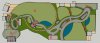
1. Entrance – The entrance to the entire exhibit complex will be through a recreated Greek Temple. The interior of the temple will tell the story of the Greek god Atlas who was condemned to carry the weight of the world on his shoulders. Story will be told in “aged” frescos and bas reliefs. Temple entrance building will also serve as off exhibit holding and propagation for the adjacent aviary. Size 3,900 sq. ft.

2. Walk-through Aviary – The first exhibit for the complex is a large walk-through aviary. The primary species here is a breeding group of Northern Bald Ibis. This species is one of the most endangered species of birds on the planet and there is a concerted effort among zoos to propagate the species. Various other species will share the space including Greater Flamingo, Eurasian Spoonbill, White Stork, African Collared Dove, and various water fowl. Size ~11,500 sq.ft.

3. Bird of Prey Aviaries – These are two multi-purpose aviaries for birds of prey. Any number of native species can be held in these enclosures. Collection will be determined by the curator and collection needs. Size – 1. ~1,950 sq.ft. 2. ~1,250 sq.ft.

4. Greek temple column ruins and restroom – Landscaping and visitor facilities. Themed as an extension of the entrance building. Restroom size - ~1,300 sq.ft.

5. Camel rides – Most camel rides in a zoo are short, boring rides. This camel ride is designed differently. The ride will take the visitor around the large hoofstock paddock and give the visitor views that cannot be seen any other way. A loading area for the rides will be located adjacent to the bird of prey aviaries. A small ticket booth and queue line are offset from the main visitor pathway. Also adjacent will be a barn for the camels and holding yards.
Size – Camel barn ~1,100 sq.ft. Camel holding yard ~1,300 sq.ft. Pathway and loading ~10,000 (total camel ride ~12,400 sq.ft.)

6. Hoofstock exhibit – This is the largest exhibit in the complex. It is built on a large sloping hill with large rock formations scattered throughout. Exhibit will house four species – Barbary Deer, Cuvier’s Gazelle, Aoudad, and Mesopotamian Fallow Deer. One of these species is extinct on the continent (Mesopotamian Fallow Deer), while the others are endangered or vulnerable. Breeding programs for all will be available and encouraged. The Barbary Deer (recently elevated to being a full species) is currently Africa’s only deer, and Aoudad is Africa’s only sheep, so these species are highly indicative of the regions uniqueness.
Size. Exhibit ~63,000 sq.ft. Barn ~2,600 sq.ft. Holding yards ~5,300 sq.ft.

7. Small carnivore exhibits – These are two exhibits built into artificial rockwork. The species list is flexible, but could include Ratel, Common Genet, Fenec Fox, etc. Holding for both exhibits is from a central housing hidden beneath the rockwork. Exhibits can be rotational.
Size. Exhibit 1 ~1,900 sq.ft. Exhibit 2 ~1,300 sq.ft. Barn ~1,000 sq.ft. Off exhibit holding ~200 sq.ft.

8. Café – A small café with indoor seating will provide visitors with both food and a place to rest. Styled after North African traditional architecture.

9. Roman Ruins – More so than the Greeks, the Romans had a large influence on this region. Various ruins are scattered throughout this area that will allow kids to climb and explore. In these ruins, tile mosaics will show replica artwork of real Roman scenes and show some of the animals of the region. Highlights will be the Romans use of animals from this region for the gladiator events in the coliseums.

10. Barbary Macaque/Wild Boar exhibits – These are two side by side exhibits serviced by a central barn. Both are built lower than pathway grade. Also, both can house large groups of animals for future breeding.
Size. Macaque exhibit ~12,600 sq.ft. Boar exhibit ~8,100 sq.ft. Barn ~1,400 sq.ft. Holding yards ~2,800 sq.ft.

11. Leopard Exhibit – This exhibit is placed adjacent to the Wild Boar exhibit to form a predator/prey type exhibit. Leopards will be raised above the grade of the boars. The Barbary Leopard is probably extinct, and this exhibit should stress that point. A substitute animal of the Amur Leopard is preferable with a message of how this is the same species, but from a different region of the world, and the work zoos are doing to help save this subspecies.
Size. Exhibit ~9,000 sq.ft. Barn ~1,600 sq.ft. Off exhibit holding ~700 sq.ft.

12. Brown Bear/Striped Hyena rotational complex – The final exhibit in the Atlas Mountains complex is a rotational exhibit for Brown Bear and Striped Hyena. The hyena is still extant in the region, but the bear has been expatriated from the continent. A surrogate subspecies of Brown Bear will need to be used (European, Syrian, or North American). The Syrian is preferable, but the North American will be easier to source. Central holding between the exhibits will house both species.
Size. Exhibit 1 ~14,500 sq.ft. Exhibit 2 ~33,800 sq.ft. Barn ~2,000 sq.ft. Holding Yards ~3,000 sq.ft.

Landscape – Approximately 58,000 sq.ft. of the exhibit is dedicated to landscaping. Various rock formations will be placed throughout the exhibit to give it a more mountainous feel.

Conservation. Conservation will be one of the major highlights of the complex. Many of the species shown are endangered, and some critically so. Two of the animals are extinct, and surrogates have been selected to replace them. Other extinct animals will be shown through the tile mosaics in the Roman ruins (Bubal Hartebeest, Barbary Lion, North African Elephant, etc.). The visitor will see an environment drastically reduced by human exploitation.
 

Attachments

  • Atlas Map.jpg
    Atlas Map.jpg
    198.6 KB · Views: 107
Last edited:
I've known this exhibit was coming up for a while since I PM'd you jbnsn, and once again, while it's not on the scale of VTSA, there is a great complex focusing on an under-represented region! Thanks very much for sharing!
 
Nice. I do wish that some of the aviaries and other flexible exhibits had species lists though. I understand the thinking for why they don't but it's always nice. If it was going to be built obviously some of the species would have to change depending on what's available. I guess I'd have to make my own lists :P
 
Nice. I do wish that some of the aviaries and other flexible exhibits had species lists though. I understand the thinking for why they don't but it's always nice. If it was going to be built obviously some of the species would have to change depending on what's available. I guess I'd have to make my own lists :P

After seeing how real collections work, I learned very quickly that species lists for a new exhibit are next to meaningless except for specialty species (namely things like giraffes and elephants).
 
I think it's time for a new exhibit, don't you? I've got a few ideas floating in my head, but I'll let the masses decide. Run some ideas past me.
 
I think it's time for a new exhibit, don't you? I've got a few ideas floating in my head, but I'll let the masses decide. Run some ideas past me.

I know it has been done many times but take a crack at a Madagascar exhibit! You could do a nocturnal part and such. If not you could always try and revolutionize Congo exhibits.

~Thylo:cool:
 
I think it's time for a new exhibit, don't you? I've got a few ideas floating in my head, but I'll let the masses decide. Run some ideas past me.

I'm not sure how large of an exhibit you want to make, but I would personally love to see a European exhibit designed the same way you did for South America.
 
Some ideas I've been bouncing around in my head for a while:
Sulawesi exhibit
Horn of Africa exhibit
Sumatran exhibit
Pakistan exhibit
 
Europe would be interesting. No one has ever really done one. Would have to be a larger exhibit... Hmm...
 
Some ideas I've been bouncing around in my head for a while:
Sulawesi exhibit
Horn of Africa exhibit
Sumatran exhibit
Pakistan exhibit

All interesting ideas. Pakistan might be harder. Are there enough animals in captivity to do a Sulawesi exhibit justice?
 
Sulawesi, if you restrict it to ones in captivity, I doubt there are enough. I'd be really interested in a full Indonesian exhibit similar to the South American one though. I guess some areas would have more species represented than others, but it was the same with South America too for areas that didn't have as many animals available. Or really any large-scale Asian exhibit, I mean how many zoos around here focus on those? There have been quite a few created in other topics on here but none for the entire continent or as detailed as your S American one for example.
 
Sulawesi, if you restrict it to ones in captivity, I doubt there are enough. I'd be really interested in a full Indonesian exhibit similar to the South American one though. I guess some areas would have more species represented than others, but it was the same with South America too for areas that didn't have as many animals available. Or really any large-scale Asian exhibit, I mean how many zoos around here focus on those? There have been quite a few created in other topics on here but none for the entire continent or as detailed as your S American one for example.

I would also be interested in a large Asian exhibit representing every Asian habitat. This exhibit would be very hard to do though and would take a very long time. That's why I suggested Europe.
 
Definitely, this isn't something you can put together easily in a few days and post. Asia is a huge place with lots and lots of possible animal and exhibit options.
There might be a way to do it in phases though, maybe do Europe first but connect it to part of Asia somehow, and then continue the rest of that later on?
Realistically though he might just be planning a specific exhibit for one country or habitat and then all of this would have to wait until another time anyway.
 
Back
Top