Atlas - The Lost Africa
Atlas – The Lost Africa
North of the Sahara lies a mysterious region of the dark continent, the Atlas Mountains. Known in ancient time to both the Greeks and Romans, the Atlas Mountains were for millennia the gateway to Africa.
Site parameters. A roughly 6.5 acre site.
Zoo needs. The zoo already has an African area with the standard/expected African species. Exhibit will highlight the unique and endangered fauna of the Atlas region. Exhibit must have several keystone species. Exhibit must have some cultural education (Greek, Roman, North African).
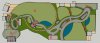
1. Entrance – The entrance to the entire exhibit complex will be through a recreated Greek Temple. The interior of the temple will tell the story of the Greek god Atlas who was condemned to carry the weight of the world on his shoulders. Story will be told in “aged” frescos and bas reliefs. Temple entrance building will also serve as off exhibit holding and propagation for the adjacent aviary. Size 3,900 sq. ft.
2. Walk-through Aviary – The first exhibit for the complex is a large walk-through aviary. The primary species here is a breeding group of Northern Bald Ibis. This species is one of the most endangered species of birds on the planet and there is a concerted effort among zoos to propagate the species. Various other species will share the space including Greater Flamingo, Eurasian Spoonbill, White Stork, African Collared Dove, and various water fowl. Size ~11,500 sq.ft.
3. Bird of Prey Aviaries – These are two multi-purpose aviaries for birds of prey. Any number of native species can be held in these enclosures. Collection will be determined by the curator and collection needs. Size – 1. ~1,950 sq.ft. 2. ~1,250 sq.ft.
4. Greek temple column ruins and restroom – Landscaping and visitor facilities. Themed as an extension of the entrance building. Restroom size - ~1,300 sq.ft.
5. Camel rides – Most camel rides in a zoo are short, boring rides. This camel ride is designed differently. The ride will take the visitor around the large hoofstock paddock and give the visitor views that cannot be seen any other way. A loading area for the rides will be located adjacent to the bird of prey aviaries. A small ticket booth and queue line are offset from the main visitor pathway. Also adjacent will be a barn for the camels and holding yards.
Size – Camel barn ~1,100 sq.ft. Camel holding yard ~1,300 sq.ft. Pathway and loading ~10,000 (total camel ride ~12,400 sq.ft.)
6. Hoofstock exhibit – This is the largest exhibit in the complex. It is built on a large sloping hill with large rock formations scattered throughout. Exhibit will house four species – Barbary Deer, Cuvier’s Gazelle, Aoudad, and Mesopotamian Fallow Deer. One of these species is extinct on the continent (Mesopotamian Fallow Deer), while the others are endangered or vulnerable. Breeding programs for all will be available and encouraged. The Barbary Deer (recently elevated to being a full species) is currently Africa’s only deer, and Aoudad is Africa’s only sheep, so these species are highly indicative of the regions uniqueness.
Size. Exhibit ~63,000 sq.ft. Barn ~2,600 sq.ft. Holding yards ~5,300 sq.ft.
7. Small carnivore exhibits – These are two exhibits built into artificial rockwork. The species list is flexible, but could include Ratel, Common Genet, Fenec Fox, etc. Holding for both exhibits is from a central housing hidden beneath the rockwork. Exhibits can be rotational.
Size. Exhibit 1 ~1,900 sq.ft. Exhibit 2 ~1,300 sq.ft. Barn ~1,000 sq.ft. Off exhibit holding ~200 sq.ft.
8. Café – A small café with indoor seating will provide visitors with both food and a place to rest. Styled after North African traditional architecture.
9. Roman Ruins – More so than the Greeks, the Romans had a large influence on this region. Various ruins are scattered throughout this area that will allow kids to climb and explore. In these ruins, tile mosaics will show replica artwork of real Roman scenes and show some of the animals of the region. Highlights will be the Romans use of animals from this region for the gladiator events in the coliseums.
10. Barbary Macaque/Wild Boar exhibits – These are two side by side exhibits serviced by a central barn. Both are built lower than pathway grade. Also, both can house large groups of animals for future breeding.
Size. Macaque exhibit ~12,600 sq.ft. Boar exhibit ~8,100 sq.ft. Barn ~1,400 sq.ft. Holding yards ~2,800 sq.ft.
11. Leopard Exhibit – This exhibit is placed adjacent to the Wild Boar exhibit to form a predator/prey type exhibit. Leopards will be raised above the grade of the boars. The Barbary Leopard is probably extinct, and this exhibit should stress that point. A substitute animal of the Amur Leopard is preferable with a message of how this is the same species, but from a different region of the world, and the work zoos are doing to help save this subspecies.
Size. Exhibit ~9,000 sq.ft. Barn ~1,600 sq.ft. Off exhibit holding ~700 sq.ft.
12. Brown Bear/Striped Hyena rotational complex – The final exhibit in the Atlas Mountains complex is a rotational exhibit for Brown Bear and Striped Hyena. The hyena is still extant in the region, but the bear has been expatriated from the continent. A surrogate subspecies of Brown Bear will need to be used (European, Syrian, or North American). The Syrian is preferable, but the North American will be easier to source. Central holding between the exhibits will house both species.
Size. Exhibit 1 ~14,500 sq.ft. Exhibit 2 ~33,800 sq.ft. Barn ~2,000 sq.ft. Holding Yards ~3,000 sq.ft.
Landscape – Approximately 58,000 sq.ft. of the exhibit is dedicated to landscaping. Various rock formations will be placed throughout the exhibit to give it a more mountainous feel.
Conservation. Conservation will be one of the major highlights of the complex. Many of the species shown are endangered, and some critically so. Two of the animals are extinct, and surrogates have been selected to replace them. Other extinct animals will be shown through the tile mosaics in the Roman ruins (Bubal Hartebeest, Barbary Lion, North African Elephant, etc.). The visitor will see an environment drastically reduced by human exploitation.