
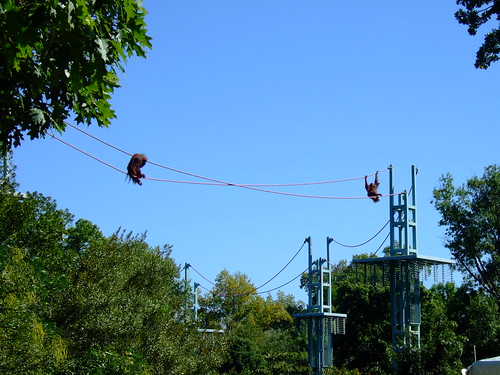
What an incredible exhibit. Do they worry about the orangutans slipping if it rains?

What an incredible exhibit. Do they worry about the orangutans slipping if it rains?


There's explanation at the site. Those animals never lose grip at will, and the cables are surely non-slippery
Also it's cool that orangs can pee and poop on the visitors from high above!

Farm animals are quite 'dumb' comparing to their wild ancestors/relatives, that's the result of selection.
Most of the vets will disapprove the poop/urine exchange, and the testing of these substances for diseases can be quite long...
In some enrichment manual, I read that elephant dung can be used to stimulate territorial behavior in rhinos.
In the same zoo, inter-species olfactory communication can be possible.
But likely no intra-species one between several zoos.
I wonder if any zoo tried to train apes not to destroy vegetation in their exhibit?
elefante said:This summer I was at a wildlife sanctuary in Costa Rica and they had a huge rope that the visitors could pull on so they could "play" with the jaguar.

Am I correct in thinking that many years ago Frankfurt made the floor of their indoor orang cage(s) from stainless steel bars? Has any other zoo tried something similar?
When introduced to their new exhibit, the gorillas thrashed the vegetation to the point of no return. They finally left it alone, and it grew back. Now they're not so rough with it.
QUOTE]
That's interesting as it is probably the only exhibit in the world that was built and then left for a year to allow the vegetation to establish before the gorillas moved in. Theses days it seems to be lucky if the concrete as dried
When introduced to their new exhibit, the gorillas thrashed the vegetation to the point of no return. They finally left it alone, and it grew back. Now they're not so rough with it.
QUOTE]
That's interesting as it is probably the only exhibit in the world that was built and then left for a year to allow the vegetation to establish before the gorillas moved in. Theses days it seems to be lucky if the concrete as dried
I was going to say exactly the same. Their Gorilla enclosure(s) were old converted Bear pits, planted up and then, -unusual this- left for a year to establish. I wonder if the Gorillas really trashed them that much? Undoubtedly the novelty factor would have played a role and they would have certainly uprooted stuff to start with, before getting used to the whole new situation. Photos I saw of the exhibit not long after it opened, it still looked heavily vegetated to me.
There comes a stage in Gorilla exhibits where if it is large enough and sufficient was planted originally, then the plant growth becomes established to the stage where the Gorillas cease to damage it much as there is more than enough for them.
Do Gorillas eat there feaces because of the high quality diet they have? Is it really so bad to lock gorillas out of there indoor areas weather permitting and to provided other primates in there enclosure to compete for browse??
My personal opinion on Coprophagy (faeces-eating) in Gorillas is that these primates are programmed to spend many of the daylight hours foraging and eating. So the eating of faeces may help to fill this need for bulk food where it is unavailable at certain times of day and the animals feel the need to eat something. I think it is extremely widespread, even in the very best-managed groups where both nutritious and bulk food is made available at very frequent intervals, and even sometimes when there is other vegetable matter always available. Many zoo Gorillas have the tell-tale brown-stained lips which is evidence of this as a longstanding habit. Though there is debate about whether it occurs in the wild too.
I think Gorillas certainly suffer stress when denied cover above them, and being locked outside aggravates that. I've seen too many Gorillas either sitting for long periods waiting by closed doors, or banging on them to get in, or sitting under or against any available cover, even an enclosure wall or tiny cave, to doubt otherwise.
I think Monkeys sharing with Gorillas can usually be fine- I don't think there is real food competition, and they can provide other stimulation and enrichment for the Gorillas- particularly the younger ones, by their presence. There have been occassional deaths caused by the Gorillas though.

There comes a stage in Gorilla exhibits where if it is large enough and sufficient was planted originally, then the plant growth becomes established to the stage where the Gorillas cease to damage it much as there is more than enough for them.
This is not, of course, strictly true nor always the case but yes, it does often occur.
And even once the exhibit and its occupants have settled, the introduction of a new individual to the group can start a cycle of landscape destruction that can eliminate many years of growth.

I think Gorillas certainly suffer stress when denied cover above them, and being locked outside aggravates that. I've seen too many Gorillas either sitting for long periods waiting by closed doors, or banging on them to get in, or sitting under or against any available cover, even an enclosure wall or tiny cave, to doubt otherwise.
zooman said:That's interesting as it is probably the only exhibit in the world that was built and then left for a year to allow the vegetation to establish before the gorillas moved in. Theses days it seems to be lucky if the concrete as dried.
Pertinax said:I wonder if the Gorillas really trashed them that much? Undoubtedly the novelty factor would have played a role and they would have certainly uprooted stuff to start with, before getting used to the whole new situation.
elefante said:This summer I was at a wildlife sanctuary in Costa Rica and they had a huge rope that the visitors could pull on so they could "play" with the jaguar.
Do Gorillas eat there feaces because of the high quality diet they have? Is it really so bad to lock gorillas out of there indoor areas weather permitting and to provided other primates in there enclosure to compete for browse??
My personal opinion on Coprophagy (faeces-eating) in Gorillas is that these primates are programmed to spend many of the daylight hours foraging and eating. So the eating of faeces may help to fill this need for bulk food where it is unavailable at certain times of day and the animals feel the need to eat something. I think it is extremely widespread, even in the very best-managed groups where both nutritious and bulk food is made available at very frequent intervals, and even sometimes when there is other vegetable matter always available. Many zoo Gorillas have the tell-tale brown-stained lips which is evidence of this as a longstanding habit. Though there is debate about whether it occurs in the wild too
..
In the old gorilla house at artis Zoo amsterdam which at the time had no outside space as I remember the gorillas used to vomit and then suck it back up, even sucking up each others, I often wonderd why they did this any ideas anyone?
In the old gorilla house at artis Zoo amsterdam which at the time had no outside space as I remember the gorillas used to vomit and then suck it back up, even sucking up each others, I often wonderd why they did this any ideas anyone?
Interesting. I hadn't heard of this before. Is there any indication of how much cover they need/prefer/whatever? Here in San Francisco, for example, cover is sparse to non-existent. Sure, they have 24hr access to their night house, but in the actual exhibit cover is a lone tree and two fake rock-like...um, arches. With large crowds, the troop essentially "circles the wagons" and face outward nearly the entire time.
90% of the vantage points provided look down into the enclosure.
That is interesting. I would have thought that allowing the enclosure to take shape would be part & parcel of moving the new inhabitants in. Here, we seem to have a problem with putting babies on exhibit in record time. Surprisingly enough, the new gorilla is still off-exhibit. In fact, I think the entire troop is currently off exhibit.
I can only report what the docent/keeper/whatever told me. Perhaps they were moved in, trashed it, then moved out to allow it to set?
I would pay an additional fee for this. As something of an athlete, I would be interested in actually feeling a jaguar's strength. Would it give the average zoogoer a further appreciation for a specific animal's strength? Would having a tug-of-war contest with an elephant be considered animal cruelty?
Is there any indication of how much cover they need/prefer/whatever? Here in San Francisco, for example, cover is sparse to non-existent. Sure, they have 24hr access to their night house, but in the actual exhibit cover is a lone tree and two fake rock-like...um, arches. With large crowds, the troop essentially "circles the wagons" and face outward nearly the entire time.
I've seen photos in the past of SF's gorilla exhibit- is it a rocky grotto-type display- possibly also a converted Bear pit? In an enclosure with so little overhead or vegetative cover, I'd expect them to spend an awful lot of time inside, if indeed they really are allowed 24 hour a day access. In some open Gorilla displays, the Gorillas are still shut outside for periods in fine weather in the daytime because they wouldn't use the outdoor area much otherwise, this is particularly true of adult males it seems.
I wonder how much time the SF gorillas use the outside area (by choice that is)?