Zoos with both African and Asian elephants

Norwegian moose

Well-Known Member
Which zoos keep both African and Asian elephants? Most large zoos keep at least one of the species, although the Asian elephants are kept more frequently than the African ones. But few zoos keep both species. I knew it was more common to keep both species before, but today I know about Berlin Tierpark that keep both the elephant species in separate exhibits, but which others? An additional question: I know one zoo San Diego keep Asian and African elephants together in the same exhibit, are there any others?
 
Zoos with both.....

With increased emphasis on breeding elephants, few zoos will take the risk of holding both species; if I'm not mistaken, African Elephants can live with a herpesvirus that is lethal to juvenile Asian Elephants.
 
Up until last year (maybe 2) the Pereira Zoo in Colombia held both species
 
I'm sure Miami keep both species in large enclosures, they did until recently anyway.

I can't think of any places in the UK that do, many collections did in the recent past and I think the two most recent were Paignton (single individuals in one enclosure) and possibly London?
 
Western Plains Zoo in Australia has both. And back in the 70's Taronga Zoo had both as well.

:p

Hix
 
Woodland park zoo in Seattle, Washington holds a female African with its Asian herd, but that is on cusp of changing, as they're looking to form a solely Asian composition

San Diego houses (0.3) African with (1.3) Asian

Topeka houses (0.1) African with (0.1) Asian

Louisville houses (0.1) African with (0.1) Asian

And Miami Metro manages (0.2) African and (1.1) Asian in separate enclosures
 
Africam Safari Puebla, an AZA accredited zoo in Mexico, has herds of both African and Asian elephants. Each species is kept separately.
 
In China, Beijing Zoo has both Asian elephants and African elephants, both had bred recently. Guangzhou Zoo and Jinan Zoo also have both species.
 
As noted in my report about my trip to Zoo Magdeburg, this collection currently holds both species in a single enclosure. I will quote the relevant part of the report here:

Outside the house there were two mid-size paddocks, neither of which was occupied at the time and both of which seemed to be in rather poor condition. The paddock on the left of the house was in rather more disrepair; we knew this to be the old enclosure for a geriatric Black Rhinoceros which passed away some months ago, and which remains unoccupied due to the fact that this area of Zoo Magdeburg is destined for substantial alteration in the second phase of the Africambo project.

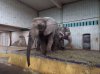
The interior of the house was the first truly bad point we had encountered at Magdeburg thus far; the house was relatively small, yet the vast majority of the floorspace was given over to the public. The two interior enclosures - each roughly 8 metres square - were bare concrete platforms separated from the public only by a shallow dry moat and a small barrier. Despite the fact the rhinoceros enclosure was unoccupied for the reason already stated, the opportunity had not been taken to move one of the elephants into this enclosure - something which would have at least slightly improved the feel and appearance of the interior. As it was, both individuals held in the house - an elderly South African Elephant (Loxodonta africana africana) and equally elderly Asian Elephant (Elephas maximus) - were confined to a single small enclosure, with access only to their sleeping quarters and not the external paddock. The overall feel in the house was one of dusty neglect, as if this corner of the zoo had been forgotten - as there are substantial redevelopments planned for this area in the future, there appears to be neither the desire nor money to improve what is, after all, a house on borrowed time.

However, despite my lack of particular enjoyment of this area of the zoo, my enjoyment of the collection as a whole was not unduly impacted by this inferior portion of the whole - as I had already seen just what had been achieved with the new rhinoceros house, the giraffe house and the surrounding developments which had been part of the first stage of Africambo, I am entirely certain that when the time comes for a new Elephant House it will be a good one.
 

Attachments

  • DSCF0435.jpg
    DSCF0435.jpg
    1.6 MB · Views: 33
Until the mid 2000s, the Los Angeles Zoo used to keep both African bush elephants (Loxodonta africana) and Asian elephants (Elaphus maximus) in the same enclosure

Before Trails of Tanzania was built, Reid Park Zoo in Tucson also used to keep both Asian elephants (Elaphus maximus) and African bush elephants (Loxodonta africana) in the same enclosure
 
One or both Asspinal collections have or had ( ? ) breeding groups of both species but kept them seperated.
 
141927172104.jpg

Beijing Zoo used to (around 2009) keep a male Asian calf Migara with a female African elephant Jing Jing who was 7 years older than him. Interestingly Jing Jing looked after Migara just as her son and Jing Jing was also a good mother when she had her own son.
 
Tierpark Berlin has breeding herds of both species, also Erlebnis Zoo Hanover kept both species in the 70;s and 80's. And Chester Zoo ofcourse
 
Back
Top