Smithsonian National Zoo Smithsonian National Zoo News 2015

Sorry, but there are a few inaccuracies:

*Dickerson Park and Tulsa have breeding Asian females. Tulsa has a young female from Ringling on temporary loan. I was under the impression that Dickerson Park stopped breeding because of EEHV.
*Spike was born at Miami. Busch Gardens has never been severely impacted by a hurricane.
*The Asian Elephant SSP was created in the 1980s. Because most zoos weren't willing to build facilities for bull elephants, it was popular to ship female Asian elephants to zoos that had bulls. It wasn't just uncommon for zoos to move bulls, but even housing them was a rarity.

*ALS has had 14 calves in 20 years. 17 calves have been born since their first in 1991.
*Ringling has had 26 calves since 1991. 23 have been born in 20 years.
*35 Asian elephant calves have been born successfully in US zoos over the past 20 years.
*Just in the last 5 years 11 calves were born in US zoos, 4 at ALS, 3 at Ringling, and 2 at Carson & Barnes.

*Genetic diversity is not a challenge that the US Asian elephant population currently faces. New genes can be easily sourced from Europe. Its also important to note that a great majority of Ringling's calves were sired by two bulls. They may have the numbers, but diversity is seriously lacking (hence the cow at Tulsa).

*Demographically, there is a worry with the population skewed towards females between 39 and 54 years of age. However most of those females are in private hands (Ringling included) or are in zoos not capable of housing males or breeding herds. It will be quite sad to see about 1/4 of the Asian elephants die in the next decade.

*What does challenge the population is a lack of space to expand. The zoos that are currently breeding have the space to hold the calves they produce for the next 10-15 years. Beyond that there isn't much room unless other zoos are willing to step up to the plate and build the enclosures needed to further the population. Most zoos that are planning to have elephants return to their collections are going with Africans.
 
Last edited:
The oldest Asian elephants I know of are:

Shirley (est. 1944) at Valdosta, GA
Ambika (est. 1948) at National Zoo
Minnie (est. 1948) at Carson & Barnes Circus
Shirley (est. 1948) at The Elephant Sanctuary, TN
Gunda (est. 1950) at Tulsa Zoo
Mysore (est. 1950) at Ringling Brothers Circus/CEC
Ted (est. 1950) at Tolunca, Mexico
 
Last edited:
Sorry, but there are a few inaccuracies:

*Dickerson Park and Tulsa have breeding Asian females. Tulsa has a young female from Ringling on temporary loan. I was under the impression that Dickerson Park stopped breeding because of EEHV.
*Spike was born at Miami. Busch Gardens has never been severely impacted by a hurricane.
*The Asian Elephant SSP was created in the 1980s. Because most zoos weren't willing to build facilities for bull elephants, it was popular to ship female Asian elephants to zoos that had bulls. It wasn't just uncommon for zoos to move bulls, but even housing them was a rarity.

*ALS has had 14 calves in 20 years. 17 calves have been born since their first in 1991.
*Ringling has had 26 calves since 1991. 23 have been born in 20 years.
*35 Asian elephant calves have been born successfully in US zoos over the past 20 years.
*Just in the last 5 years 11 calves were born in US zoos, 4 at ALS, 3 at Ringling, and 2 at Carson & Barnes.

*Genetic diversity is not a challenge that the US Asian elephant population currently faces. New genes can be easily sourced from Europe. Its also important to note that a great majority of Ringling's calves were sired by two bulls. They may have the numbers, but diversity is seriously lacking (hence the cow at Tulsa).

*Demographically, there is a worry with the population skewed towards females between 39 and 54 years of age. However most of those females are in private hands (Ringling included) or are in zoos not capable of housing males or breeding herds. It will be quite sad to see about 1/4 of the Asian elephants die in the next decade.

*What does challenge the population is a lack of space to expand. The zoos that are currently breeding have the space to hold the calves they produce for the next 10-15 years. Beyond that there isn't much room unless other zoos are willing to step up to the plate and build the enclosures needed to further the population. Most zoos that are planning to have elephants return to their collections are going with Africans.

I agree with you on many points here and appreciate the information. I was totally wrong about Spike; I had always thought Metrozoo was a Tampa Zoo that was folded into Busch Gardens. LOL And I clearly don't know enough about Florida geography to know where hurricanes hit Likewise, with your fine explanation of the 1980s and dearth of male housing, I don't disagree one bit. I was merely trying to describe what the average NZP member knew in 2005 and why it seemed plausible that Kandula would be staying. And, of course, I agree that lack of space in zoos is an obstacle; I think the best chance lies with the movement to large off-campus "remote elephant centers," to use Portland's term. Hopefully, the AZA center in FL and Portland's are the just the start of facilities offering much more space.

The numbers I gave for Ringling and ALS births were meant to paint broad strokes of facilities that together produce roughly double what the entire US zoo population can. The ultimate point is that US zoos will need the continued cooperation of both if they are to become self-sustaining. Your numbers--and I do appreciate the actual numbers and apologize that I didn't take the time to be more precise--reflect only birth and not final numbers after morbidity and mortality. In point of fact, I know of only one death attributed to EEHV at ALS and none at Ringling; in fact, the only deaths at Ringling include Bertha who only lived 10 days and 3 young males who died in unusual accidents, not of ongoing problems or infectious disease. This still makes for a survival rate of 32/37. I will have to do some calculations to come up with exact US zoo survival rates for this time period, but I'd be hard-pressed to think of even half as many throughout US zoos.

I think you're mistaken about Tulsa now having a breeding herd. Both females are post-reproductive, so Sneezy has stepped in on 3 occasions to breed outside females. Ringling has sent 46-year-old Tova and 13-year-old Asha to Tulsa, but only Tova is staying on. Asha is only scheduled to be there for several weeks, after which she is returning to Florida. I presume she is in Tulsa to be bred with Sneezy, to utilize his wild-born genes in a mix with the Ringling genepool. I've often wished he had a chance to breed more, but sadly his first two calves died.

Most unfortunately, his most recent offspring, 4-year-old Malee at OK City, died suddenly two days ago of EEHV. It's one of the most rapid assaults I've heard of; she died within 12 hours from onset. This was the zoo's first elephant birth, and the city was absolutely in love with her. This must have come as a devastating blow--and now a quiet reminder that Sneezy's genes are once again unrepresented. It seemed clear that Kandula was being sent to OKC to be Malee (and sister Achara's) husband one day. This one incident shows how intricately tied are the fortunes of the few US zoos involved in breeding this species.

I don't know what the status of Dickerson's program is. I know the AZA suspended its breeding after Nisha's death, but with so many other EEHV deaths in Houston, St. Louis, etc., I thought the new consensus was that the virus was carried within certain elephants, not necessarily a particular environment. With that understanding, it would seem that Dickerson's breeding program could continue. Even with Indy's pending departure for NZP, the zoo still has the Packy son Khun Chorn (Mr. Ed, I think?) as a possible stud, but both females are beyond reproductive age. While Moola at 34 may look to be within the window, I learned today of a new criteria for breeding: If a female has not had a calf within the last 5 years, it's too dangerous to try again. So Dickerson is lacking a breeding-age female.

I very much disagree with you that maintaining genetic diversity is going to be easy, particularly your opinion that it will be easy to get new blood from Europe. There is a great deal of overlap between the males of Europe and the US. Kandula's father Calvin is represented by 5 sons throughout North America, and he's represented by 3 sons and 3 daughters in Europe. That's even more than Ringling's Vance, who has 10 living offspring. Furthermore, Indy is represented on both continents, with 3 daughters of his own here and 8 more offspring through son Emmet at Whipsnade in Europe. Tusko and Whimpy have, together and separately, 7 offspring and multiple grandchildren, while their son Nikolai has sired 11 in Europe. It may not be so easy to get a European elephant that isn't related to at least one of these.

What's even more worrisome about relying on Europe's genepool is its heavy reliance on the children and grandchildren of Motek and Warda of the Ramat Gan Zoo in Israel. Motek has not only sired 19 children over a 40-year period, but more than a few have been inbreedings with his daughters. When Charlie Gray brought Motek daughters Phoebe and Lilly here from Israel, both were pregnant, Lilly by her father, and Phoebe by her full brother Alexander. Alexander has sired another 15 offspring. It's not entirely easy to avoid the sheer number of Motek's progeny all over Europe, but the repeated inbreeding, to females as young as 3, certainly makes these lines unsound.

To illustrate what a small world it truly is, the AZA just received its first male from Europe, a juvenile at the Denver Zoo now named Billy. Billy is the son of Alexander and Yasmin, making him the grandson of Motek and Warda. Living right next to him at Denver is Phoebe's juvenile male Bodhi, also Motek and Warda's grandson. Full cousins. Two of the first males to use the wonderful new Denver male holding facility actually end up being full cousins from two continents under one roof.

I'm curious: Who is the second birth at Carson and Barnes (beside Hugo)? I heard Whimpy was still going strong at 45. Did she have a calf recently?!
 
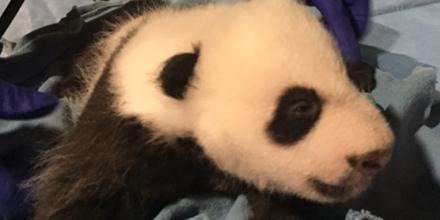
Keepers had a chance to weigh Bei Bei on Oct. 1. He now weighs 4.5 lbs. (2070g)—half a pound increase since he was weighed the previous week. Vets did a thorough check and took some body measurements. From Bei Bei’s head to the tip of his tail is 33 cm., just shy of 14 inches. His eyes are now partially open and teeth buds are developing! Bei Bei's ear canals are still closed but he should be able to hear some noises

Zoos facebook
 
If Shanti`s genes are so valueable, the National Zoo should have sent her to a zoo with an adult bull 10 years ago. She is really unlikely to breed again after not having a calf for 14 years. Females need to start breeding young (preferably before they reach the age of 20) and then they need to reproduce regularly to stay fertile. A break of more then 10 years means a new pregnancy becomes really unlikely. And I am 100% sure that Swarna is not pregnant. She never had a calf and therefore at 39 is way too old for a first pregnancy. The only female at the National Zoo who is likely to have another calf is Maharani.

That the National Zoo kept Shanti despite not being able to house a bull is a symptom of why the US population of Asian elephants is in such dire state: zoos with mature bulls are too egoistic to send them to a zoo with females in breeding age, and the zoos with fertile females are too egoistic to send (permanently, short-time breeding loans rarely work) them to the zoos that house males. A breeding program will never work this way.
 
I think they tried AIing Shanthi another time after Kandula was born but something happened and there was no calf
 
Ai has worse sucess rates then natural breeding. Most zoos without a bull that rely on AI only archieve one pregnancy or two in many years.
No zoo can afford (neither financially nor logistically) to do AI EVERY cycle for a couple of years if the female needs time to concieve again. A bull will try again every 3 months for free! It is more then likely that Shanti had bred again if she had lived in a zoo with a breeding male. But yeah, the National Zoo wanted to keep her at all costs and wasted her fertile years, so that`s the result - no babies and the AZA population is dying out.
 
@AmbikaFan I would advise against "painting broad strokes" on this site as it is often read by a variety of people including professionals, activists, journalists, and everyone else in between. As you will learn, this site has layers of past discussions that are easily found with a simple internet search. Its not hard for someone to read just a small bit and take something out of context when they don't read the whole thread.

As you can see Ringling & ALS combined don't produce double of the calves born in zoos. Even after mortalities, you'll still find that you come short of that statement - I'd guess they produce 50% more than zoos at most. And as you continue your research, you'll also find that EEHV has impacted Ringling's program as well.

*Wasn't mistaken about Tulsa or Dickerson Park having a breeding-age female. You'll find cows that have gone several years without a calf are still able to reproduce. The criteria you mentioned may be for zoos where you have spoken to employees, but I doubt you'll find the same sentiment industry wide. And while generalizations can be made about elephant physiology. Its really a matter of what's going on individually with each elephant.

*You'll find that Sneezy isn't under-represented - he's not represented at all.

*The AZA doesn't make decisions for zoos. SSPs make recommendations for guided cooperative breeding programs. AZA has little mechanisms to "punish" individuals zoos that don't follow these guidelines. AZA has no ownership over any animal and can't force any zoo to do so. Taking away accreditation is the only tool the organization has - something AZA has never used to enforce SSP decisions. Individual zoos (and the owners of these zoos) make decisions for their respective animals.

*An overlap of 3 bloodlines between North America and Europe is not is at all big. Its common in Europe for bulls to have 10+ offspring. Maxi, Chieng Mai, Ramon, Shinto, Radza, Siam, Ankhor, and Mohti all have their own legacies. In the 1990s, several elephants were also imported from Asia into European zoos. The bulls from these imports are starting to come into their own as well. Europe has a lot more zoos with Asian Elephants than in America, its quite easy to visit a zoo and not see a descendant of Motek.

*I can't remember now why Budi/Billy was imported. I thought it was silly to bring him over, when there are other young bulls in Europe that have no relations in North America. But Billy is still very valuable - his mother is a descendant of Ramon and, while the Ramat Gan bloodline is already represented in North America, it certainly is not over-represented. Two young bulls from the Netherlands were supposed to also be imported around the same time.

*In-breeding is not a problem (long-term) if its restricted to just a generation. You'll find many captive breeding programs in zoos rely on in-breeding to maintain demographics.

*Vance has 12 living offspring. 10 are in North America. And 8 can potentially or already have reproduced.

*Whimpy did have another calf this year.

@Yassa you are half correct about the state of the American Asian elephant captive breeding. Zoos with breeding bulls were not hampering the production of calves. At the time, zoos that didn't have bulls had no means to house them which is why American zoos tried out the short-term breeding loan policy for so long. There were also many zoos that didn't want to breed because they didn't want to house any bulls potentially born at their zoo.
 
Ai has worse sucess rates then natural breeding. Most zoos without a bull that rely on AI only archieve one pregnancy or two in many years.
No zoo can afford (neither financially nor logistically) to do AI EVERY cycle for a couple of years if the female needs time to concieve again. A bull will try again every 3 months for free! It is more then likely that Shanti had bred again if she had lived in a zoo with a breeding male. But yeah, the National Zoo wanted to keep her at all costs and wasted her fertile years, so that`s the result - no babies and the AZA population is dying out.

Is it cheaper to house and feed a bull elephant, than do consistent AI procedures? It would be cool if a zoo has published those figures.
 
It is cheaper to house a male if the infrastructure is in place. Each AI procedure is around 10k is if it's done by a specialist. Times that roughly 3x per female per year. And depending on how many females it can get very expensive. However, a facility like Ringling has a specialist on payroll which helps. At least their last half dozen calves were AI
 
The Smithsonian Conservation Biology Institute is celebrating the birth of two Eld's deer fawns! The first fawn, pictured here, was born Sept. 26 to 7-year-old mother Sherri and 6-year-old father Nam Tann. His half brother was born just a day later on Sept. 27 to 5-year-old mother Iris. According to keepers, both fawns continue to do great and gain weight. At just over 1 week old, they're already 18.7 pounds and 16.5 pounds! Less than 1,500 Eld's deer remain in their native Myanmar due to habitat loss and hunting.

12072576_10153623090982902_8780047868431989527_n.jpg


Zoos facebook

Also from another post on the zoos website the zoo said they have 24 Elds deer at SCBI.
 
It is cheaper to house a male if the infrastructure is in place. Each AI procedure is around 10k is if it's done by a specialist. Times that roughly 3x per female per year. And depending on how many females it can get very expensive. However, a facility like Ringling has a specialist on payroll which helps. At least their last half dozen calves were AI

Loxodanta, I'm always eager for information relating to Ringling's success! Would you answer a few questions?

* Do these AI's go back to calves already born like Piper and Mike, or are these new pregnancies?

* Are these being done by Dennis Schmitt, or has one of his protoges become this reliably successful? Have they had any success using frozen samples?

* Is AI being used because onsite bulls Casey and Rajah don't breed naturally, or to utilize outside sperm? I vaguely remember before Casey went to Fort Worth that there was a cute moment when matriarch Rasha was shown photos of both Casey and Rajah and allowed to "pick" which stud she'd like to see join the herd. (I think the public was even given a 'vote') This suggested that both bulls had been semen-tested for virility and were supposedly good-to-go. It seemed clear--to me, at least--that Ringling had intentionally saved both Casey and Rajah to breed to the Vance granddaughters/Charlie and Romeo daughters to avoid inbreeding, so they had been unproven. Fast-forward a number of years with Casey being replaced by Romeo for non-production, and I'm wondering if the AI's have become necessary because neither are virile any longer?

* I was surprised that Romeo chose to send Romeo away. With no Vance or Charlie genes, wouldn't he be valuable to Ringling by being able to sire calves with any of their females except sisters Asha and April?

* I know Baby and Karen came off tour, and I think youngsters April and Piper were thought to be natural performers, but I'm longer sure which 13 elephants are out on tour. Do you know this? (It seems directly related to why they haven't bred many of the females at their usual first-time ages)

Thank you, Loxodonta, for any info!
 
PS It goes without saying that Romeo couldn't breed his mother Alana or daughters Mable or Piper either, but for the moment, Piper is too young and all three can be bred to Charlie. Was Romeo sent out because Ringling was sure enough about Rajah and Casey? Is "bad boy" Rajah then perhaps too rough with the girls, necessitating AI? This enquiring mind is anxious to know!
 
PS It goes without saying that Romeo couldn't breed his mother Alana or daughters Mable or Piper either, but for the moment, Piper is too young and all three can be bred to Charlie. Was Romeo sent out because Ringling was sure enough about Rajah and Casey? Is "bad boy" Rajah then perhaps too rough with the girls, necessitating AI? This enquiring mind is anxious to know!

Romeo is now at Fort Worth and in return they sent Casey back to CEC ;)
 
Last edited:
Romeo is not at Fort Worth and in return they sent Casey back to CEC ;)

Do you mean Romeo is NOW at Fort Worth? I've just been assured that CEC has plenty of frozen Romeo sperm, so perhaps their AI successes have been with frozen sperm, which is a huge step forward. Thank you!
 
Back
Top