Smithsonian National Zoo Smithsonian National Zoo News 2015

On Oct. 5, the Small Mammal House welcomed its newest (and prickliest) baby: Charlotte, the prehensile-tailed porcupine! When keepers observed that she was not nursing properly and losing weight, they banded together with Zoo nutritionists and vets to ensure Charlotte was getting the nutrition she needed to thrive. Today, at just over 2 pounds, she’s healthy and doing great!

Zoos facebook.
 
The zoo has two new snakes in the Reptile Discovery Center.

a male and female bushmaster.

It takes a sharp eye to spot the newest snakes in the Reptile Discovery Center: a male and female bushmaster. This species is a master of disguise; the pattern on its scales camouflages it perfectly among leaves on the forest floor. Measuring 6 to 7 feet in length, they’re also the largest pit viper on earth and the largest venomous snake in the Americas. Unlike most New World pit vipers (which produce live young), bushmaster females lay eggs. Slither in to the Zoo and say hello to these gorgeous creatures! ‪#‎WeSaveSpecies‬
 
MALE SCIMITAR-HORNED ORYX DIES AT SMITHSONIAN CONSERVATION BIOLOGY INSTITUTE

Animal care staff at the Smithsonian Conservation Biology Institute (SCBI) humanely euthanized an elderly male scimitar-horned oryx named Dr. Bob Dec. 14. A final pathology report will provide more information in the coming weeks. Dr. Bob was 18 years old. The median life expectancy for scimitar-horned oryx in human care is 15 years.

Born at SCBI in 1997 as the result of artificial insemination, the oryx was named "Dr. Bob" in honor of the veterinarian who assisted with the procedure. According to Dr. Bob's keepers, he had a good demeanor and was a favorite among the animal care staff. Most zoo animals participate in a breeding program called the Species Survival Plan. The SSP scientists determine which animals to breed by considering their genetic makeup, nutritional and social needs, temperament and overall health. Between 2010 and 2014, Dr. Bob sired two female and seven male offspring. Last year, he was listed as the second most valuable male in the scimitar-horned oryx SSP. SCBI has cared for and bred scimitar-horned oryx since 1975; today, it houses a herd of 24—11 males and 13 females.

The International Union for Conservation of Nature lists the scimitar-horned oryx as extinct in the wild. Scimitar-horned oryx once lived in northern African countries of Egypt, Senegal and Chad. They are adapted for survival in extremely harsh desert conditions. They are mostly white with reddish brown necks and distinct facial markings with a long, dark, tufted tail. Their white coat helps reflect the heat of the desert while their body reacts instinctively when coping with a shortage of water. They can raise their body temperature by several degrees, up to 116 degrees Fahrenheit, to conserve water by avoiding sweating.

https://nationalzoo.si.edu/publications/pressmaterials/pressreleases/press-release.cfm?id=2746
 
I went to the zoo today and these are some of the things I saw/noticed.

* The old Collard Peccary and the old Maned Wolf exhibit are still empty.

* There is an exhibit in the small mammal house that is covered in paper so I'm assuming they are preparing it for some animal.

* There is a ton of exhibits in the reptile discovery center that are either empty for cleaning or being prepared for an animal.

* The Red Pandas are not on exhibit yet but there are coming soon signs behind the small mammal house.

* It looks like the zoo is doing some work on or around the Orangutan exhibit at the great ape house. Does anyone know what they're doing? I might upload a picture of it.

* The zoo has two oryxs now at the zoo. I believe they've only had 1 for a majority of the year.
 
Last edited:
I would say about 95% of the photos I'm gonna upload are in the gallery.

Also, my camera battery died real quick and I didn't know why. Turns out I was recording and I didn't know. The footage I took I uploaded to youtube so if you want to see it here it is.

https://www.youtube.com/watch?v=YWUNuw-_Taw&feature=youtu.be

A majority of the photos you see in the video are the deleted ones so don't question my terrible photography.
 
Could someone tell me why exactly red pandas were pulled from display? I know one escaped a while ago and if I recall correctly i remember reading something about people traffic and noise being an issue with them. I though they had a nice exhibit? Where will they be going on exhibit once they return and if not in their original space then what will happen with their former exhibit?

Sorry, that's a lot of questions.
 
Could someone tell me why exactly red pandas were pulled from display? I know one escaped a while ago and if I recall correctly i remember reading something about people traffic and noise being an issue with them. I though they had a nice exhibit? Where will they be going on exhibit once they return and if not in their original space then what will happen with their former exhibit?

Sorry, that's a lot of questions.

This is where they will be going.

http://www.zoochat.com/612/small-mammal-house-red-pandas-coming-433186/

http://www.zoochat.com/612/small-mammal-house-red-pandas-coming-433185/

They do have a good exhibit. I know my opinion is kinda bias but I think it's the best Red Panda exhibit in the USA.

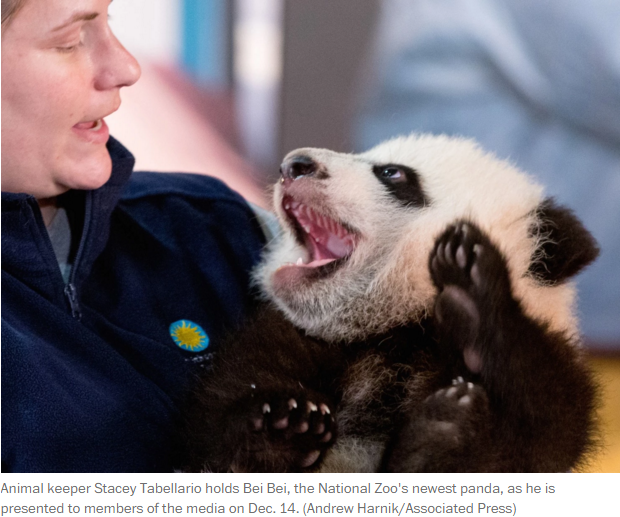
The reason they're going to the small mammal house is because Bei Bei makes his public debut in mid January and the zoo is getting all new animals and not bringing some in from front royal.

Because of where the exhibit is located they expect big crowds for the first couple of months when Bei Bei debuts so they don't want to stress the animals out with so many people around {possibly hundreds I mean today there was a couple hundred people looking at the pandas and imagine the crowd when Bei Bei debuts}.

The last ones they had were pulled because they wanted them to breed out in Front Royal and not at the zoo {I guess because it's quieter out there}.

Oh and the female died after she gave birth.
 
Don’t cut back the National Zoo’s hours


q3Hhx31.png


Recently, without consulting affected neighbors, the National Zoo announced that beginning Jan. 1 its grounds will be open from 8 a.m. to 7 p.m., with a 5 p.m. closing in winter, instead of the current 6 a.m. to 8 p.m. (with a 6 p.m. closing in winter).

These changes affect multiple groups: walkers and joggers, for whom the zoo is a safe and beautiful place to exercise; pedestrians crossing between the east and west sides of Rock Creek Park; families who bring their children after school to explore ; and drivers and bicyclists who cross the Harvard Street bridge to swing down onto Rock Creek Parkway or head up to Connecticut Avenue.

Why is the zoo changing its hours? According to Director Dennis Kelly, there are two reasons: safety and security. He and his team are concerned about the potential for a collision between zoo vehicles and visitors. But no accidents have been reported, and no data have been collected about the near-misses that Mr. Kelly cited as the basis for his concern. Nor have data been collected about how many people will be affected by this change.

Mr. Kelly indicated that, without early-morning visitors, it will be easier for zoo staff members to move around on their morning rounds, which means they’ll be able to get their work done more quickly. Actually, the zoo vehicles won’t be able to move much faster because they will still have to watch out for workers on foot, other vehicles and ever-present deer roaming the zoo’s open spaces. And, in the summer, it’s light well before 8 a.m. (In June, it’s light before 6 a.m.)

The explanation for closing off car traffic, which affects only the zoo’s perimeter, is even more vague — essentially, that the zoo is not a public thoroughfare. Yes, but the zoo is an integral part of Rock Creek Park, which includes a commuter route. And the combination of this closure with the upcoming reconstruction of Beach Drive, requiring months-long closures, will significantly affect neighborhoods adjoining the zoo.

No sensible explanation has been offered for the change in evening hours.

There has been no real explanation of the security issue. There were vague references to potential terrorism, but no cogent discussion. None of us really understands how keeping out the neighbors — reducing eyes and ears who could report suspicious activity — would increase security in a park where no amount of fencing has kept out the deer who wander in from Rock Creek Park.

Bottom line: We call on officials to keep the zoo’s current hours and to consult with neighbors about how we could work together to solve any real safety problems.

https://www.washingtonpost.com/opin...1ce6c6-a5b5-11e5-8318-bd8caed8c588_story.html
 
This is where they will be going.

http://www.zoochat.com/612/small-mammal-house-red-pandas-coming-433186/

http://www.zoochat.com/612/small-mammal-house-red-pandas-coming-433185/

They do have a good exhibit. I know my opinion is kinda bias but I think it's the best Red Panda exhibit in the USA.

The reason they're going to the small mammal house is because Bei Bei makes his public debut in mid January and the zoo is getting all new animals and not bringing some in from front royal.

Because of where the exhibit is located they expect big crowds for the first couple of months when Bei Bei debuts so they don't want to stress the animals out with so many people around {possibly hundreds I mean today there was a couple hundred people looking at the pandas and imagine the crowd when Bei Bei debuts}.

The last ones they had were pulled because they wanted them to breed out in Front Royal and not at the zoo {I guess because it's quieter out there}.

Oh and the female died after she gave birth.

Why not just delay the new animal's arrival then? Or at least them going on-exhibit. That doesn't make sense to build an entirely new enclosure that's worse than the current one in an area of the zoo most people don't know even has anything (as, if memory serves, their new enclosure will be behind the Small Mammal House, correct?) simply because it might be a bit crowded for a few weeks when the new animals arrive.

Will they be returning to the old enclosure after the Bei-Bei buzz quiets down? If not, what becomes of the old enclosure and if so, what happens to the new enclosure?

~Thylo:cool:
 
Why not just delay the new animal's arrival then? Or at least them going on-exhibit. That doesn't make sense to build an entirely new enclosure that's worse than the current one in an area of the zoo most people don't know even has anything (as, if memory serves, their new enclosure will be behind the Small Mammal House, correct?) simply because it might be a bit crowded for a few weeks when the new animals arrive.

Will they be returning to the old enclosure after the Bei-Bei buzz quiets down? If not, what becomes of the old enclosure and if so, what happens to the new enclosure?

~Thylo:cool:

They will return to Asia Trail after all the buzz around Bei Bei quiets down.

I would hope they would have finished but they were doing some work on their inside area. But they reached their goal last year so I would hope that has nothing to do with it.

Also the two exhibits behind the small mammal house are not new... they've been their for ages.
 
I know they are not new, but it seems like they've done considerable renovations to them for the Red Pandas.

~Thylo:cool:

I actually think that the exhibits are meant for temporary use.

If my memory serves me right then back when American Trail was being renovated the NA otters were kept there and they had a little pool.

From the last time I saw them it looks like they only added some branches and logs for the Pandas to climb on.

They might have an inside exhibit as well because there was an exhibit in the small mammal house that was covered in paper and looked like it was big enough to hold a couple of Red Pandas temporarily.

Also this is question is for anybody but does anyone know what type of dog this is????? It looks like a living teddy bear....

a real dog - Album on Imgur
 
@dcpandafan - I'm 95% sure that is a Pomeranian pup with a very good haircut!

I was just at the zoo yesterday (of course after a great weekend I chose the cold windy day to go out). Though I've had a great time previously, it was a bit sad yesterday and many animals were off exhibit. The Asia Trail was almost empty, though I was told that the pandas come out in the morning and tend to be reasonable active - will have to make the trip later. A very friendly keeper was feeding one the beavers (he is 16 years old! blew my mind!), which was really fun to watch. There was one wolf out but the otters were inside.

Spent a long time at the elephant house. Ambika and Shanthi (I think it was Shanthi but I'm not sure) were inside, which was nice to watch but the area was a lot smaller than I had thought it would be. There was also another elephant out but locked in a small pen, which made a lot of visitors go "aww how sad"... for how impressive the building itself is they need to make the place look a bit more cheerful. The elephants seemed to be quite engaged browsing for food.

The bird house was really nice too, very beautiful but it was overrun with mice, especially the tinamou exhibit! Couldn't see the kiwi, but the two male micronesian kingfishers on exhibit were really fun to watch (and very loud!). I couldn't find more info, but I guess the zoo has females off exhibit? I know they've bred them!

I didn't have the time to go see the big cats and apes, so have to go again soon! I'll try again on a warmer day but the zoo will probably be packed.
 
Back
Top