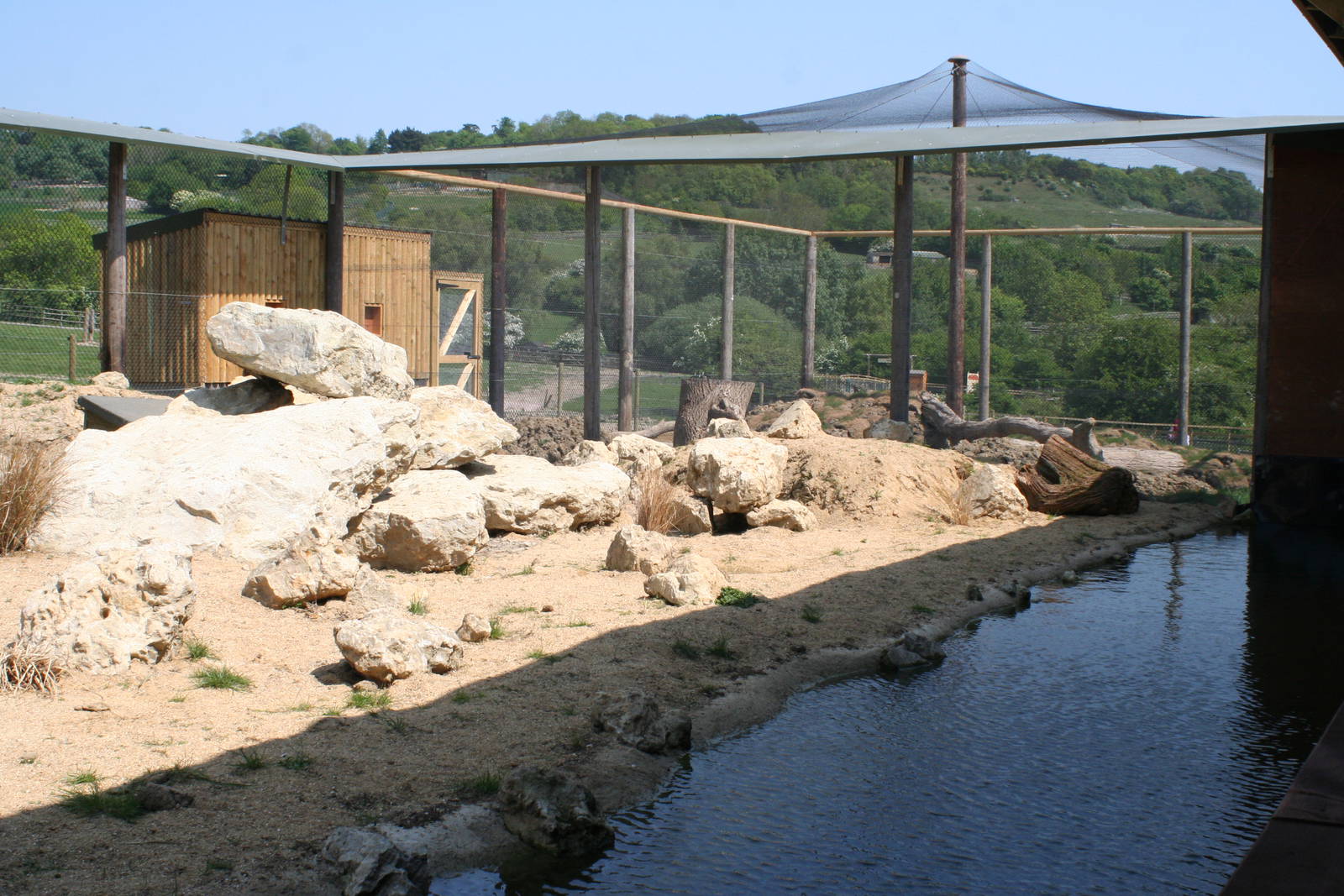
This exhibit is much different from the other small cat enclosures at Port Lympne, so does this mark the beginning of a new style of exhibitry at the zoo? Will the chicken wire finally be dumped or is it a one-off occasion?
I'm sure its a one-off. You have only to look at the equivalent Primate situation- lots of Monkey species including rare species like Drills and Golden-bellied Mangabeys, still living in the old style 'wood framed/netting' enclosures, while there are also nowadays three excellent modern-style primate enclosures (one at Port Lympne, two at Howletts) To renovate/change all those old-style enclosures(both small cats and primates)would cost them the earth- so I would not expect any sudden major changes, just the odd newbuild like this one.
Those will be the original cages built there- same with the many old Primate cages in the woods and elsewhere too. Similar at Howletts, with many older style cages dating from the earliest days, particularly behind the Mansion.
There is indeed just the water moat between people and Pallas' cats, or there will be once the cats move in. No glass (so far, although I would be concerned about people not caring about the water jumping in to hug the 'pussycats'). To be honest, this type of exhibit would do much more justice to their splendid cat collection than does the 1970s chicken wire (and this exhibit can't have been THAT expensive to build).
I do wonder how many people will actually see the Pallas Cats in here, given their small size and that they are often shy and retiring. At Howletts they tending to come out mostly in the very late afternoon though some individuals show themselves better.
I do wonder how many people will actually see the Pallas Cats in here, given their small size and that they are often shy and retiring. At Howletts they tending to come out mostly in the very late afternoon though some individuals show themselves better.
With Pallas Cats it very much varies from place to place and from animal to animal - I never have have any problems at Cotswold and there was one that used to be at Edinburgh that was surely handreared and was unbelievably showy. But other times I have gone three or four 'Pallas Cat' zoos without seeing one.
With Pallas Cats it very much varies from place to place and from animal to animal - I never have have any problems at Cotswold and there was one that used to be at Edinburgh that was surely handreared and was unbelievably showy. But other times I have gone three or four 'Pallas Cat' zoos without seeing one.
This is too true with Pallas' Cats, it's usually everything or nothing. They either hide from you alltogether or are almost in your face the whole time you're by their exhibit, I can think of several examples off the top of my head of both cases.
With Pallas Cats it very much varies from place to place and from animal to animal - I never have have any problems at Cotswold and there was one that used to be at Edinburgh that was surely handreared and was unbelievably showy.
The ones at Cotswold don't have much/any vegetation cover and can be seen up on platforms or boxes at the back of the enclosure which is simple and looks like their Owl aviaries. Those at Howletts can be invisible if they want to be. But there's at least one there too that is showy, like the Edinburgh one- maybe it was handreared too?
Maybe they need handraised ones for this new PL exhibit...
This is too true with Pallas' Cats, it's usually everything or nothing. They either hide from you alltogether or are almost in your face the whole time you're by their exhibit, I can think of several examples off the top of my head of both cases.
At Howletts there are(or were) two pairs kept in side by side enclosures- they are usually invisible most of the day but I've seen all four animals(both pairs) active after 5.p.m. But in another enclosure on the other side of the path, there's one(or a pair) which seem totally oblivious to people and active the whole time.
This enclosure is brilliant in its simplicity.Few if any zoos would have the audacity to try this, manipulated as many of them are by prestigious architects and specialized designers who need high-cost projects to fuel their commission payments.Nevertheless , the zoo world is captivated by this enclosure & I am sure it will not be long before we see different versions of this being tried with different species.In these necessarily cost-conscious times this simplicity and close-to-zero maintenance construction should put a smile on the face of any zoo´s financial director.You could design this type of thing with a HB pencil & drawing board and have the zoo maintenance team do most if not all of the work.Sometimes it is more a matter of imagination than money - luckily!