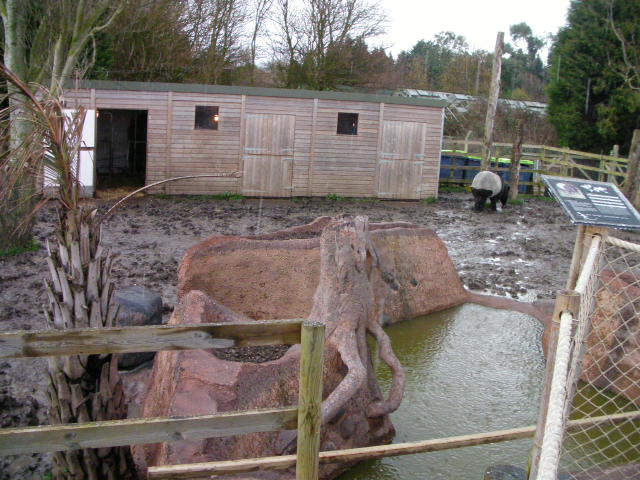
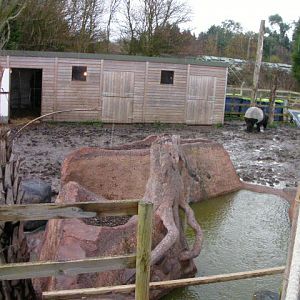
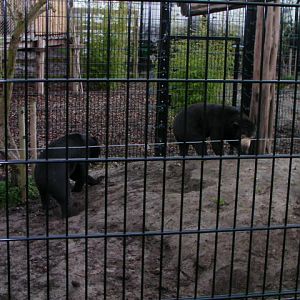
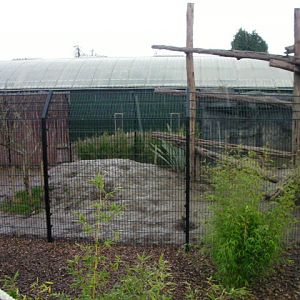
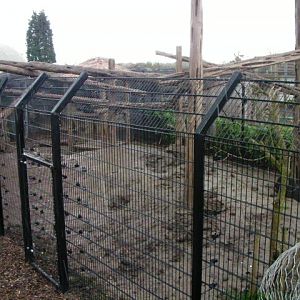
Well perhaps it was "foolish" of me to take the bait from Mark77, who initiated the comparison with the Bronx. But your comment does beg the question of why a "tiny private zoo" should be in the business of keeping and exhibiting such a rare and vulnerable species, and what possible value there is for anyone to visit and see the animals in such a spartan (to be charitable) enclosure.
Well perhaps it was "foolish" of me to take the bait from Mark77, who initiated the comparison with the Bronx. But your comment does beg the question of why a "tiny private zoo" should be in the business of keeping and exhibiting such a rare and vulnerable species, and what possible value there is for anyone to visit and see the animals in such a spartan (to be charitable) enclosure.
They're looked after well and the enclosure is fine, why shouldn't they keep them? It's size is fine as it's about the same size as Bristol's tapir exhibit, bigger than Dartmoor's old one, and not much smaller than Edinburgh's. I agree the mud makes it look bad, but it was raining and towards the end of winter. I don't see what the problem is
As someone mentioned before the concrete pond wasn't there when they had visited. So maybe RSCC plans to natural their exhibits up over time seeing as they've only recently opened and they may not be able to afford it all straight away. This is fine by me if the animals are kept properly in the mean time.
I will add photos of Bronx tapir enclosure to forum gallery. As you can see it looks amazing and as part of a stunning huge rainforest building, but is it better for the tapir than at RSCC.
The reason I remember it was because the tapir spent the whole time walking at pace back and forth (I well understand there are a lot of reason why this could be happening) the evidence is there in the sand. I admit the hot wire comment might have been incorrect looking back at my photos could have been confused with the stunning tree kangeroo pit.
Anyway will add photos shortly, not trying to argue/bait just giving a different perspective to the largely negative comments on RSCC.
At the very least needs some hard stand where the tapir can keep its feet dry.
The fake rockwork is just very, very ugly and completely pointless (and looks much like pictures of rainforest areas I have seen AFTER they have been de-forested). They should have spent the money on improving the general conditions of the enclosure rather than tarting it up. A more practical pool would have been a start.
Quite possibly the worst tapir enclosure I have seen for some years. For comparison see Linton (low investment also but vastly superior in every way). Even Marwell's is really just a paddock but still much better.
I am not a fan of small zoos keeping large animals, there is just no need.
I am a big supporter of all zoos but this sort of things just lets the zoo community down. I just think that with a little imagination, a lot can be achieved without massive financial outlay. Need to choose the right species and consider the space and type of land available (including vegetation). E.g There is no point is throwing some garden centre cast offs into the enclosure and hoping they will last the winter, they will not. Much better to promote the growth of native vegetation.
It is reminiscent of a shabby smallholding for ponies or goats that you see dotted round rural areas.
A lot of people defend this zoo, possibly due to the unusual species it seems to be collecting. It may be new, and on a tight budget, but if this is the case they should STOP GETTING NEW ANIMALS and concentrate on developing/enriching the current exhibit spaces.
Mud is not the worst substrate for a forest herbivore that lives near water. But this dries in summer, becomes dusty, hard and compacted, and is unsuitable until rain allows the ground to soften.
Even London Zoo, with a very small outdoor exhibit, has accomodated for the sensitive eyes of this species with army nets and planting inside the exhibit to provide shade.
There clearly was a budget for improving the space, with the addition of a pool. The rockwork appears to have been moulded for two containers for planting. These will not be large enough to plant anything remotely suitable for creating shade. I must say that there are plenty of cheaper options for creating shade cover than the numerous palms and other exotics planted throughout the site.
IMO the zoo should immediately plant half a dozen protected trees in the enclosure, and extend the space if at all possible. They should provide a compost or woodchip cover during the summer to keep the ground soft enough. Visually dirty water isn't really an issue with tapirs as they defecate in the pool to hide their scent from predators. As long as it is regularly changed it's not a problem for the animals.
Dartmoor, as someone mentioned, was a small cobblestone yard, but the tapirs were given access to the entire llama field and lower lake.
Again, we compare to nearby Howletts, which has tapir paddocks under trees, using wood and cattle wire fencing, and with small concrete pools similar in size to RSCC. Yet they achieve infinitely better enclosure space for their tapirs.
The space is ok IMO, about the same as Bristols. And I can see at least 2 trees in the pic, one of which is quite large, and there were at least 2 more in the paddock. You know that trees lose their leaves in the winter.
The enclosure in summer is not really shaded either. There are a couple of trees, but ZSL for example shaded their exhibit with young trees evenly spaced throughout the enclosure...and where the was no planting, army nets were hung, and wooden shelters were erected. In summer, this exhibit still does not create joined up shade, but yes, there are a couple of trees. And yes, all UK enclosures look at their worst in winter.
I personally would not hold up Bristol as a marker of good enclosure space for herbivores. However, Zona Brazil is fairly secluded and lush, and the indoor facility is IMO better than this one appears to be. Lowland tapirs are more common in captivity, easier to breed, and less threatened in the wild. This should in no way compromise their husbandry as opposed to Malayan tapirs, but what is frustrating is the knowledge that there are half a dozen UK facilities with prior experience of tapir husbandry and with Lowland tapir enclosures that would be able to make a far superior contribution to the Malayan Tapir EEP, which isn't exactly thriving right now.
IMO this collection was able to open with such species as a result of the supposed links with Howletts and Port Lympne, which other members have suggested have been severed. If Borth animalarium decided to open an enclosure like this and a malayan tapir appeared in it, everyone would be up in arms, yet the RSCC seeminly deserves more respect for assembling a collection of unusual species not often seen in the UK. I agree, it does, at a certain level, but it is frustrating to see a difficult species such as the Malayan tapir not given proper facilities.