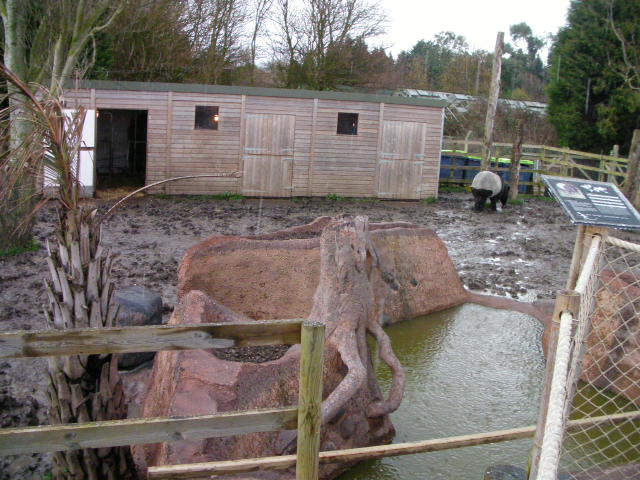
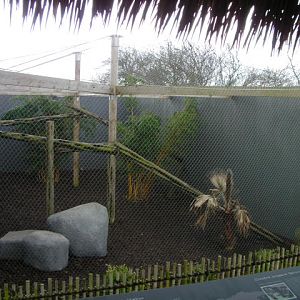
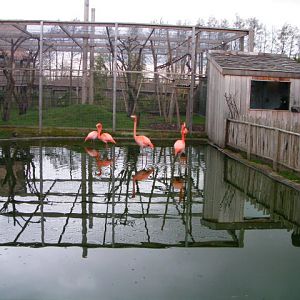
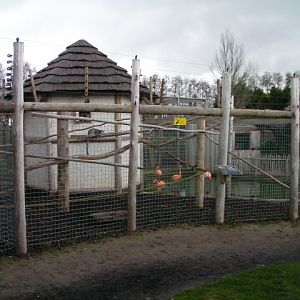
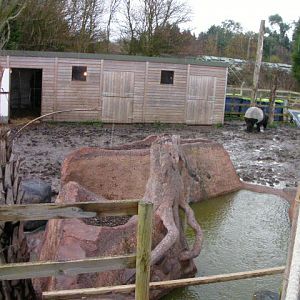
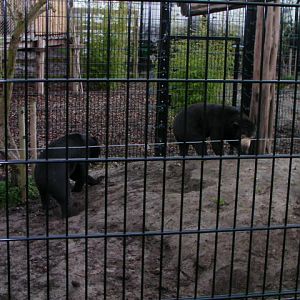
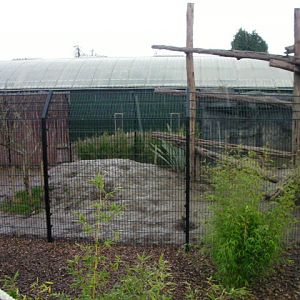
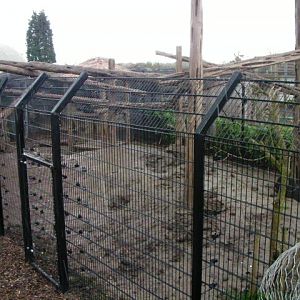
The 'rockwork' and the pool are new since my visit last year. It's not pretty and it's not big, but it shows they are trying to improve things for the animals.
For those "not in the know", RSCC is owned by one Todd Dalton who is famous for taking on his local Council (Lambeth I believe) and spending 25k on legal fees in order to keep clouded leopards in his back garden. Money talks!
@reptile1517: that explains how there is an amazing assortment of animals on only a couple of acres. Some Brits here at ZooChat support this collection and the exhibits, but the majority appear to not be pleased by many of the enclosures.
Okay, this photo makes my argument for me. What on earth is the point of the "naturalistic" (but totally fake and ugly) rockwork and "roots" in the foreground with the mud pit and domestic animal barn immediately behind it? At best,this is an example of exceedingly bad taste. At worst, an unhealthy (no shade, no dry land) and inhumane exhibit for a marvelous animal adapted to live in the dense tropical rain forest.
In defence, but not disagreement with above.
The end of UK winter is usually the least attractive time for many outdoor zoo exhibits.
New enclosures take time to mature/settle, such as from building work disturbing roots/soil etc
The domestic animal barn immediately behind provides both shade and dry land as well as heat, food, water, retreat,bedding and so on.
In comparasion, the other malayan tapir enclosure that comes to my mind is the very natualistic looking one in bronx zoo (2006). Which is a stunning looking hot wired pit half the size of this enclosure (please correct me).
Looking at this again, this enclosure is probably about the same size as Bristol's Tapir enclosure. It was one of the best at the RSCC and is a completely acceptable size IMO.
In defence, but not disagreement with above.
The end of UK winter is usually the least attractive time for many outdoor zoo exhibits.
New enclosures take time to mature/settle, such as from building work disturbing roots/soil etc
The domestic animal barn immediately behind provides both shade and dry land as well as heat, food, water, retreat,bedding and so on.
In comparasion, the other malayan tapir enclosure that comes to my mind is the very natualistic looking one in bronx zoo (2006). Which is a stunning looking hot wired pit half the size of this enclosure (please correct me).
No question the Bronx Zoo's tapir exhibit is far from ideal in terms of space, but there are no hotwires in use, the pool is much bigger than what is shown here and is much more usable (important for this semi-aquatic species) as the building is maintained at a tropical humidity and temperature levels year round.
Where the Bronx exhibit pulls away from this approach is that it displays the tapir in the context of a rainforest--tropical vegetation, vines, buttress root trees, aerial termite nests, gibbons, birds and squirrels etc. A tapir in context, not in a squalid pig pen with a weird fake rock pool incongruously plunked into the middle of the paddock.
Presentation matters. Once you've taken care of the basics of proper animal care (which the RSCC space perhaps can be said to do), zoos should strive to do much more in terms of creating connections and educational opportunities for their visitors. Just keeping animals alive and (maybe) happy is not enough.
Where the Bronx exhibit pulls away from this approach is that it displays the tapir in the context of a rainforest--tropical vegetation, vines, buttress root trees, aerial termite nests, gibbons, birds and squirrels etc. A tapir in context, not in a squalid pig pen with a weird fake rock pool incongruously plunked into the middle of the paddock.
Once you've visited the place you make a comment like that, but it's very unfair to say that unless you've seen it. If it was swimming in it's own crap, then fine, call it "squalid". But it isn't, it's muddy because it's pouring down with rain.
Presentation matters. Once you've taken care of the basics of proper animal care (which the RSCC space perhaps can be said to do), zoos should strive to do much more in terms of creating connections and educational opportunities for their visitors.
No question the Bronx Zoo's tapir exhibit is far from ideal in terms of space, but there are no hotwires in use, the pool is much bigger than what is shown here and is much more usable (important for this semi-aquatic species) as the building is maintained at a tropical humidity and temperature levels year round.
Where the Bronx exhibit pulls away from this approach is that it displays the tapir in the context of a rainforest--tropical vegetation, vines, buttress root trees, aerial termite nests, gibbons, birds and squirrels etc. A tapir in context, not in a squalid pig pen with a weird fake rock pool incongruously plunked into the middle of the paddock.
Presentation matters. Once you've taken care of the basics of proper animal care (which the RSCC space perhaps can be said to do), zoos should strive to do much more in terms of creating connections and educational opportunities for their visitors. Just keeping animals alive and (maybe) happy is not enough.
A good argument and one I can find myself sort of agreeing with, however it is very foolish to compare arguably one of the best zoos on the planet backed my a massive conservation society with a tiny, new, private zoo.
A good argument and one I can find myself sort of agreeing with, however it is very foolish to compare arguably one of the best zoos on the planet backed my a massive conservation society with a tiny, new, private zoo.
Well perhaps it was "foolish" of me to take the bait from Mark77, who initiated the comparison with the Bronx. But your comment does beg the question of why a "tiny private zoo" should be in the business of keeping and exhibiting such a rare and vulnerable species, and what possible value there is for anyone to visit and see the animals in such a spartan (to be charitable) enclosure.