Then zoogiraffe, you do seem to have missed my point where I noted the differences between training dogs and tigers.
If the training you have seen is done well, then I will not argue with that. But I am not going to accept that all circus training is as positive as Jim Clubb's, I can't see all tigers as being that easily trained, and I shall stand by my views as an anti-circus while you stand by yours as a pro Ash.
Ok, the bit you say about tigers compared to dogs I understand as they are solitary. What about lions then? They have hierarchies in nature, do you think it's more acceptable to train them?
Perhaps; but as I mentioned, dogs have developed a bond towards humans instinctivley, while lions are still wild and naturally undomesticated in their instincts. In that sense, they would be no more easy to co-operate with a trainer than a tiger.
Perhaps; but as I mentioned, dogs have developed a bond towards humans instinctivley, while lions are still wild and naturally undomesticated in their instincts. In that sense, they would be no more easy to co-operate with a trainer than a tiger.
Yes but many humans still train their dogs to do things that they wouldn`t do in the wild,so what is the difference between them and what a circus does to train animals absolutely NOTHING they are both training an animal to do something that it wouldn`t do in the wild!
I would love to know how the train the cats to "act" aggressive, I have observed cats unleash all hell and then in the same breath rub against their keepers as if they were a domestic kitten.
Yes but many humans still train their dogs to do things that they wouldn`t do in the wild,so what is the difference between them and what a circus does to train animals absolutely NOTHING they are both training an animal to do something that it wouldn`t do in the wild!
i agree, i have also heard people dislike when we take zoo animals and hand rear them so that they can be handled with free contact. but we take our dogs and cats at a very similar stage . when we take puppys and kittens at 8 weeks that is not a natural time for them. Dogs will revert back to a "wild pack " if left to there own devices. Or theyt exscape and go feral so there is not much diffrent from dogs to tigers in this instance ( obviously tigers and big cats are very dangerous and im not saying that we should have them as pets)
Conditioning a wild animal to a life in captivity is "training". Getting a zoo tiger to come into its den for feeding is training. Getting a circus tiger to sit on a pedestal for its food reward is little different. A zoo tiger sitting in the same cage all day, eating a prepared beef steak, sleeping in the same den at night is probably less natural than a circus tiger expressing its full range of physical and mental abilities each day.
Animals in the wild are forced to do things the don't "want" to do every day. If a Lion had the option I am sure that it wouldn't "chose" to waste its energy and comfort chasing a zebra, I'm sure that a wildebeeste wouldn't "chose" to tire itself walking hundreds of miles in the drought season, I'm sure a male spider wouldn't "chose" to get eaten by his mate after mating.
When does a wild animal become a domestic one? Where, Zambar, do you draw the line? There are a set number of animals that are recognised as domestic by law in Britain - that does not include reindeer, or camels, or yak yet these species are as domesticated in other parst of the world as cattle, sheep and chickens are in the UK. How many generations of captive breeding does it take to class a species as domestic? Domestic animals, if brought up in a non-domestic environment can express a character as wild as any "wild" species. And the converse is true: wild animals brought up in a domestic situation can be as tractable as any domestic species.
Mental and physical excercise is good for us but seldom is it a pleasurable experience. For our own welfare we know that we should eat a good diet (however good doughnuts taste/bad spinach tastes), and that we should excercise regularly (however tiring/breathless/painful an experience that might be and despite how infinitely more pleasurable it might be to lie on the sofa all day) and that we should keep ourselves mentally stimulated (however boring schooling might be compared to watching inane television) . These principles can equally be applied to animals who would, at the end of the day, just as readily take the easy route out and become only half the individual that they might be if stimulated by the trials of a wild existance - an existance that can be more exactly replicated via the stimulation of a circus environment than a zoo one.
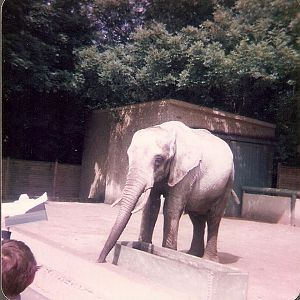
Getting back to Southampton Zoo , the enclosures were indeed very small , though there would have been similar ones in other collections then . Apart from an Elephant which did not look good ( I do not think the one pictured ) all the animals seemed to be in good condition , from memory . Much of the stock was held long-term here , not just a holding centre . I remember at least one Clouded leopard , I think traded from Dublin where it was bred ( they were reared by the mother in an area the size of a cupboard ) . I also remember the first Bongo I had seen - these later went to Woburn where they bred successfully .