Well animals were their business so it was in their best interests, financially, to keep them in good condition. Animals dont need a lot of space to be kept in good health!
But what I fail to see is how a circus life can be a stimulating one for an animal. Sure, they're doing active things, but is a tiger jumping over hoops and other big cats really comparable to a chase through the forest hunting down deer, or is an elephant rearing up on a podium equivalent to it swaything down the trees as it chomps it's way through the browse? An essential difference that does not put circus activities as reliable methods of stimulation is that the animals are being forced to perform. If a tiger sees a hoop, it's first thought will not be 'I have to jump through that'. It will ignore it, or at the most scratch against it or scent mark it. If a tiger sees three lions rearing up on a pole, the absolute last thing it's going to do is climb up the ladder and jump over all three, it's immediate thought will be 'here are three evenly matched rivals, I'm outnumbered, I'm off!' You may say that if they didn't want to do it, they wouldn't perform: They are doing it because they are forced to, and if they don't they pay the consequence, whatever it may be but at least something that makes them goes against their perceptions. Whilst it is true that a tiger would rather scavenge then go after a deer if it had to choose, and it may be applied to circus performing, chasing that deer is a way of balancing whether the animal eats, and in turn whether it lives or dies. Performing in a circus is definately NOT an essential part of it's life, meerly to entertain people by making them feel they have gained control over nature by the cheap tricks to make it seem like a joke (that kind of irrespect sickens me, but it is not a liable debate when talking about the practicalities of this subject). And to me, it seems an unnessacarilly creul one, especially after seeing the out-of-show conditions French circuses keep their animals in. At least in a zoo, the animal's actions aren't driven constantly by what the public want. If it wants to be unseen, it can hide behind a bush, off-show den, etc. And importantly, keepers keep a wide birth between them and their subject, knowing that superficially it is still wild: This brings back to the point of hand-raised animals being left alone when they mature if they are something like a lion.
Back on Southampton, I heard there was definately a polar bear, which was likely to be a permanent resident.
Performing in a circus is definately NOT an essential part of it's life, meerly to entertain people by making them feel they have gained control over nature by the cheap tricks to make it seem like a joke (that kind of irrespect sickens me, but it is not a liable debate when talking about the practicalities of this subject).
Ok, if you're going to play the "it's sick that humans take advantage of nature like circuses do" then you need to be a vegan with no pets who's never so much as looked at a zoo! It's the same principal. And for the record, the Heythrop tigers pace a lot less than any other tigers I've seen in captivity.
It's just the way that to me, the animals seem to be humilated in the big tops, more like clowns than real feats of nature, and they do all this hard work purely to 'amuse' us. At least in a zoo, even if they're not part of a breeding programme, the animals are presented in a way that both educates us through talks and interpretation and makes us say 'wow, that's amazing' or something along those lines. To make us appreciate nature and not laugh or gawp at it, to inspire the odd future zoologist/keeper/conservationist, and to portray the animal's environment either through naturalistic design (ie. Immersion) or function (ie. Howletts Gorilla Cages). It's here I must also point out that I'm not blaming Heythrop: With one or two exceptions, I thougt the standard at Heythrop and I enjoyed the rest of my day. But the big cat show was the downer that I found very uncomfortable to watch.
But now I'm deleving into my own sentimentalities, which doesn't apply to the debate given that it is based on different viewpoints
Im not agreeing with or defending circuses here but for arguments sake, what are the influences affecting a big cat in the wild during its active hours? (they are inactive for a large part of the day) Fear? adrenaline? aggression? physical effort? there are many more... now what does a circus cat experience in the ring or during training? I would say something similar. both acts (hunting and performing) are done to obtain food.
compared to a zoo cats day, which seems more natural now when you think about it from a different angle?
I used to visit Southampton Zoo regularly when I was a nipper. By today's standards the zoo was shocking. I remember buying popcorn and being allowed to feed the giraffe and elephant. The chimp was called James and was in residence for many years. He did indeed smoke, sometimes visitors would throw their cigarettes into his enclosure. He also ate jam sandwiches! For it size the zoo did have some unusual animals, I remember seeing the Bongo and I think they had an Okapi for a while. I can also remember the clouded leopard, it was located in a very small cage, the lions and tigers were either side in a kinda semi circle building.
The zoo occupied just two acres on Southampton Common, I remember it very well if anyone wants further memories
Thank goodness for Marwell which opened in 1972, great zoo, animals displayed in large paddocks.
B
BriteSpark
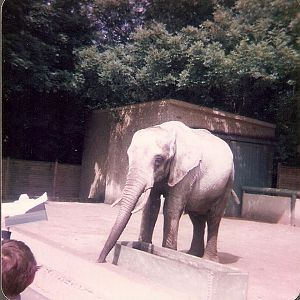
Does anyone remember the Elephant at Southampton Zoo that suddenly died? They did a post mortem on it and found that it had a carrier bag in its gut. This must have been about 1977 or so. The story was on the front page of the local paper 'The Southern Evening Echo' but their archives don't go back that far. I know what happened. A young boy was feeding the elephant some bread that he was holding in a J Sainsbury's carrier bag, the elephant grabbed the bag and the bread and was clearly far too strong for the little boy to grab it back. The elephant ate the lot as the boy ran away, and died a day or two later. The public were allowed to feed the elephant and this was a tragic accident which showed how poorly supervised the animals and public were.
Southampton Zoo was mainly a quaratine zoo for ungalates etc being brought in to the U.K. In thoses day,s i belive it was 12 months, unlike today.Certain people and mainly the younger ones on i belive are unaware that Southampton Zoo was fairly standard zoo, like alot of orther ones that sprung up in the late 60,s 70,s,, i would suggest that they look for imformation on some of the seaside zoo,s, and some of these, were a lot worse. I feel that some on here only saying how bad Southampton was because of the name of the person who owned it, Mr J. Chipperfield.
I've just read this thread for the first time; I did not visit Southampton Zoo, but I do like the look of the entrance from the photo posted.
D
Droopy964
Can you remember the name of the elephant pictured? I used to work at Southampton zoo and I am trying to trace what happened to the Elephant. I thought her name was Tanya but my memory is diabolical, I have tried other means of trying to find her but no luck so far. Then I came across this forum. Hope you can help