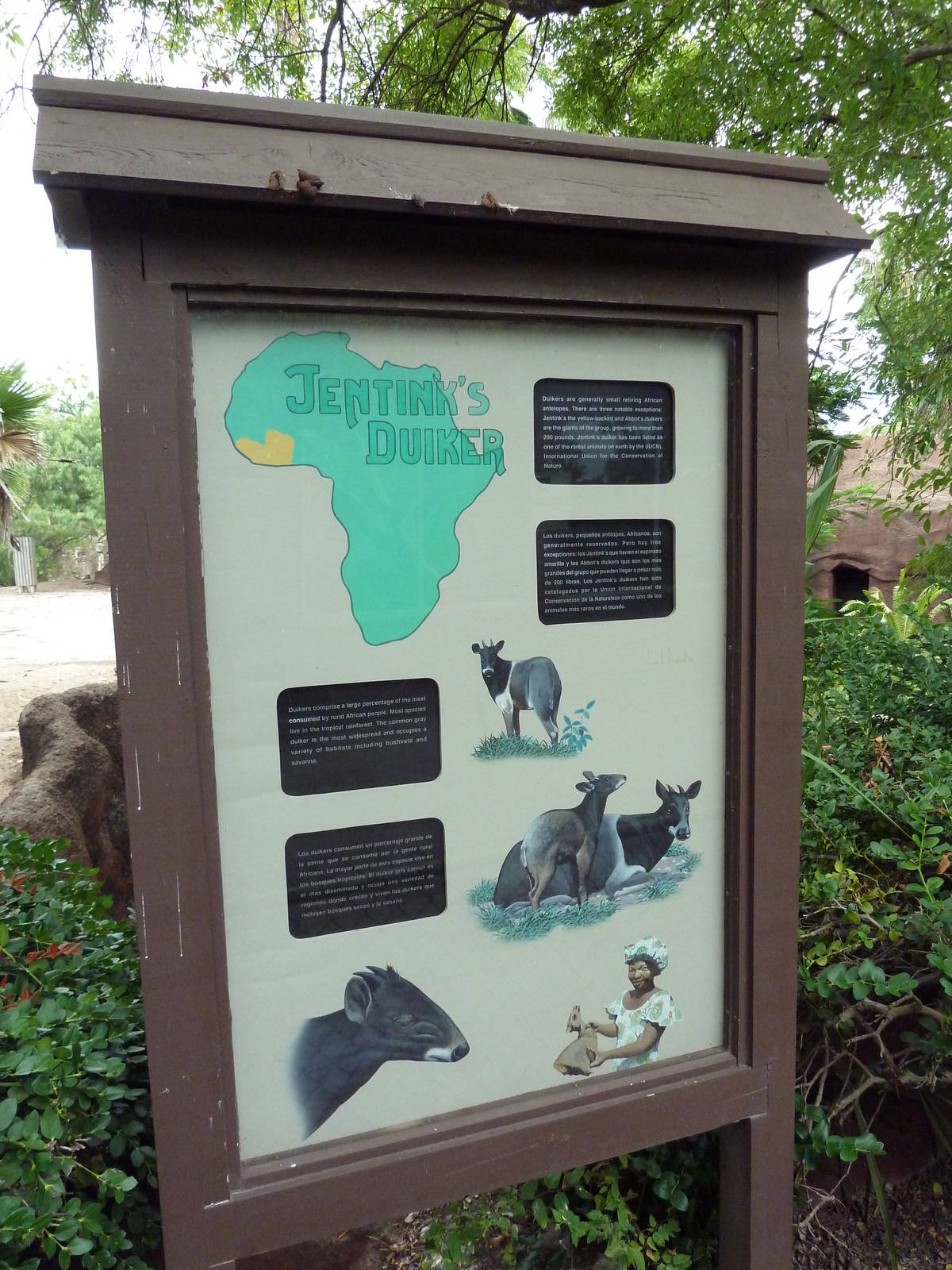
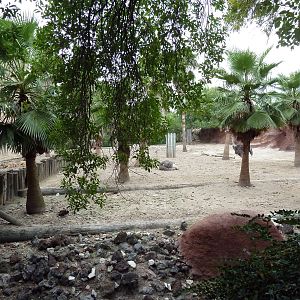
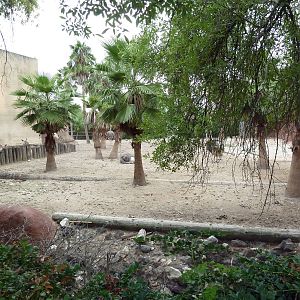
The top right text-box says: "Duikers are generally small retiring African antelopes. There are three notable exceptions: Jentink's, the yellow-backed and Abbott's duikers are the giants of the group, growing to more than 200 pounds. Jentink's duiker has been listed as one of the rarest animals on earth by the (IUCN) International Union for the Conservation of Nature"
Bottom left text-box says: "Duikers comprise a large percentage of the meat consumed by rural African people. Most species live in the tropical rainforest. The common gray duiker is the most widespread and occupies a variety of habitats including bushveld and savanna"
I don't know what other signage there is but in my experience zoos are terrible at conveying how rare or unique their animals are, rarely pointing out that they are, perhaps, the only individuals in captivity in the country for example or in this case the world.
I think it would be good for zoos to really shout out things like 'rarer than a giant panda' or 'this is the only place you can see this animal' for the average visitor to fully appreciate what they are seeing.
Perhaps zoos don't often publicise an animal’s rarity in captivity on exhibit signage because it contradicts modern zoo philosophy? Also these circumstances can turn around relatively quickly just look at how many Cloud Rats there are floating around Europe now!
It's entirely possible that when this sign was commissioned the species was also exhibited at LA and Monrovia.
Perhaps zoos don't often publicise an animal’s rarity in captivity on exhibit signage because it contradicts modern zoo philosophy? Also these circumstances can turn around relatively quickly just look at how many Cloud Rats there are floating around Europe now!
It's entirely possible that when this sign was commissioned the species was also exhibited at LA and Monrovia.
Generally speaking, if a zoo can claim to be the "only zoo" exhibiting a certain species, it is very likely to be the "last zoo" to exhibit it as well. Not a particularly compelling story.
I disagree, I think it is compelling and highlights to the average visitor just how special it is to see what they are looking at. I also think this is the case with endangered/extinct in the wild species.
I disagree, I think it is compelling and highlights to the average visitor just how special it is to see what they are looking at. I also think this is the case with endangered/extinct in the wild species.
I agree it is an interesting fact at the brief point of time a zoo holds the last captive specimen. But it is also a very mixed message: either it underscores the lack of a successful husbandry protocol (i.e. Saiga, Douc langur, Sumatran rhino), a lack of cooperation amongst zoos (geladas, walruses, bantengs) or both.
The days when zoos were rated by the rarity of their collections is nearly gone. It is no longer--for the most part--possible to source new wild rarities from their natural habitat, and to successfully maintain a viable long-term population of any species requires large numbers of specimens being held and cooperatively managed by many institutions.
I get as much of a "zoo nerd" thrill out of seeing a bushbuck, a capuchin bird or a ringed seal as anyone, but it is a selfish and transitory satisfaction that is at odds with the conservation philosophy that zoos have--by necessity--adopted.
Like it or not, the future of zoos will require greater collection homogeneity, and an ever-decreasing number of unique rarities.