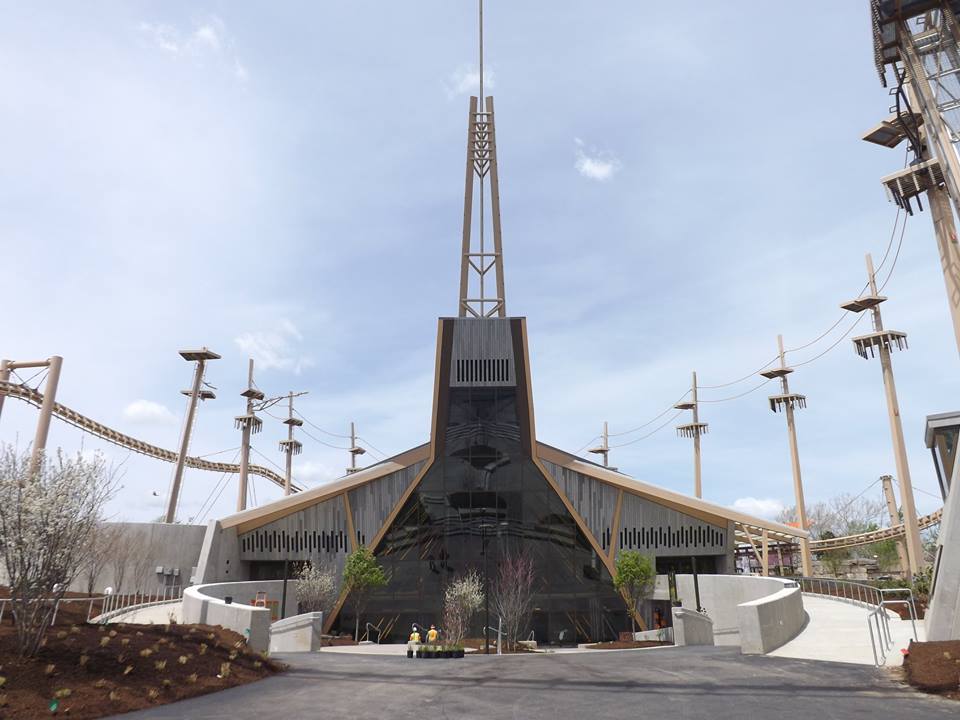
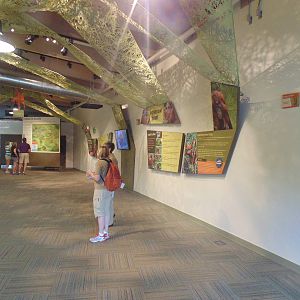
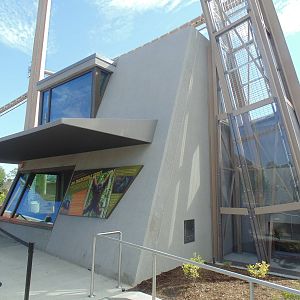
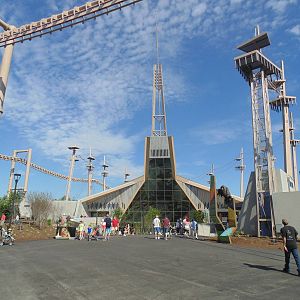
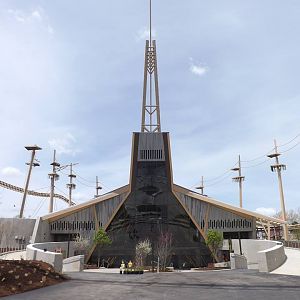
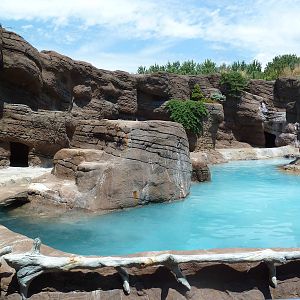
Looks to me a grossly overwrought vanity project... no doubt it provides a varied (sort of) environment for orangutans, but the bulk of the cost went to features that have nothing to do with the apes - the utterly pointless ride and that spire. And I have to agree with Shirokuma's point that there is not one shred of natural feature in the entire complex, and it is deeply depressing.
It looks an entirely unnatural set-up. Is there any outdoor space for them apart from the 'O'line concept? No doubt the Orangs will make best use of what's available to them and the main indoor areas- which they would use the most anyway, seem spacous- at that enormous cost one would hope they would be.
I have wondered at the Zoos that have them, how much the Orangs actually use these 'O' lines? Given they can only clamber along them from platform to platform, in a very exposed situation and without allowing for any/much free-swinging really. Or am I totally wrong about that? (there is nothing like this- yet- this in a UK Zoo). The monorail alongside the 'O' line seems a bit over the top/fairground-like and I wonder how often the Orangs will actually be visible from that aspect.
I think I agree that an equally(or more?) effective design could have been done for far less cost. The spire of course is totally unnecessary, it reminds me of a T.V or Radio station.
IMHO, that said it all. To build a good exhibit for Orangs in a zoo in the Northern Hemisphere is expensive, but surely not that expensive. If zoos in Europe and North America really want to make a difference to conservation they have to be thinking along the lines that Chili pointed out.
Talked to several zoo professionals that had the chance to experience this exhibit over the past few weeks. Obviously we would never want to "diss" our professional colleagues that all work so tirelessly in the name of conservation but we all agree that someone sold the Indy Zoo folks a pig in a poke with this one (anyone see the Music Man?). Comments (by professionals mind you) were all consistent - a humongous waste of money. How could a zoo board allow something like this to happen? - the fiscal indiscretion is staggering!
No, I actually live here in Indianapolis and I'm a member of the Zoo, and I personally am very impressed so far. Keep in mind, however, that the exhibit is not yet open, so I haven't yet been able to walk through it and see what's inside. But from the outside, it looks amazing! There is nothing "over the top" about it. It looks like a gigantic ultra-modern building that is going to be seen by visitors to our city from miles around, especially when they turn that beacon light on.
One thing that many people know is that what draws visitors to a tourist attraction is offering them something truly unique. Clearly this exhibit will do that. I'm excited to try out the high monorail, with views of the orangutans on their extremely high cable network, and longer range views of the entire Zoo and downtown Indianapolis. Rides like this -- such as the sky rides in San Diego and the Bronx, and the monorails in Miami, Dallas, and Minnesota - are what put these zoos on the map.
I think it's crazy to worry about how they "could have" used the money that was used to build this exhibit. That money was raised by the Indianapolis Zoo to build this exact exhibit. It was not raised to send off to some conservation project in Asia. People and businesses contributed for the building of this exhibit, and they are getting exactly what they wanted.
I forgot to mention that, on a recent visit to the Zoo, they had an orangutan out on the high cables. My gosh, I couldn't believe how HIGH that orangutan was off the ground! That alone makes this exhibit both unique and attractive. The red ape was visible to visitors from all over the entire Zoo!
I always hesitate to criticize a zoo staffs way of designing exhibits, but in this case, I am going to have to agree with Zoo Chatters. This was a colossal waste of money. However, as I have been on the side designing exhibits in the past, let me offer some perspective. Reasons for this kind of design can be a result of a lot of factors zoo staff have little control over. It can include things like having to satisfy municipal authorities desire for a big impressive building, having to satisfy the desires of donors for the same thing in order to keep them donating, the knowledge that big impressive buildings help to forestall or mute criticism from animal rights groups (for example, when the average zoo visitor, without the knowledge of the average zoo chatter, sees a building like this and like it, they are very prone to discount criticism from AR groups, and zoo staff know this). It's often very complicated. Although I too would like to have seen a smaller
Amount spent on the building, and the rest going to in situ conservation, as a practical matter it is most often impossible to get the people donating the money to agree to this, or if it's city money , to get the city council to agree to it
I forgot to mention that, on a recent visit to the Zoo, they had an orangutan out on the high cables. My gosh, I couldn't believe how HIGH that orangutan was off the ground! That alone makes this exhibit both unique and attractive. The red ape was visible to visitors from all over the entire Zoo!
The exhibit is not unique. They directly ripped off the National Zoo for the O-line (not a bad thing).
The exhibit is not attractive. It is an embarrassment to the zoo world, the zoo design community, the AZA, the orangutans, and ultimately, the Indianapolis Zoo. It is a regressive return to the sterile concrete and steel ape exhibits of the 1950s.
Obviously that is only my opinion. But it doesn't seem to be a unique opinion.
Rides are not what put the zoos that were mentioned "on the map". Quality animal collections in good exhibits is what put those zoos on the map.
Unfortunately for the Indianapolis Zoo Folks, AZA will be hosting their annual conference in Indy in 2017 - which means all of us zoo directors will get a chance to see this exhibit first hand. I can almost hear the comments now!
The exhibit is not unique. They directly ripped off the National Zoo for the O-line (not a bad thing).
The exhibit is not attractive. It is an embarrassment to the zoo world, the zoo design community, the AZA, the orangutans, and ultimately, the Indianapolis Zoo. It is a regressive return to the sterile concrete and steel ape exhibits of the 1950s.
I live here in Indianapolis, and I've been to the Indianapolis Zoo 4 times in the past couple weeks, so (at least from the outside) I've seen the exhibit in person, not just through pictures or drawings. I personally love the look of this exhibit and don't find it at all "embarrassing". This city is very excited about the opening of this exhibit this coming weekend. I'm guessing the Zoo will be packed all weekend.
As for unique, the design of the building is entirely unique, with the high-rising spire and beacon light into the sky. The sky ride monorail is also quite unique. The only thing borrowed from the National Zoo's O-Line exhibit is the chance for the apes to swing on open cables over the heads of visitors. Even this is quite different, as the cables in Indianapolis are MUCH higher than those at the National Zoo.
Honestly folks, give this thing a chance! Everyone wants to be an expert, telling other zoos how to spend their money. I say that if it draws more visitors to the Indianapolis Zoo, then it's a tremendous success! If not, then it's a failure. Let's wait and see, and evaluate based on that.