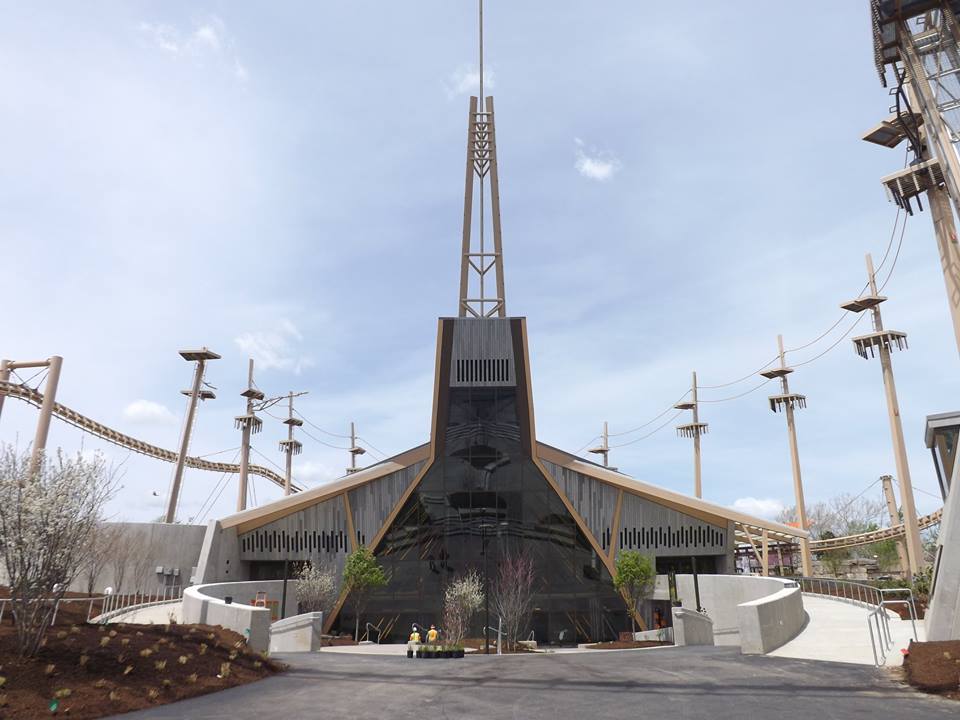
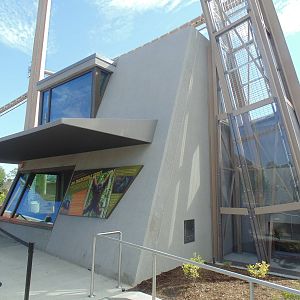
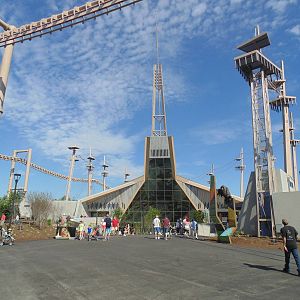
No, I actually live here in Indianapolis and I'm a member of the Zoo, and I personally am very impressed so far. Keep in mind, however, that the exhibit is not yet open, so I haven't yet been able to walk through it and see what's inside. But from the outside, it looks amazing! There is nothing "over the top" about it. It looks like a gigantic ultra-modern building that is going to be seen by visitors to our city from miles around, especially when they turn that beacon light on.
One thing that many people know is that what draws visitors to a tourist attraction is offering them something truly unique. Clearly this exhibit will do that. I'm excited to try out the high monorail, with views of the orangutans on their extremely high cable network, and longer range views of the entire Zoo and downtown Indianapolis. Rides like this -- such as the sky rides in San Diego and the Bronx, and the monorails in Miami, Dallas, and Minnesota - are what put these zoos on the map.
I think it's crazy to worry about how they "could have" used the money that was used to build this exhibit. That money was raised by the Indianapolis Zoo to build this exact exhibit. It was not raised to send off to some conservation project in Asia. People and businesses contributed for the building of this exhibit, and they are getting exactly what they wanted.
I'm going to respectfully disagree with our resident book author on this one. I would say that a gigantic ultra modern building with a beacon light could not possibly be anything but "over the top".
My ultimate issue with this exhibit is not the money that was spent or the attempt at making a statement. Admittedly I have not seen the exhibit myself, but everything I have seen appears to have stripped any appropriate context from the animals. People may have an amazing experience viewing the apes, and the apes themselves may have an enriched and fulfilling existence here. However, ultimately in this foreign and incredibly artificial setting people will gain no sense of what an orangutan is in terms of its role in the ecosystem. One is more likely to subconsciously associate this exhibit experience with current science-fiction films such as "Planet of the Apes" than to gain an appreciation of the plight of the rapidly diminishing rainforests of Sumatra and Borneo.
Maybe I am being a bit to hasty in my criticism - not having seen it first hand. ANyhuis, I trust your take on it having seen it in person - you are usually right on the nose with your assessment of good/poor exhibits. Looking forward to getting the chance to see it!
My ultimate issue with this exhibit is not the money that was spent or the attempt at making a statement. Admittedly I have not seen the exhibit myself, but everything I have seen appears to have stripped any appropriate context from the animals. People may have an amazing experience viewing the apes, and the apes themselves may have an enriched and fulfilling existence here. However, ultimately in this foreign and incredibly artificial setting people will gain no sense of what an orangutan is in terms of its role in the ecosystem. One is more likely to subconsciously associate this exhibit experience with current science-fiction films such as "Planet of the Apes" than to gain an appreciation of the plight of the rapidly diminishing rainforests of Sumatra and Borneo.
Fair enough criticism. I will point out that they consulted with some of the world's top experts on orangutans in the design of this exhibit. While I am a bit leery that this exhibit may not be too "naturalistic", I am reminded that one of the best gorilla exhibits that I've ever seen was not a bit naturalistic -- the gorillas at Howletts Wildlife Park in England. Nothing natural about it, but the apes were tremendously entertaining, and I've never seen so many baby gorillas in one place! So while building natural habitat exhibits is always my first choice, it's not the only choice.
Maybe I am being a bit to hasty in my criticism - not having seen it first hand. ANyhuis, I trust your take on it having seen it in person - you are usually right on the nose with your assessment of good/poor exhibits. Looking forward to getting the chance to see it!
Thanks, Chili.
But like I said, I haven't been inside yet, and I haven't seen the finished product yet. I'm just saying that the quick condemnations of this exhibit are a bit hasty. Let's wait to see how the public reacts to it. I personally won't call it a "success" or a "failure" for at least a couple years.
However, ultimately in this foreign and incredibly artificial setting people will gain no sense of what an orangutan is in terms of its role in the ecosystem. One is more likely to subconsciously associate this exhibit experience with current science-fiction films such as "Planet of the Apes" than to gain an appreciation of the plight of the rapidly diminishing rainforests of Sumatra and Borneo.
Fair enough criticism. I will point out that they consulted with some of the world's top experts on orangutans in the design of this exhibit. While I am a bit leery that this exhibit may not be too "naturalistic", I am reminded that one of the best gorilla exhibits that I've ever seen was not a bit naturalistic -- the gorillas at Howletts Wildlife Park in England. Nothing natural about it, but the apes were tremendously entertaining, and I've never seen so many baby gorillas in one place! So while building natural habitat exhibits is always my first choice, it's not the only choice.
I strongly agree with Ituri.
Yes, getting visitors to the zoo is essential. But unless zoos connect humans to Nature and encourage respect for animals as animals, they serve no purpose. No matter how entertaining the animals are, that is not the only reason for them to be there; and if visitors, especially children, get the wrong idea about what these animals are and what their place in the world is then the exhibit has done a disservice.
The experts involved with the design are primate cognition researchers not wildlife biologists. The zoo has made a decision to feature orangutans as "smart apes" which may -- or may not-- be a mistake. My fear is that this showcases primates as lab animals.
Next time you return, stop some families after they leave the exhibit... or the monorail... and ask them what they learned about orangutans. You may be surprised. (Hint: their response "Orangutans are cool." is not a good sign)
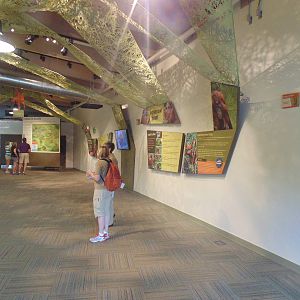
A very stimulating discussion - but one that must be incomplete until several ZooChatters have visited the complex. I would be very interested to learn about the interpretative and educational displays in the atrium. Do these describe and explain the environmental and ecological points that the design of the building cannot show? And how effective are they?
Personally, I find some of the 'immersive' features of contemporary zoo exhibits as risible as the Hollywood jungles of the Johnny Weismuller Tarzan films: adding little of substance to the visitors' experience and frequently doing nothing at all for the animals.
The material available suggests that one of the main design considerations was the requirements of the orangs - some of the features are developed from the exhibit at NZP, some seem to be novel. It will take time for the orangs and the visitors to appreciate them all. I like Zooplantman's suggestion of a survey, it would be very interesting to repeat it at other zoos with large modern orang exhibits - they might give very different, but equally valid results.
There is nothing "over the top" about it. It looks like a gigantic ultra-modern building that is going to be seen by visitors to our city from miles around, especially when they turn that beacon light on.
There is nothing architecturally wrong with the building. It would look impressive - in a city. But as an orang utan display, a "gigantic ultra-modern building" is incongruous and unnecessary (unless the zoo wants to invoke images of King Kong?). I believe a good zoo should attract visitors with its animal collection and appropriate exhibits, not a big shiny building with a blinking light.
I appreciate the suggestion though that the building design may be driven by forces beyond the zoo, and was intended as a showpiece for the city.
To be fair, there is no animal more difficult to create a vibrant immersion exhibit for than orangs. While I think there should have been at least an attempt, a mix of approaches, I do need to spend time there with the animals and the visitors to get a real impression of the effect of this exhibit.
The designers of the interpretive exhibits are among the finest (they were also lead designers for the new 9/11 Museum/Memorial in NYC -- which required ultimate sensitivity and creativity)
I strongly agree with Ituri.
Yes, getting visitors to the zoo is essential. But unless zoos connect humans to Nature and encourage respect for animals as animals, they serve no purpose. No matter how entertaining the animals are, that is not the only reason for them to be there; and if visitors, especially children, get the wrong idea about what these animals are and what their place in the world is then the exhibit has done a disservice.
Next time you return, stop some families after they leave the exhibit... or the monorail... and ask them what they learned about orangutans. You may be surprised. (Hint: their response "Orangutans are cool." is not a good sign)
Zooplantman, while I deeply respect your years of work in the zoo business and thus also your well-thought opinions, I have another take on the goals of this (and every) zoo exhibit. One of my favorite quotes on such things is from none other than Walt Disney:
“I would rather entertain and hope that people learned something than educate people and hope they were entertained.”
While that may sound heretical on the surface, I think Disney has something that zoos should learn from. To take your point, Zooplantman, as an example, if the kids leaving this exhibit say that what they learned is that "Orangutans are cool", that may not be so bad. If they learned that in the midst of having a super time, that probably means that they and their families will be back. They will come back to the Zoo to learn more things -- consciously and subconsciously, and they will also be inputting more money into the Zoo's budget when they do come back. Perhaps in the future these "Orangutans are cool" kids will choose to go to the Zoo instead of the video game arcade, and maybe on their next family vacation this family will visit another zoo, instead of a more expensive coaster park. On the other hand, if they were not entertained, but had some good orangutan education force-fed into them, they will likely forget what they learned, and they will not come back to be force-fed again. This, I believe, was Disney's message.