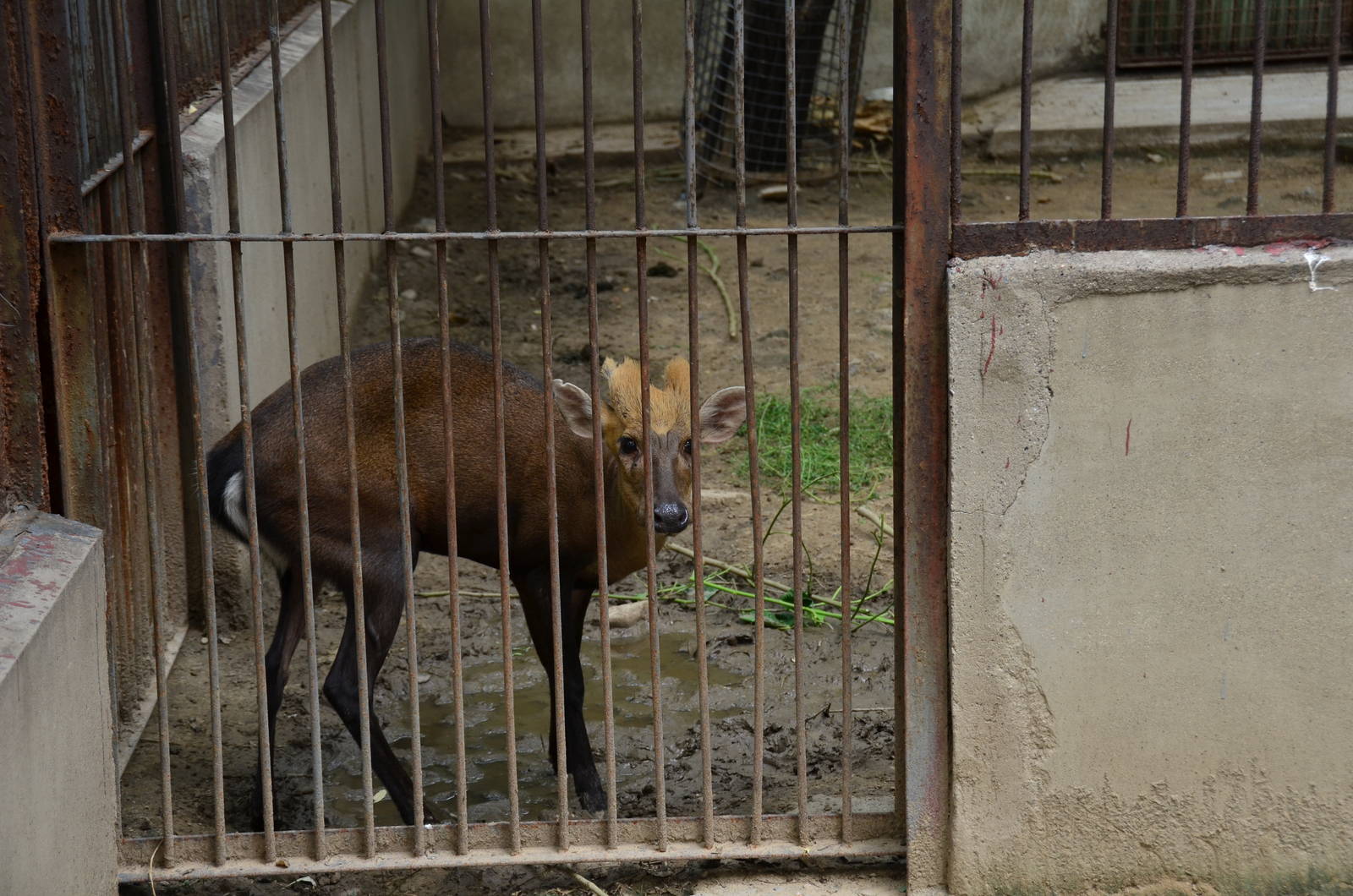
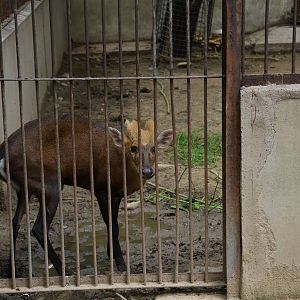
Thank you very much! The Annamensis red muntjac looks so different from other subspecies! What I mean is, I have seen red muntjac in southwest China, which is near Vietnam, but the muntjac is just similar to other "ordinary" red muntjacs. And on the photo, the white spots on its fore knees remind me the giant muntjac
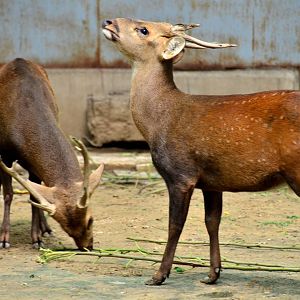
I believe that Giant muntjac (Muntiacus vuquangensis) have longer antlers and more of a reddish coloration as opposed to the yellowish coloration that you see in the animals on that website that were listed as Truong son muntjacs, Giant muntjacs also have a more stalky build
I believe that Giant muntjac (Muntiacus vuquangensis) have longer antlers and more of a reddish coloration as opposed to the yellowish coloration that you see in the animals on that website that were listed as Truong son muntjacs, Giant muntjacs also have a more stalky build
Yes, I have seen some photos of that giant muntjac kept by that Laos general, really stalky and dark-red, and I used to think the white spots on its fore knees was the distinguishing feature of giant muntjac, and had never realized that even Vietnam's red muntjac also had those white spots
BTW, when I worked in the southwest rainforest of China, I had shown the pictures of giant muntjac to locals, and one local hunter immediately pointed out that he had hunt one a dozen of years ago, and he was quite sure it was not red muntjac, instead it was a larger and blacker muntjac.
If you compare this photograph with http://www.zoochat.com/634/black-muntjac-muntiacus-crinifrons-357036/ , further down the page, and note the very black body colour and the very obvious crown tufts in this group of animals, classic black muntjac, then I would suggest that the solitary animal above is not a black muntjac but possibly a Gongshan muntjac, based on the descriptions in Smith and Xie's "A Guide to the Mammals of China".
If you compare this photograph with http://www.zoochat.com/634/black-muntjac-muntiacus-crinifrons-357036/ , further down the page, and note the very black body colour and the very obvious crown tufts in this group of animals, classic black muntjac, then I would suggest that the solitary animal above is not a black muntjac but possibly a Gongshan muntjac, based on the descriptions in Smith and Xie's "A Guide to the Mammals of China".
On the specimen in the photo above, If you look closely, I notice what looks like a dorsal stripe, I haven't seen anything like it on a Black muntjac, how would you explain that ?
Black muntjac can become browner in summer, and total black in winter. The main feature distinguishing black from Gongshan muntjac is that Gongshan muntjac has a white stripe around each of its ankles.
Black muntjac can become browner in summer, and total black in winter. The main feature distinguishing black from Gongshan muntjac is that Gongshan muntjac has a white stripe around each of its ankles.
Thank you Baboon!
I didn't know that this was the reason
White legs are actually the distinguishing feature that differentiates Chinese serow (Capricornis milneedwardsii) from Sumatran serow (Capricornis sumatraensis), but that is a different conversation
Going back to the topic of Gongshan muntjacs and Black muntjacs, genetic studies have been shown that they are possibly close enough to be considered the same species despite different coloration, this theory is debatable though, I will read through the following books to see if I can find more details on this topic
Ungulate Taxonomy by Colin Groves and Peter Grubb
And
Deer of the World Their Evolution, Behavior, and Ecology by Valerius Geist
The latter was written in 1998, whereas the former was written in 2011, so information in the former might be more reliable
Thank you Baboon!
I didn't know that this was the reason
White legs are actually the distinguishing feature that differentiates Chinese serow (Capricornis milneedwardsii) from Sumatran serow (Capricornis sumatraensis), but that is a different conversation
Going back to the topic of Gongshan muntjacs and Black muntjacs, genetic studies have been shown that they are possibly close enough to be considered the same species despite different coloration, this theory is debatable though, I will read through the following books to see if I can find more details on this topic
Ungulate Taxonomy by Colin Groves and Peter Grubb
And
Deer of the World Their Evolution, Behavior, and Ecology by Valerius Geist
The latter was written in 1998, whereas the former was written in 2011, so information in the former might be more reliable
Wonder your study results The muntjac taxonomy is confusing; it is said that there may be more than one dark-colored muntjac species in southwest Yunnan, thus besides Gongshan muntjac, there may also be Fea's or Roosevelt's muntjac, according to some scientists.
Wonder your study results The muntjac taxonomy is confusing; it is said that there may be more than one dark-colored muntjac species in southwest Yunnan, thus besides Gongshan muntjac, there may also be Fea's or Roosevelt's muntjac, according to some scientists.
That is very interesting how that many similar species in the same genus (Muntiacus) could live in one small area, I wonder how that would work evolutionarily
This reminds me of Dibatag (Ammodorcas clarkei) and Gerenuk (Litocranius walleri), they are both in the subfamily Antilopinae and have very similar morphology, but are both native to the Horn of Africa, the difference is that unlike Feas muntjacs, Roosevelts muntjacs, and Gongshan muntjacs, Dibatag and Gerenuk belong to seperate genera
That is very interesting how that many similar species in the same genus (Muntiacus) could live in one small area, I wonder how that would work evolutionarily
This reminds me of Dibatag (Ammodorcas clarkei) and Gerenuk (Litocranius walleri), they are both in the subfamily Antilopinae and have very similar morphology, but are both native to the Horn of Africa, the difference is that unlike Feas muntjacs, Roosevelts muntjacs, and Gongshan muntjacs, Dibatag and Gerenuk belong to seperate genera
In southwest China, three of the largest rivers on earth, i.e. Yangtze River, Mekong River and Nujiang River (Salween) run south side by side, between them are the rugged mountains of more than 4000 meters high, such as Gaoligongshan Mountain, Nushan Mountain and Wuliangshan Mountain. Thus the high mountain-big river-high mountain-big river-high mountain-big river pattern of the small region of southwest China generates many small isolated patches, making it a biodiversity hotspot.