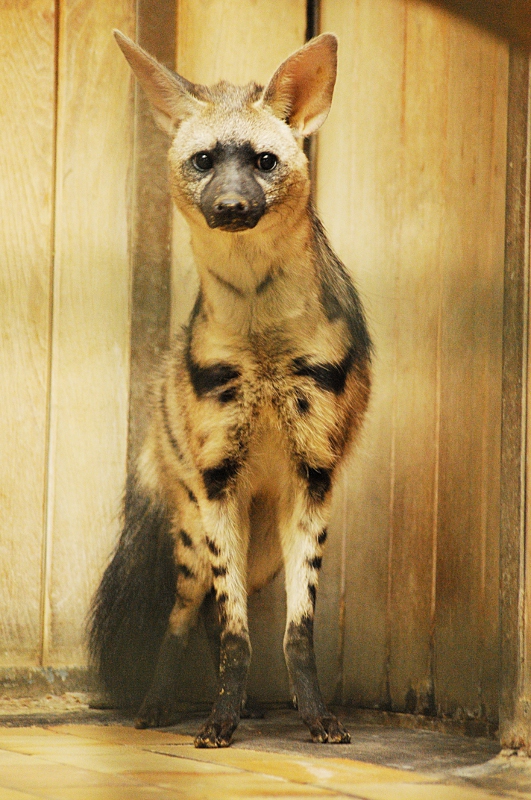
The animals are captured before they are weaned (it’s unclear what happens to the mother), but the animals are then switched to the captive diet during the process the condition of individuals can rapidly decline and those are lost.
I would be very interested to hear how the animals are actually captured, and what happens to the mother. It might make a big difference to the argument.
I would be very interested to hear how the animals are actually captured, and what happens to the mother. It might make a big difference to the argument.
I do know and it's not nice. But I really don't think it should make a big difference to the argument.
I think I said in my original post that animals that don't adjust the the new feeding regime suffer greatly and are often lost.
I'm sorry if I offended, but there is an inconsistency to those who say that animals should not be brought in from the wild, but fail to recognise that without this having been done at some stage in the past - recent or distant - there would be no animals in captivity.
I’m not offended and I’m not saying animals shouldn’t be brought in from the wild, there are numerous circumstances where it is more than acceptable.
But there is no need to continue to state the obvious as if it somehow validates your opinion.
For someone who portrays himself to be clued in on the management of zoos, I’m not sure you understand population management and that there is minimum number of individuals needed to maintain maximum genetic diversity over a given period of time.
Just to fill you in very species/sub-species have enough space available to achieve this at present. This situation is not helped when individuals and institutions go against TAG recommendations and breed/import species which take the existing slots.
The vast, vast majority of the zoo going public do not know or care if they see an Aardwolf or a Striped Hyeana, its only people like yourself who want that tick in their notebook.
Resources are finite; species diversity in animal collections comes at the cost of space and enrichment of animals in the collection. This is all too evident in Berlin.
Yes, absolutely serious. Again, sorry to have raised your ire. I think that an animal which is well looked-after, in a good zoo, is, very often, a great deal better off than its wild counterparts. If I didn't believe that, I'm not sure I could embrace zoos in the way that I do.
Even in the best zoos animals suffer from behavioural and physical conditions which they do not in the wild. I'm pro zoo (I wouldn’t be here if I wasn’t) but I don’t try to deceive myself and pretend that the animals are better off there because it’s not true.
I’m lucky enough to have seen many species I have seen in captivity in the wild (as it sounds you may have too?) and it isn’t often you see animals in the same physical condition you see them in the wild (many animals are obese, arthritic and lethargic in captivity).
An animal such as an aardwolf is going to fall victim to road collisions and hunting in a country such as Tanzania - the origin, I believe, of the RSCC animals. The specimens which turn up in Europe are the lucky ones.
I am not sure how someone develops a “Put it in a zoo for its own safety” mentality? It really doesn’t make any sense.
Take the aadrwolves for example; these animals get no variety in their diet and never get to consume the animals they have spent hundreds of thousands of years being selected to eat. This artificial diet means they never achieve optimum physical condition (and is perhaps why captive reproduction is so incredibly rare). There is no mate selection in captivity so incompatible animals are often housed together, there is no chance at all of replicating complex social interactions when animals are isolated from more of their kind or restricted by enclosure size and design.
Captive animals experience a drastic reduction in quantity and frequency of environmental stimulus which often leads to behavioural conditions, long periods of inactivity and obesity.
There is an abundance of species which have drastically reduced life expectancies and suffer prolonged illness because their natural diets can’t yet be successfully replicated (just quickly Hoatzin, Birds of Paradise, toucans, pangolins, langurs, duikers)
Animals in captivity (both inside and outside of their natural range) are exposed to pathogens such as avian Malaria and aspergillus which they have no immunity to and suffer immeasurably (as all animals do their best to suppress symptoms) before they die.
Primates, again in many of your “good zoos”, are often kept in far from natural social group’s compositions (single pairs, lone males), how are these animals better off?
Surly only the most deluded individuals could convince themselves animals are better off in a zoo? – It’s people like you that unfortunately give organisation like born free ammunition.
The point I was trying to make is that, in the great scheme of things, a few animals being taken from the wild for zoos in Europe is not the worst thing that will happen. I've seen many, many African civets, for example - but only one that was living (at Colchester Zoo, a number of years ago). The rest were all road-kill, scattered along the various highways of Tanzania. Likewise, the majority of the African palm civets that I have seen have been dead ones that have caught by farmers who believe them to have been attacking their fowls. Against these sorts of depredations, I really do think that the impact of a few animals being taken for zoos will be minimal.
If you’re talking about aardwolves then I said that taking then would endanger the species, however there are cases of limited collection destabilising the species. I am sorry but your points in my opinion thus far are archaic and irrelevant. It’s unfortunate you’re so sensitive but your arguments are supported by the quantity of roadkill you saw on holiday, I begin to suspect a lack of knowledge.
This has always been about animal welfare.
But is that not true of all animals? There's nothing altruistic about our desire to do so, is there? For whose benefit, ultimately, do zoos exist? And for whose benefit are we striving to steer animals away from extinction or to learn about their zoology? It's all for our benefit, is it not?
You speak for everyone in conservation? Of course it’s never done for the animals benefit??? The way you speak I think you honestly believe there is no such thing as an altruistic act towards an animal.
There is a huge difference between saving a species from extinction and seeing a few individuals suffer so some “dinosaur” can tick it off in their notebook.
On a more general note, whilst I really appreciate your willingness to engage in debate and discussion, I'm not sure why you need to be so vituperative in doing so! You and I disagree, and that is fine, but it isn't really a reason to launch personal attacks, or to start questioning my knowledge, is it?
“Vituperative”? I actually had to look it up! I wonder what you are like to talk to IRL?
Back to Aardwolves.
In the late 1990s a large number were imported from the same source to achieve a self-sustaining population in the USA (there were 20+ individuals in 2000). There are none alive today.
For that, you first would have to establish that cortisone (or cortisol) and/or its metabolites is a reliable stress indicator in aardwolves (or not), what kind of sample would be most useful, and then evaluate a mean value of this factor for this species. Such a study would require a certain number of specimens (and samples), different control groups and a test setting preventing/decreasing any possible influencing factors, for the results to be feasible and accepted in the scientific community. Therefore, you would have to obtain and keep quite an amount of specimens under controlled conditions. The alternative, i.e. to collect samples from the wild population, might be rather pracitically tricky, and influence your results in unexpected ways (f.e., by catching a wild animal and taking your sample, the levels might be way higher due to the acute stress).
Thank you for your input, I did actually intend to suggest cortisol!
When investigating animal welfare cortisol secreation is a BVA standard in determining stress.
It was indeed the alternative I was suggesting and as I am sure you know there are several well established non-invasive techniques for measuring adrenocortical activity.
You seem well versed scientific procedure. Do you mind if I ask you’re profession and degree of education (sorry if you feel it’s inappropriate to discuss publicly)?
The BVA does regard cortisol secreation as a stress indicator, but this is not generally accepted elsewhere, and for all species (see the constant discussion regarding fish/herps analgesia in the scientific community).
And for your assumption and your results to be reliable, you still would have to prove that it is a correct stress indicator in aardwolves-and that would require procedures such as the ones mentioned before. Even and in particular when relying on non-invasive procedures (such as using faecal samples).
@Blackduiker. It makes no sense starting a breeding programme with a species, which has never bred well in zoos, which is even not doing well in human care. The Zoos aren't succesful in keeping this very hard to keep species, altough some individuals reached a high age. A german zoo has kept that species between 1967 and 1999, until 1994, this zoo imported 13 ! aardwolfes, 18 were born between 1985 and 1991, but only 4 of them could be raised, three were send to other zoos, but died within a few years,the other one has lived for 12 years.Most mammal species which are eating mostly on insects in the wild are to hard to keep them in human care. All other european attempts to keep aardwolfes, failed also.
The Aardwolves, which has imported now to europe, were not imported for conservation reasons.
It might be nice, that Berlin has completed now, after it has closed the Takin-Collection, also his"Hyena"Collection, but again,not in the interest of the animals.