Thank you too Joker
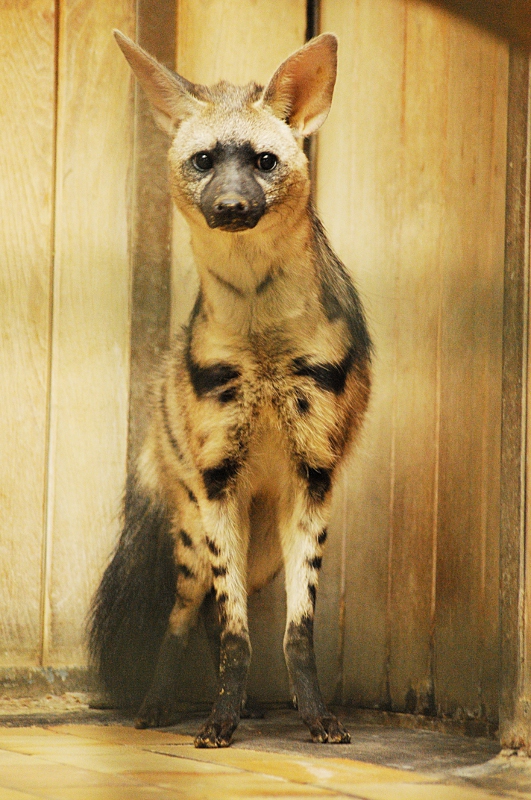
Yes they are kept in the Brehmhouse.
They are only visible when the zoo opens, and after 16 o'clock, but you have to be very patient, because the aardwolf has the option to choose between the cage and his box.
Those at the RSCC wouldn't show themselves for this very reason when I was there last week. Too bad, but maybe that's why they breed them so well, the privacy factor.
I have been three times to my local Edinburgh Zoo but only seen them once. However, it was such a splendid view which resulted in several excellent photos and I'm still thrilled with it a month later.
Those at the RSCC wouldn't show themselves for this very reason when I was there last week. Too bad, but maybe that's why they breed them so well, the privacy factor.
I have been three times to my local Edinburgh Zoo but only seen them once. However, it was such a splendid view which resulted in several excellent photos and I'm still thrilled with it a month later.
RSCC are NOT breeding aardwolves. They are all wild caught, and have had to endure the miserable experience of diet adjustment. Speculation is they are being imported for financial gain and to be used as "currency" to acquire animals from established zoos.
If anyone can offer a valid reason to justify these imports I’d be interested to hear it.
RSCC are NOT breeding aardwolves. They are all wild caught, and have had to endure the miserable experience of diet adjustment. Speculation is they are being imported for financial gain and to be used as "currency" to acquire animals from established zoos.
If anyone can offer a valid reason to justify these imports I’d be interested to hear it.
OK I was under the impression that they're breeding them but aparently I was wrong and I'm happy to admit that.
I could name public education for a start, and to increase species vairity in our zoos, but I have the feeling that you won't accept those reasons, which is fine by me. I just don't have time or energy to debate so I'll leave it here, even if you may disagree with me.
All animals in all zoos are descended from wild-caught stock, whether it be many generations ago, or more recently than that.
The glory of the wild is much over-stated. Nasty, brutish and short. How many animals die of old age in the wild?
The impact on the wild population of removing a few individuals is likely to be very low. Loss of habitat is, overwhelmingly, a bigger issue than loss of individual animals. the wild population can take the hit.
An animal such as an aardwolf is going to fall victim to road collisions and hunting in a country such as Tanzania - the origin, I believe, of the RSCC animals. The specimens which turn up in Europe are the lucky ones.
Because those people who will work with, and see, these animals will have their lives immeasurably enriched by that experience.
If I thought that these animals were not being well looked-after at Edinburgh, Berlin or Sandwich, of course none of this would be valid. But I am convinced that they are being well cared-for, and so I do think these are valid reasons.
I think there is a great deal of squeamishness about taking animals from the wild. I am not sure that such squeamishness is often justified (although, of course, I recognise and respect the counter argument).
They may well be being used as "currency" to get other species in, but I think it would be very questionable as to whether there is any financial gain to be had from importing aardwolves into Europe. On the contrary, i am sure that Mr Dalton, the proprietor of the RSCC, has 'lost' a great deal of money with this venture. I am sure that money was not and is not ever a motivation.
They may well be being used as "currency" to get other species in, but I think it would be very questionable as to whether there is any financial gain to be had from importing aardwolves into Europe. On the contrary, i am sure that Mr Dalton, the proprietor of the RSCC, has 'lost' a great deal of money with this venture. I am sure that money was not and is not ever a motivation.
I enjoyed his guidance around the place just this week. The way he put it to me was "I'm not a millionare, I just have a passion". Call me naive but I believe him and wish the place all the best.
What a ridiculous point. So ridiculous im not entirely sure it’s serious? How many species never adjust to captivity? How many species do far better in the wild?
-compare cortisone levels in wild aardwolves to the animals at RSCC then perhaps we can talk seriously.
[*]The impact on the wild population of removing a few individuals is likely to be very low. Loss of habitat is, overwhelmingly, a bigger issue than loss of individual animals. the wild population can take the hit.
Who said this was an issue? But just so you know there are cases of collection (well under quotas) destabilising populations and causing local extinctions as animals of a certain age or condition are the target. These artificial selection pressures can have an impact on physical traits of a population (shrinking Python molurus for example).
But you knew that? Or does your expertise end at the zoo turn styles or your vintage and long out of date library?
[*]An animal such as an aardwolf is going to fall victim to road collisions and hunting in a country such as Tanzania - the origin, I believe, of the RSCC animals. The specimens which turn up in Europe are the lucky ones.
[*]Because those people who will work with, and see, these animals will have their lives immeasurably enriched by that experience.
If I thought that these animals were not being well looked-after at Edinburgh, Berlin or Sandwich, of course none of this would be valid. But I am convinced that they are being well cared-for, and so I do think these are valid reasons.
The primary concern is the welfare issue with the species transition to captivity.
I have been told that animals have been lost while in UK quarantine but this is not from a direct source so I will discount that. What I have no doubt on is that the exporter in East Africa, who I have had personal contact with (before accusation are made), will admit that animals are lost during “adjustment to captivity”. These animals do not count towards the export quota of Tanzania.
The animals are captured before they are weaned (it’s unclear what happens to the mother), but the animals are then switched to the captive diet during the process the condition of individuals can rapidly decline and those are lost.
I think there is a great deal of squeamishness about taking animals from the wild. I am not sure that such squeamishness is often justified (although, of course, I recognise and respect the counter argument).
There is nothing than can be said about this species which couldn’t be said on a sign in front of a Striped Hyeana enclosure (many zoo’s include information on related species as part of their education system).
I’m all for zoos and even bringing a species into captivity but there needs to be sound reasons and the ones you list are are more than little on the selfish side.
They may well be being used as "currency" to get other species in, but I think it would be very questionable as to whether there is any financial gain to be had from importing aardwolves into Europe.
On the contrary, i am sure that Mr Dalton, the proprietor of the RSCC, has 'lost' a great deal of money with this venture. I am sure that money was not and is not ever a motivation.
I'm sorry if I offended, but there is an inconsistency to those who say that animals should not be brought in from the wild, but fail to recognise that without this having been done at some stage in the past - recent or distant - there would be no animals in captivity.
Yes, absolutely serious. Again, sorry to have raised your ire. I think that an animal which is well looked-after, in a good zoo, is, very often, a great deal better off than its wild counterparts. If I didn't believe that, I'm not sure I could embrace zoos in the way that I do.
It's always nice to have your opinions treated with respect! The point I was trying to make is that, in the great scheme of things, a few animals being taken from the wild for zoos in Europe is not the worst thing that will happen. I've seen many, many African civets, for example - but only one that was living (at Colchester Zoo, a number of years ago). The rest were all road-kill, scattered along the various highways of Tanzania. Likewise, the majority of the African palm civets that I have seen have been dead ones that have caught by farmers who believe them to have been attacking their fowls. Against these sorts of depredations, I really do think that the impact of a few animals being taken for zoos will be minimal.
There is nothing than can be said about this species which couldn’t be said on a sign in front of a Striped Hyeana enclosure (many zoo’s include information on related species as part of their education system).
I’m all for zoos and even bringing a species into captivity but there needs to be sound reasons and the ones you list are are more than little on the selfish side.
Yes, i would agree with you here - the motivation for keeping an animal in captivity is selfish. But is that not true of all animals? There's nothing altruistic about our desire to do so, is there? For whose benefit, ultimately, do zoos exist? And for whose benefit are we striving to steer animals away from extinction or to learn about their zoology? It's all for our benefit, is it not?
Fine - but I still don't buy the argument that anyone is going to get rich importing aardwolves!
On a more general note, whilst I really appreciate your willingness to engage in debate and discussion, I'm not sure why you need to be so vituperative in doing so! You and I disagree, and that is fine, but it isn't really a reason to launch personal attacks, or to start questioning my knowledge, is it?
For that, you first would have to establish that cortisone (or cortisol) and/or its metabolites is a reliable stress indicator in aardwolves (or not), what kind of sample would be most useful, and then evaluate a mean value of this factor for this species. Such a study would require a certain number of specimens (and samples), different control groups and a test setting preventing/decreasing any possible influencing factors, for the results to be feasible and accepted in the scientific community. Therefore, you would have to obtain and keep quite an amount of specimens under controlled conditions. The alternative, i.e. to collect samples from the wild population, might be rather pracitically tricky, and influence your results in unexpected ways (f.e., by catching a wild animal and taking your sample, the levels might be way higher due to the acute stress).