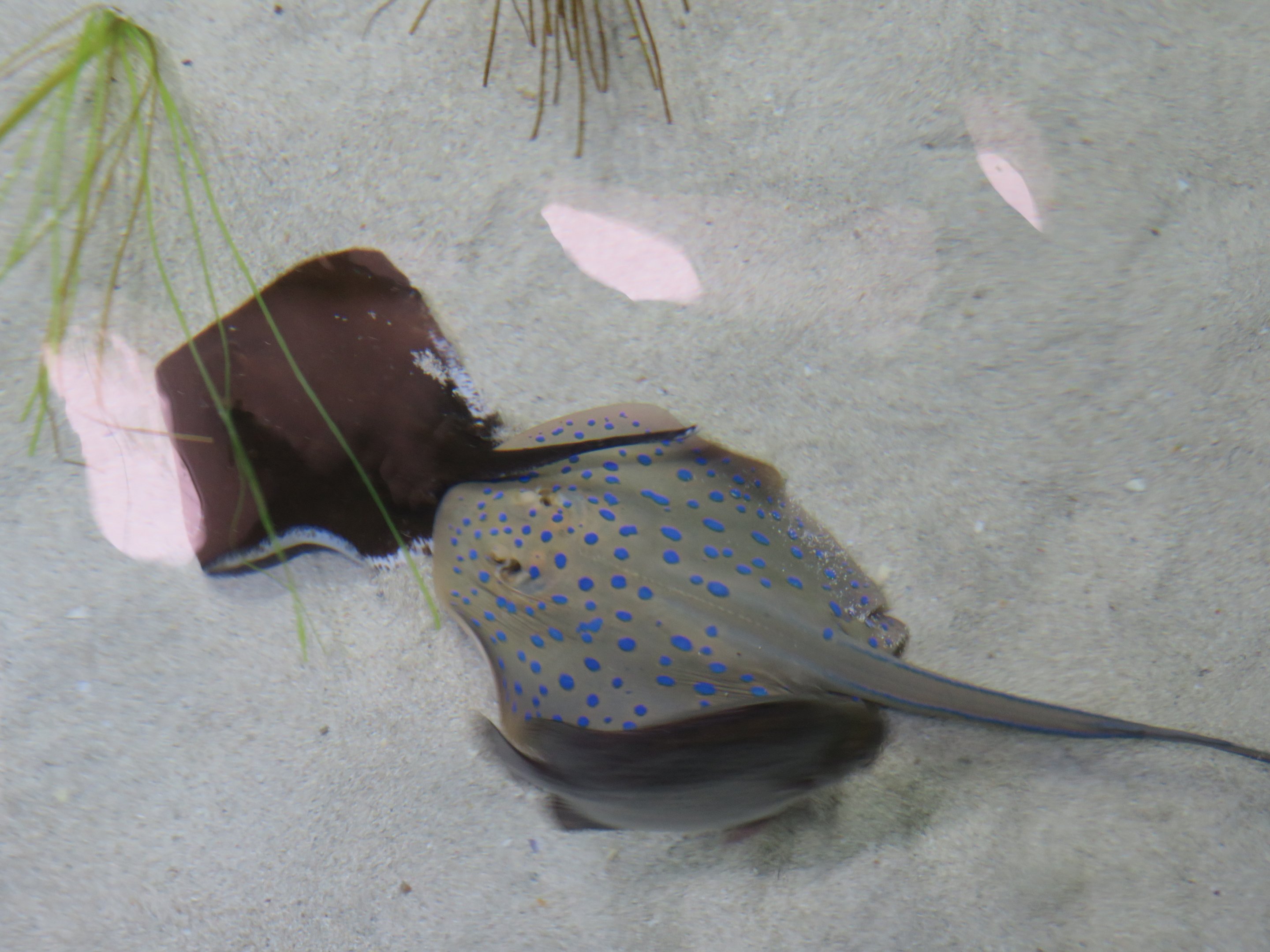
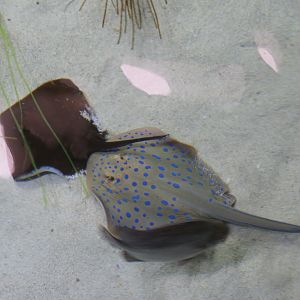
There are only a couple of Neotrygon species that lack the blue spots, but they're usually a much lighter color than this one. I'm wondering it's a juvenile Roughtail Stingray(Bathytoshia centroura), the body shape and color seem to match. Having an Atlantic species in a mainly Indo-Pacific centric exhibit would be a little funny, but I'm leaning more towards that than a Neotrygon species though.
Southern Stingray's also have a similar body shape I believe, but I think they're also a little lighter in color @Local_Shark could give a better ID
@Northwest_FIsh_Keeping Oh boy, this is a really weird one. Honestly I have genuinely no idea, it definitely strikes me as a member of Dasyatidae though. I'm going to examine the possibilities there.
EDIT: Okay, I think I may have a solution for the fact that as you pointed out, the roughtail stingray is only found in the Atlantic: this individual could be a member of the roughtail's sister species, the broad stingray (Bathytoshia lata). That species is often called the "Hawaiian broadray/broad stingray", as it's most famously found around the Hawaiian Islands, but it also is found all through the Indo-Pacific and even into the Eastern Atlantic. It looks extremely similar to the roughtail but larger as an adult. The reason I'd speculate about it is because the species has recently made it into mainland American aquaria, OdySea Aquarium in AZ has at least one. There is also the possibility of the pink whipray (Pateobatis fai) which is common in the exact area that they are replicating in this exhibit and also is present in at least one or two American aquaria (I believe Georgia still has one). However, usually those are a little lighter in disc color. I can try to reach out to any connections I may have in the area about exactly what this one is, but honestly someone who lives in SF may have an easier time getting that info if they just ask a Steinhart docent lol.
@Local_Shark I can definitely try and ask someone when im down there in 2 weeks. Sucks that it looks like its missing the back end of its tail, which would be the easiest way to at least tell the genus (like how the Neotrygon have the black and white stripes).
I've definitely seen videos of the Khulii in there, so this one should definitely be a new species for the Academy which is very exciting
@Local_Shark for what it's worth, @splendens has a photo from back in February that also shows the Ray, so it's been there for a while now it seems. I sent an email to the Academy asking if they have an ID for it, hopefully they email back with something good
@Coelacanth18 well, Charles Delbeek (the aquarium project curator) got back to me and confirmed that it is the N. khulii, honestly I would've been skeptical still if it was someone else who got back to me but Charles is a really prominent figure so I trust his knowledge and word a lot so, it looks like it really is just a very dark individual