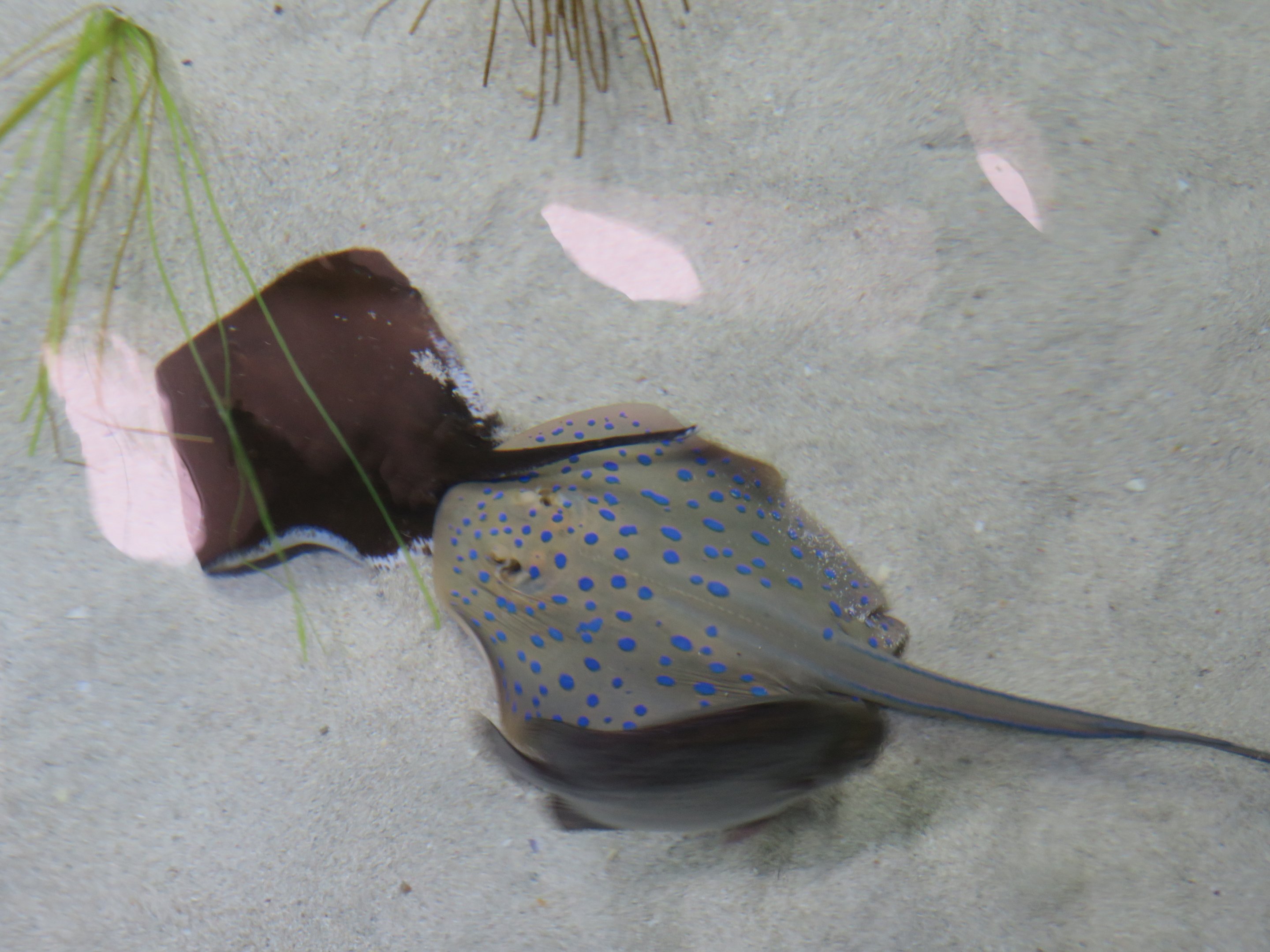
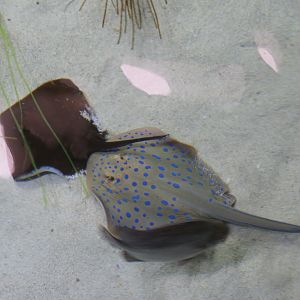
@Northwest_FIsh_Keeping@splendens Yeah, it does look to me like you can actually see the mask there haha. And also, it’s possible the angle and lighting of the shot was making us think more about true whiptail stingrays when looking at it. It could be that it’s just an odd color morph or genetic mutation or both. But hey, I’m glad we managed to resolve the question, and many thanks to you and Mr. Delbeek for the info!
Thanks everyone! As a fish ID beginner I'm surprised my first suspicion of it just being a dark N. kuhlii was the right one the rule of thumb for aquariums is usually "don't just go off signage" but I guess every rule has its exception!
@Coelacanth18 They absolutely do haha. It's one I've run across a few times, but genuinely from your picture I wasn't sure myself. All of my pictures of their kuhlii are much more distinctive, so perhaps it was just a weird trick of the light at that moment.
@Coelacanth18 well, a new development has arisen. I was talking a bit to Charles after I told him I knew some other people in the scene and he followed up and said hes not actually 100% sure if they're B. Khulii. Guess he had to reply with the generic answer then realized he could tell me after we started conversing. He confirmed that these ones have 0 blue spots, but do have a very faint mask. He says hes never seen an N. Khulii that didn't have any blue spots, so he's trying to see if they can do a DNA test. But he says the population came from Taiwan, so it could be a regional variant or another species. This just keeps getting more interesting (in a good way)
His quote, "To be honest I am not sure if they are N. kuhlii since I have never seen one in the wild that did not have at least one or two blue spots.I am looking into whether or not we can get a sample for DNA testing to confirm. These came from Taiwan so maybe that population is missing the bluespots??"
If anything, im really starting to wonder if this is just a dark individual of Neotrygon varidens thanks to the location tip-off, that species has 0 blue spots and looks extremely similar besides most of the pics online showing them as being a lighter shade of brown.
@Northwest_FIsh_Keeping You know, I was considering proposing that idea as I couldn't see brown spots either, but I didn't; want to speak out of turn. It would not entirely shock me if it is indeed another species of maskray like N. varidens. This is all very interesting!