I stand by LBB - unless JR has heavily edited the photo they're too dark for Herring.
But, as noted, there's an argument that they are the same thing, after a fashion! The clinal 'ring' of these two 'species' was perhaps the most interesting thing I studied in my whole degree course (along with hybridogenetic ranid frogs).
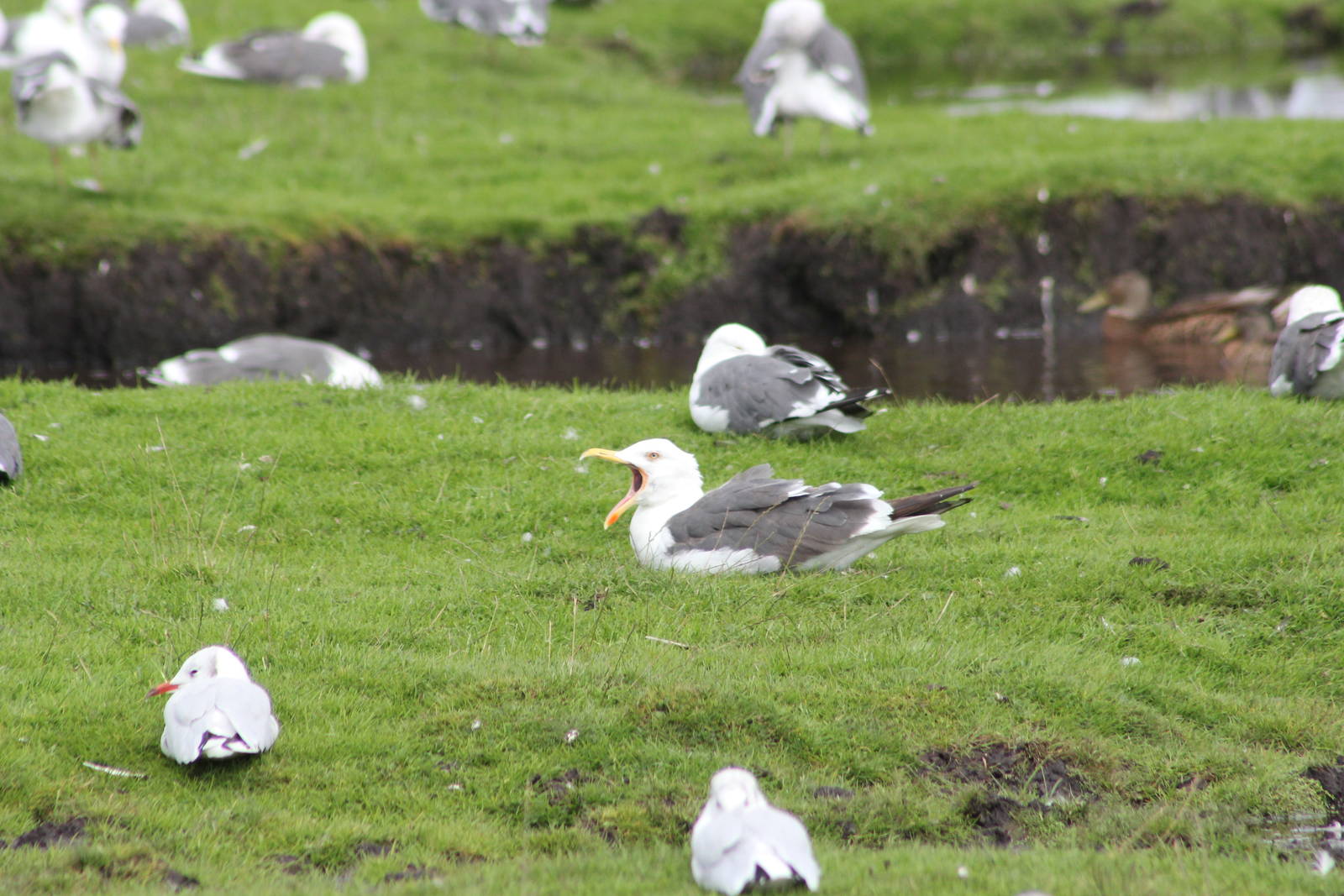
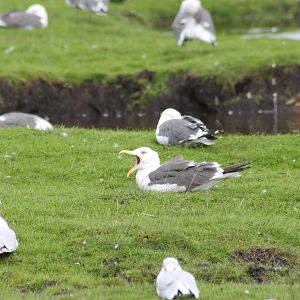
This looks to fit with a yellow-legged gull pretty well. Not nearly as dark as any LBBG I've ever seen, I can say with 99% certainty that is not what this is.. I am not familiar with the European Herring Gull. Without seeing the leg color, and I cannot tell if there is a red orbital ring, I don't think a distinction can be made between the two. But, it is definatly not a LBBG. Scapulars fit well with any American Herring Gull I've seen.
This looks to fit with a yellow-legged gull pretty well. Not nearly as dark as any LBBG I've ever seen, I can say with 99% certainty that is not what this is.. I am not familiar with the European Herring Gull. Without seeing the leg color, and I cannot tell if there is a red orbital ring, I don't think a distinction can be made between the two. But, it is definatly not a LBBG. Scapulars fit well with any American Herring Gull I've seen.
But I simply don't think you'd find at least three (possibly more) Yellow-legged or American Herring Gulls in an inland, field setting in north-west England. Both species would be rare vagrants here, and unlikely to be found away from the coast in these numbers.
This animal looks a perfect fit for a Lesser Black-back based on animals I've seen in the UK. A quick Google Image search will show plenty of birds with the same shade of grey on the back.
The only other possibility that would fit the image is a (European) Herring Gull if the photographic process has darkened the grey (local Herring Gulls are a lot paler than this) - but even this is ruled out given the description of yellow legs.
But I simply don't think you'd find at least three (possibly more) Yellow-legged or American Herring Gulls in an inland, field setting in north-west England. Both species would be rare vagrants here, and unlikely to be found away from the coast in these numbers.
This animal looks a perfect fit for a Lesser Black-back based on animals I've seen in the UK. A quick Google Image search will show plenty of birds with the same shade of grey on the back.
The only other possibility that would fit the image is a (European) Herring Gull if the photographic process has darkened the grey (local Herring Gulls are a lot paler than this) - but even this is ruled out given the description of yellow legs.
I am not suggesting an American HERG, but the rather the European version. A quick search of the yellow-legged range map makes me change my mind there. eBird maps aren't as advanced for the UK as for the US. Also, where was it said the bird had yellow legs? I don't thing legs color if this bird has been established. That leaves my thinking HERG, rather than LBBG, and here is my reasoning:
I think it is pretty obvious that this is an adult bird, in its fourth cycle or beyond. The gape (red on LBBG, yellow on HERG) and the orbital ring (red on LBBG, yellow-orange on HERG) are not clear enough to tell in this photo. So that is not possible for use. While it is difficult to tell with the mouth open, HERG usually have a much longer, thicker bill, which appears to be so here. LBBG also have a slightly more bulged forhead, but, again, any details in the head area are hard to gather from this photograph, though it seems to have a pretty sloping forehead.
I have givern up trying to make a positive ID on the color of the back, as the photo has probably messed with the coloration somewhat. I learned how pointless it is long ago, trying to ID a THGU vs. HERG on leg color in a photograph. I agree that is seems a little dark for a typical HER, but it also seems much too bright for a LBBG. From my experience, HERG's can vary a lot more than LBBG's. I am also a little confused by the lack of white spotting on the primaries, which wouldn't really point towards either species.
A little research tells me that, in adult plumage, European and American HERG's are indistinguishable, which makes it easy or me to transfer my experience with the American HERG to the European. I don't know if I should make reference to the Howell/Dunn guide, as I don't think many Europeans have it, but here ase some observations. Plate 25B.11 shows a third cycle HERG with no white spotting on the primaries, but plate 27.21 also shows a LBBG with no spots on the primaries, so that field mark is out.
I have come to the simple conclusion, that, with the extreme variability of both species, it is impossible for a positive ID to be made from this photo, without seeing the gape, orbital ring, or leg color. Judging the color of the back, as it appears to be intermediate between the two species, is just not practical here, especially as photos distort color. In my opinion, it has the overall look of a HERG, not a LBBG, but that is simply speculation, not to be used in a positive ID. I think it can be easily agreed that this bird is, however, either a LBBG or a HERG, and not a GBBG, or any other species.
And, just to be a smart-ass, I'll suggest a Herring x Lesser-black-backed Gull hybrid
I find the best distinguishing feature is often leg colour (LBB=yellowish) but it doesn't help here. I still agree with Maguari that they are LBB, the appearance of the grey does vary with the light but these are too dark for herring gulls. This is a very interesting example of a ring species (or superspecies) which is a cline with the mantle colour getting essentially paler going east around the globe from Scandinavia: the herring gull is the other end of the cline that now overlaps with our lesser black backs and therefore appears to be a different species.
I am not suggesting an American HERG, but the rather the European version. A quick search of the yellow-legged range map makes me change my mind there. eBird maps aren't as advanced for the UK as for the US. Also, where was it said the bird had yellow legs? I don't thing legs color if this bird has been established.
This is indeed possible - though again the present of multiple seemingly similar birds makes me doubt a little (though a whole hybrid population is also not unthinkable, of course!).