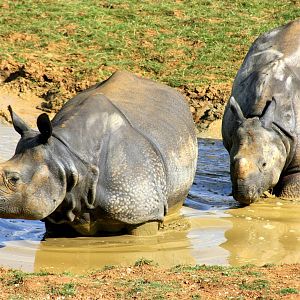
The fact that Hugo (and the younger bull?) uses the indoor pools quite happily indicates to me that the failing in this house may not be a design fault, but just that these particular two adult cows won't enter the pools because they were kept for many years without access to water via a ramp. So as adults they don't trust themselves to the slope. I certainly saw them happily using the steps in the moat to enter the water in the Cotton terraces enclosure(now Okapis) at London that they were kept in on arrival- they were only small/half grown then of course. After transfer to Whipsnade they didn't have any access to a deep water pool like that for many years(about ten?) until the new house was built. By then they were of enormous bulk and may have become very set in their ways.
Does the younger bull use the indoor pools if he's given access I wonder?
I think your other explanations are valid, but not necessarily this one. Most zoos that keep Asian rhinos tend to keep bull and cows in adjacent housing/stalls without problem. I have seen that in several zoos in Europe.
I suspect the Whipsnade House was built along those lines, the three indoor areas designed one each for one bull and the two cows plus their calves. But things have turned out rather differently as we know.
I think your other explanations are valid, but not necessarily this one. Most zoos that keep Asian rhinos tend to keep bull and cows in adjacent housing/stalls without problem. I have seen that in several zoos in Europe.
I suspect the Whipsnade House was built along those lines, the three indoor areas designed one each for one bull and the two cows plus their calves. But things have turned out rather differently as we know.
I think you are probably right with regards to the plans for the building when it was built. I think maybe this point I made was more of an observation rather than a reason for the set-up being as it is. When he is in the large paddock, Hugo often bangs on the gate between the yard that the female is in. It may be the case that housing them in adjoining stalls could cause an element of stress or frustration which is limited to outdoors with the females and male being housed in different buildings. As I said this may just be a coincidence or something that just works out well with the situation how it is and as you mentioned many zoos will house males and females together without an issue.
I've never seen the younger male in the pool, but I think I've been told he does occasionally use it. Couldn't say that for definite though...
I've seen him banging the gate in the old small paddock too- it is a common form of stereotyped behaviour in this species (as is horn-rubbing ). In that case I think he wanted to get indoors( for food?) rather than trying to join a female. Sometimes the reason for behaviour isn't quite as obvious as it first seems.
But having said that, many moons ago at Basel, the male of the first breeding pair in Europe injured himself badly trying to mount the dividing fence of his small enclosure- presumably to try and get to the females next door. He had to be destroyed.
Anyway, I think my overall view of the Whipsnade Asian rhinos is just that after they built that nice new house, I really didn't expect most(?) of them to go on living in those old primitive sheds but they are still there even now- and they seem likely to continue doing so permanently.
Its been discussed on here a number of times(usually by me ) and its an ongoing riddle(for me anyway) to exactly what is wrong.
Originally I believe the adult females, which had not had deep bathing water for many years since they left the London Cotton terrace enclosure, would not enter the indoor pools. I saw a ZSL video of keepers trying to lure them in with food but that didn't work. It seems the access ramps/steps may be the problem. The bull Hugo may have been used to a similar set-up/access to a pool where he came from(Rotterdam?) hence why he uses them- sometimes.
What I find even stranger is why there are hardly ever any rhinos in there- even the bull is often in the small paddock and old house too. I think that is because he can have an outdoor paddock there. Maybe the water is thought dangerous for the calves too? Another fault I've been told is the access from the new house to the large paddocks is only through one small yard, not several holding areas.
I fear that this is the sort of issue to cause me to get cross with ZSL. It is an agreed husbandry protocol for Asian rhino that they should have indoor pools, and given the importance of this species and these two females, getting this house right ought to be dealt with. It should not be a case of shrugging shoulders and mooching off to design a lion exhibit for £5 million at London Zoo.
It is an agreed husbandry protocol for Asian rhino that they should have indoor pools, and given the importance of this species and these two females, getting this house right ought to be dealt with. It should not be a case of shrugging shoulders and mooching off to design a lion exhibit for £5 million at London Zoo.
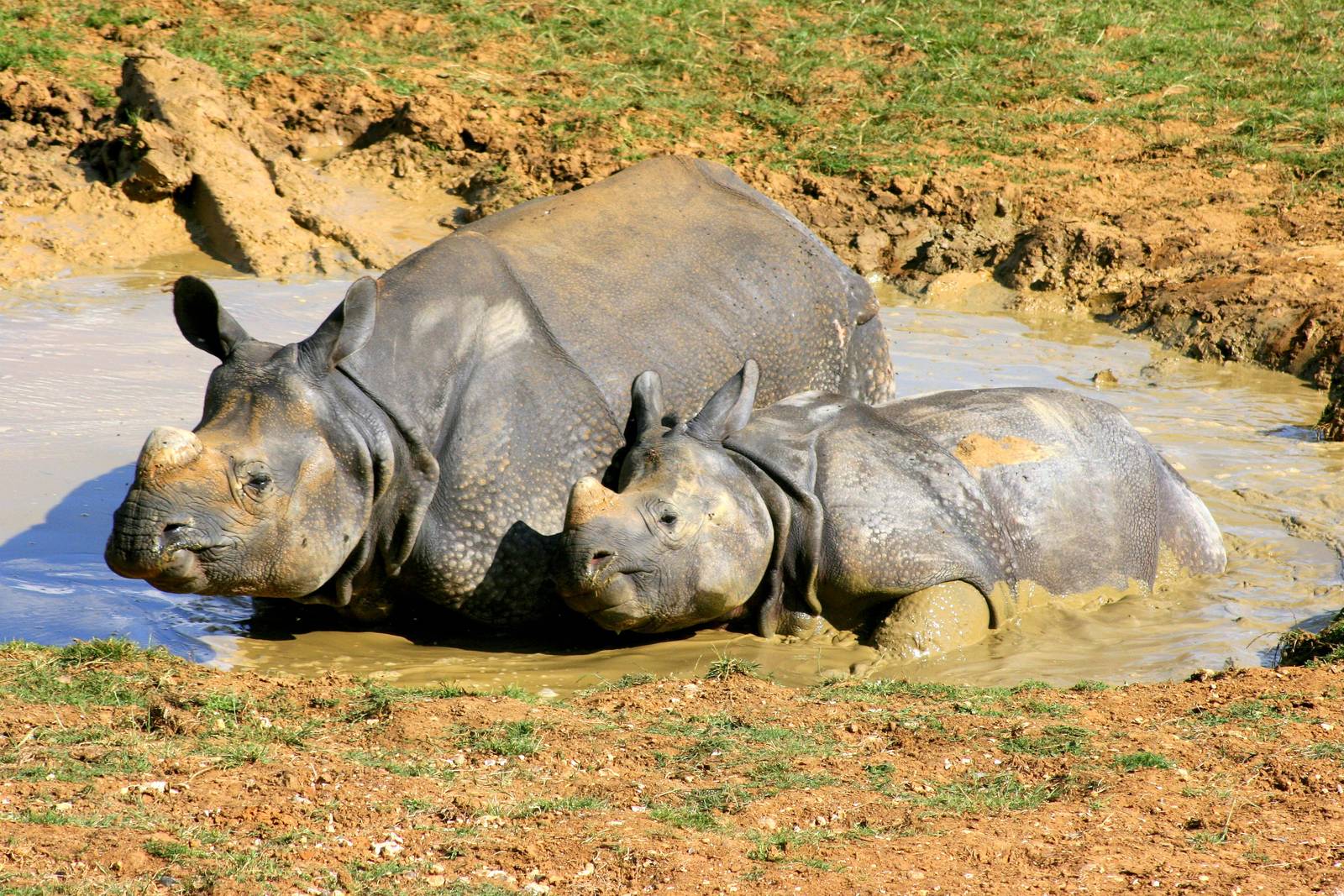
I agree with you absolutely. The house was purpose-designed for them and they should all potentially be able to use it, space allowing. They would spend literally several hours per day- and every day- immersed in the water indoors if they were able/encouraged to get into the habit of using it properly. Instead they have to make do with an outdated brick barn, a shower spray and an outdoor wallow- while in this current heat the latter is fine, for much of the year it can't possibly replace the usage the indoor pools should be having.
The current situation means that either three or four(?) of five/six animals seem unable to benefit from the building at all, and the other one or two only 'sometimes'.
It is a very weird state of affairs IMO. I feel sure they could rectify whatever the shortcomings are if they put their minds to it.