Another interesting species for them to have held way back then was Przewalski's Horse, which I hadn't realised were in Australia that early. Did any other zoos keep them during this period? They must have all been gone by 1945 regardless.
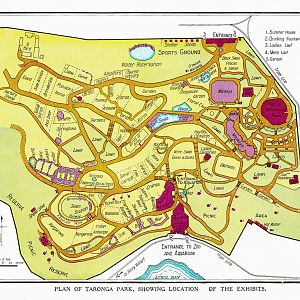
The main entrance building is still present although the interior has been changed considerably. The Lower Entrance also remains but has also undergone renovations. The Aquarium was built in two parts, the lower which was a large shark pool was closed first in the 1970's, and the upper closed in the 1980's, because it was deemed structurally unsound. A good part of it was demolished when the Great Southern Oceans complex was built.
As Zooboy already said, the Elephant temple remains, but without occupants as it is now a museum-type walkthrough. The floral clock also remains. Only one of the Monkey Pits is still present the others making way for a Nocturnal House and the 'Creatures of the Wollemi' exhibit. The structure housing the offices and Refreshment Rooms had been renovated over the years and a brick building built for the offices until the mid-80's when the wooden building was replaced by the multi-storey Taronga Function Centre which also included offices out the back.
The Seal Pools remained until last year when they were filled in to become the Lemur Walkthrough and playground. The Giraffe enclosure is the same, although it has doubled in size. The cat enclosures are still there but also changed significantly - those marked Lions and tigers now house bears. Right at the bottom of the zoo the westernmost bear exhibit is the only one still in existence, modified and now housing Red Pandas.
Just above the entrance top the Aquarium is a circle labelled 'Aviary' - this is the Moore Park Aviary Zooboy mentioned, and just above the Ladies Lavatories (beside the Elephants) are two hemispherical aviaries labelled 'Parrots and Cockatoos' - these aviaries were demolished quite recently when the elephant enclosure was upgraded in 2008.
The thing I find interesting is that Tahr Mountain - supposedly built in 1928 - isn't on the map.
This shows no development in the south east corner where the rhinos were in the 70's-early 90s. I wonder when those enclosures were built in that isolated spot?
I remember Ron Strahan once telling me that when he took over as director in the early sixties he discovered that the keepers used to sit on the backs of the Black Rhinos - he put a quick stop to that practice. So I guess the enclosures were built sometime between 1930 & 1960.