Chester's original Orang House wasn't particularly good. A small flat island with an ok climbing frame and a few dead trees on it. Indoor accomodation was fairly basic but had a larger climbing frame than outside and allowed the Orangs to get quite high in the house.
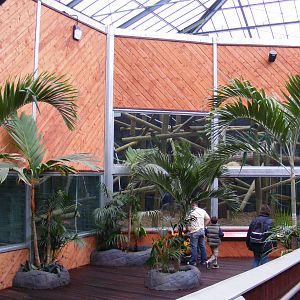
The Orangutans at Chester used to be in the tropical house originally. When they moved to the 'new' house I expected big things but although being spacious, it was remarkably lacking in climbing equipment- a few logs and simple frame outdoors, and the taller 'iron frames' indoors. It seemed very uninspiring given they must have been aware even then of Orangutan arboreal habits. And that climbing equipment wasn't improved much during some 30 years of its existence apart from nets and firehoses added to the indoor frames (which was a help..) i'll bet its the same in there now too.
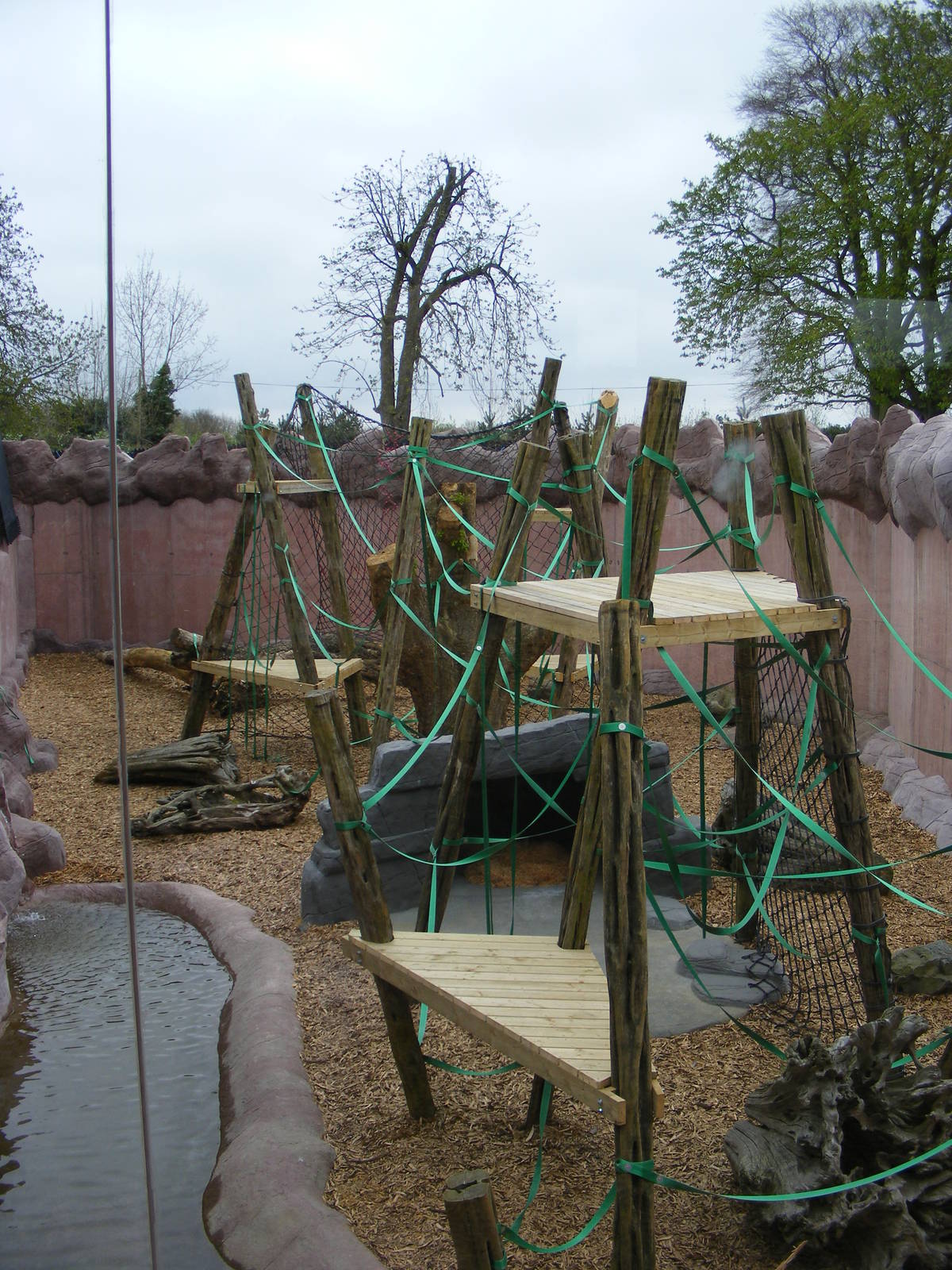
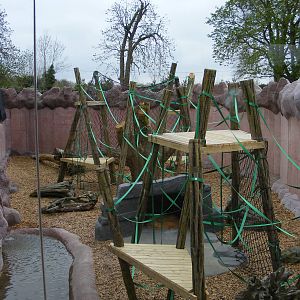
Only with ROTRA has the need for REAL climbing equipment been finally met. Its a similar story elsewhere- only in the latest 'generation' of new orangutan enclosures are we seeing some really decent 'state of the art' enclosures- but not at Colchester!!
Its surprising how effective even simple improvements can sometimes be. At Bristol Zoo in the 1960's the Orangutans lived in dismal standard barred cages in the old Ape House (which was a former Lion House). Indoors they could really only climb up and down the bars at the front and that was about it. Copying a design from Frankfurt Zoo, they welded a series of parallel tubular poles just below the ceiling. To see the young Sumatran pair Henry and Anne(grandparents of Chester's females) using this was amazing, they could now swing, brachiate and do cartwheels (using both hands and feet) all around the ceiling of the cage, which they did at high speed during their activity periods. And all that was possible for them just from adding some simple metal bars...
yet when they moved them to a brand new 'modern' house it had nothing like that for them....
I once saw an adult male Sumatran at the Nurenburg Zoo similarly swinging and doing cartwheels around the barred ceiling of his cage- truly impressive with the long flowing hair- and great exercise for him too.
Its surprising how effective even simple improvements can sometimes be. At Bristol Zoo in the 1960's the Orangutans lived in dismal standard barred cages in the old Ape House (which was a former Lion House). Indoors they could really only climb up and down the bars at the front and that was about it. Copying a design from Frankfurt Zoo, they welded a series of parallel tubular poles just below the ceiling. To see the young Sumatran pair Henry and Anne(grandparents of Chester's females) using this was amazing, they could now swing, brachiate and do cartwheels (using both hands and feet) all around the ceiling of the cage, which they did at high speed during their activity periods. And all that was possible for them just from adding some simple metal bars...
yet when they moved them to a brand new 'modern' house it had nothing like that for them....
I once saw an adult male Sumatran at the Nurenburg Zoo similarly swinging and doing cartwheels around the barred ceiling of his cage- truly impressive with the long flowing hair- and great exercise for him too.
Wasn't that the idea behind the Sobell Pavillions at London? Even now the Colobus and Diana monkey (and to an extent, the Gibbon) enclosures are still very suitable for the primates as they allow full movement
Wasn't that the idea behind the Sobell Pavillions at London? Even now the Colobus and Diana monkey (and to an extent, the Gibbon) enclosures are still very suitable for the primates as they allow a full movement
Yes, I believe so. I think the design worked well for the smaller species e.g. Monkeys as it gave them an artificial 'forest canopy' to run about in. For the Orangutans the network of bars in the roof seemed almost a bit too complex and I never saw them use them much- mind you they were lazy Borneans! It worked okay for the Gorillas and Chimps though.