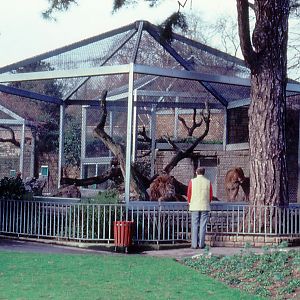
The tunnel area of the aquarium is the part which was the open pit. If you go into the tunnel and look upwards, you can see through the skylights and make out the shape of the pit.
This may be where they were originally kept?
Where they live now used to contain their pair of Black Rhinos would you believe- they even produced 5 calves in here too. Of course both inside and outside areas has been extensively remodelled for the hippos since, but the public viewing area inside remains the same.
One thing that never cease to amaze me is the truly tiny size of indoor areas for both rhino and hippo which are actually tremendously successful from a husbandry perspective.In some ways it reminds me of racehorse stabling - even the fastest , most athletic racehorse in the world heads in every evening to a stable probably smaller than your bedroom.Could it be that they interpret the enclosure as a barrier which keeps predators out , and this allows them to feel far more relaxed than in a more open space?I´m just wondering out loud?Does anybody have experience of keeping this stock in ample indoor holding areas and finding their stock nervous , stressed and incapable of relaxing.At this stage I´m just asking - I don´t want to infer anything but I am wondering if some curators in the past were being stingy with space or if they had actually identified a need for these reduced dimensions for good husbandry reasons .
I would say it is similar to how gorillas would prefer to be in a small compact indoor area to a large outdoor area unless this area has a canopy layer which provides security to the gorillas. In the same way the small area could offer secuirty to the pygmy hippos.
I assume you are referring to Bristols breeding record also with Black Rhino here, but in both cases I would say, compare Bristol's record for rhino with that of Port Lmypne, and its record with Pygmy hippo with that of Marwell's.
You can be lucky in a small enclosure and have a particularly compatible pair or a very prolific male or female, but ultimately longevity and fitness is affected if there isn't sufficient room to exercise. Not always the case, but often.
I assume you are referring to Bristols breeding record also with Black Rhino here, but in both cases I would say, compare Bristol's record for rhino with that of Port Lmypne,You can be lucky in a small enclosure and have a particularly compatible pair or a very prolific male or female, but ultimately longevity and fitness is affected if there isn't sufficient room to exercise. Not always the case, but often.
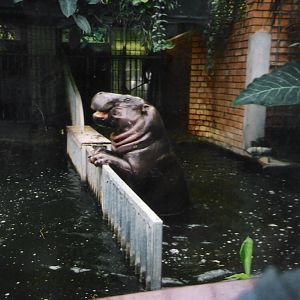
Agree. In the case of Bristol's Black Rhino pair they were compatable and productive despite the ridiculously small enclosure- the outside was just a little circular concrete pit. The indoors by contrast was two reasonable sized stalls- the green tiling behind the hippo's head in the photo being part of the original indoor wall- which is still in use as the converted hippo house..
However, I must stress Bristol's black rhino breeding record was actually poor, with only the first two calves, out of five born, being reared to maturity. As the rhino pair were regular breeders I would attribute the losses(of partgrown calves in each case) to management problems and/or enclosure size, also responsible for the poor state of adult rhinos held in this enclosure in their later years.
If my memory seves me right, Bristol formerly kept Pygmy Hippos in a converted greenhouse up behind the Reptile House? This was before they moved into the existing House.
Hi Kate,
My first job when I started at Bristol Zoo in 1968 was to clean/feed the birds that were in the first of two greenhouses that also housed the pigmy hippos.There were two small aviaries in here and a pair of Blue crowned Mot-mots that flew free over the hippos.On entering the greenhouse a large cabinet containing stick insects (a relic from the old bird house) was on your right.The greenhouse/hippo pond was heated by large pipes from a coal boiler and the place was steaming! The hippos spent the night in stalls ajoining the greenhouse.In the second greenhouse behind this most of the birds from the old bird house were kept including macaws/cockatoos/lorikeets/amazons/toucans and various other odds and ends.Most of these were eventually moved to the Dalton Burgess Aviary opposite the main restaurant.