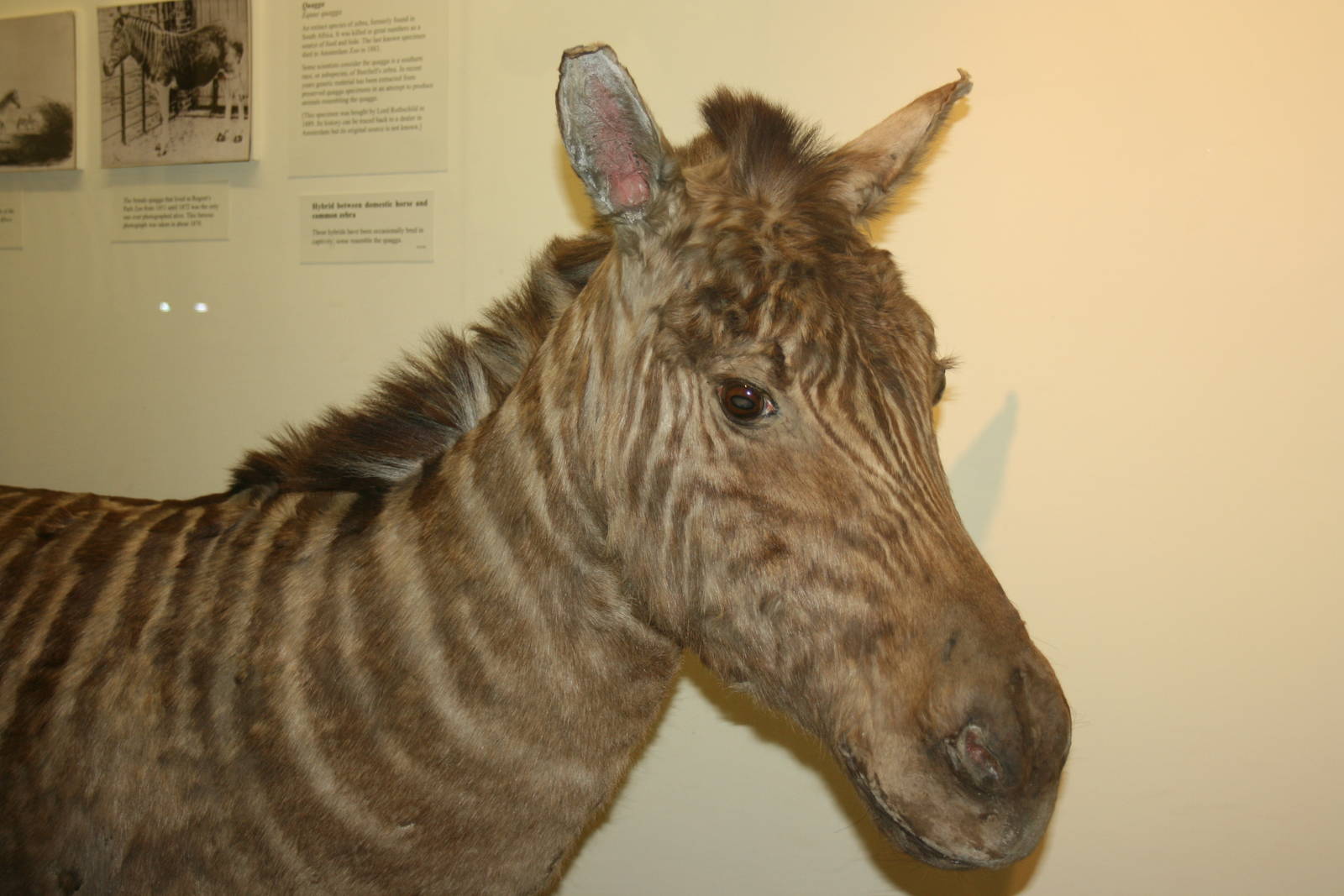
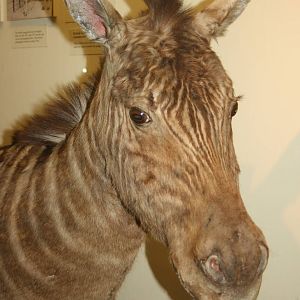
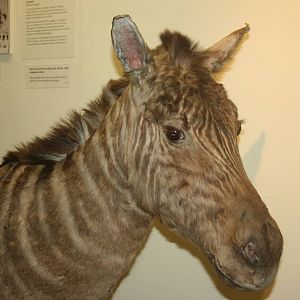
Tim- Something I picked up on from that museum postcard you sent me.. and now I can see it again on the Tring Quagga's head too.
There is a faint horizontal line running midway down the jawline from under the eye to the nostril- below is more heavily striped while above is slightly fainter/more brownish, except for the forehead. From a distance it forms quite a distinct marking. Look on your postcard or photos and you will see it on all of the Quaggas, even the foal. No modern zebras have this.
I recently found a modern painting of 'Quaggas in the Bushveld' on the internet and the artist has obviously noticed this marking and featured it on all the Quaggas in the painting too. (But its not apparent on the London Quagga photos).
I'm pretty sure their mane was shorter too than in other South African Plains zebras- the ones in the Quagga project all have very tall 'crest-like' manes.
It just adds more fuel to my theory that it was a completely seperate/isolated race of Plains Zebra with its own unique characteristics that can't be recreated!
Other possible ways the Quagga's features differed from other Plains Zebras that I've noticed;
Different colour scheme- brown not black, and including the dark stripes(?). Buff, rather than white background colour on head, neck etc.
Different striping pattern including the relative width of the dark/light stripes, particularly on forequarters. Head markings as described.
Larger body size(?) in relation to head- it was the most Southernmost race
Smaller ears(?)
Shorter mane in relation to to other Southern plains zebras
Tim- Something I picked up on from that museum postcard you sent me.. and now I can see it again on the Tring Quagga's head too.
There is a faint horizontal line running midway down the jawline from under the eye to the nostril- below is more heavily striped while above is slightly fainter/more brownish, except for the forehead. From a distance it forms quite a distinct marking. Look on your postcard or photos and you will see it on all of the Quaggas, even the foal. No modern zebras have this.....
......(But its not apparent on the London Quagga photos).
I agree with you that this feature is not apparent on the photographs of the London Zoo quagga mare; is that just individual variation, or is it because the photos are in black & white and this is only obvious in colour?
Not sure, but its certainly evident on most of the other Museum specimens.
Now I'm interested to know the real colour of the Quagga. We always presume these skins are 'faded' but are they really, and to what degree? . Other b/w zebra skins of similar age don't seem to fade that much so I suspect the Quaggas haven't either. I believe their stripes and body colour may always have been similar to what the museum specimens show now.
I've seen a photo of one wild Damara zebra that has a very yellow ground colour- far more so than any of the animals in the Quagga Project. An animal like that could help them a lot.
Interestingly, in his book Natural History Essays (1904) Graham Renshaw writes:-
“Careful examination of several museum specimens has convinced me that the mane of the female quagga was longer than that of the male”.
I have never seen this recorded elsewhere, although I doubt Renshaw examined enough specimens for this observation to be statistically significant.
I must look out for Renshaw's books; not seen them. My knowledge of him is from his editorship of the AVICULTURAL MAGAZINE [no, I'm not that old, I've got the magazines] and he talks a certain amount of, shall we say, unsubstantiated stuff [don't we all?].
Indeed, in his book The Horse and its Relatives (1912) Richard Lydekker comments that quagga’s ears are comparatively small.
Interestingly, in his book Natural History Essays (1904) Graham Renshaw writes:-
“Careful examination of several museum specimens has convinced me that the mane of the female quagga was longer than that of the male”.
I have never seen this recorded elsewhere, although I doubt Renshaw examined enough specimens for this observation to be statistically significant.
Interesting about Lydekker's comments on 'Ears', I was not aware of them!
I don't believe there is any distinction in mane length between male and female, but overall a shorter length than other plains zebras.
It does seem to me, particularly from looking at your Mainz postcard/photo that apart from its unique colouration and markings, the Quagga also differed from other Plains zebras in having a comparatively larger body but shorter ears and mane, possibly adapations to living at more southerly latitude. The photos of the London Quagga seem to bear this out too- a long heavy body, shorter ears and mane.
I must look out for Renshaw's books; not seen them. My knowledge of him is from his editorship of the AVICULTURAL MAGAZINE [no, I'm not that old, I've got the magazines] and he talks a certain amount of, shall we say, unsubstantiated stuff [don't we all?].
I purchased Renshaw’s three volumes of natural history essays from second-hand bookshops some years ago.
•Natural History Essays (1904)
•More Natural History Essays (1905)
•Final Natural History Essays (1907)
These original versions are now scarce and hard to find; the second one seems to be the rarest of the three.
However, I believe that they have recently been reprinted by an American publisher and the new editions can be purchased on-line.
These books are all obviously out-of-date and need to be used with caution (I am far from convinced by Renshaw’s comments on quagga’s manes, for example), but they are extremely interesting and well-worth reading.
(Renshaw’s quagga essay features in the first volume; this one also includes a chapter on blauuwbok. The second one contains an interesting chapter on thylacines.)